


‘His Career Was Incredible’ … Billy Mcneill Was a Winner as Player and Manager

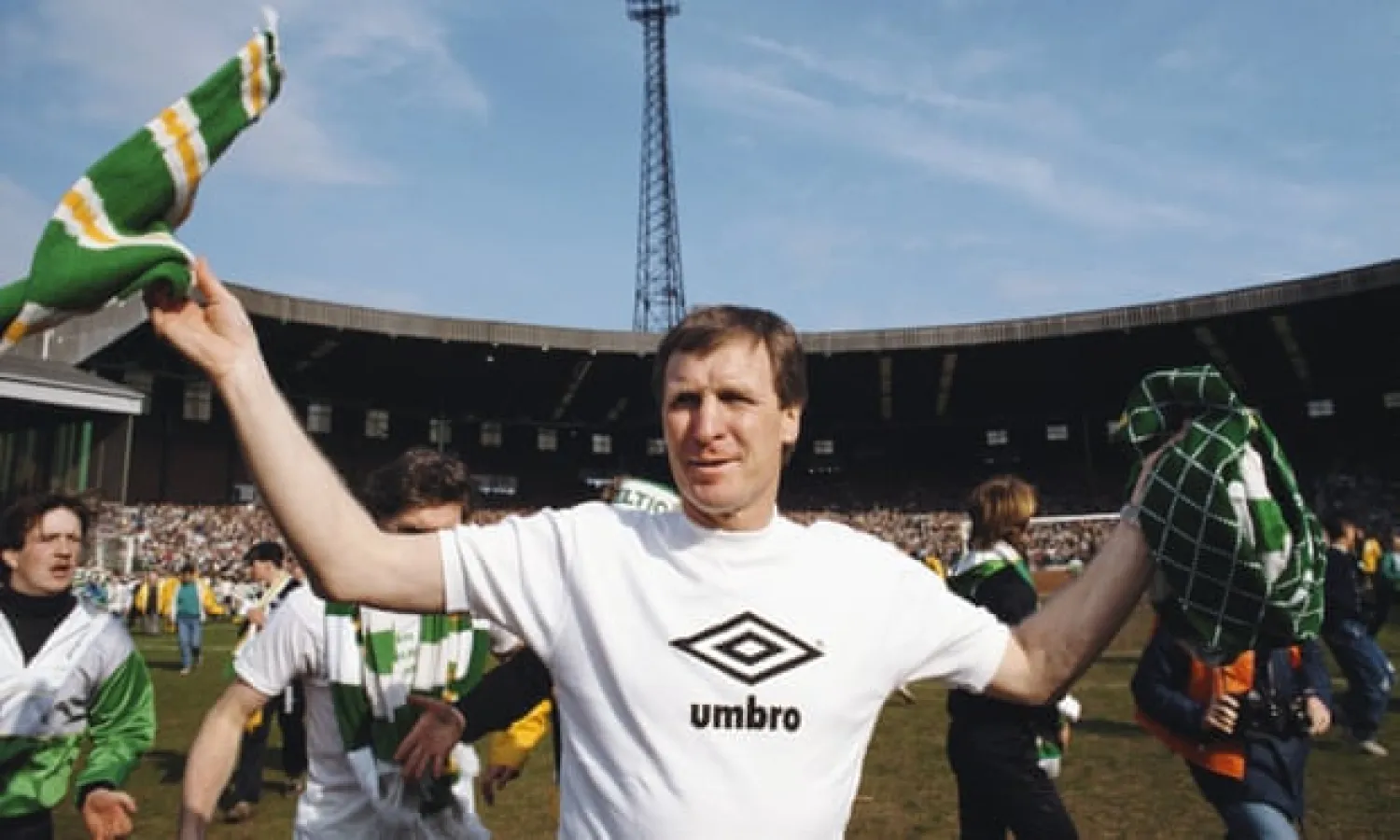
 Billy McNeill, pictured celebrating the Scottish league title in 1988, played for Celtic 822 times and also won eight trophies across two spells as the club’s manager. Photograph: Getty Images
Billy McNeill, pictured celebrating the Scottish league title in 1988, played for Celtic 822 times and also won eight trophies across two spells as the club’s manager. Photograph: Getty Images
TT

‘His Career Was Incredible’ … Billy Mcneill Was a Winner as Player and Manager

 Billy McNeill, pictured celebrating the Scottish league title in 1988, played for Celtic 822 times and also won eight trophies across two spells as the club’s manager. Photograph: Getty Images
Billy McNeill, pictured celebrating the Scottish league title in 1988, played for Celtic 822 times and also won eight trophies across two spells as the club’s manager. Photograph: Getty Images

Tributes have been pouring in to Billy McNeill, the first British player to lift the European Cup as captain of Celtic’s all-conquering 1967 side, who has died at the age of 79 after a battle with dementia in his later years.

In addition to making a record 822 appearances for Celtic as a player McNeill was twice manager of the club, either side of a brief spell in England, amassing a haul of 31 trophies over the course of his career. He will always be most closely associated with the Lisbon Lions’ success under Jock Stein, when Celtic not only beat Internazionale 2-1 in Portugal to become the first British team to win the European Cup, but the first ever winners of the now recognised treble.

Only seven different clubs have won the European Cup plus their domestic league and major domestic cup competition in the same season, and Celtic were not only the pioneers, they also won the Scottish League Cup in 1967 for good measure. The quadruple that Manchester City were chasing until a week ago was actually achieved half a century ago in Scotland, and there are those who will point to Celtic winning the Glasgow Cup in the same season and claim the club could boast an unprecedented quintuple.

Celtic certainly won everything in sight in the 1966-67 season, and a statue of McNeill holding the European Cup aloft has pride of place outside the stadium, yet when the centre-half first joined the club from local junior side Blantyre Victoria in 1957, trophies were few and far between. It was only the arrival of Stein in 1965 that galvanised Celtic into a winning machine, and as captain and ever-present McNeill was in a perfect position to reap the benefit.

As every member of the Lisbon Lions team was Scottish, and all but one of the side was born within 10 miles of Celtic Park (Bobby Lennox was born 30 miles away) winning the European Cup has to be regarded as one of the greatest British achievements abroad, perhaps comparable only with Brian Clough’s Nottingham Forest conquering Europe twice in a row just two years after coming up from the second division.

McNeill won most of his relatively modest total of 29 caps for Scotland early in his career, after making his debut in the infamous 9-3 defeat by England in 1961. At club level McNeill was such a doughty performer he was never once substituted – in other words he played every minute of his 822 Celtic games. With Stein in charge and McNeill as captain Celtic won nine Scottish titles in a row, in addition to seven Scottish Cups and six league cups.

On retiring as a player in 1975 McNeill initially worked with Celtic youth players before beginning his managerial career at Clyde and then Aberdeen. He was succeeded by Alex Ferguson at the latter, but might never have left in 1978 but for Stein stepping down at Celtic and recommending his former captain as the man to replace him.

McNeill’s Aberdeen had finished runners-up in the league that year, their best showing since 1972 and three places better than Celtic, but predictably he felt the call from his old club and manager too hard to turn down. McNeill’s return brought instant success, with a league title clinched with a 4-2 victory over Rangers on the final day of the season, and two others would follow in his five-year spell as manager, though by the early 80s he was disillusioned and frustrated at the way the club was being run by chairman Desmond White. Charlie Nicholas being sold to Arsenal against his wishes was apparently the last straw, though McNeill had also discovered he was being paid less than rival managers at Aberdeen, Dundee United and St Mirren.

When Manchester City came calling in 1983 he was ready to take up the challenge of managing in England, even though his new club was languishing in the second division. McNeill got them promoted in his second season in charge and managed to keep them up the following year, but 1986-87 was a struggle and he quit City early in the season to join fellow underachievers Aston Villa, thereby becoming one of the few managers to be involved with two relegated clubs in the same season.

Aptly and happily McNeill was back in Scotland in time to supervise a league and cup double in Celtic’s centenary season of 1987-88, though this was the period of Rangers domination in Scotland and the following seasons were less rewarding. He was sacked in May 1991 at the age of 51, after four years back in charge.

Rangers, like the rest of Scottish football, were quick to pay tribute once news of McNeill’s death was announced, referring to him as a “Celtic legend”. The Scottish national team said he was a true icon of Scottish football whose like would not be seen again.

The Celtic chairman, Ian Bankier, said: “This is an extremely sad day for everyone connected with Celtic Football Club, and our thoughts are with Billy’s wife, Liz, and their family. Billy’s career was incredible, and those of us lucky enough to meet and get to know him over the years came to realise that as well as a great footballer he was also a great man. His love for Celtic was evident, while his humility was always something to be admired.”

The Guardian Sport


Chelsea Injuries up 44% After Club World Cup but Report Says Event Has Had ‘Minimal’ Impact

Chelsea's Reece James, center, lifts the trophy following the Club World Cup final soccer match between Chelsea and PSG at MetLife Stadium in East Rutherford, N.J., Sunday, July 13, 2025. (AP)
TT

Chelsea Injuries up 44% After Club World Cup but Report Says Event Has Had ‘Minimal’ Impact

Chelsea's Reece James, center, lifts the trophy following the Club World Cup final soccer match between Chelsea and PSG at MetLife Stadium in East Rutherford, N.J., Sunday, July 13, 2025. (AP)

Chelsea suffered a 44% spike in injuries after competing in the supersized Club World Cup this year, according to findings published on Tuesday.

But the newly expanded tournament has so far had a “minimal impact” on injuries overall, the latest edition of the Men’s European Football Injury Index found.

There was fierce opposition to FIFA's new flagship club event when it was confirmed in 2023 that it would increase from seven to 32 teams, with players' unions warning of physical and mental burnout of players due to an ever expanding match schedule. But FIFA pressed ahead and staged the tournament in the United States in June-July.

Chelsea went on to win the inaugural competition, receiving the trophy from US President Donald Trump at MetLife Stadium and taking home prize money of around $125 million. But, according to the Index, from June-October, Chelsea picked up more injuries — 23 — than any of the nine clubs from Europe's top leagues that participated in the Club World Cup.

They included star player Cole Palmer, and was a 44% increase on the same period last year.

While Chelsea, which played 64 games over the entire 2024-25 season, saw an increase in injuries, the Index, produced by global insurance firm Howden, found that overall there was a decrease.

“In principle you would expect this increased workload to lead to an increase in the number of injuries sustained, as a possible rise in overall injury severity,” the Index report said, but added: “The data would suggest a minimal impact on overall injury figures.”

Despite the figures, the authors of the report accept it was too early to assess the full impact of the Club World Cup, with the findings only going up to October.

“We would expect to see the impact to spike in that sort of November to February period,” said James Burrows, Head of Sport at Howden. “What we’ve seen previously is that’s where the impact is seen from summer tournaments."

Manchester City has sustained 22 since the tournament, which is the highest among the nine teams from Europe's top leagues — England, Spain, Italy, Germany and France.

Those teams have recorded 146 injuries from June-October, which is down on the previous year's figure of 174.

From August-October that number is 121, the lowest for that three-month period in the previous six years of the Index.


Sunderland Worst Hit by Losing Players to African Cup of Nations 

14 December 2025, United Kingdom, London: Sunderland's Habib Diarra (L) and Leeds United's Gabriel Gudmundsson battle for the ball during the English Premier League soccer match between Brentford and Leeds United at the Gtech Community Stadium. (dpa)
TT

Sunderland Worst Hit by Losing Players to African Cup of Nations 

14 December 2025, United Kingdom, London: Sunderland's Habib Diarra (L) and Leeds United's Gabriel Gudmundsson battle for the ball during the English Premier League soccer match between Brentford and Leeds United at the Gtech Community Stadium. (dpa)

Premier League Sunderland will have to do without six players over the next few weeks and are the club worst hit as the Africa Cup of Nations takes its toll on European clubs competing over the holiday season.

Sunderland, eighth in the standings, had four of their African internationals in action when they beat Newcastle United on Sunday, but like 14 other English top-flight clubs will now lose those players to international duty.

The timing of the African championship, kicking off in Morocco on Sunday and running through to January 18, has long been an irritant for coaches, with leagues in Belgium, France, Germany, Italy, Netherlands, Portugal, and Spain also affected.

Hosting the tournament in the middle of the season impacts around 58% of the players at the Cup of Nations, though the Confederation of African Football did try to mitigate the impact by moving the start to before Christmas, so it is completed before the next round of Champions League matches.

The impact on European clubs was also lessened by allowing them to release players seven days, rather than the mandatory 14 days, before the tournament, meaning they could play for their clubs last weekend.

Sunderland's Congolese Arthur Masuaku and Noah Sadiki, plus full back Reinildo (Mozambique), midfielder Habib Diarra (Mali), and attackers Chemsdine Talbi (Morocco) and Bertrand Traore (Burkina Faso) have now departed for Morocco.

Ironically, Mohamed Salah’s absence from Liverpool to play for Egypt should lower the temperature at the club after his recent outburst against manager Arne Slot, but Manchester United will lose three players in Noussair Mazraoui, Bryan Mbeumo and Amad Diallo, who scored in Monday’s 4-4 draw with Bournemouth.

France is again the country with the most players heading to the Cup of Nations, and with 51 from Ligue 1 clubs. But their absence is much less impactful than previously as Ligue 1 broke after the weekend’s fixtures and does not resume until January 2, by which time the Cup of Nations will be into its knockout stage.

There are 21 players from Serie A clubs, 18 from the Bundesliga, and 15 from LaLiga teams among the 24 squads at the tournament in Morocco.


Rodgers Takes Charge of Saudi Team Al-Qadsiah After Departure from Celtic 

Then-Celtic head coach Brendan Rodgers greets supporters after a Europa League soccer match between Red Star and Celtic at Rajko Mitic Stadium in Belgrade, Serbia, Sept. 24, 2025. (AP)
TT

Rodgers Takes Charge of Saudi Team Al-Qadsiah After Departure from Celtic 

Then-Celtic head coach Brendan Rodgers greets supporters after a Europa League soccer match between Red Star and Celtic at Rajko Mitic Stadium in Belgrade, Serbia, Sept. 24, 2025. (AP)

Brendan Rodgers has returned to football as the coach of Saudi Arabian club Al-Qadsiah, six weeks after resigning from Scottish champion Celtic.

Al-Qadsiah, whose squad includes Italian striker Mateo Retegui and former Real Madrid defender Fernandez Nacho, is in fifth place in the Saudi Pro League in its first season after promotion.

Rodgers departed Celtic on Oct. 27 and has opted to continue his managerial career outside Britain for the first time, having previously coached Liverpool, Leicester and Swansea.

In its statement announcing the hiring of Rodgers on Tuesday, Al-Qadsiah described him as a “world-renowned coach” and said his arrival “reflects the club’s ambitious vision and its rapidly growing sporting project.”

Aramco, the state-owned Saudi oil giant, bought Al-Qadsiah in 2023 in a move that has helped to transform the club’s status.

“This is a landmark moment for the club,” Al-Qadsiah chief executive James Bisgrove said. “The caliber of his experience and track record of winning reflects our ambition and long-term vision to establish Al-Qadsiah as one of Asia’s leading clubs.”

Rodgers is coming off winning back-to-back Scottish league titles with Celtic, where he won 11 major trophies across his two spells. He also won the FA Cup with Leicester.

Al-Qadsiah's last two coaches were former Liverpool striker Robbie Fowler and former Spain midfielder Michel.
