


Saudi Arabia Seeks to Increase Women’s Participation in Development Process

Minister Ahmed al-Rajhi and Saudi Ambassador to the United States Princess Reema bint Bandar during the conference. (Abdulrahman al-Salem)
TT

Saudi Arabia Seeks to Increase Women’s Participation in Development Process

Minister Ahmed al-Rajhi and Saudi Ambassador to the United States Princess Reema bint Bandar during the conference. (Abdulrahman al-Salem)

Saudi Arabia is seeking through its Vision 2030 to increase women’s participation in its development process.

It has prepared 13 programs aimed at achieving sustainable development goals through empowering women in various fields.

During the past few years, women have been assigned leadership positions, and their employment amounted to 8.5 percent in Q4 2018.

The Ministry of Labor and Social Development has set a goal to increase women's participation in the labor market, its Minister, Eng. Ahmed al-Rajhi, told Asharq Al-Awsat.

He explained that this goal includes 10 initiatives that have been rapidly implemented, stressing that it would ensure increasing women’s share in the labor market in the private sector from 29 to 40 percent in late 2020, with the private sector achieving 32.7 percent by the end of 2018.

Rajhi pointed out that women’s economic participation increased from 17 to 19.7 percent by the end of 2018.

He said the goal is to reach 25 percent by 2020 and then work to achieve the Saudi vision’s target of 30 percent by 2030.

Director of Princess Nourah bint Abdulrahman University Dr. Inas bint Suleiman bin Mohammed al-Issa affirmed that the universities’ role in achieving development lies in the knowledge industry.

She said they should provide an integrated system with various public sectors, the private sector, scientific research and innovation.

The universities’ role has evolved with the recent cultural and cognitive revolution, she noted.

Besides being educative, universities have also become institutions for the development of entrepreneurship, innovation and building the economy through knowledge and focus on the concept of sustainable development.

She pointed to an upcoming initiative by her university to empower women through preparing and supporting women leaders, following-up on legislations that support them and establishing human and infrastructure partnership with the public and private sectors.

She noted in this regard that Princess Nourah bint Abdulrahman University has signed with the Ministry of Labor and Social Development a project titled “Leaders of 2030” to train 1,000 female staff in the ministry.

She made her remarks at a conference in Riyadh on Saturday during which indicators of the “National Observatory for Women” was launched. The meeting also included several dialogue sessions on the empowerment of women in various fields.
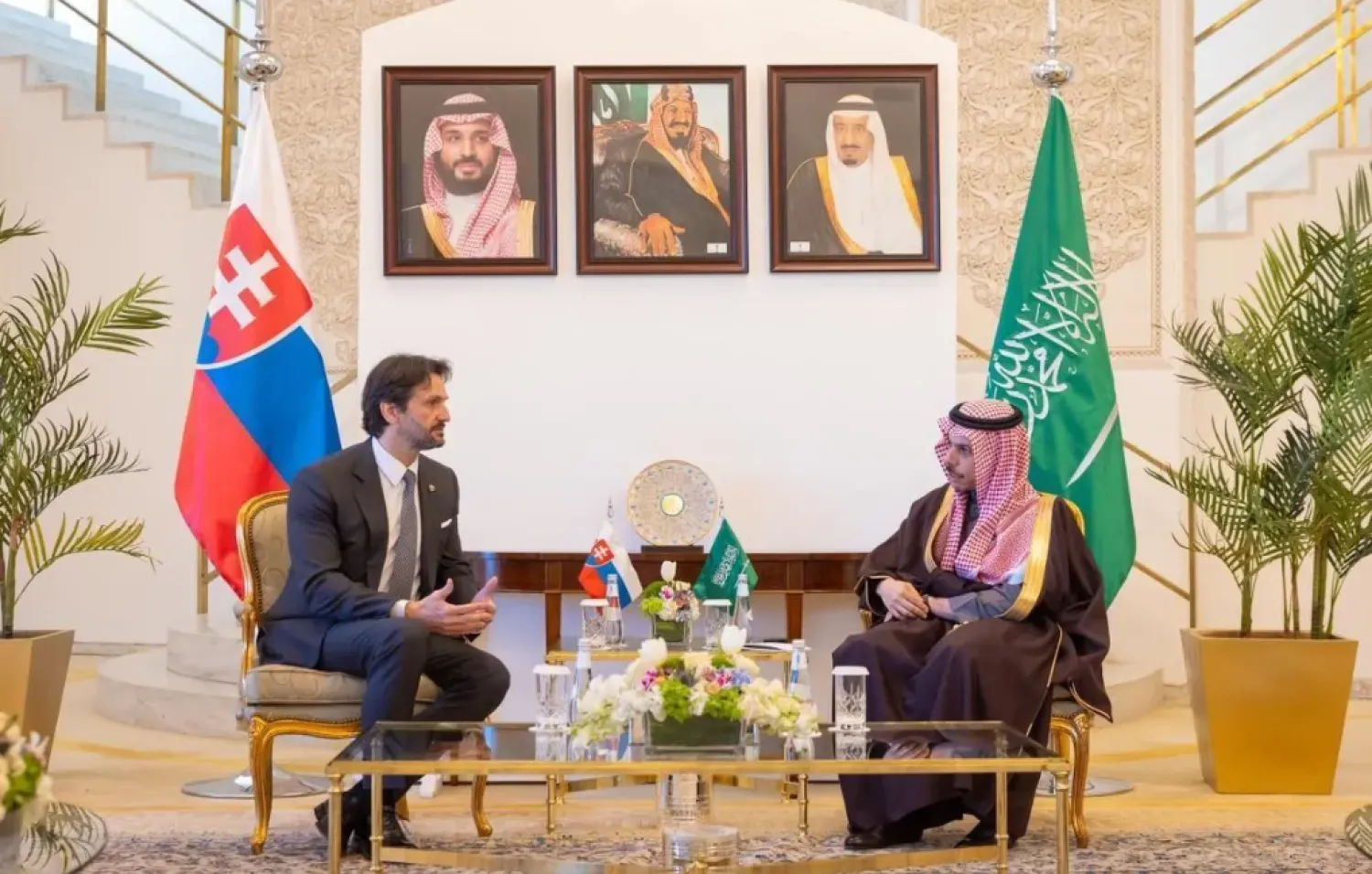



Saudi Foreign Minister, Slovak Deputy Prime Minister Sign General Cooperation Agreement

The two sides signed a general cooperation agreement aimed at enhancing cooperation and mutual understanding across various fields - SPA
TT

Saudi Foreign Minister, Slovak Deputy Prime Minister Sign General Cooperation Agreement

The two sides signed a general cooperation agreement aimed at enhancing cooperation and mutual understanding across various fields - SPA

Saudi Minister of Foreign Affairs Prince Faisal bin Farhan bin Abdullah met in Riyadh Monday Deputy Prime Minister and Minister of Defense of the Slovak Republic Robert Kaliňák.

They reviewed ways to strengthen cooperation between the two countries in a manner that serves their mutual interests and discussed regional and international developments, SPA reported.

The two sides signed a general cooperation agreement between the Government of the Kingdom of Saudi Arabia and the Government of the Slovak Republic, aimed at enhancing cooperation and mutual understanding across various fields.


Khalid bin Salman Visits Saudi Interior Ministry Pavilion at World Defense Show

Prince Khalid was briefed on the ministry’s operational capabilities to enhance decision-making. SPA
TT

Khalid bin Salman Visits Saudi Interior Ministry Pavilion at World Defense Show

Prince Khalid was briefed on the ministry’s operational capabilities to enhance decision-making. SPA

Saudi Minister of Defense Prince Khalid bin Salman bin Abdulaziz visited the Ministry of Interior's pavilion at the World Defense Show, held in Riyadh.

Prince Khalid was briefed on the ministry’s operational capabilities to enhance decision-making, command and control, and predictive intelligence, all aimed at protecting residents across the Kingdom.

During his tour, he explored how the ministry is advancing proactive security and efficient emergency management through innovative technical solutions.

The tour also underscored the role of the unified security operations centers (911) in the national response system and the ministry's commitment to international partnerships in security and smart systems.


OIC Condemns Israeli Cabinet's Legalization of Settlements

 Israeli soldier points his weapon towards the camera, during a weekly settlers' tour in Hebron, in the Israeli-occupied West Bank, February 7, 2026. (Reuters)
Israeli soldier points his weapon towards the camera, during a weekly settlers' tour in Hebron, in the Israeli-occupied West Bank, February 7, 2026. (Reuters)
TT

OIC Condemns Israeli Cabinet's Legalization of Settlements

 Israeli soldier points his weapon towards the camera, during a weekly settlers' tour in Hebron, in the Israeli-occupied West Bank, February 7, 2026. (Reuters)
Israeli soldier points his weapon towards the camera, during a weekly settlers' tour in Hebron, in the Israeli-occupied West Bank, February 7, 2026. (Reuters)

The General Secretariat of the Organization of Islamic Cooperation (OIC) condemned on Monday the Israeli cabinet’s approval of measures that aim to deepen Israeli control over the occupied West Bank and weaken the already limited powers of the Palestinian Authority.

The OIC said Israel’s “colonial settlement policy constitutes a war crime and a flagrant violation of international law and relevant United Nations resolutions, foremost among which is Security Council Resolution 2334 and the legal opinion issued by the International Court of Justice.”

It renewed its call on the international community, particularly the Security Council, “to shoulder its responsibilities and take immediate action to put an end to all crimes and violations committed by Israel against the Palestinian people, their land, and their holy sites.”

The office of Israeli far-right Finance Minister Bezalel Smotrich in a statement announced the decisions that would make it easier for Jewish settlers to force Palestinians to give up land, adding that “we will continue to bury the idea of a Palestinian state.”

Palestinian President Mahmoud Abbas in a statement called the decision “dangerous” and an “open Israeli attempt to legalize settlement expansion” and land confiscation. He called for the United States and UN Security Council to intervene immediately.

The decision was announced a few days before Israeli Prime Minister Benjamin Netanyahu is expected to meet with US President Donald Trump in Washington about Iran and other matters.

The measures announced Sunday include canceling a prohibition on sales of West Bank land to Israeli Jews, declassifying West Bank land registry records to ease land acquisition, transferring construction planning at religious and other sensitive sites in the volatile city of Hebron to Israeli authorities, and allowing Israeli enforcement of environmental and archaeological matters in Palestinian-administered areas.

The measures also would revive a committee that would allow the state of Israel to make “proactive” land purchases in the territory — “a step intended to guarantee land reserves for settlement for generations to come.”