

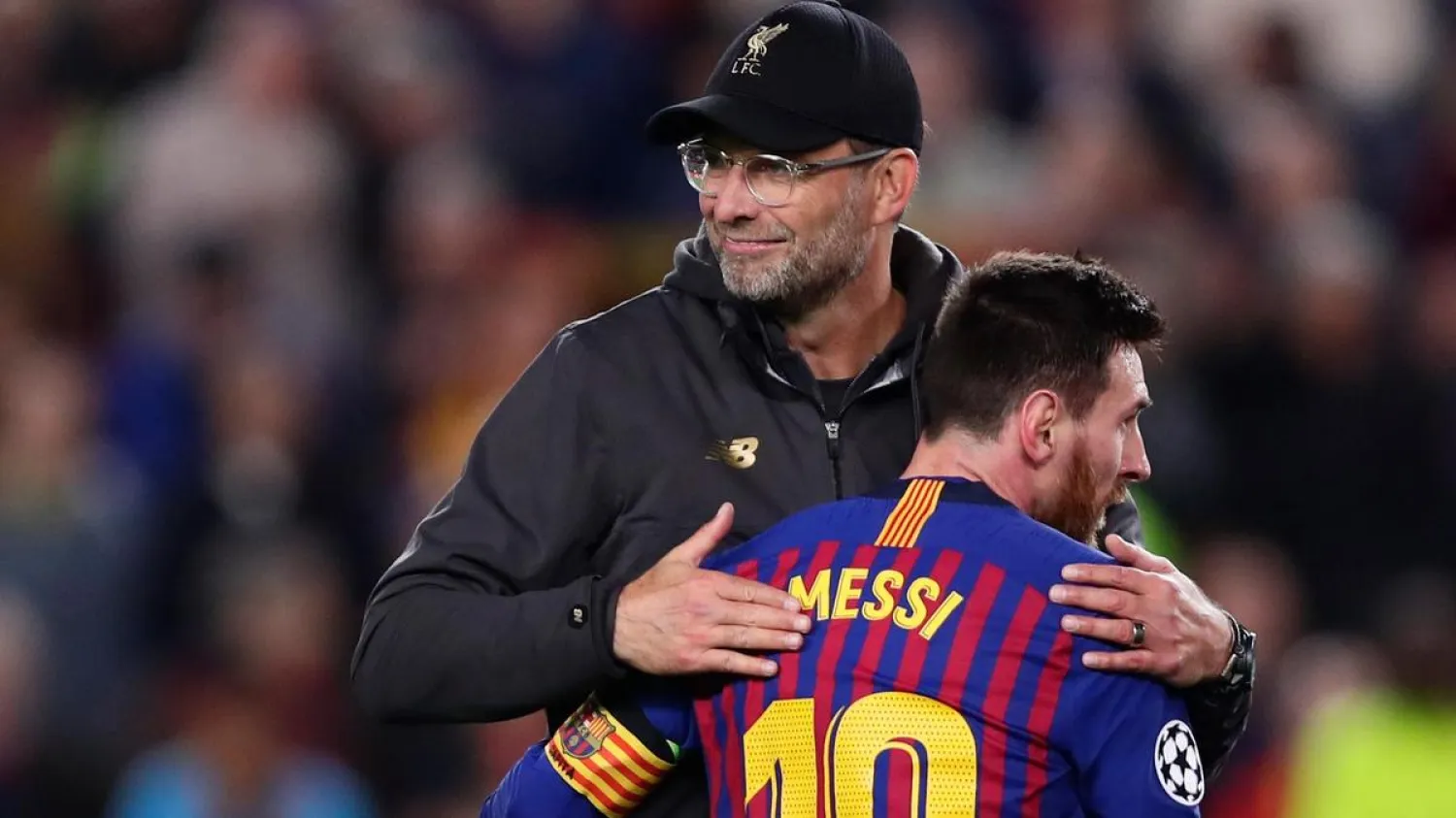

Klopp Took a Risk with his Barcelona Tactics – and Messi Made him Pay

Barcelona's Lionel Messi is congratulated by Liverpool manager Jurgen Klopp after the defeat at the Camp Nou on Wednesday. (AP)
TT

Klopp Took a Risk with his Barcelona Tactics – and Messi Made him Pay

Barcelona's Lionel Messi is congratulated by Liverpool manager Jurgen Klopp after the defeat at the Camp Nou on Wednesday. (AP)

Contemplating his side’s Champions League quarter-final against Manchester City last season, Jurgen Klopp said that to sit back and look to absorb pressure against such a side was in effect to try to “win the lottery”. Against the very best, he believes there is no point – at least for a team of Liverpool’s ability – in curling up like a hedgehog and hoping the threat somehow goes away. He vowed to attack, and did, and his reward was three goals in an extraordinary 20-minute spell that settled the tie before half-time in the first leg.

But such an approach against a side of great quality, meeting fire with fire, comes with a risk. Klopp has become slightly more cautious this season. Liverpool have not pressed quite so hard. The experience of the end of last season, as fatigued players struggled through the final weeks of the campaign, has led to compromise. But it has been grudging compromise, a change of approach for the long-term goal of easing the burden on his team; Klopp still fundamentally believes that when it really matters football should be played at the highest possible volume.

In terms of personnel on Wednesday, there was some concession to the fact they were playing Barcelona. There was James Milner, level-headed and reliable, in midfield, while the preference for Georginio Wijnaldum to stand in for Roberto Firmino hinted at a slightly more defensive mindset. Wijnaldum performed manfully in the unfamiliar role and created a chance for Milner with a deft dummy, but if the idea was for him to drop deep and prevent Sergio Busquets acting as Barça’s metronome, it failed. Busquets still registered a 91.3 percent pass completion rate.

Joe Gomez was a more conservative choice than Trent Alexander-Arnold at right-back – although it is an admittedly unusual strain of conservatism that gives a player his first start in five months at the Camp Nou. The idea, presumably, was that his experience as a central defender would help the back four play narrow and so crowd out Lionel Messi – a plan that, for three-quarters of the game, worked as well as any plan to stop Messi has this season. The problem was it came at the cost of surrendering the right flank to Philippe Coutinho and Jordi Alba – at least until Jordan Henderson arrived, eyes bright and tail wagging, to lollop tirelessly, plugging gaps and offering a threat with his long, booming crosses. Before he had a chance to work his influence, though, the space in front of and outside Gomez had offered up the opening goal.

Essentially, though, Liverpool’s plan was still attack. And for 25 minutes or so after half-time it worked. Barça looked rattled. Between the 50th and 70th minutes, they had 34 percent possession. Their pass completion rate fell to 76 percent. Barça may be more used to it than they were when Pep Guardiola’s Bayern went to the Camp Nou in the Champions League semi-final and pressed them in 2015, but they are still susceptible. Simple balls were knocked out of play, their unease seen in the persistent appeals to the admirably phlegmatic Dutch referee, Björn Kuipers.

But the two centre-backs, Clément Lenglet and, especially, Gerard Piqué, were excellent, and the midfield three efficient in dropping deep to offer a shield; Liverpool were never afforded the sort of space to surge into that Chelsea had been last season. Barcelona did not freeze, as they had seemed to in Rome a year ago. And when Liverpool did create chances, they fell, slightly unfortunately, to Milner.

And then there was Messi.

It was not only his brilliance that opened up Liverpool, though. That decisive second goal was also the result of a series of ricochets – it has been a great week for diminutive assassins emerging unexpectedly from a relentless assault to inflict the decisive blow. Could Liverpool feel unfortunate? Perhaps, but then reacting to close space in the box is part of the art of the central defender and this was a night on which Virgil van Dijk, after such a dominant season, was twice punished for failing to react as quickly as an opposing forward in the box.

And so Liverpool ended up – as Guardiola’s Bayern had – paying for their gamble by losing 3-0. As four years ago, Messi scored twice. Back then, all three goals came in the final 13 minutes, here it was two in the final 15, but the message was similar: take Barça on and they might wobble, but the slightest slip can be punished and, whatever you do, do not get tired. In those chaotic final minutes, although Firmino and Mohamed Salah went close to scoring an away goal that might have kept the tie alive, Barça also wasted two three-on-one breaks.

That is the risk teams who take on Barcelona face. Attack them and you may unsettle them, but you will also expose yourself. And when Messi is in the sort of form he has been in this season, that can be fatal. That is not to say Klopp’s approach was wrong – on the contrary, his side came close to a remarkable result – but the possibility of a heavy defeat is inherent in the approach he takes.

And that, of course, is part of what makes Barcelona, particularly with this re-energized Messi, so difficult to play against.

The Guardian Sport


Portugal’s Fernandes Hopes to Win World Cup to Crown Ronaldo’s Career

 Al-Nassr's Cristiano Ronaldo in action during the AFC Champions League Two 2025/2026 semi-finals match between Al-Nassr and Al Ahli Doha in Dubai, United Arab Emirates, 22 April 2026. (EPA)
Al-Nassr's Cristiano Ronaldo in action during the AFC Champions League Two 2025/2026 semi-finals match between Al-Nassr and Al Ahli Doha in Dubai, United Arab Emirates, 22 April 2026. (EPA)
TT

Portugal’s Fernandes Hopes to Win World Cup to Crown Ronaldo’s Career

 Al-Nassr's Cristiano Ronaldo in action during the AFC Champions League Two 2025/2026 semi-finals match between Al-Nassr and Al Ahli Doha in Dubai, United Arab Emirates, 22 April 2026. (EPA)
Al-Nassr's Cristiano Ronaldo in action during the AFC Champions League Two 2025/2026 semi-finals match between Al-Nassr and Al Ahli Doha in Dubai, United Arab Emirates, 22 April 2026. (EPA)

Portugal midfielder Bruno ‌Fernandes expressed hope that he and his teammates can help crown Cristiano Ronaldo's international career by winning the 2026 World Cup.

The 41-year-old Ronaldo is set to appear in a record sixth World Cup in June, a tournament expected to be the final major chapter of the forward's career.

"Wrapping up ‌all this ‌last World Cup with ‌Cristiano (Ronaldo) ⁠winning it would ⁠be something amazing," Fernandes told Wayne Rooney in a BBC report published on Friday.

"I really hope we can make it happen, not just for Portugal, but for everything Cristiano gave ⁠to football and the world," ‌the Portuguese midfielder ‌and Manchester United captain said.

Ronaldo, considered one ‌of the greatest players ever to ‌have not won a World Cup, is the record scorer in international football with 143 goals.

The five-time Ballon d’Or winner was ‌part of Portugal's Euro 2016-winning team and has lifted the ⁠Nations ⁠League twice.

Portugal's opening Group K game is on June 17 against the Democratic Republic of Congo, followed by Uzbekistan on June 23, with both games in Houston. They play Colombia on June 27 in Miami in their final group game.

The World Cup runs from June 11 to July 19 in Canada, the United States and Mexico.


Defending Champion Alcaraz to Miss French Open with Wrist Injury

Spanish tennis player Carlos Alcaraz gives a press conference to announce his withdrawal from the Barcelona Open Banc Sabadell-Trofe Conde de Godo, in Barcelona, Spain, 15 April 2026. (EPA)
TT

Defending Champion Alcaraz to Miss French Open with Wrist Injury

Spanish tennis player Carlos Alcaraz gives a press conference to announce his withdrawal from the Barcelona Open Banc Sabadell-Trofe Conde de Godo, in Barcelona, Spain, 15 April 2026. (EPA)

Two-time reigning French Open champion Carlos Alcaraz said on Friday he will not play at this year's tournament as he recovers from a wrist injury.

"We have decided that the most prudent thing to do is to be cautious and not participate in Rome or Roland Garros," Alcaraz said on social media.

"It's a complicated moment for me, but I'm sure we'll come out stronger from this," the Spaniard added, saying that he and his team would monitor his recovery before deciding when and where he would return.

Alcaraz sustained the injury during the first round of the Barcelona Open last week, where he beat Otto Virtanen but subsequently pulled out of the tournament.

The 22-year-old announced his withdrawal from the Madrid Masters on April 17, increasing concerns over whether he would be able to appear at the French Open.

Alcaraz became the youngest man to complete the career Grand Slam in January with his triumph at the Australian Open. He holds a 22-3 record this season and also won a title in Doha.

Ranked second in the world, Alcaraz lost top spot following his defeat by Jannik Sinner in the Monte Carlo Masters final on April 12.

The seven-time Grand Slam winner, an expert on clay, triumphed at Roland Garros in 2024 and 2025. He saved three championship points against Sinner in last year's final.


Formula 1 Returns to Türkiye from 2027 on 5-year Contract

Formula One F1 - Turkish Grand Prix - Intercity Istanbul Park, Istanbul, Türkiye - October 10, 2021 General view at the start of the race REUTERS/Umit Bektas/ File Photo
TT

Formula 1 Returns to Türkiye from 2027 on 5-year Contract

Formula One F1 - Turkish Grand Prix - Intercity Istanbul Park, Istanbul, Türkiye - October 10, 2021 General view at the start of the race REUTERS/Umit Bektas/ File Photo

The Turkish Grand Prix is back on the Formula 1 calendar next season for the first time since 2021, on a five-year agreement.

After an initial announcement Friday by the Turkish government and President Recep Tayyip Erdogan, there was confirmation from F1 and its governing body.

Erdogan said the deal would be for “at least five years”.

The Istanbul Park circuit outside the city first hosted F1 from 2005 through 2011, and next year's race would be the first since Türkiye returned to the calendar in 2020 and 2021 during disruption caused by the COVID-19 pandemic. Valtteri Bottas won the most recent race for Mercedes.

“Many memorable moments have been made in our sport’s history at Istanbul Park and I’m excited to begin the next chapter of our partnership, giving fans the opportunity to experience even more incredible racing in a truly fantastic location,” Formula 1 chief executive Stefano Domenicali said.

Hosting F1 would “demonstrate to the world that our country is the safe haven of its region,” Erdogan said.

The news comes after the Iran war caused widespread disruption to sports in the region and forced F1 to call off races in Bahrain and Saudi Arabia scheduled for this month.

That left a large gap in this year’s schedule. The Miami Grand Prix next week will be the first F1 race since the Japanese Grand Prix on March 29.

F1’s return to Istanbul had been widely expected since Domenicali said in February that it was a candidate to return.

He added venues like Istanbul Park and the Portimão circuit, which will host the returning Portuguese Grand Prix next year, show F1 is not focusing too much on street races in glamorous locations.

Those can be some of F1's most lucrative events, like the Las Vegas Grand Prix, but are generally less popular with drivers than purpose-built race tracks.

“Türkiye is not 100% confirmed. Stay tuned on Türkiye, let me put it this way,” Domenicali said at the time. “This is also to answer to the people that were saying there were too many street races. The new ones that are coming are tracks, not street races.”

The return of Türkiye and Portugal next year will come as the Dutch Grand Prix, four-time champion Max Verstappen's home race, leaves the schedule after six years. The Belgian Grand Prix and the second Spanish race at the Circuit de Barcelona-Catalunya will host in alternate years from 2027, freeing up another slot.

F1 estimated Friday it has 19 million fans in Türkiye, and FIA President Mohammed Ben Sulayem called the race's return “a powerful reflection of the continued global growth and appeal of our sport.”

The Istanbul Park track was generally popular with drivers and its long, high-speed turn eight was often ranked as one of the most challenging corners in the world.

Felipe Massa is the most successful driver at the Turkish Grand Prix with three wins in a row for Ferrari from 2006 through 2008, while Lewis Hamilton has won the race twice.
