


Gabriel Paulista: ‘I Tackled Lukaku and the Emirates Reacted as If I Had Scored’

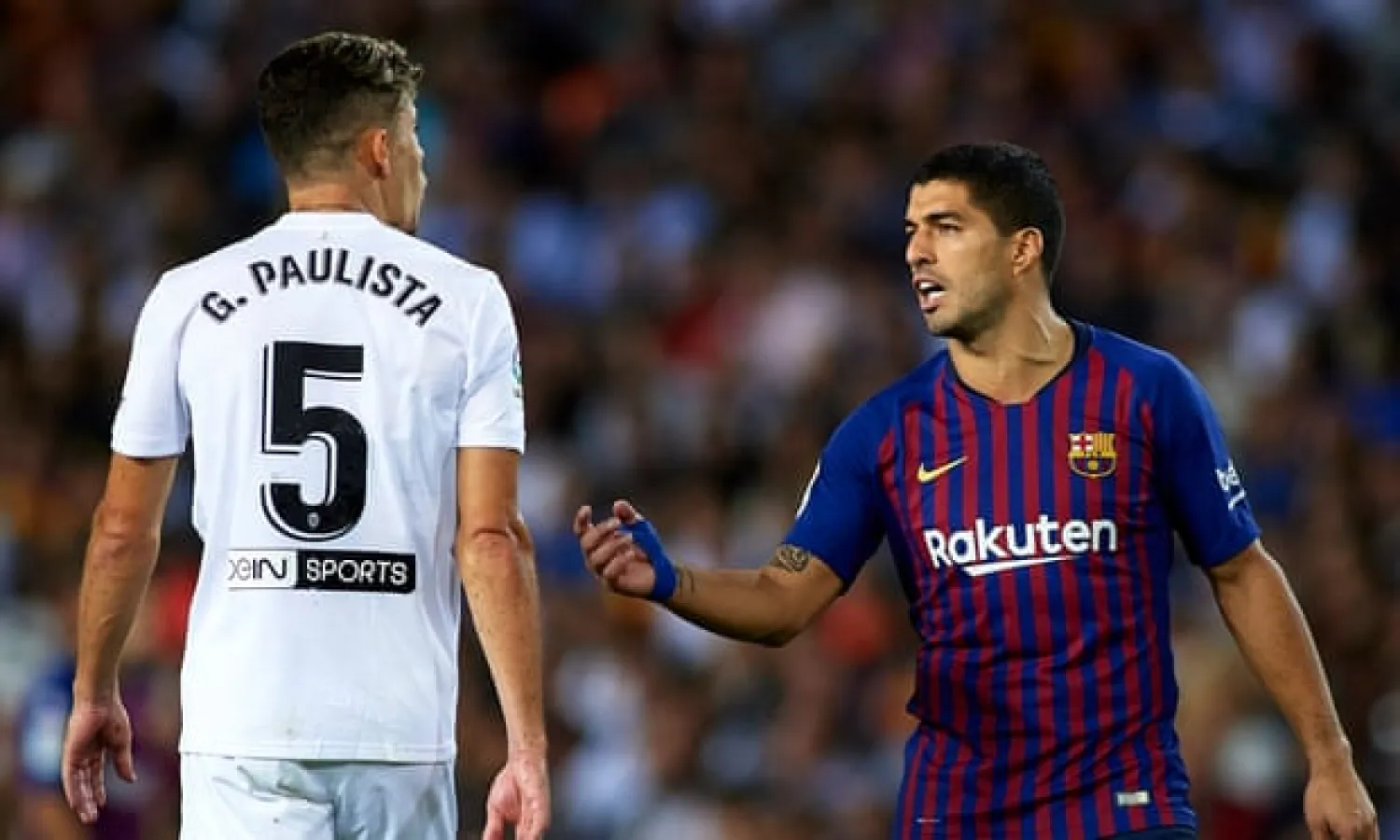
 Gabriel Paulista argues with Luis Suárez during a La Liga game. ‘Suárez talks to you all the time because he wants to put you off. But at the end, he’ll give you a hug’ Photograph: Manuel Queimadelos Alonso/Getty Images
Gabriel Paulista argues with Luis Suárez during a La Liga game. ‘Suárez talks to you all the time because he wants to put you off. But at the end, he’ll give you a hug’ Photograph: Manuel Queimadelos Alonso/Getty Images
TT

Gabriel Paulista: ‘I Tackled Lukaku and the Emirates Reacted as If I Had Scored’

 Gabriel Paulista argues with Luis Suárez during a La Liga game. ‘Suárez talks to you all the time because he wants to put you off. But at the end, he’ll give you a hug’ Photograph: Manuel Queimadelos Alonso/Getty Images
Gabriel Paulista argues with Luis Suárez during a La Liga game. ‘Suárez talks to you all the time because he wants to put you off. But at the end, he’ll give you a hug’ Photograph: Manuel Queimadelos Alonso/Getty Images

It is difficult not be drawn to the small boy with the curly hair standing on the train tracks gazing into the distance, a ball at his feet, and in the end you cannot help but ask. Gabriel Paulista has been talking for half an hour or so about his return to the Emirates, Arsenal and Arsène Wenger, about Valencia and Villarreal, London, language barriers and footballing cultures, referees and repartee too, when he turns to the tattoo that covers his right calf. The boy in the picture is his son and the symbolism is his too. “I saw a photo and I identified with it,” he says. “It’s been a difficult journey to be here.

“I grew up in São Paulo. My family had a lot of problems, I saw bad things, and so there are lots of victories along the way. I saw a photo and I wanted to have it as a tattoo and I wanted to put my son in there – and a ball of course.”

When the Valencia defender tells five-year-old Miguel how things were, and he does often, it is a different world. He lived in a wooden house in the favela that flooded when it rained and the family went hungry. His older brother played football but never got the chance and took a wrong turn, got into a lot of trouble. He was killed by police, aged 21.

“He is a lesson for me, a source of motivation. I fight on the pitch for them [his family] and to try to be an example for my own family now,” Gabriel says.

The way Gabriel puts it, his mother spent money needed for food on trying to help him play but also told him once that he needed to get a job to help out rather than concentrate on football. He had failed trials before, at Grêmio and Santos, and his brothers had not made it either. “My older brothers wanted to be footballers too. I saw them cry because they didn’t get the chance. But I’m a believer and at 17, God wanted to help me,” he says. A friend of his late brother bought a small local team competing in one of São Paulo’s most important youth tournaments, called Gabriel’s mother and told her he was going to give Gabriel the chance her other son never had.

Gabriel says he could not and would not let them down. And so it began. From there, to Vitória, then Villarreal, and then Arsenal. On Thursday, he returns to the Emirates with Valencia to face the club for whom he played 64 games across three years. It was the draw he wanted and one he was swiftly warned about. “I got a message from Nacho Monreal saying: ‘Watch out! We’ll make it hard for you.’

“I remember my agent calling me and asking if I wanted to play for Arsenal. What was I going to say? Everyone would love to play there, at one of the biggest clubs in the world. The first time I spoke to Arsène Wenger, I was nervous,” Gabriel says, waggling his fingers, as if trembling. “He has such a long history in football, he’d been at the club 20 years and I was nervous but he calmed me down and he gave me a lot of confidence. He’s a coach who embraces you and I have a lot of affection for him.

“My characteristics are strength, aggression so in football terms my adaptation to the league wasn’t so difficult although Arsenal’s football is a bit different: it’s more about the ball. I remember my first game. I was up against [Romelu] Lukaku and there were a couple of 50-50 challenges early on and I went into this challenge hard, down on the ground and came away with the ball and suddenly the noise in the Emirates …”

There’s a huge grin on Gabriel’s face, eyes wide almost in awe. “It was as if I had scored,” he says. “It was a big surprise to me. I knew then what I had to do to. I saw that the English fans love that. I did my best for them and I think the majority of games I played well. I wanted more opportunities and I deserved more but that’s football and now I’m here.”

There are no regrets. Well, there is one. “I didn’t make the most of the city: I was someone who stayed at home a lot. We lived in Hampstead and because of the climate I didn’t fancy going out much. We would go walking in a park nearby, where there were some animals, but not a lot else. When I came back to Spain, I regretted it: London is a great city and I never saw much of it.”

Nor did he really learn English. Asked what language they spoke on the pitch, Gabriel laughs. “All of them. I started playing alongside [Laurent] Koscielny or [Per] Mertesacker and they didn’t speak Spanish or Portuguese but they made an effort. Mertesacker was an incredible guy. Koscielny was a bit more reserved, but they both tried. Koscielny would be there shouting ‘derecha, derecha!’ [right, right] at me. Mertesacker would look things up in Spanish to help me. Even the manager spoke some Spanish to me. And there were others like Monreal, Héctor [Bellerín], [Santi] Cazorla, Alexis [Sánchez]. [Mikel] Arteta too. Mesut [Özil] also spoke a little bit of Spanish.

“And when refs came over, I could just about manage ‘sorry, sorry’,” Gabriel continues, laughing again. “Usually the captains were there to talk for me. Cazorla would translate. Because of my way of playing I like the English referees. If you go into hard to challenge, they don’t pull out the yellow straight away. They come over and talk to you. Here it’s different: the first hard challenge you go into it’s a card and they don’t talk to you.

“It was sometimes a problem not being about to talk my way out of things, though: the problem I had with Chelsea when I was sent off …” Gabriel says, as he recalls the tussle he and Diego Costa had in September 2015. “The referee spoke to me and Diego and I didn’t understand anything.

“The thing is, Costa is …” There is a pause. “I’m the same. I change on the pitch, I’m like another person, and I want to defend my team. Diego Costa off the pitch is someone with an incredible heart. If I didn’t know him off the pitch then, yeah, I might also say: ‘This guy is crazy – he’s a bad guy, bad character.’ But he’s an incredible guy with a big heart.

“I didn’t talk to him after the game, I was still too wound up but I saw him later that season at the Emirates. I was talking to David Luiz and he came over and started talking to my son and playing with my son and talking to my wife. These are things that happen in football. He’s not a bad guy: a lot of players change when they cross the line. I change a lot.”

It was precisely that aggression that Arsenal supposedly lacked – “you can see that they have improved in many things now, in terms of having the ball and that aggression,” Gabriel says – and that they sought in him. As he talks about the battles, it is clear that most of the time he enjoys it, that there’s a kind of mutual respect between defender and striker.

Asked about the hardest forwards he faced, he says: “That’s a difficult question: Costa, [Sergio] Agüero … Luis Suárez too, he’s very aggressive and he’ll talk too. He’s heavy-going, he talks to you all the time because he wants to put you off. And at the end, he’ll give you a hug. I understand that because I do it a lot. I want to provoke but then we are friends as soon as the whistle.”

The style that took Gabriel to Arsenal is part of what the Valencia manager Marcelino admires in him too. Marcelino coached Gabriel at Villarreal and brought him back to Valencia; he “made” him, Gabriel admits. “When I first came to Europe, I found it difficult. Football in Brazil is not as organised and I had to learn: where the line is, when to step out, when to stay, defending in the area,” he says. I have learned so much from Marcelino: I’m another player now thanks to the míster. And that loyalty works both ways. He knows he can rely on me. They can split my face open one game and the next game I’ll be there available to play.”

And now the next game is Arsenal, back at the Emirates – “a special game, at a special stadium, against a very strong team,” Gabriel says, before heading off in search of another victory.

The Guardian Sport



Hospital: Vonn Had Surgery on Broken Leg from Olympics Crash

This handout video grab from IOC/OBS shows US Lindsey Vonn crashing during the women's downhill event at the Milano Cortina 2026 Winter Olympic Games on February 8, 2026. (Photo by Handout / various sources / AFP)
TT

Hospital: Vonn Had Surgery on Broken Leg from Olympics Crash

This handout video grab from IOC/OBS shows US Lindsey Vonn crashing during the women's downhill event at the Milano Cortina 2026 Winter Olympic Games on February 8, 2026. (Photo by Handout / various sources / AFP)

Lindsey Vonn had surgery on a fracture of her left leg following the American's heavy fall in the Winter Olympics downhill, the hospital said in a statement given to Italian media on Sunday.

"In the afternoon, (Vonn) underwent orthopedic surgery to stabilize a fracture of the left leg," the Ca' Foncello hospital in Treviso said.

Vonn, 41, was flown to Treviso after she was strapped into a medical stretcher and winched off the sunlit Olimpia delle Tofane piste in Cortina d'Ampezzo.

Vonn, whose battle to reach the start line despite the serious injury to her left knee dominated the opening days of the Milano Cortina Olympics, saw her unlikely quest halted in screaming agony on the snow.

Wearing bib number 13 and with a brace on the left knee she ⁠injured in a crash at Crans Montana on January 30, Vonn looked pumped up at the start gate.

She tapped her ski poles before setting off in typically aggressive fashion down one of her favorite pistes on a mountain that has rewarded her in the past.

The 2010 gold medalist, the second most successful female World Cup skier of all time with 84 wins, appeared to clip the fourth gate with her shoulder, losing control and being launched into the air.

She then barreled off the course at high speed before coming to rest in a crumpled heap.

Vonn could be heard screaming on television coverage as fans and teammates gasped in horror before a shocked hush fell on the packed finish area.

She was quickly surrounded by several medics and officials before a yellow Falco 2 ⁠Alpine rescue helicopter arrived and winched her away on an orange stretcher.


Meloni Condemns 'Enemies of Italy' after Clashes in Olympics Host City Milan

Demonstrators hold smoke flares during a protest against the environmental, economic and social impact of the Milano-Cortina 2026 Winter Olympics in Milan, Italy, February 7, 2026. REUTERS/Kevin Coombs
TT

Meloni Condemns 'Enemies of Italy' after Clashes in Olympics Host City Milan

Demonstrators hold smoke flares during a protest against the environmental, economic and social impact of the Milano-Cortina 2026 Winter Olympics in Milan, Italy, February 7, 2026. REUTERS/Kevin Coombs

Italian Prime Minister Giorgia Meloni has condemned anti-Olympics protesters as "enemies of Italy" after violence on the fringes of a demonstration in Milan on Saturday night and sabotage attacks on the national rail network.

The incidents happened on the first full day of competition in the Winter Games that Milan, Italy's financial capital, is hosting with the Alpine town of Cortina d'Ampezzo.

Meloni praised the thousands of Italians who she said were working to make the Games run smoothly and present a positive face of Italy.

"Then ⁠there are those who are enemies of Italy and Italians, demonstrating 'against the Olympics' and ensuring that these images are broadcast on television screens around the world. After others cut the railway cables to prevent trains from departing," she wrote on Instagram on Sunday.

A group of around 100 protesters ⁠threw firecrackers, smoke bombs and bottles at police after breaking away from the main body of a demonstration in Milan.

An estimated 10,000 people had taken to the city's streets in a protest over housing costs and environmental concerns linked to the Games.

Police used water cannon to restore order and detained six people.

Also on Saturday, authorities said saboteurs had damaged rail infrastructure near the northern Italian city of Bologna, disrupting train journeys.

Police reported three separate ⁠incidents at different locations, which caused delays of up to 2-1/2 hours for high-speed, Intercity and regional services.

No one has claimed responsibility for the damage.

"Once again, solidarity with the police, the city of Milan, and all those who will see their work undermined by these gangs of criminals," added Meloni, who heads a right-wing coalition.

The Italian police have been given new arrest powers after violence last weekend at a protest by the hard-left in the city of Turin, in which more than 100 police officers were injured.


Liverpool New Signing Jacquet Suffers 'Serious' Injury

Soccer Football - Ligue 1 - RC Lens v Stade Rennes - Stade Bollaert-Delelis, Lens, France - February 7, 2026  Stade Rennes' Jeremy Jacquet in action REUTERS/Benoit Tessier
Soccer Football - Ligue 1 - RC Lens v Stade Rennes - Stade Bollaert-Delelis, Lens, France - February 7, 2026 Stade Rennes' Jeremy Jacquet in action REUTERS/Benoit Tessier
TT

Liverpool New Signing Jacquet Suffers 'Serious' Injury

Soccer Football - Ligue 1 - RC Lens v Stade Rennes - Stade Bollaert-Delelis, Lens, France - February 7, 2026  Stade Rennes' Jeremy Jacquet in action REUTERS/Benoit Tessier
Soccer Football - Ligue 1 - RC Lens v Stade Rennes - Stade Bollaert-Delelis, Lens, France - February 7, 2026 Stade Rennes' Jeremy Jacquet in action REUTERS/Benoit Tessier

Liverpool's new signing Jeremy Jacquet suffered a "serious" shoulder injury while playing for Rennes in their 3-1 Ligue 1 defeat at RC Lens on Saturday, casting doubt over the defender’s availability ahead of his summer move to Anfield.

Jacquet fell awkwardly in the second half of the ⁠French league match and appeared in agony as he left the pitch.

"For Jeremy, it's his shoulder, and for Abdelhamid (Ait Boudlal, another Rennes player injured in the ⁠same match) it's muscular," Rennes head coach Habib Beye told reporters after the match.

"We'll have time to see, but it's definitely quite serious for both of them."
Liverpool agreed a 60-million-pound ($80-million) deal for Jacquet on Monday, but the 20-year-old defender will stay with ⁠the French club until the end of the season.

Liverpool, provisionally sixth in the Premier League table, will face Manchester City on Sunday with four defenders - Giovanni Leoni, Joe Gomez, Jeremie Frimpong and Conor Bradley - sidelined due to injuries.