

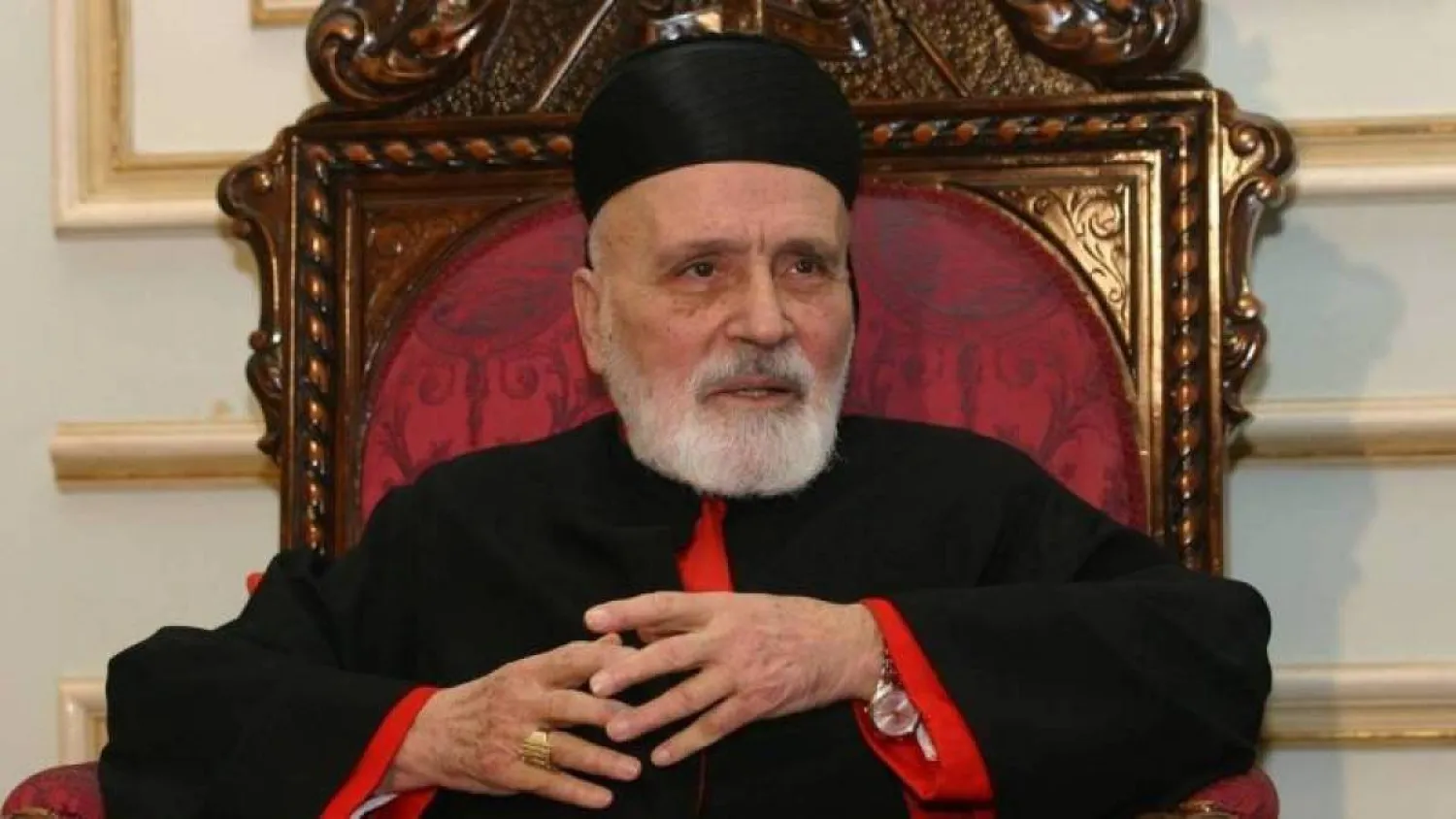

Lebanon’s Former Maronite Patriarch Sfeir Passes Away

Late former Lebanese Maronite Patriach Nasrallah Sfeir.
TT

Lebanon’s Former Maronite Patriarch Sfeir Passes Away

Late former Lebanese Maronite Patriach Nasrallah Sfeir.

Lebanon's former Maronite patriarch Nasrallah Boutros Sfeir passed away on Sunday, said the church.

Sfeir, who was about to turn 99 on May 15, died at 3:00 am (0100 GMT) "after days of intensive medical care," said a statement by the Maronite church.

He became the leader of the church in 1986 until he resigned in 2011 due to his declining health, and held the title "76th Patriarch of Antioch and the Whole Levant".

He was a respected power broker during the 1975-1990 civil war, which saw bitter infighting between rival militias including opposing Christian factions.

Sfeir, who spoke fluent Arabic and French, was made a cardinal by Pope John Paul II in 1994.

Cardinal Beshara al-Rahi, who succeed Sfeir in 2011, called on churches to ring their bells and hold prayers for the late leader.

President Michel Aoun said that the church lost one of its greatest patriarchs with Sfeir’s passing.

He hailed his national stances and defense of Lebanon’s sovereignty, independence and people during Lebanon’s most dire moments, crediting him with bolstering national partnership.

Prime Minister Saad Hariri offered his condolences to the church over Sfeir’s passing.

Sfeir embodied spiritual and national values during a critical time of Lebanon’s history, he added. “He became a national symbol through his firm and brave stances that inevitably helped change the course of events.”

Born in 1920 in Rayfoun, a village in Lebanon's Keserouan mountains, Sfeir studied theology and philosophy but was never shy to delve into Lebanon's tumultuous politics.

His backing of the 1989 Taif agreement that brought the 15-year civil war to an end bolstered Christian support for the accord, but reduced the powers of the presidency -- a seat reserved for Lebanon's Maronite Christians under the country's confessional power-sharing.

Sfeir also spearheaded the opposition to Syria's three decades of military and political domination over Lebanon.

"His biggest struggle was to end the Syrian presence in Lebanon, which we all thought was impossible because of the divisions in Lebanon," his biographer Antoine Saad told AFP.

"But he worked on it steadily, objectively, meticulously and quietly," he said.

Sfeir refused to visit Syria during his time as patriarch, even when John Paul II made a trip to the country in 2001.

His outspokenness helped swell the anti-Syria movement in 2000.

It eventually lead to the withdrawal of thousands of Syrian troops from the country five years later, following the assassination of former Prime Minister Rafik Hariri, whose murder the opposition blamed on Damascus.

Sfeir's opinion and advice continued to be sought by politicians of all stripes, not only Christians, after he stepped down.

"He was completely against war," Saad said of the cleric who enjoyed hiking in nature until his late years.

"His loss can't be compensated for."


Türkiye Begins Black Box Analysis of Jet Crash That Killed Libyan Military Chief and 7 Others

Libyan national flags fly at half-mast in Tripoli on December 24, 2025, after the head of Libya's armed forces and his four aides died in a plane crash in Türkiye. (AFP)
TT

Türkiye Begins Black Box Analysis of Jet Crash That Killed Libyan Military Chief and 7 Others

Libyan national flags fly at half-mast in Tripoli on December 24, 2025, after the head of Libya's armed forces and his four aides died in a plane crash in Türkiye. (AFP)

The technical analysis of the recovered black boxes from a jet crash that killed eight people, including western Libya’s military chief, began as the investigation proceeded in cooperation with Libyan authorities, the Turkish Ministry of Defense said Thursday.

The private jet with Gen. Muhammad Ali Ahmad al-Haddad, four other military officials and three crew members crashed on Tuesday after taking off from Türkiye’s capital, Ankara, killing everyone on board. Libyan officials said the cause of the crash was a technical malfunction on the plane.

The high-level Libyan delegation was on its way back to Tripoli after holding defense talks in Ankara aimed at boosting military cooperation between the two countries.

The wreckage was scattered across an area covering 3 square kilometers (more than a square mile), complicating recovery efforts, according to the Turkish Interior Minister Ali Yerlikaya.

A 22-person delegation, including five family members, arrived from Libya early on Wednesday to assist in the investigation.


Lebanese President: We are Determined to Hold Parliamentary Elections on Time

President Joseph Aoun between Prime Minister Nawaf Salam and Speaker Nabih Berri (Lebanese Presidency file photo)
TT

Lebanese President: We are Determined to Hold Parliamentary Elections on Time

President Joseph Aoun between Prime Minister Nawaf Salam and Speaker Nabih Berri (Lebanese Presidency file photo)

Lebanese President Joseph Aoun reiterated on Thursday that the country’s parliamentary elections are a constitutional obligation that must be carried out on time.

Lebanon’s state-run National News Agency quoted Aoun as saying that he, alongside Prime Minister Nawaf Salam and Parliament Speaker Nabih Berri, is determined to hold the elections on schedule.

Aoun also emphasized that diplomatic efforts have continued unabated to keep the specter of war at bay, noting that "things are heading in a positive direction".

The agency also cited Berri reaffirming that the elections will take place as planned, with "no delays, no extensions".

The Lebanese parliamentary elections are scheduled for May next year.


Israel Calls Countries Condemning New West Bank Settlements ‘Morally Wrong’

Newly constructed buildings are pictured in the Israeli settlement of Givat Zeev near the Palestinian city of Ramallah in the occupied West Bank on October 24, 2025. (AFP)
TT

Israel Calls Countries Condemning New West Bank Settlements ‘Morally Wrong’

Newly constructed buildings are pictured in the Israeli settlement of Givat Zeev near the Palestinian city of Ramallah in the occupied West Bank on October 24, 2025. (AFP)

Israel reacted furiously on Thursday to a condemnation by 14 countries including France and Britain of its approval of new settlements in the occupied West Bank, calling the criticism discriminatory against Jews.

"Foreign governments will not restrict the right of Jews to live in the Land of Israel, and any such call is morally wrong and discriminatory against Jews," Foreign Minister Gideon Saar said.

"The cabinet decision to establish 11 new settlements and to formalize eight additional settlements is intended, among other things, to help address the security threats Israel is facing."

On Sunday, Israel's far-right Finance Minister Bezalel Smotrich announced that authorities had greenlit the settlements, saying the move was aimed at preventing the establishment of a Palestinian state.

Fourteen countries, including Britain, France, Germany, Spain and Canada, then issued a statement urging Israel to reverse its decision, "as well as the expansion of settlements".

Such unilateral actions, they said, "violate international law", and risk undermining a fragile ceasefire in Gaza in force since October 10.

They also reaffirmed their "unwavering commitment to a comprehensive, just and lasting peace based on the two-state solution... where two democratic states, Israel and Palestine, live side-by-side in peace and security".

Israel has occupied the West Bank following the 1967 Arab-Israeli war.

Excluding east Jerusalem, which was occupied and annexed by Israel in 1967, more than 500,000 Israelis live in the West Bank, along with about three million Palestinian residents.

Earlier this month, the United Nations said the expansion of Israeli settlements in the West Bank, all of which are illegal under international law, had reached its highest level since at least 2017.
