Chronicles of the Rings: What Trees Tell Us

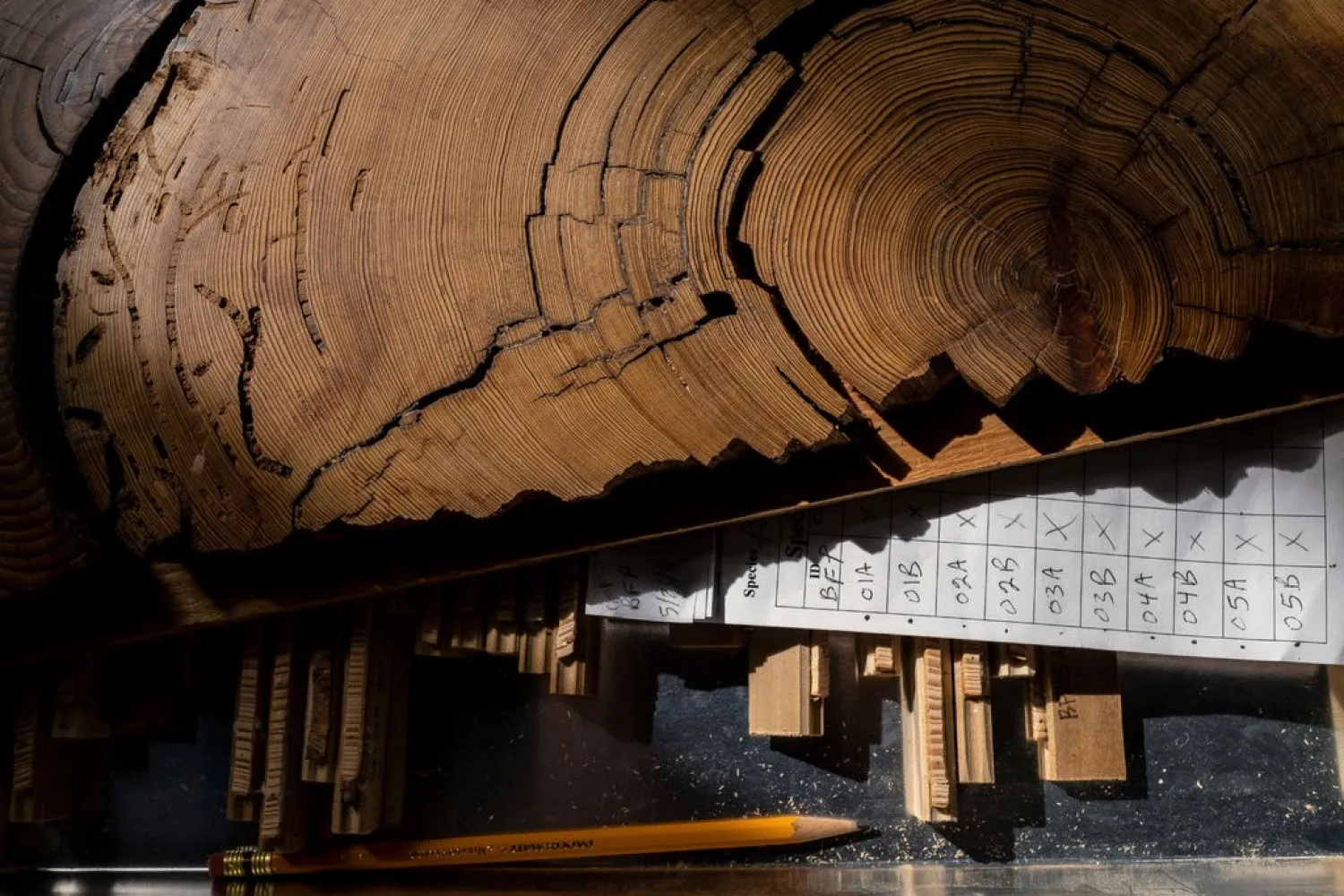
Wood samples for research at the Laboratory of Tree Ring Research at the University of Arizona. Credit Adriana Zehbrauskas for The New York Times
TT

Chronicles of the Rings: What Trees Tell Us

Wood samples for research at the Laboratory of Tree Ring Research at the University of Arizona. Credit Adriana Zehbrauskas for The New York Times

From the early 1700s until the 1960s, the fast moving river of wind known as the North Atlantic Jet Stream, which drives weather extremes over Europe, was pretty steady on its course.
Then it became less predictable. But instrument data alone can’t tell the jet stream’s movements for comparison over the centuries, given that scientists began keeping records of weather events via instruments only in the late 19th century.

The rings of trees, however, offer a far more complete historical picture of climate variations. As they age, trees form new distinctive rings, outward from the center, and each year a new, distinct circle of dead wood is created around the trunk of most trees. In that ring, one can find information about precipitation, temperature and other data about that year.

Kiyomi Morino, a research associate at the Laboratory of Tree-Ring Research at the University of Arizona, during a field sampling on Mount Bigelow, in the Santa Catalina Mountains.

A team led by Valerie Trouet, a dendrochronologist, sampled 400 trees from the Balkans and 200 in Scotland — including what might be the oldest known tree in Europe, a Bosnian pine in Greece named Adonis, which is 1,075 years old. The jet stream flows between these two regions, and trees revealed the range of temperatures in their rings and the frequency of fires over time, an expansive chronicling of jet stream behavior.

“More extreme positions create more extreme climate events, especially heat waves and storms,” in Europe, Dr. Trouet said. And the tree rings show “big fires happen in the Balkans when the jet is in its southerly position.”

The fact that the stream has become more variable only in recent decades suggests that the shift is the result of humans’ effects on climate, Dr. Trouet said. “The recent rise in variance is unprecedented in 300 years,” she said. More analysis is underway to look back to even earlier centuries.

Reading the climate stories these trees tell will help with forecasting. “One of the big questions in the field is what’s going to happen to the jet stream,” said Dr. Trouet. “This data helps the modeling of climate change become more reliable.”

Trees, it seems, are giant organic recording devices that contain information about past climate, civilizations, ecosystems and even galactic events, much of it many thousands of years old.
In recent years, the techniques for extracting information from tree rings has been honed and expanded. New technologies and techniques are able to pry a much deeper and wider range of information out of trees.

The field “has exploded,” Edward Cook, director of the tree ring lab at Lamont-Doherty Earth Observatory, said.

The Laboratory of Tree-Ring Research here at the University of Arizona was founded in the 1930s by A.E. Douglass, an astronomer who turned to trees to better understand the connection between sunspots and climate.

The lab has helped establish other labs around the world, which in turn has rapidly increased the number of studied trees. There are now roughly a dozen large labs globally and data from 4,000 sites on all continents except Antarctica. The information is stored in the International Tree Ring Data Bank, a library open to all researchers. As more tree data becomes available, a much richer picture forms of the nexus of past climate, ecosystems and human civilization.

For its first 80 years, the lab was located in much smaller — and noisier — quarters under the University of Arizona football stadium. “If you worked on Saturdays you could hear people in the bleachers stamping their feet,” said Russell K. Monson, who studies plant physiology here.

In 2012, the lab moved into a larger building to accommodate its growing mission and number of researchers — now some 70 or so — and to unpack its vast collection of tree rings and core samples. There are now more than a half-million samples, from slivers to an enormous slice of giant sequoia in the lobby, a large enough table top, perhaps, to seat all of King Arthur’s knights. The building houses the world’s largest collection of tree ring samples.

The basement storage area resembles a coffee table wood shop, infused with the fragrant perfume of cut wood. Hundreds of two-inch-thick slices of large trees, their rich grains sanded and polished, are stacked on their sides.

The lab also houses a slice of the bristlecone pine that was cut down in the 1960s by a graduate student named Donald Rusk Currey from the University of North Carolina at Chapel Hill. It wasn’t until after he felled the tree and counted the rings that he realized, to his horror, that he had, with permission from the United States Forest Service, unceremoniously sawed down the oldest known tree in the world — a stately gnarled pine called Prometheus.

Research involving tree rings is divided into three main categories — dendroclimatology, the analysis of tree rings for past climate data; dendroarchaeology, the study of tree rings to understand how past climate affected human societies; and dendroecology, which reconstructs past forest ecosystems. The most common tree rings studied come from bristlecone pine, fir and spruce.

At this particular time, the most essential role for tree rings is probably their use in reconstructing past climate and providing much greater context. “The instrumental period provides a snapshot,” of past climate, said David Meko, a researcher here, “but the tree rings are a panorama.”

This window into the deep climate past has become vital in a rapidly warming world, to show how the climate of the last half-century is far outside the historical norms going back thousands of years.

Living bristlecone pine trees, for example, are several thousand years old and their information is added to by those that died thousands of years ago, but remained intact in their cold, dry high-altitude environment.

It’s hard to argue with tree rings that huge environmental changes are not occurring. Climate change seen in the past six or seven decades has few, if any, comparisons in the far past, researchers say.
The current two-decade-long drought on the Colorado River, for instance, is the longest since medieval times when a drought lasted for 62 years — with no very wet years in between dry years. An occasional very wet year can make a long drought more bearable.

Moreover, conditions in some recent years are the hottest and driest in many centuries. “We keep breaking records year after year,” Dr. Meko said. “It’s a little worrisome to see the most extreme years right near the present.”

Unprecedented hot droughts, like the current one, make a decline in precipitation even worse, by causing more evaporation. Officials along the Colorado River are deeply worried about the trend toward warmer temperatures and less precipitation and are preparing for a grim future without or with less river water — unthinkable just 20 years ago. (This year though, was an El Niño year, and the snowpack in the Colorado Rockies was well above average.)

To make matters worse, tree rings show that water in the Colorado River was apportioned to states based on flow from 1905 to 1922, some of the wettest years in the last 12 centuries, an era known as a pluvial period.

Researchers can also look at snowpack in tree ring records. In 2015, in the Sierras the snowpack was the lowest in 500 years. This year may be one of the highest snowpacks in decades, a testament perhaps to climate whiplash. Researchers here are reconstructing snowpack data by examining tree ring records across the entire western United States for the last 2,000 years.
Trees hold other valuable information as well. Oxygen isotope analysis, for example, has unlocked the source of the water that a tree took up centuries ago and can determine whether it was from a hurricane or a severe thunderstorm.

Tree rings also provide a glimpse into the possible global impacts of geoengineering — a proposal to scatter aluminum sulfate into the atmosphere to block the sun and cool the planet, which some scientists have proposed as a solution to climate change.

“Volcanic eruptions are the best proxy of geoengineering,” Dr. Trouet said. Rings analyzed from trees in five locations around the world show that after a volcano erupted in 1568, the global climate cooled considerably for two years — evidenced in narrow tree rings — and the northern edge of the tropics receded as the planet cooled.

Those tree rings also showed that during six decades, from 1568 until 1634, there was, because of natural climate variation, six decades of expansion of the subtropics, which pushed desert climates north. Because of expanding zones of hot and dry weather, the Ottoman Empire began to decline, the Ming dynasty collapsed and the Jamestown colony in Virginia was abandoned, suggesting, Dr. Trouet said, they were in part at least, climate-related. “The way society handles a drought politically is also part of the picture,” she said.

Other sources — lake sediments; ice core samples; coral; the otolith, or ear bone, of fish; and even the shells from living and long dead geoducks, a large bivalve with a snakelike appendage — add to the broader picture.

“We have divers sucking up ancient geoducks off the ocean floor,” said Bryan Black, a professor of dendrochronology who also specializes in marine organisms. Combined with long dead geoduck shells, data could go back many thousands of years. Shells from the coast of Iceland already go back 1,000 years. “They show that the last century is unprecedentedly warm,” Dr. Black said.

Experts are using the shell ring information, combined with tree ring data, to understand how climate drives ocean productivity and the species mix of fish, to assist fisheries managers. “The bottom line is to be aware of climate whiplash and what that means for fisheries,” Dr. Black said.

Even the stars give up some of their secrets to trees. The sun and other stars emit radiation called Galactic Cosmic Rays, or G.C.R.s, that react in the atmosphere with nitrogen and change the levels of carbon 14, which is taken up by every living thing and becomes a tracer for cosmic ray levels.

Past spikes in G.C.R.s from solar flares or other sources are largely a mystery, but have attracted keen interest from researchers, because if they occur now they could wipe out communication satellites and other technology. An event in 774-775, first found in Japanese cedar trees and since found globally, is the strongest cosmic ray event in the tree ring record, a magnitude larger than the Carrington event, a solar storm in 1859, and apparently noted by people alive at the time.

“This year also appeared in the heavens a red crucifix, after sunset,” was how the Anglo-Saxon Chronicles reported the event in the mid-eighth century.

It was most likely a huge solar flare. “It is unprecedented, there’s nothing else like it,” said Charlotte Pearson, a professor at the tree ring lab. “We’re trying to work out what it is and what caused it but we’re still not sure.”

(The New York Times)


An Iconic Puzzle Comes Home as Production of the Rubik’s Cube Returns to Hungary

Hungarian architect and inventor Ernő Rubik attends the opening event of Rubik's Cube production line of the Jasz-Plasztik plastic processing company in Jaszbereny, Hungary, 10 November 2026. (EPA)
TT

An Iconic Puzzle Comes Home as Production of the Rubik’s Cube Returns to Hungary

Hungarian architect and inventor Ernő Rubik attends the opening event of Rubik's Cube production line of the Jasz-Plasztik plastic processing company in Jaszbereny, Hungary, 10 November 2026. (EPA)

More than half a century ago, a Hungarian architect, sculptor and professor invented what would become one of the world's most popular and beloved puzzles whose appeal has spanned generations: the colorful, mind-bending, six-sided Rubik's Cube.

Now, after selling more than half a billion units and becoming a worldwide cultural touchstone, production of the cube is returning to Hungary, where its inventor, Ernő Rubik, first conceived of the iconic object that bears his name.

Hungary “is the home of the cube. The cube was born here,” Rubik, 82, said on Tuesday at the opening of a new, fully automated Rubik's Cube production line in the Hungarian city of Jászberény.

The journey of the Rubik's Cube began in 1974, when Rubik was teaching design at the Academy of Applied Arts and Design in Budapest. Seeking to create a three-dimensional object that was “infinite,” he said, he completed a prototype — then made of wood — of a cube that could rotate on multiple axes and was made up of 27 blocks.

Recognizing its consumer value, Rubik soon began producing more of the puzzles. Beginning in 1977, an initial 5,000 units of what was then called the “Magic Cube” were sold at specialty shops in the Hungarian capital.

The invention — or what Rubik prefers to describe as a “discovery” — gained popularity, and after having difficulties procuring materials for the cubes in then-socialist Hungary, he realized: “We were not prepared for that size of production ... We can’t fulfill the needs of the market worldwide.”

The cube was licensed to a British and then a US toy company, and its production was moved abroad. By the early 1980s, its popularity had exploded in what Rubik called “the first big wave,” in which he said 200 million units were sold between 1980 and 1983.

While sales of the cube dipped after its initial success, it still attracts plenty of users eager to try their hand at solving the puzzle. Millions are sold every year.

At the new production line in Hungary, a series of robotic arms assembles the cubes and tests them for functionality and durability — a level of automation Rubik said was “very different” than in the early days when the cubes were assembled by hand.

The new line in Jászberény plans to produce 1 million cubes annually.

Steve Radewych, a senior vice president with Canadian toy company Spin Master, which owns the Rubik's Cube trademark, said at Tuesday's opening that the theme of the day was: “Back to its roots: The cube comes home.”

“Ernő, your discovery is more than a toy,” Radewych told Rubik. “It's a global social phenomenon.”

Radewych noted the “incredible staying power” of the Rubik's Cube, and the fact that the puzzle continues to hold the fascination of young people even today.

“The cube represents an intellectual journey, a symbol of intelligence, problem-solving and cognitive discipline,” he added, which “has brought joy — and frustration — to many generations.”

The cube has enjoyed another surge in popularity in recent years as global competitions have proliferated, measuring who can solve the puzzle the fastest.

The current record, set only last month in China by nine-year-old Xuanyi Geng, is 2.51 seconds, according to the World Cube Association, which organizes and certifies competitions across the world.

Rubik, who does not consider himself a speed competitor, said that for him, the cube represents a “transformable sculpture,” the place where art and engineering meet and users can manipulate and change the cube in nearly endless variations.

“If you are doing something, creating something, you have the chance to do something that is meaningful — that’s one part — and beautiful,” he said.


SpaceX Starship Test to Attempt First-Ever Spaceship ‘Catch'

SpaceX's mega rocket Starship is stacked and prepared for a test flight from Starbase, Texas, Thursday, Nov. 12, 2026. (AP)
TT

SpaceX Starship Test to Attempt First-Ever Spaceship ‘Catch'

SpaceX's mega rocket Starship is stacked and prepared for a test flight from Starbase, Texas, Thursday, Nov. 12, 2026. (AP)

Elon Musk's SpaceX was poised Friday to carry out its latest test of the world's biggest and most powerful rocket, the Starship, with plans for a groundbreaking "catch" of the spaceship following a day in orbit.

A successful capture of the Starship upper stage would mark a significant milestone in the space industry's decades-long pursuit of fully reusable spacecraft that can drastically reduce mission costs and make frequent travel possible.

"If successful, this will mark the first full recovery of an orbital launch system and a breakthrough moment in making Starship a reliable, rapidly reusable rocket," SpaceX said.

For the 15th Starship test flight Friday, SpaceX aims to recover both stages of the massive 124-meter (407-foot) launch vehicle.

The company has caught the booster, dubbed Super Heavy, on three previous occasions, with the first stage descending vertically back to the launch site shortly after blastoff and nestling into mechanical "chopstick" arms.

It will now attempt to do the same with the spaceship. Some versions of the vessel are designed to launch internet satellites and data centers into orbit, while others will be made to ferry people to the Moon and Mars.

A spacecraft that can be fully reused is the "Holy Grail" of the space industry, said Clayton Swope, an aerospace expert at the Center for Strategic and International Studies.

"No one's really been able to do that so far," he said. "People have been trying to do that since the (NASA) space shuttle. But the space shuttle ended up being kind of a compromise because a lot of the vehicle wasn't reusable."

Reusing the Starship spacecraft would require the vessel to withstand the extreme heat of reentering Earth's atmosphere and then return to service without extensive refurbishment.

- Refueling challenge -

Musk, the world's richest person, has already revolutionized the space sector with the partially reusable Falcon rockets, which are regularly employed to launch satellites and carry astronauts to the International Space Station.

The Starship project, however, has been plagued by years-long delays as SpaceX grapples with novel engineering challenges -- even as NASA is counting on the spaceship to serve as a lunar lander for its Artemis program.

Other technical challenges include transferring fuel to Starship in orbit -- a requirement for any journey to the Moon or Mars.

Following SpaceX's high-profile stock market debut in June, the company carried out the first orbital flight of Starship in September, though the mission was cut short due to an engine issue.

It is also investing heavily in additional launch sites for its mega-rocket in Louisiana and Florida.

- Complex capture -

Friday's launch is scheduled to take place at SpaceX's "Starbase" in southern Texas at 4:45 pm (2245 GMT).

Following liftoff and the mid-air separation of the two stages, SpaceX plans to bring Super Heavy back to Earth six and a half minutes later, catching it at the launch site on the Gulf of Mexico coastline.

The spaceship will continue to reach Earth's orbit, where it will deploy 26 satellites into Musk's Starlink satellite internet constellation that has become a major revenue stream for SpaceX.

It will then circle the planet 14 times, before returning 22 hours later and -- SpaceX hopes -- descending safely into the chopstick arms.

This capture attempt is more complex than that of the booster, as the spaceship will be descending much faster and from a much greater altitude.

SpaceX has said it would proceed with these maneuvers only if conditions are optimal, and in the past has made last-minute changes to test flights under Musk's "fail fast" strategy of learning through crashes, explosions and other mishaps.

As of late Thursday, the US Federal Aviation Administration had not yet given its final approval for the test flight.


Delhi Overtakes Lahore as World’s Most Polluted City as Air Quality Drops

Traffic moves on a smoggy morning as air pollution spikes in New Delhi, India, November 13, 2026. (Reuters)
TT

Delhi Overtakes Lahore as World’s Most Polluted City as Air Quality Drops

Traffic moves on a smoggy morning as air pollution spikes in New Delhi, India, November 13, 2026. (Reuters)

India's capital Delhi overtook Lahore in Pakistan to become the world's most polluted city on Friday, with air quality reaching hazardous levels and visibility dropping as smog blanketed the city of 20 million people.

Air quality index (AQI) in Delhi was "hazardous" at 334, making ‌it the ‌most polluted global major ‌city, ⁠according to Swiss group ⁠IQAir, which measures air quality levels based on the concentration of toxins.

An AQI reading up to 50 is considered good with little or no ⁠health risk.

India's official ‌Central Pollution ‌Control Board pegged the AQI higher at ‌403 and rated it "severe".

The ‌Swiss and Indian readings vary due to the different AQI scales and methodologies used to calculate and ‌classify air pollution levels.

Cars and motorcycles emerged from dense ⁠smog, ⁠which also appeared to obscure streetlights on the city's main roads, videos from news agency ANI showed.

Pollution is a seasonal problem in many parts of northern India and neighboring Pakistan, as the cold, heavy air of winter traps vehicle emissions, construction dust and smoke from agricultural burning.