


Iran Sets Conditions for Ensuring Success of Japan’s PM Mediation

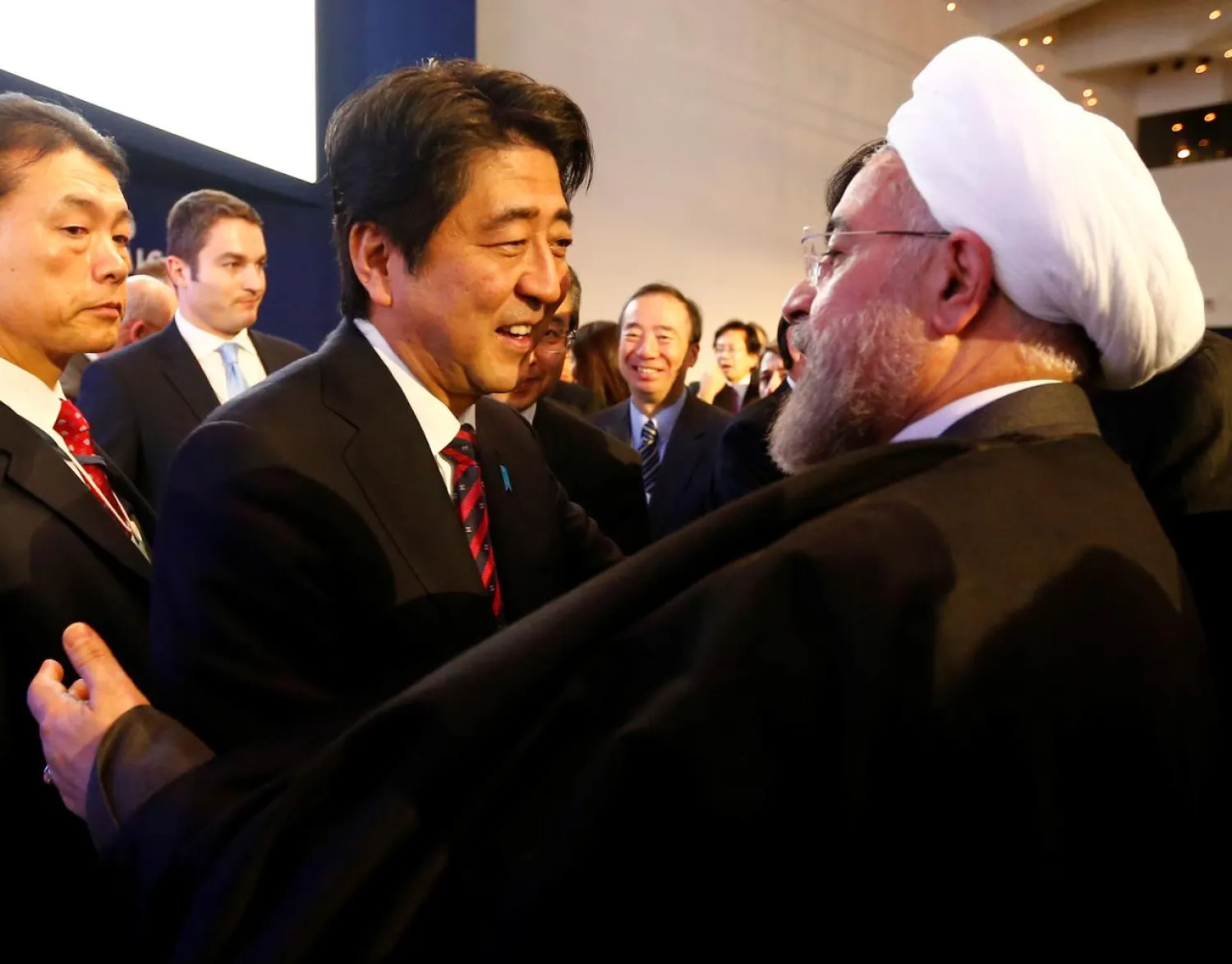
Japan's Prime Minister Shinzo Abe greets Iran's President Hassan Rouhani (R) during the annual meeting of the World Economic Forum (WEF) in Davos January 22, 2014. (File Photo: Reuters)
TT

Iran Sets Conditions for Ensuring Success of Japan’s PM Mediation

Japan's Prime Minister Shinzo Abe greets Iran's President Hassan Rouhani (R) during the annual meeting of the World Economic Forum (WEF) in Davos January 22, 2014. (File Photo: Reuters)

Iran's Supreme National Security Council determined the conditions to ensure the success of Prime Minister Shinzo Abe's scheduled visit to Tehran next Wednesday to reduce tension between Iran and the United States.

In a note on Saturday, Spokesman for the Supreme National Security Council Keivan Khosravi wrote that the upcoming visit of Abe to Iran will definitely be an important event in consolidating and developing friendly relations between the two countries in various fields.

Abe's trip to Iran will be the first visit by a Japanese prime minister in over 40 years and has become particularly important regarding intensive diplomacy between Iran and the US and tensions in the region.

“An effort to bring the US back to the Iran nuclear deal, compensating Iran for the loses it has sustained following the US withdrawal from the JCPOA and removing all transnational sanctions against the Islamic Republic could be a guarantee for the success of the upcoming visit of the Japanese Prime Minister Shinzo Abe to Tehran,” stated Khosravi.

Khosravi did not comment on reports that Japan had received positive signals from Tehran over Tokyo's mediation efforts.

A Japanese government spokesman said Thursday that Tokyo would make efforts to be useful, pointing out that Abe is set to meet with Supreme Leader Ali Khamenei and President Hasan Rouhani.

He went on to say that Japan’s approach towards legal and political norms has been approved by the international community, and has not been hampered by extreme measures.

Japanese Foreign Minister Taro Kono is likely to arrive in Iran prior to Abe’s visit and will hold meetings with his Iranian counterpart Mohammad Javad Zarif to discuss Abe's agenda, Japan’s Kyodo news agency reported.

“The best that Abe can say is to propose to Iran’s Supreme Leader to sit down with the US president without any pre-conditions,” a former Japanese diplomat told Reuters.

A former Japanese diplomat noted that Abe may be taking a risk but "I don’t think so – I don’t think Iran will treat Mr Abe badly. I don’t think Iran will let the prime minister go home empty handed."

Over the past month, Tokyo has been exchanging letters between Tehran and Washington, along with attempts from Switzerland, Oman, and Iraq.

US President Donald Trump welcomed at the end of month Abe's contribution to the Iran issue.

Japan has sent mixed messages about its position on developing relations with Iran. However, Tokyo's position in support of the nuclear deal following US withdrawal has sent messages encouraging Tehran to approach Tokyo in search of mediation.

The Iranian government had expressed its desire to expand the scope of the nuclear agreement to include other countries when the Iranian president put forward the idea of continuing the nuclear agreement without the United States.

Abe expressed his support for Iran's stay in the nuclear deal during consultations with Rouhani at the end of September on the sidelines of the UN General Assembly in New York.

Two months before the meeting, the US administration had asked Japan to stop importing Iranian oil, which accounted for 5 percent of Japan's total imports while 90 percent of its imports come from Saudi Arabia and UAE.

Iranian Foreign Ministry spokesman Abbas Mousavi indicated that additional sanctions imposed on Iran by the United States show that Washington’s offer of talks is not genuine.

Washington placed sanctions on Iran’s largest petrochemical holding group on Friday for indirectly supporting the Iranian Revolutionary Guard Corps (IRGC), a step it said aimed to dry up revenues to the elite Iranian military force but that analysts called largely symbolic, according to Reuters.

Trump said earlier this month that he would be willing to talk to Iran, and Foreign Minister Mike Pompeo said he was willing to sit at the negotiating table without preconditions.

The Iranian Foreign Ministry announced it was only necessary to wait one week until the claim of President Trump about talks with Iran were proven to be hollow.

“The US policy of maximum pressure is a defeated policy,” Mousavi said in a statement.

In recent weeks, tensions have risen between Iran and the US after Washington sent more military forces to the Middle East, including an aircraft carrier, B-52 bombers, and Patriot missiles, in a show of force against what US officials call Iranian threats to US troops and interests in the region.

State-owned ISNA news agency reported that Iran’s Defence Minister Amir Hatami noted the presence of US warships in the region on Saturday and said that Iran's enemies are afraid of conflict because of the country’s advanced offensive and defensive power.

“They are afraid of any kind of war or possible conflict with Iran,” he said, also noting that US offers of talks without preconditions are false.

"Iran's enemies, particularly the Great Satan America, and the Zionists, seize every opportunity such as explosions in a few ships in Fujairah, UAE, to level accusations against the Islamic Republic of Iran,” he concluded.



Top Trump Iran Negotiator Says Visits US Aircraft Carrier in Middle East

US Special Envoy Steve Witkoff delivers a press conference upon the signing of the declaration on deploying post-ceasefire force in Ukraine, during the so-called "Coalition of the Willing" summit, at the Elysee Palace in Paris, France, January 6, 2026. (Reuters)
TT

Top Trump Iran Negotiator Says Visits US Aircraft Carrier in Middle East

US Special Envoy Steve Witkoff delivers a press conference upon the signing of the declaration on deploying post-ceasefire force in Ukraine, during the so-called "Coalition of the Willing" summit, at the Elysee Palace in Paris, France, January 6, 2026. (Reuters)

US President Donald Trump's lead Iran negotiator Steve Witkoff on Saturday said he visited the USS Abraham Lincoln aircraft carrier currently in the Arabian Sea, with Washington and Tehran due to hold further talks soon.

"Today, Adm. Brad Cooper, Commander of US Naval Forces Central Command, Jared Kushner, and I met with the brave sailors and Marines aboard the USS Abraham Lincoln, her strike group, and Carrier Air Wing 9 who are keeping us safe and upholding President Trump's message of peace through strength," said Witkoff in a social media post.

Iranian Foreign Minister Abbas Araghchi said on Saturday he hoped talks with the United States would resume soon, while reiterating Tehran's red lines and warning against any American attack.


Israel’s Netanyahu Expected to Meet Trump in US on Wednesday and Discuss Iran

Israeli Prime Minister Benjamin Netanyahu delivers a speech during a special session to mark the 77th anniversary of the Knesset's establishment and the 60th anniversary of the dedication of the current building at the Knesset, the Israeli parliament, in Jerusalem, 02 February 2026. (EPA)
TT

Israel’s Netanyahu Expected to Meet Trump in US on Wednesday and Discuss Iran

Israeli Prime Minister Benjamin Netanyahu delivers a speech during a special session to mark the 77th anniversary of the Knesset's establishment and the 60th anniversary of the dedication of the current building at the Knesset, the Israeli parliament, in Jerusalem, 02 February 2026. (EPA)

Israeli Prime Minister Benjamin Netanyahu is expected to meet US President Donald Trump on Wednesday in Washington, where they will discuss negotiations with Iran, Netanyahu's office said on Saturday.

Iranian and US officials held indirect nuclear ‌talks in the ‌Omani capital ‌Muscat ⁠on Friday. ‌Both sides said more talks were expected to be held again soon.

A regional diplomat briefed by Tehran on the talks told Reuters Iran insisted ⁠on its "right to enrich uranium" ‌during the negotiations with ‍the US, ‍and that Tehran's missile capabilities ‍were not raised in the discussions.

Iranian officials have ruled out putting Iran's missiles - one of the largest such arsenals in the region - up ⁠for discussion, and have said Tehran wants recognition of its right to enrich uranium.

"The Prime Minister believes that any negotiations must include limiting ballistic missiles and halting support for the Iranian axis," Netanyahu's office said in a ‌statement.


Italy FM Rules Out Joining Trump’s ‘Board of Peace’

Italy's Minister for Foreign Affairs Antonio Tajani speaks to the press during the EPP Leaders’ meeting, in Zagreb, Croatia, 30 January 2026. (EPA)
TT

Italy FM Rules Out Joining Trump’s ‘Board of Peace’

Italy's Minister for Foreign Affairs Antonio Tajani speaks to the press during the EPP Leaders’ meeting, in Zagreb, Croatia, 30 January 2026. (EPA)

Italy will not take part in US President Donald Trump's "Board of Peace", Italian Foreign Minister Antonio Tajani said Saturday, citing "insurmountable" constitutional issues.

Trump launched his "Board of Peace" at the World Economic Forum in Davos in January and some 19 countries have signed its founding charter.

But Italy's constitution bars the country from joining an organization led by a single foreign leader.

Prime Minister Giorgia Meloni, a Trump ally, last month noted "constitutional problems" with joining, but suggested Trump could perhaps reopen the framework "to meet the needs not only of Italy, but also of other European countries".

Tajani appeared Saturday to rule that out.

"We cannot participate in the Board of Peace because there is a constitutional limit," he told the ANSA news agency.

"This is insurmountable from a legal standpoint," he said, the day after meeting US Secretary of State Marco Rubio and US Vice President JD Vance at the Olympics in Milan.

Although originally meant to oversee Gaza's rebuilding, the board's charter does not limit its role to the Palestinian territory and appears to want to rival the United Nations.