

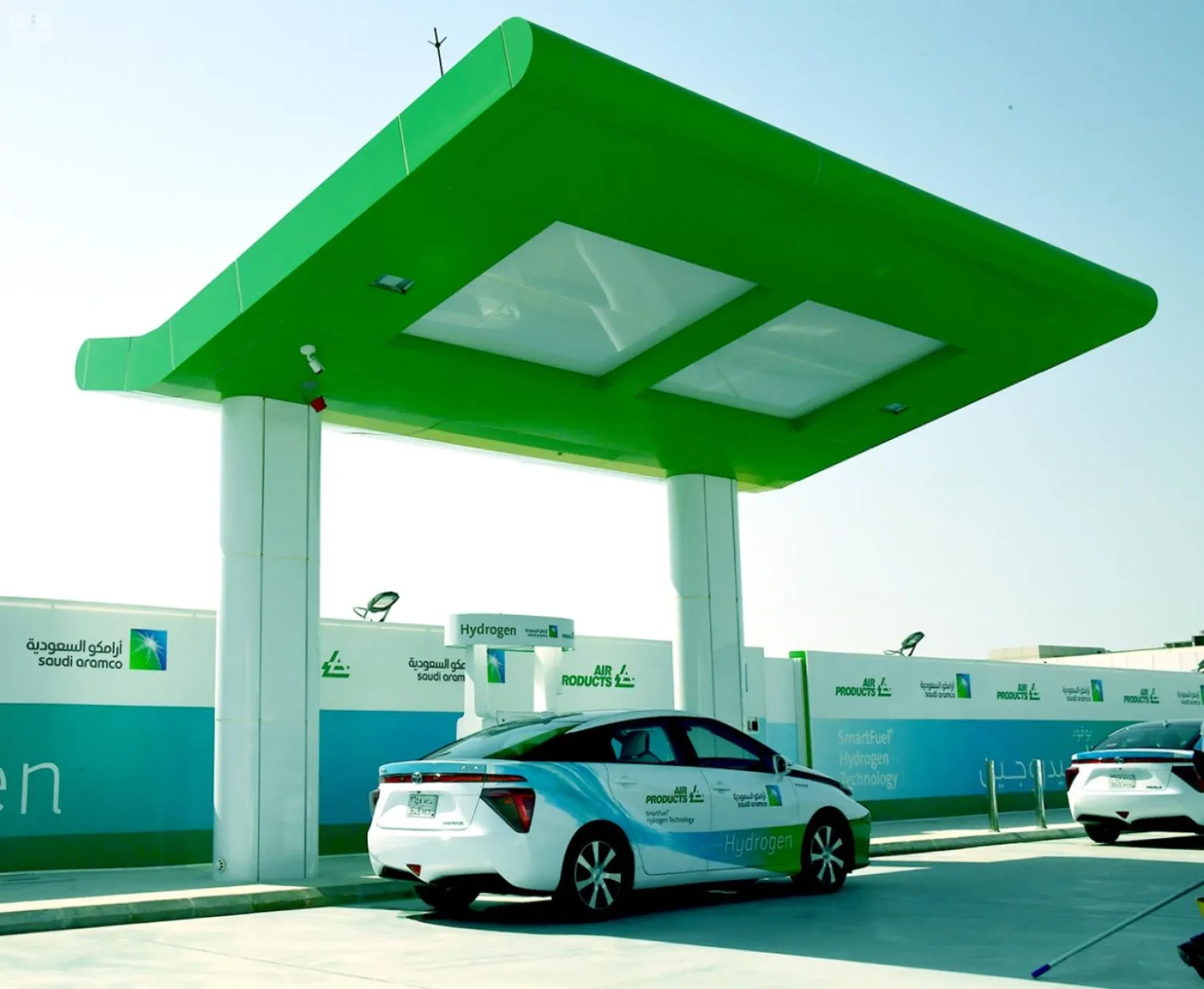

Aramco, Air Products Inaugurate Saudi Arabia’s 1st Hydrogen Fueling Station

Saudi Aramco and Air Products inaugurated the first hydrogen fueling station in Saudi Arabia. (SPA)
TT

Aramco, Air Products Inaugurate Saudi Arabia’s 1st Hydrogen Fueling Station

Saudi Aramco and Air Products inaugurated the first hydrogen fueling station in Saudi Arabia. (SPA)

Saudi Aramco and Air Products inaugurated on Tuesday the first hydrogen fueling station in Saudi Arabia at the Air Products’ new Technology Center in the Dhahran Techno Valley Science Park. The pilot station will fuel an initial fleet of six Toyota Mirai fuel cell electric vehicles with high-purity compressed hydrogen, reported the Saudi Press Agency.

The announcement comes amid growing international recognition of hydrogen’s benefits. A report released last week by the International Energy Agency (IEA) concludes that hydrogen has vast potential to help the world reduce emissions while addressing its energy needs.

“This pilot project represents an exciting opportunity for Saudi Aramco and Air Products to demonstrate the potential of hydrogen in the transport sector and its viability as a sustainable fuel for the future,” said Amin Nasser, President and Chief Executive Officer of Saudi Aramco.

“Today’s milestone is an important step in making oil-to-hydrogen a reality as Saudi Aramco continues to be focused on creating breakthrough technologies and solutions as part of our long-term efforts to reduce carbon emissions and address climate concerns.”

“It is well known that our world needs a sustainable system to address environmental challenges while also meeting growing energy demand. Hydrogen and fuel cell technologies are well positioned to be part of the solution,” said Seifi Ghasemi, Air Products’ Chairman, President and CEO.

“We are honored to collaborate with Saudi Aramco to establish and develop a sustainable, hydrocarbon-based hydrogen supply system for fuel cell vehicles in Saudi Arabia.”

The new fueling station combines Saudi Aramco’s industrial and technological experience with Air Products’ know-how and experience in the field of hydrogen fueling.

Air Products’ proprietary SmartFuel® hydrogen fueling technology will be incorporated into the new station to supply Toyota Mirai Fuel Cell Vehicles with compressed hydrogen. The data collected during the initial phase of this project will provide valuable information for the assessment of future applications of this emerging and diverse transport technology in the local environment.

It is expected that the fleet of Toyota Mirai vehicles will have a driving range of 500km with water as their only emission and the ability to be fueled in five minutes as opposed to an hour for traditional battery electric vehicles. This would demonstrate the potential of hydrogen fueled vehicles to make a significant contribution to a clean, secure and affordable energy future.



Syrian Central Bank Allows Dealings With Global Electronic Payment Companies

Key benefits include allowing Syrians entering the country to use their international bank cards domestically (X).
TT

Syrian Central Bank Allows Dealings With Global Electronic Payment Companies

Key benefits include allowing Syrians entering the country to use their international bank cards domestically (X).

The Central Bank of Syria on Monday issued a decision allowing banks and local electronic payment companies to work with global electronic payment companies such as Visa and Mastercard, in a move seen as a step toward modernizing financial infrastructure and expanding digital inclusion.

Central Bank Governor Abdulkader Husrieh said in a statement the decision marks a strategic shift toward a more advanced digital economy and will help facilitate money transfers and payment transactions for Syrians both inside the country and abroad.

He added that the move opens the door to a new phase in the development of electronic payment systems and strengthens Syria’s integration into the global financial system after years of reliance on limited, traditional tools.

Husrieh said the decision enables banks and local electronic payment providers to broaden their services with more advanced and secure payment solutions for individuals and businesses.

Key benefits include allowing Syrians entering the country to use their international bank cards domestically, enabling wider use of Syrian-issued cards abroad, expanding the adoption of electronic payments, reducing reliance on cash, improving user experience, supporting e-commerce and startups, and enhancing the security and reliability of financial transactions.

The governor added that cooperation with global electronic payment companies will help transfer expertise and modern technologies to the local market, improving the efficiency and competitiveness of the financial sector.

The central bank said it continues to implement a package of reforms aimed at rebuilding financial institutions and strengthening monetary policy tools, alongside upgrading electronic payment systems and expanding the digitalization of banking services, in a bid to restore international financial connectivity and create a more efficient and transparent environment to support economic recovery.


Gold Eases as Inflation Jitters, Iran War Cloud US Rate Outlook

AFP: A photo shows gold bangles and necklaces for sale at a gold shop at the Grand Baazar in Istanbul
TT

Gold Eases as Inflation Jitters, Iran War Cloud US Rate Outlook

AFP: A photo shows gold bangles and necklaces for sale at a gold shop at the Grand Baazar in Istanbul

Gold prices nudged lower in thin trade on Monday, weighed down by inflation worries that clouded the US monetary policy outlook, while markets awaited developments in US-Iran peace negotiations.

Spot gold was down 0.5% at $4,588.71 per ounce, as of 0655 GMT. US gold futures for June delivery fell 0.9% to $4,600.60.

Markets in China, Japan and the UK are closed for holidays.

Federal Reserve Chair Jerome Powell closed out eight years as head of the US central bank last Wednesday with interest rates on hold and rising concern about inflation, Reuters reported.

"Gold is still feeling the lingering effects of last week's hawkish Fed messaging, particularly the notable dissenting voices pushing back against further easing," said Tim Waterer, chief market analyst at KCM Trade.

Federal Reserve officials, who dissented against the policy statement last week, said the oil price shock from the Iran war means the US Fed should be clear it can no longer lean towards interest rate cuts, with a rise in borrowing costs possible in the future.

Increasing oil prices could encourage central banks to hold interest rates higher for longer, which would pressure non-yielding assets such as gold.

Oil prices eased but held above $100 a barrel, with the lack of clarity around a potential US-Iran peace deal remaining in focus.

President Donald Trump said the United States would start helping to free ships stranded in the Gulf by the US-Israeli war on Iran from Monday, as a tanker reported being hit by unknown projectiles in the Strait of Hormuz.

Iranian state media reported that Washington conveyed its response to Iran's 14-point proposal via Pakistan, and that Tehran was now reviewing it.

"We see gold largely trading in a $4,400-$5,500 range by year-end. The upper end of that range would require a durable reduction in Middle East tensions and some easing of inflation pressures, while persistent high oil prices would keep the metal toward the lower half of the range," Waterer added.

Spot silver fell 0.6% to $74.91 per ounce, platinum held steady at $1,989, and palladium was down 0.4% at $1,519.78.


Global LNG Exports Fall to Two-Year Low

Maritime tracking data indicates that global LNG shipments decreased to 33 million tons last month (X)
TT

Global LNG Exports Fall to Two-Year Low

Maritime tracking data indicates that global LNG shipments decreased to 33 million tons last month (X)

Global exports of liquefied natural gas fell to the lowest in almost two years in April, as the war in the Middle East disrupted flows of the super-chilled fuel through the Strait of Hormuz, Bloomberg reported.

Shipments declined to about 33 million tons, the lowest level since May 2024, according to ship-tracking data compiled by Bloomberg.

The drop came after Qatar — the second-largest exporter last year — halted production following strikes on the world’s biggest plant by Iran in March, with the damage set to take years to repair.

Despite the ceasefire in the war with Iran, the Strait of Hormuz, through which about one-fifth of the world's oil and LNG supplies pass, remains closed. Since the start of the conflict, only one LNG tanker has transited the strait.

Nevertheless, lost volumes have been partially offset by new production elsewhere in the world. According to ship-tracking data compiled by Bloomberg, April shipments were down only 7 percent from the previous year, suggesting that increased output from suppliers, including the United States and Canada, has partially compensated for the reduced volumes from Qatar.

In the United States, the massive Golden Pass LNG terminal shipped its first cargo last month. Qatar also delivered some volumes to Kuwait, which can export them without transiting the Strait.