


UN: Record 71 Million People Displaced by War Worldwide

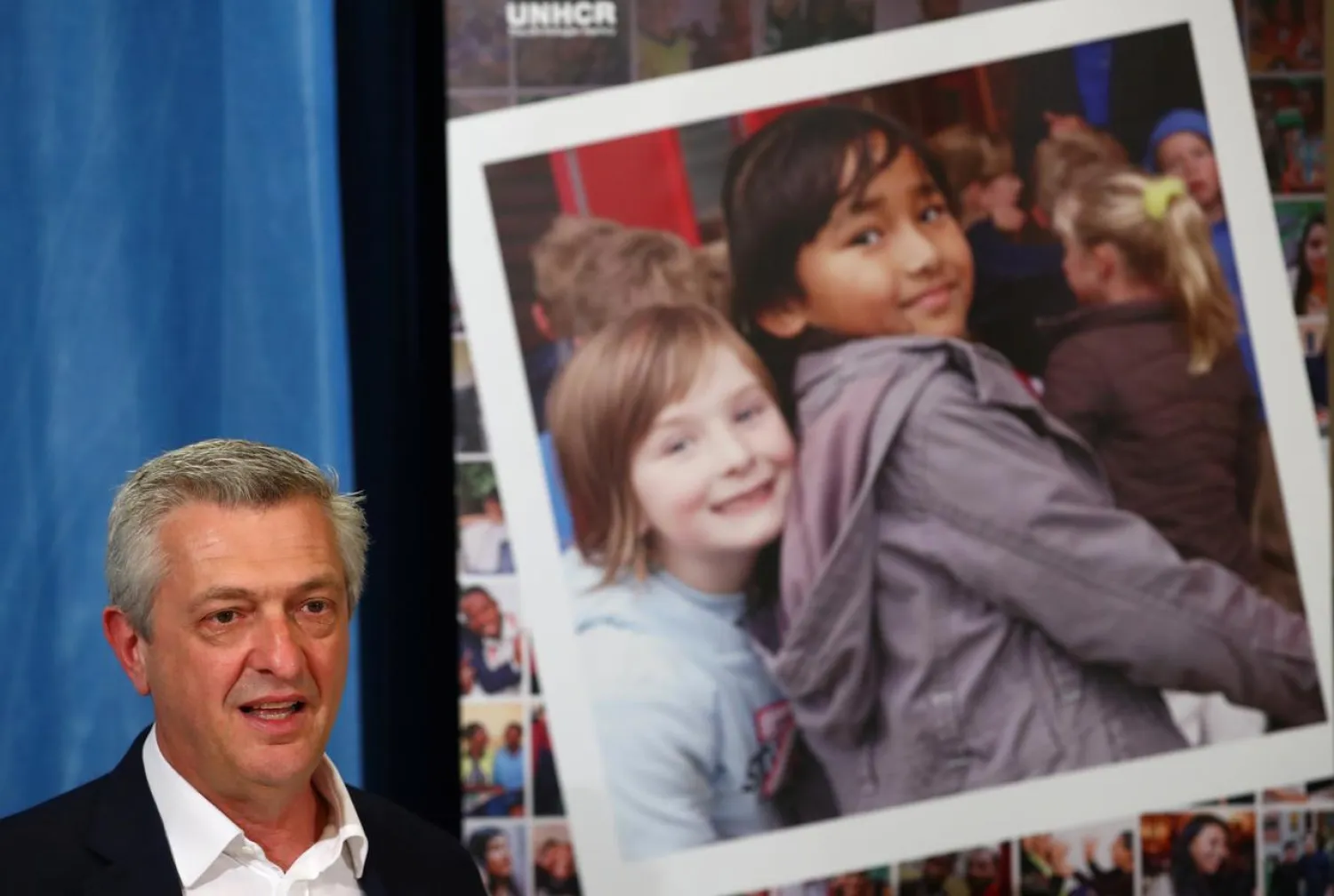
UN High Commissioner for Refugees Filippo Grandi attends a news conference on the annual Global Trends report on forced displacement at in Geneva, Switzerland, June 17, 2019. (Reuters)
TT

UN: Record 71 Million People Displaced by War Worldwide

UN High Commissioner for Refugees Filippo Grandi attends a news conference on the annual Global Trends report on forced displacement at in Geneva, Switzerland, June 17, 2019. (Reuters)

The United Nations announced on Wednesday that a record 71 million people have been displaced by war worldwide, saying developing countries, not rich Western nations, are bearing the brunt of the refugee crisis.

The figure was an increase of more than 2 million from last year and an overall total that would amount to the world's 20th most populous country, said the annual "Global Trends" report released by the UN High Commissioner for Refugees.

The agency counts the number of the world's refugees, asylum-seekers and internally displaced people at the end of 2018, in some cases following decades of living away from home.

The figures, coming on the eve of World Refugee Day on Thursday, are bound to add fuel to a debate at the intersection of international law, human rights and domestic politics, especially the movement in some countries, including the US, against immigrants and refugees.

Launching the report, the high commissioner, Filippo Grandi, had a message for US President Donald Trump and other world leaders, calling it "damaging" to depict migrants and refugees as threats to jobs and security in host countries. Often, they are fleeing insecurity and danger themselves, he said.

The report also puts a statistical skeleton onto often-poignant individual stories of people struggling to survive by crossing rivers, deserts, seas, fences and other barriers, natural and man-made, to escape government oppression, gang killings, sexual abuse, militia murders and other such violence at home.

UNHCR said 70.8 million people were forcibly displaced at the end of last year, up from about 68.5 million in 2017 — and nearly a 65 percent increase from a decade ago. Among them, nearly three in five people — or more than 41 million people — have been displaced within their home countries.

More than two-thirds of the world’s refugees come from five countries: Syria, Afghanistan, South Sudan, Myanmar and Somalia, the report said.

"The global trends, once again unfortunately, go in what I would say is the wrong direction," Grandi told reporters in Geneva. "There are new conflicts, new situations, producing refugees, adding themselves to the old ones. The old ones never get resolved."

The phenomenon is both growing in size and duration. Some four-fifths of the "displacement situations" have lasted more than five years. After eight years of war in Syria, for instance, its people continue to make up the largest population of forcibly displaced people, at some 13 million.

Amid runaway inflation and political turmoil at home, Venezuelans for the first time accounted for the largest number of new asylum-seekers in 2018, with more than 340,000 — or more than one in five worldwide last year. Asylum-seekers receive international protection as they await acceptance or rejection of their requests for refugee status.

UNHCR said that its figures are "conservative" and that Venezuela masks a potentially longer-term trend.

Some 4 million people are known to have left the South American country in recent years. Many of those have traveled freely to Peru, Colombia and Brazil, but only about one-eighth have sought formal international protection, and the outflow continues, suggesting the strains on the welcoming countries could worsen.

Grandi predicted a continued "exodus" from Venezuela and appealed for donors to provide more development assistance to the region.

"Otherwise these countries will not bear the pressure anymore and then they have to resort to measures that will damage refugees," he said. "We are in a very dangerous situation."

The United States, meanwhile, remains the "largest supporter of refugees" in the world, Grandi said in an interview. The US is the biggest single donor to UNHCR. He also credited local communities and advocacy groups in the United States for helping refugees and asylum-seekers in the country.

But the refugee agency chief noted long-term administrative shortcomings that have given the United States the world's biggest backlog of asylum claims, at nearly 719,000. More than a quarter-million claims were added last year.

He also decried recent rhetoric that has been hostile to migrants and refugees.

"In America, just like in Europe actually and in other parts of the world, what we are witnessing is an identification of refugees — but not just refugees, migrants as well — with people that come take away jobs that threaten our security, our values," Grandi said. "And I want to say to the US administration — to the president — but also to the leaders around the world: This is damaging."

“This is the crisis of solidarity that I have mentioned. It is identifying refugees and migrants with a problem instead of people that are fleeing from a problem,” he said.

He said many people leaving Honduras, Guatemala and El Salvador through Mexico have faced violence by gangs and suffered from "the inability of these governments to protect their own citizens."

The UNHCR report noted that by far, the most refugees are taken in in the developing world, not wealthy countries.

“When you say Europe has a refugee emergency, or the United States, or Australia - no. Most of the refugees are in fact in the country next to where the war is, and unfortunately that means mostly in poor countries or in middle-income countries,” Grandi said.

“That’s where the crisis is, that’s need where we need to focus,” he added.

In Europe, the issue has been heavily politicized, leaving some governments “terrified” to commit to take in people rescued at sea after fleeing Libya or other conflict zones, Grandi said.

“So the appeal I make, now that we are in a situation where European (Parliament) elections are behind us, is to stop this electoral agitation. The numbers arriving in Europe are frankly manageable,” he said.

The figures marked the seventh consecutive year in which the numbers of forcibly displaced rose.

"Yet another year, another dreadful record has been beaten," said Jon Cerezo of British charity Oxfam. "Behind these figures, people like you and me are making dangerous trips that they never wanted to make, because of threats to their safety and most basic rights."



Nigeria's President to Make a Sate Visit to the UK in March

Nigeria’s President Bola Tinubu gives a joint statement with Brazil’s President Luiz Inacio Lula da Silva, at the Planalto presidential palace, in Brasilia, Brazil, Aug. 25, 2025. (AP Photo/Eraldo Peres, File)
TT

Nigeria's President to Make a Sate Visit to the UK in March

Nigeria’s President Bola Tinubu gives a joint statement with Brazil’s President Luiz Inacio Lula da Silva, at the Planalto presidential palace, in Brasilia, Brazil, Aug. 25, 2025. (AP Photo/Eraldo Peres, File)

Nigeria’s president is set to make a state visit to the UK in March, the first such trip by a Nigerian leader in almost four decades, Britain’s Buckingham Palace said Sunday.

Officials said President Bola Tinubu and first lady Oluremi Tinubu will travel to the UK on March 18 and 19, The AP news reported.

King Charles III and Queen Camilla will host them at Windsor Castle. Full details of the visit are expected at a later date.

Charles visited Nigeria, a Commonwealth country, four times from 1990 to 2018 before he became king. He previously received Tinubu at Buckingham Palace in September 2024.m

Previous state visits by a Nigerian leader took place in 1973, 1981 and 1989.

A state visit usually starts with an official reception hosted by the king and includes a carriage procession and a state banquet.

Last year Charles hosted state visits for world leaders including US President Donald Trump, French President Emmanuel Macron and German President Frank-Walter Steinmeier.


Iran Strikes Hard Line on US Talks, Saying Tehran's Power Comes From Saying 'No'

Traffic moves through a street in Tehran on February 7, 2026. (Photo by ATTA KENARE / AFP)
TT

Iran Strikes Hard Line on US Talks, Saying Tehran's Power Comes From Saying 'No'

Traffic moves through a street in Tehran on February 7, 2026. (Photo by ATTA KENARE / AFP)

Iran's top diplomat insisted Sunday that Tehran's strength came from its ability to “say no to the great powers," striking a maximalist position just after negotiations with the United States over its nuclear program and in the wake of nationwide protests.

Foreign Minister Abbas Araghchi, speaking to diplomats at a summit in Tehran, signaled that Iran would stick to its position that it must be able to enrich uranium — a major point of contention with President Donald Trump, who bombed Iranian atomic sites in June during the 12-day Iran-Israel war.

Iran will never surrender the right to enrich uranium, even if war "is imposed on us,” he noted.

"Iran has paid a very heavy price for its peaceful nuclear program and for uranium enrichment." 

Israeli Prime Minister Benjamin Netanyahu is expected to travel to Washington this week, with Iran expected to be the major subject of discussion, his office said.

While Iranian President Masoud Pezeshkian praised the talks Friday in Oman with the Americans as “a step forward,” Araghchi's remarks show the challenge ahead. Already, the US moved the aircraft carrier USS Abraham Lincoln, ships and warplanes to the Middle East to pressure Iran into an agreement and have the firepower necessary to strike the Islamic Republic should Trump choose to do so, according to The AP news.

“I believe the secret of the Islamic Republic of Iran’s power lies in its ability to stand against bullying, domination and pressures from others," Araghchi said.

"They fear our atomic bomb, while we are not pursuing an atomic bomb. Our atomic bomb is the power to say no to the great powers. The secret of the Islamic Republic’s power is in the power to say no to the powers.”

‘Atomic bomb’ as rhetorical device Araghchi's choice to explicitly use an “atomic bomb” as a rhetorical device likely wasn't accidental. While Iran has long maintained its nuclear program is peaceful, the West and the International Atomic Energy Agency say Tehran had an organized military program to seek the bomb up until 2003.

Iran had been enriching uranium up to 60% purity, a short, technical step to weapons-grade levels of 90%, the only non-weapons state to do so. Iranian officials in recent years had also been increasingly threatening that Tehran could seek the bomb, even while its diplomats have pointed to Iranian Supreme Leader Ali Khamenei’s preachings as a binding fatwa, or religious edict, that Iran wouldn’t build one.

Pezeshkian, who ordered Araghchi to pursue talks with the Americans after likely getting Khamenei's blessing, also wrote on X on Sunday about the talks.

“The Iran-US talks, held through the follow-up efforts of friendly governments in the region, were a step forward,” the president wrote. “Dialogue has always been our strategy for peaceful resolution. ... The Iranian nation has always responded to respect with respect, but it does not tolerate the language of force.”

It remains unclear when and where, or if, there will be a second round of talks. Trump, after the talks Friday, offered few details but said: “Iran looks like they want to make a deal very badly — as they should.”

Aircraft carrier in the Arabian Sea During Friday's talks, US Navy Adm. Brad Cooper, the head of the American military's Central Command, was in Oman. Cooper's presence was apparently an intentional reminder to Iran about US military power in the region. Cooper later accompanied US special envoy Steve Witkoff and Jared Kushner, Trump's son-in-law, to the Lincoln out in the Arabian Sea after the indirect negotiations.

Araghchi appeared to be taking the threat of an American military strike seriously, as many worried Iranians have in recent weeks. He noted that after multiple rounds of talks last year, the US “attacked us in the midst of negotiations."

“If you take a step back (in negotiations), it is not clear up to where it will go,” Araghchi said.


Russia: Man Suspected of Shooting Top General Detained in Dubai

An investigator works outside a residential building where the assassination attempt on Russian Lieutenant General Vladimir Alexeyev took place in Moscow, Russia February 6, 2026. REUTERS/Anastasia Barashkova
TT

Russia: Man Suspected of Shooting Top General Detained in Dubai

An investigator works outside a residential building where the assassination attempt on Russian Lieutenant General Vladimir Alexeyev took place in Moscow, Russia February 6, 2026. REUTERS/Anastasia Barashkova

Russia's Federal Security Service (FSB) said on Sunday that the man suspected of shooting top Russian military intelligence officer Vladimir Alexeyev in Moscow has been detained in Dubai and handed over to Russia.

Lieutenant General Vladimir Alexeyev, deputy head of the GRU, ⁠Russia's military intelligence arm, was shot several times in an apartment block in Moscow on Friday, investigators said. He underwent surgery after the shooting, Russian media ⁠said.

The FSB said a Russian citizen named Lyubomir Korba was detained in Dubai on suspicion of carrying out the shooting.

Russian Foreign Minister Sergei Lavrov accused Ukraine of being behind the assassination attempt, which he said was designed to sabotage peace talks. ⁠Ukraine said it had nothing to do with the shooting.

Alexeyev's boss, Admiral Igor Kostyukov, the head of the GRU, has been leading Russia's delegation in negotiations with Ukraine in Abu Dhabi on security-related aspects of a potential peace deal.