


Russia Considers US Plan to Contain Iran in Syria

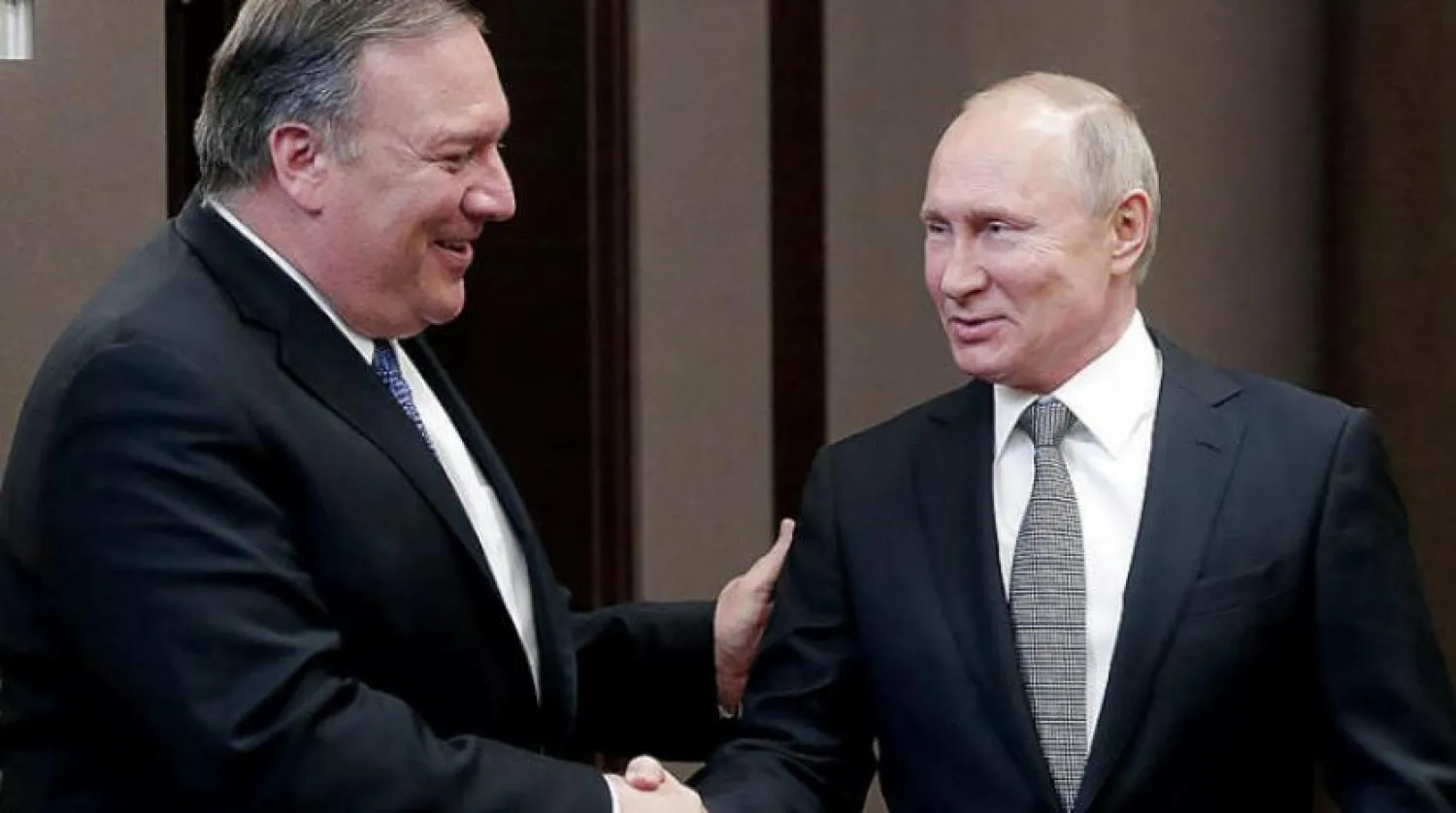
Putin during his meeting with Pompeo in Sochi in May (Getty Images)
TT

Russia Considers US Plan to Contain Iran in Syria

Putin during his meeting with Pompeo in Sochi in May (Getty Images)

Talks between Washington and Moscow continue over the US plan presented to Russia to contain Iran and to tackle principles of the Syrian settlement amid disagreement over the “sequence” of its implementation.

The plan is expected to be discussed during the high-level security meeting between US, Russia and Israel, which will be held in west Jerusalem on June 24.

According to what Asharq Al-Awsat has learned, US Secretary of State Mike Pompeo presented mid-May an eight-point plan on the implementation of resolution 2254 to reach a political solution in Syria.

This took place during his visit to Sochi, where he met President Vladimir Putin and his counterpart Sergei Lavrov in the presence of US special envoy for Syria James Jeffrey.

The plan included articles that call for cooperation in the fight against terrorism and ISIS, weakening Iranian influence, eliminating weapons of mass destruction in Syria, providing humanitarian aid, supporting neighboring countries, preparing conditions for the return of Syrian refugees and ratifying the principle of holding those who committed war crimes in Syria accountable.

Russia seemed to agree on these principles, while sources pointed to a disagreement over the “sequence of implementation,” in conjunction with European doubts over the promises made by Moscow to Washington.

Jeffrey has earlier told Asharq Al-Awsat that his country wanted a full Iranian withdrawal from Syria and would not allow Iran to “fill the void” in the northeast of the country.

Meanwhile, White House national security adviser John Bolton and his Russian counterpart Nikolai Patrushev are expected to discuss this plan before the three-party meeting.

Israeli Prime Minister Benjamin Netanyahu's visit to Moscow late March, during which he met with Russian President Vladimir Putin, has ended the tension between Russia and Israel after the latter shot down a Russian military plane near Syria's seacoast in September 2018.

Netanyahu proposed forming a “joint team to work on the withdrawal of all foreign forces from Syria.”

He also called for the continuation of “military coordination” between the two parties, leading to an agreement in which heads of the three countries’ national security councils meet in west Jerusalem.



Christmas Spirit Returns to Bethlehem after Ceasefire in Gaza

People pose for a picture in Manger Square in the West Bank city of Bethlehem, Tuesday, Dec. 16, 2025. (AP Photo/Mahmoud Illean)
TT

Christmas Spirit Returns to Bethlehem after Ceasefire in Gaza

People pose for a picture in Manger Square in the West Bank city of Bethlehem, Tuesday, Dec. 16, 2025. (AP Photo/Mahmoud Illean)

At midnight on Christmas Eve, the words of the traditional hymn “The Night of Christmas” will ring out in the tiny grotto in Bethlehem’s Church of the Nativity, built on the site where Christians believe Jesus Christ was born.

“On the night of Christmas, war is buried, On the night of Christmas, love is born,” a local choir sings each year during the midnight service. As they rehearsed ahead of this year's service, many choir members said the words echoed with deeper meaning following the ceasefire in Gaza, The AP news reported.

“It reminds us that no matter the difficulties, the darkness, there is always a light and that hope is always alive,” said Joseph Hazboun, the conductor of the lay choir made up of local Catholics.

For the past two years, as the war in Gaza dragged on, Christmas in Bethlehem has been a somber affair, without the traditional festivities and decorations and music. But this year, families are flocking again to Manger Square, signaling hope about the fragile ceasefire and providing a much-needed economic boost to Bethlehem.

On a recent visit, Manger Square was crowded and buzzing with festive lights, a Christmas market, and music shows for children.

“You can see the town come alive again,” said Zoya Thalgia, a resident of Bethlehem. “Everyone’s happy, everyone’s coming out to celebrate, no matter religion, no matter their stance, everyone is here.”

Bethlehem's economy and spirit have been strained by war Christmas and religious pilgrims have always been a prime economic engine for Bethlehem. Around 80% of the Muslim-majority city’s residents depend upon tourism-related businesses, according to the local government. During good times, their earnings ripple out to communities across the West Bank, a territory occupied by Israel since 1967 that has long struggled with poverty.

But during the Gaza war, the unemployment rate in the city jumped from 14% to 65%, Bethlehem Mayor Maher Nicola Canawati said earlier this month. And in previous years, as an act of protest, some churches created Nativity scenes with Jesus as an infant surrounded by rubble and barbed wire.

Despite the ceasefire that began in October, tensions remain high across much of the West Bank.

Israel’s military has said it is cracking down on militants in the territory and carrying out frequent raids. Attacks by Israeli settlers against Palestinians in the West Bank this year reached their highest level since the UN humanitarian office started collecting data in 2006.

The endurance of Christianity in the Holy Land Odette Al Sliby, a Bethlehem resident, has sung in choirs since she was seven years old, but she said few things compare to being able to sing in the grotto at the midnight Mass.

“It’s very holy, the place and the atmosphere and the songs and the words,” she said. Singing those songs is a message of hope, she said, and a reminder to Christians of the significance of endurance. “As Christians in the Holy Land, there is a big message of being here,” she said.

Christians account for less than 2% of the West Bank’s roughly 3 million residents, a presence that has been shrinking.

As poverty and unemployment have soared during the war, about 4,000 people have left Bethlehem in search of work, the mayor said. It’s part of a worrying trend for Christians, who are leaving the region in droves.

Hazboun said he will pray this Christmas that the Christian population of Bethlehem and of other areas in the region important to Christianity don’t shrink any further.

The return of Christmas festivities across the West Bank, including a Christmas market in Ramallah thronged with visitors, is a much-needed break for local children, said Hazboun.

While Palestinians in the West Bank are still devastated by the images coming out of Gaza, lighting the community Christmas tree in Bethlehem's Manger Square for the first time in two years earlier this month provided a boost of much-needed holiday joy.

“We continue to pray for peace. This is the land of peace, it’s the land where the Prince of Peace was born, and we continue to pray and hope that one day we all will enjoy peace,” Hazboun said.


Israeli Army Reportedly Ignored Oct. 6 Intel Warning of Hamas Attack

(FILES) This aerial view shows displaced Palestinians returning to the war-devastated Jabalia refugee camp in the northern Gaza Strip on January 19, 2025, shortly before a ceasefire deal in the war between Israel and Hamas was implemented. (Photo by Omar AL-QATTAA / AFP)
TT

Israeli Army Reportedly Ignored Oct. 6 Intel Warning of Hamas Attack

(FILES) This aerial view shows displaced Palestinians returning to the war-devastated Jabalia refugee camp in the northern Gaza Strip on January 19, 2025, shortly before a ceasefire deal in the war between Israel and Hamas was implemented. (Photo by Omar AL-QATTAA / AFP)

On October 6, 2023 - less than 24 hours before the Hamas attack that triggered the Gaza war - Israel gathered intelligence indicating the Palestinian group was planning something for the following morning, Israeli Kan public broadcaster has revealed.

The information came through an intelligence-gathering operation, conducted via drones over the Gaza Strip, focused on the Hamas guards operating in the tunnel where Israel believed hostage Avera Mengistu was being held, the report said, according to an article published in The Times of Israel on Saturday.

Mengistu, a member of Israel’s Ethiopian minority and reportedly suffering from mental illness, entered Gaza by crossing a barbed wire fence in 2014, and was then arrested and held by Hamas. He was freed as part of a ceasefire deal in February this year.

The Times of Israel quoted Kan as saying that some piece of information obtained during that drone operation, though unclear, set off a red flag, and it was passed along to the Israeli army’s Southern Command.

The broadcaster, citing “sources,” claimed that the Command dismissed the intelligence as, in all likelihood, indicative of a Hamas training exercise, rather than an imminent attack.

The October 6 operation does not appear in the Israeli army’s records, nor has it been mentioned by probes into the events leading up to and during the subsequent terror onslaught, Kan said, adding that the reason for its omission is not clear.

Kan first reported on the intelligence operation earlier this month, but initially cited a source privy to the matter who said it had brought neither an intelligence breakthrough on Mengistu nor any indication of the imminent Hamas attack, The Times of Israel said.

It added that the Kan report comes about two weeks after Israeli Chief of Staff Lt. Gen. Eyal Zamir appointed a panel of experts to investigate the military’s failed handling of intelligence reports received since 2018, which outlined Hamas’s intent to launch a wide-scale attack against Israel, a topic not included in the army’s initial probes into the October 7, 2023, onslaught.


Tetteh Accuses Libyan Stakeholders of Stalling Political Progress

Special Representative of the Secretary-General for Libya Hanna Tetteh (Getty)
TT

Tetteh Accuses Libyan Stakeholders of Stalling Political Progress

Special Representative of the Secretary-General for Libya Hanna Tetteh (Getty)

Special Representative of the Secretary-General for Libya and Head of the United Nations Support Mission in Libya Hanna Tetteh has accused Libya’s stakeholders of stalling political progress on the UN-backed roadmap intended to lead the country toward national election.

“Four months have elapsed since I first presented the Roadmap to this Council on 21 August and UNSMIL has been engaging Libyan stakeholders with regard to its implementation, which I admit has been quite challenging,” Tetteh told the Security Council in New York on Friday.

She said efforts to advance electoral preparations had failed to meet agreed timelines, despite repeated engagement with Libya’s rival political bodies.

She recalled that committees from the House of Representatives and the High Council of State had agreed in October to reconstitute the High National Elections Commission within two weeks, but “despite multiple efforts and engagements with these institutions, this did not happen.”

Tetteh said a subsequent agreement signed last November, under UN auspices, established a mechanism to select new HNEC board members, with a deadline of December 11 to finalize the process. That deadline also passed without action.

“It is my assessment that the delays are a manifestation of the lack of trust between the two institutions, their own internal divisions, and the inability to overcome their differences and agree on the way forward to resolve the current impasse,” Tetteh said.

She listed the obstacles facing the amendment of the constitutional and legal framework for elections.

Despite the setbacks, Tetteh highlighted the launch of a new UN-facilitated dialogue process held in Libya earlier this month, describing it as a key component of the roadmap.

On December 14 and 15 “UNSMIL launched the inaugural meeting of the Structured Dialogue which is one of the three core components of the Roadmap,” she said. “This is the first process of this magnitude to be held on Libyan soil.”

She said 124 participants included representatives from sovereign institutions, civil society, political parties, academia and cultural and linguistic groups, alongside other state institutions.

The dialogue aimed to define guiding principles for state-building, formulate political and legislative recommendations covering governance, economy, security, and national reconciliation.

On the economy, Tetteh said Libya's persistent financial fragmentation continues to undermine its dinar.

The UN envoy also said that the security environment in Tripoli has stabilized to a certain extent, however the situation remains fragile with sporadic outbreaks of armed clashes in southern Tripoli and elsewhere.

Tetteh commented on UN Security Council Resolution 2796 (2025) of October 31, which extended UNSMIL’s mandate for one year.

She said UNISMIL formed an internal task force to gradually implement key decisions and recommendations, due to limited resources.