

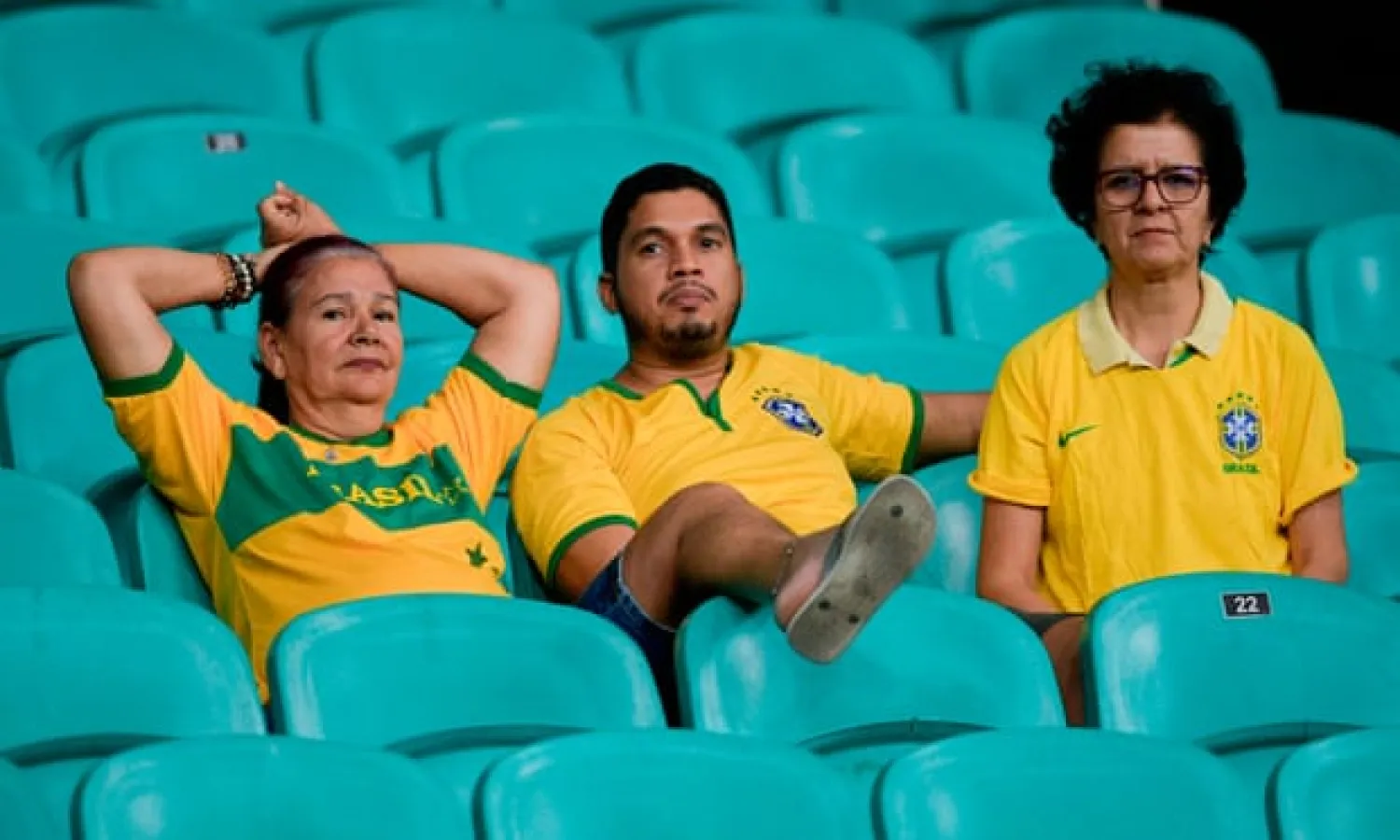

Brazilians Are Falling out of Love With Their Distant, Expensive Football Team

 Brazil fans reflect on a goalless draw with Venezuela at the Copa América. Photograph: Raúl Arboleda/AFP/Getty
Brazil fans reflect on a goalless draw with Venezuela at the Copa América. Photograph: Raúl Arboleda/AFP/Getty
TT

Brazilians Are Falling out of Love With Their Distant, Expensive Football Team

 Brazil fans reflect on a goalless draw with Venezuela at the Copa América. Photograph: Raúl Arboleda/AFP/Getty
Brazil fans reflect on a goalless draw with Venezuela at the Copa América. Photograph: Raúl Arboleda/AFP/Getty

The organisers of the Copa América insisted the opening match between Brazil and Bolivia on Friday evening would sell out the 67,000-capacity Morumbi stadium in São Paulo. It didn’t. Just 46,342 fans paid for tickets, leaving the ground just 70% full. With the game still goalless at half-time, the deafening silence turned to boos as Tite’s men trudged off the pitch. Two goals from Philippe Coutinho and a superb solo strike from Everton Soares gave Brazil a 3-0 win, but much of the debate after the game was about the crowd’s antipathy to their own team.

Manager Tite said he “expected” a negative reaction given the way his team played. “We need to understand. If we get forward and create chances they will applaud. Having been at big clubs, when you sometimes don’t produce, then don’t expect the fans to understand. They will boo. When you pass the ball along the back, from full-back to central defender to goalkeeper, the first thing you hear is boo.”

Dani Alves put the poor reception down to São Paulo’s clubismo tribalism and a lack of unity between fans of its three main teams. “Whenever we come here to Sao Paulo, that happens,” said Alves. “The people cannot separate their clubs from the Brazilian national team. In Bahia the energy is different. People miss the Brazil team, that energy the Seleção takes wherever it goes. Surely there will be more excitement than here.”

Alves was less forthcoming about the swathes of empty seats. “I don’t know if it was the price,” he pondered. His teammate, Thiago Silva, was more emphatic: “A lot of the time the ticket prices should be lower. It’s very expensive for our people. First of all, for us to create a greater spectacle, I think we need to be more sensible.”

Mauro Cezar, who covers the national team for ESPN in Brazil, agrees. “There’s a lack of sense from South American football directors when it comes down to economic reality. If you measure the Women’s World Cup against the average wage of French people, it’s completely disproportionate. The prices of tickets for the Copa are much higher. And remember we are talking about a World Cup here in comparison.”

Things hardly improved over the weekend. Just 11,107 fans paid to attend the second match of the tournament – the goalless draw between Venezuela and Peru on Saturday – leaving the Arena do Grêmio in Porto Alegre just 20% full. As Martín Fernandez pointed out in O Globo, the average attendance for the five games over the opening weekend of the tournament (25,034) is lower than six Brasileiro Série A clubs have attracted this season – and they have their own fair share of problems when it comes to attracting punters.

With tickets for the Peru v Venezuela game costing an average of R$216 (£44.30), it is little surprise so few people attended. Lance columnist Valdomiro Neto says the organisers of the tournament have shown “poor common sense” and “excessive greed”. “In a country with serious socioeconomic problems”, Neto explained to us, “it is very likely that more palatable prices would fill more spaces and make the competition capable of competing against popular forms of entertainment.”

Though the prices may not appear excessive to people outside Brazil, it is worth noting that the local currency, the real, has almost halved in value since the start of a recession in 2015. When the minimum wage pays R$1,000 a month (£205), tickets are beyond the reach of most people. Brazil games are the most expensive of all. The average cost of a ticket for the opening game was R$485 (£100), half a month’s pay to some fans.

A home Copa América could have brought together the Brazilian people and their once-cherished national team, but the extortionate prices are making that disconnect even worse. The Seleção was once a source of pride on the global stage, but it is now laden with stars who leave Brazil at such a young age that Brasileiro Série A supporters are unable to develop an affinity for them.

On top of that, most of Brazil’s fixtures, apart from World Cup qualifiers, are played in other continents. Since their exit from the World Cup last summer Brazil have played two friendlies in the US, two in Saudi Arabia, two in England, one in Portugal and one in the Czech Republic. Local fans are rarely considered.

“Nothing is being done to bring the Seleção closer to the Brazilian fan,” says Cezar. “They’re not trying and they’re not worried about that. So, those who end up going to the stadium are a concert audience. They’re financially healthy and can afford to pay R$600. Sometimes they might not even like who’s playing, but it’s something they can put on social media. Lots of people bought tickets thinking they would see Neymar.”

Despite Alves’ hope that things would be “different” in Salvador for Brazil’s match against Venezuela, the team were booed off after a lacklustre 0-0 draw. “We have to understand the supporters,” said manager Tite after the match. “They want to see goals and if I had been in the crowd I also would have wanted to boo us.”

Brazil’s next fixture – a group decider against Peru on Saturday night – will be played at the Arena Corinthians, the home of the fervently supported São Paulo club. The Gaviões da Fiel fangroup fill the north stand of the stadium every time Corinthians play, but their leader, José Cláudio Moraes, does not expect that fervent support to translate to the Seleção. “Today it’s no longer a Brazilian national team,” says Moraes. “With players playing far from here, identification with the people is difficult. There’s a select audience, an elite that participates when considering those orbiting prices.”

“I haven’t been to Brazil games for a long time. Formerly there was a bond with Corinthians supporters, when players like Rivellino, Sócrates and others represented us in the national team and we went to games. Over time, this connection has faded and it’s no longer the people’s team. I identify myself more as a Corinthiano. I’m passionate, but I also used to cheer for the national team until a few years back. Until 2006 you saw Ronaldinho, Romário, Ronaldo, Kaká and others. Nowadays I don’t even know the squad. I’m Brazilian, but currently I’m not going to support them in the stadium”

There is another factor to consider in all this. “The Copa América is the third international event in the space of five years in Brazil, meaning there is likely to be saturation,” says Neto. “São Paulo, Rio de Janeiro, Salvador, Belo Horizonte and Porto Alegre had the opportunity to receive football’s biggest in the World Cup and, to a lesser extent, in the Olympic Games. The Copa América is on a plateau below these other two tournaments. The organisation only cared about high incomes and never took into account disinterest and a lack of social sensitivity that empty seats would provoke. The damage has already been inflicted.”

If the organisers are motivated by gate receipts, they may not be too concerned about the low attendances. The opening game of the tournament brought in more than R$22.5m, a record for any game ever held in Brazil. This financial success has been trumpeted in Brazil, says Cezar, who believes the media have been complicit in the way profit has become more important than people. “There’s negligence from the press, which stands out in bold letters, with excitement, whenever million-dollar revenue rolls in from a match. You end up pushing the most common fans out of pocket. You lose people. In the long run it’s a dangerous thing.”

The Guardian Sport


Liverpool New Signing Jacquet Suffers 'Serious' Injury

Soccer Football - Ligue 1 - RC Lens v Stade Rennes - Stade Bollaert-Delelis, Lens, France - February 7, 2026  Stade Rennes' Jeremy Jacquet in action REUTERS/Benoit Tessier
Soccer Football - Ligue 1 - RC Lens v Stade Rennes - Stade Bollaert-Delelis, Lens, France - February 7, 2026 Stade Rennes' Jeremy Jacquet in action REUTERS/Benoit Tessier
TT

Liverpool New Signing Jacquet Suffers 'Serious' Injury

Soccer Football - Ligue 1 - RC Lens v Stade Rennes - Stade Bollaert-Delelis, Lens, France - February 7, 2026  Stade Rennes' Jeremy Jacquet in action REUTERS/Benoit Tessier
Soccer Football - Ligue 1 - RC Lens v Stade Rennes - Stade Bollaert-Delelis, Lens, France - February 7, 2026 Stade Rennes' Jeremy Jacquet in action REUTERS/Benoit Tessier

Liverpool's new signing Jeremy Jacquet suffered a "serious" shoulder injury while playing for Rennes in their 3-1 Ligue 1 defeat at RC Lens on Saturday, casting doubt over the defender’s availability ahead of his summer move to Anfield.

Jacquet fell awkwardly in the second half of the ⁠French league match and appeared in agony as he left the pitch.

"For Jeremy, it's his shoulder, and for Abdelhamid (Ait Boudlal, another Rennes player injured in the ⁠same match) it's muscular," Rennes head coach Habib Beye told reporters after the match.

"We'll have time to see, but it's definitely quite serious for both of them."
Liverpool agreed a 60-million-pound ($80-million) deal for Jacquet on Monday, but the 20-year-old defender will stay with ⁠the French club until the end of the season.

Liverpool, provisionally sixth in the Premier League table, will face Manchester City on Sunday with four defenders - Giovanni Leoni, Joe Gomez, Jeremie Frimpong and Conor Bradley - sidelined due to injuries.


Højlund Rescues Napoli with Dramatic 3-2 win Over Genoa in Serie A

Napoli's Rasmus Winther Hojlund celebrates with his teammates after scoring a goal  during the Italian Serie A soccer match between Genoa Cfc and Ssc Napoli at the Luigi Ferraris stadium in Genoa, Italy, 07 February 2026.  EPA/LUCA ZENNARO
Napoli's Rasmus Winther Hojlund celebrates with his teammates after scoring a goal during the Italian Serie A soccer match between Genoa Cfc and Ssc Napoli at the Luigi Ferraris stadium in Genoa, Italy, 07 February 2026. EPA/LUCA ZENNARO
TT

Højlund Rescues Napoli with Dramatic 3-2 win Over Genoa in Serie A

Napoli's Rasmus Winther Hojlund celebrates with his teammates after scoring a goal  during the Italian Serie A soccer match between Genoa Cfc and Ssc Napoli at the Luigi Ferraris stadium in Genoa, Italy, 07 February 2026.  EPA/LUCA ZENNARO
Napoli's Rasmus Winther Hojlund celebrates with his teammates after scoring a goal during the Italian Serie A soccer match between Genoa Cfc and Ssc Napoli at the Luigi Ferraris stadium in Genoa, Italy, 07 February 2026. EPA/LUCA ZENNARO

Rasmus Højlund scored a last-gasp penalty as 10-man Napoli won 3-2 at Genoa in Serie A on Saturday, keeping pressure on the top two clubs from Milan.

Højlund was fortunate Genoa goalkeeper Justin Bijlow was unable to keep out his low shot, despite getting his arm to the ball in the fifth minute of stoppage time.

The spot kick was awarded after Maxwel Cornet – who had just gone on as a substitute – was adjudged after a VAR check to have kicked Antonio Vergara’s foot after the Napoli midfielder dropped dramatically to the floor.

Højlund’s second goal of the game moved Napoli one point behind AC Milan and six behind Inter Milan. They both have a game in hand.

“We showed that we’re a team that never gives up, even in difficult situations, in emergencies, and despite being outnumbered, we had the determination to win. I’m proud of my players’ attitude, and I thank them and congratulate them because the victory was deserved,” Napoli coach Antonio Conte said, according to The Associated Press.

His team got off to a bad start with goalkeeper Alex Meret bringing down Vitinha after a botched back pass from Alessandro Buongiorno just seconds into the game. A VAR check confirmed the penalty and Ruslan Malinovskyi duly scored from the spot in the second minute.

Scott McTominay was involved in both goals as Napoli replied with a quickfire double. Bijlow saved his first effort in the 20th but Højlund tucked away the rebound, and McTominay let fly from around 20 meters to make it 2-1 a minute later.

However, McTominay had to go off at the break with what looked like a muscular injury, and another mistake from Buongiorno allowed Lorenzo Colombo to score in the 57th for Genoa.

“Scott has a gluteal problem that he’s had since the season started. It gets inflamed sometimes," Conte said of McTominay. "He would have liked to continue, but I preferred not for him to take any risks because he’s a key player for us.”

Napoli center back Juan Jesus was sent off in the 76th after receiving a second yellow card for pulling back Genoa substitute Caleb Ekuban.

Genoa pushed for a winner but it was the visitors who celebrated after a dramatic finale.

"The penalty wasn’t perfect. I was also lucky, but what matters is that we won,” Højlund said.

Fiorentina rues missed opportunity Fiorentina was on course to escape the relegation zone until Torino defender Guillermo Maripán scored deep in stoppage time for a 2-2 draw in the late game.

Fiorentina had come from behind after Cesare Casadei’s early goal for the visitors, with Manor Solomon and Moise Kean both scoring early in the second half.

A 2-1 win would have lifted Fiorentina out of the relegation zone, but Maripán equalized in the 94th minute with a header inside the far post after a free kick for what seemed like a defeat for the home team.

Fiorentina had lost its previous three games, including to Como in the Italian Cup.

Earlier, Juventus announced star player Kenan Yildiz's contract extension through June 2030.


Juventus Ties Down Star Player Kenan Yildiz Until 2030

Turkish player Kenan Yildiz (Reuters)
TT

Juventus Ties Down Star Player Kenan Yildiz Until 2030

Turkish player Kenan Yildiz (Reuters)

Türkiye midfielder Kenan Yildiz has extended his contract with Juventus through June 2030, the Italian club announced Saturday.

The 20-year-old Yildiz scored on his debut against Frosinone in December 2023. He has since inherited the club’s No. 10 jersey and last year became the youngest player to captain the team.

Altogether Yildiz has scored 25 goals and also set up 19 in 115 appearances over two and half seasons with Juventus. This season he has eight goals and five assists in Serie A.

“Kenan embodies leadership, sacrifice and the constant pursuit of improvement. He is the personification of Juventus’ values, and he carries them onto the pitch in every game he plays,” The Associated Press quoted the club as saying.

Media reports suggested the new deal made Yildiz the best-paid player in the squad.

The German-born Yildiz switched to Juventus Under-19s from Bayern Munich’s youth setup in 2022.
