


Sven-Göran Eriksson: I Should Have Taken a Mental Coach to 2006 World Cup

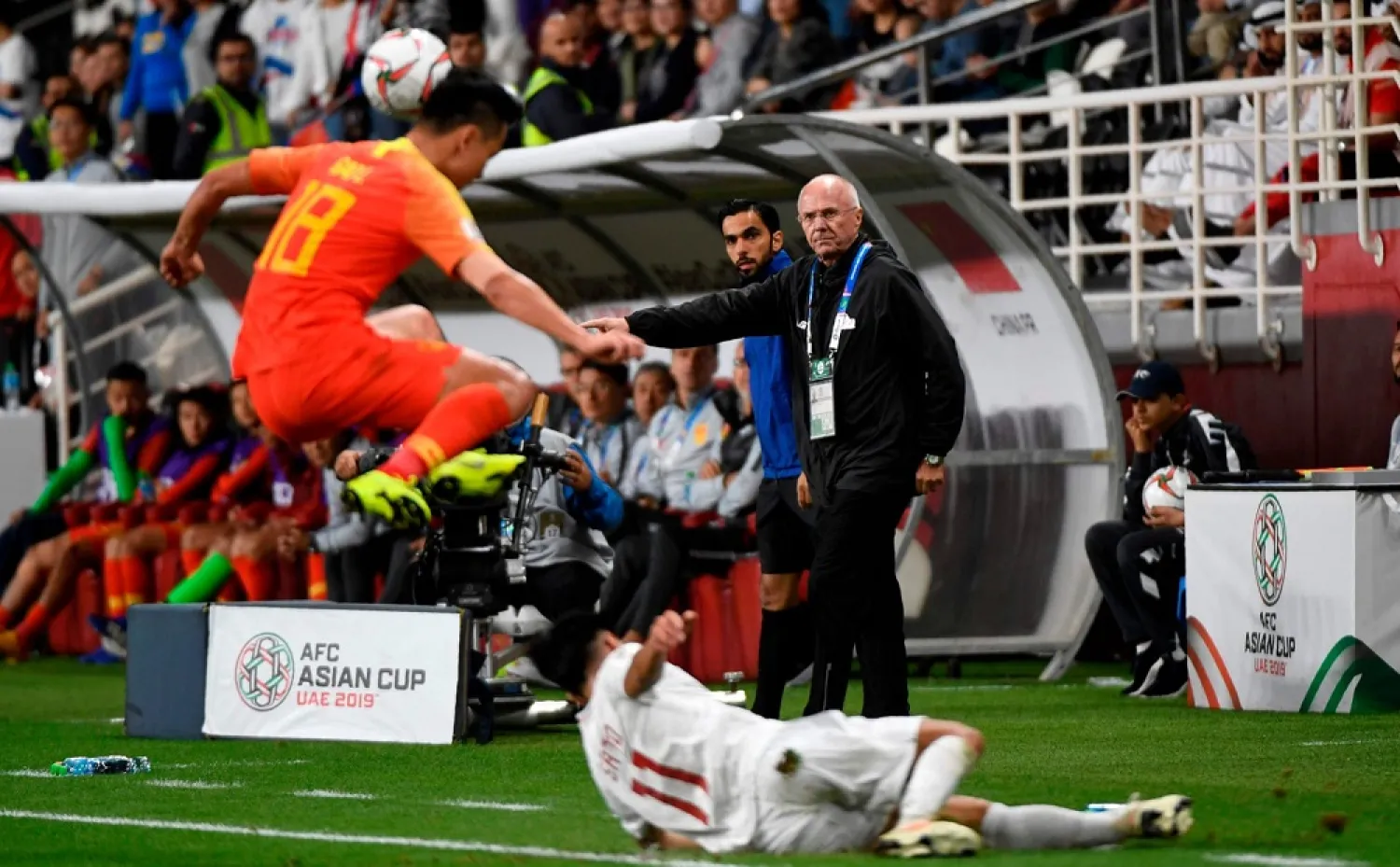
Sven-Göran Eriksson points the way during the Philippines 3-0 defeat by China at the Asian Cup. (Getty Images)
TT

Sven-Göran Eriksson: I Should Have Taken a Mental Coach to 2006 World Cup

Sven-Göran Eriksson points the way during the Philippines 3-0 defeat by China at the Asian Cup. (Getty Images)

Sven-Göran Eriksson doesn’t really do regrets. The Swede has had an extraordinary career – and it is still going – having managed 16 teams in eight different countries but, he says on a sunny day in Abu Dhabi, there are not many things he would have done differently over the past 42 years.

Not a single one? “Well … Maybe one then … and that would be that last World Cup.”

In 2006 England travelled to the World Cup in Germany with a squad including Steven Gerrard, David Beckham, Rio Ferdinand, John Terry, Wayne Rooney and Michael Owen. They progressed through the group and beat Ecuador in the last 16 to set up a quarter-final meeting with Portugal.

In Gelsenkirchen, after 120 minutes and no goals, no Beckham (injured) and no Rooney (sent off), England scored just one spot-kick to lose 3-1 and exit a major tournament at the quarter-final stage under Eriksson for a third time in four years. Gerrard, Frank Lampard and Jamie Carragher all missed and Eriksson says now: “I should have taken a mental coach for the penalty shootout. I thought we were experienced enough and we had players who were specialists in penalties.” He shakes his head, smiling, and then adds: “It is history now.”

He still follows England and there was no jealousy of Gareth Southgate and his players as they reached the World Cup semi-finals in Russia. Rather the contrary. “I was very happy for them. They did well but they also had a good squad – young, hungry players. And when you see them play for Tottenham and [Manchester] United, they are playing great football and are confident. They also have one very important thing – pace – and so they are very dangerous on the counterattack.”

Eriksson also notes that these players then go back to their clubs and are coached by some of the best tacticians in the world. That, too, makes a difference. “When I was in Italy in the 90s, early 2000s, everybody wanted to go to Italy, all the players. Today they want to go to the Premier League and it is the same with coaches.”

And that includes Pep Guardiola at Manchester City. Eriksson, sandwiched in the club’s managerial roll-call between Stuart Pearce and Mark Hughes, left the then City of Manchester Stadium in June 2008, almost a year after joining and just two months before the Abu Dhabi United Group took over. Again, there is no jealously at the hundreds of millions that have left this sprawling city to fund Manchester City’s rise.

“It would have been great, no? I was there just a little too early,” he says with that familiar smile. He is a fan. “They are great and I think they will be a great, great club for years to come.”

After stints in China and now southeast Asia, Eriksson is well-placed to see whether City can rival the other Manchester team in terms of popularity in the world’s biggest continent where the sight of light blue shirts is still rare. “They can, but it will take some time because you know that, in Asia, United and Liverpool are huge with the history.” But there are signs of change. “I think that the young generation are looking at Manchester City, not Manchester United.”

City are leading the way on the field and managers such as Guardiola ensure that, even at 70, Eriksson has to work to stay abreast of modern trends and methods.

“If you want to keep up with the changes, then you have to watch as much football as you can. Live is the best way but also on television. All the best teams: Barcelona, Real Madrid, Bayern Munich and now City. What are they doing? If possible, go and see them training. You can always learn. You will never be fully learned in this job.”

The ability to adapt is key even for a man who started at Degerfors in 1977. “Back then in Sweden it was 4-4-2 all the way, it was the bible. If it was 1-0 with three minutes to go and I take out a striker then I put in another one, 4-4-2 all the time.” Now, he says, he is much more flexible. “Over time I realized that the most important thing is not the system but the players you have. Then you make a system for them.”

But studying the game is not a chore. “I love football. I don’t use drugs but football is my drug. I had one year off before this job so I took care of my local team in the fifth division in Sweden and we went up to the fourth. I helped them with players too. It was great.”

Eriksson denies that money is the main motivation despite the fact that, due to the actions of a former financial adviser, the coach lost millions in the previous decade. “I am not here for the money, I don’t need to work if I don’t want to.”

He was appointed on a three-month contract in October, replacing Terry Butcher who resigned in August after 50 days in the job and no games. “I wasn’t looking for a job. I had just said no to Cameroon and Iraq. I thought it wouldn’t hurt to go and see the Philippines.”

He immediately felt comfortable. “I liked the players and I liked the people. I am here for three months, the weather is nice and it is cold in Sweden from November to January. Also, the Asian Cup is a high level.”

The Philippines may have the friendliest football scene in Asia but crowds at home are small. “There is a huge difference and not just with the interest and pressure. Behind the scenes with England, the organization and the rest, everything is perfect and was perfect even in my time.”

Instead of the Three Lions, the Philippines have the three B’s – billiards, boxing and basketball – with football sometimes struggling for attention in the former American colony. “It is not a football country but the generation of players they have are good and had their football education in Europe: England, Spain and Germany. If things can change a little bit to make football more popular in the country then now is the time.”

And when his time here ends? Well, it is more likely that he will stay east than go back to England, if the offer was to come. “It will not come. They are looking at age. Asia is better. They are looking for grey hair.”

The Guardian Sport


Salah Steers Egypt into Africa Cup Knockout Stages After VAR Denies South Africa Late Penalty

 Egypt's forward #10 Mohamed Salah shoots from the penalty spot to score the team's first goal during the Africa Cup of Nations (CAN) Group B football match between Egypt and South Africa at Adrar Stadium in Agadir on December 26, 2025. (AFP)
Egypt's forward #10 Mohamed Salah shoots from the penalty spot to score the team's first goal during the Africa Cup of Nations (CAN) Group B football match between Egypt and South Africa at Adrar Stadium in Agadir on December 26, 2025. (AFP)
TT

Salah Steers Egypt into Africa Cup Knockout Stages After VAR Denies South Africa Late Penalty

 Egypt's forward #10 Mohamed Salah shoots from the penalty spot to score the team's first goal during the Africa Cup of Nations (CAN) Group B football match between Egypt and South Africa at Adrar Stadium in Agadir on December 26, 2025. (AFP)
Egypt's forward #10 Mohamed Salah shoots from the penalty spot to score the team's first goal during the Africa Cup of Nations (CAN) Group B football match between Egypt and South Africa at Adrar Stadium in Agadir on December 26, 2025. (AFP)

Mohamed Salah scored again on Friday as Egypt's 10 men held on to beat South Africa 1-0 to reach the knockout stages of the Africa Cup of Nations.

Salah, who secured the Pharaohs’ opening win with a stoppage-time strike against Zimbabwe on Monday, did it again in Agadir and his penalty before the break secured progression from Group B.

But South Africa should arguably have been given a penalty in stoppage time when Yasser Ibrahim blocked a shot with his arm. After a long delay, the referee decided against awarding the spot kick after consulting video replays and Ibrahim sank to the ground in relief.

“We didn’t have much luck. We also had several refereeing decisions go against us,” South Africa coach Hugo Broos said.

Salah converted his penalty after he was struck in the face by the hand of the retreating South Africa forward Lyle Foster. Salah showed no ill effects from the blow and sent his shot straight down the middle while goalkeeper Ronwen Williams dived to his right.

There was still time before the break for Egypt defender Mohamed Hany to get sent off, after receiving a second yellow card for a foul on Teboho Mokoena.

Goalkeeper Mohamed El Shenawy was Egypt’s key player in the second half.

“We gave our all in this match right until the end, and we also hope for the best for what comes next,” the 37-year-old El Shenawy said.

Earlier, Angola and Zimbabwe drew 1-1 in the other group game, a result that suited neither side after opening losses.

Egypt leads with 6 points from two games followed by South Africa on 3. Angola and Zimbabwe have a point each. The top two progress from each group, along with the best third-place finishers.

Zambia drew 1-1 with Comoros in the early Group A fixture after both lost their opening games, meaning the winner of the late match could be sure of progressing.


Draper to Miss Australian Open Due to Injury

 Jack Draper, of Great Britain, reacts after defeating Federico Agustin Gomez, of Argentina, during the first round of the US Open tennis championships, Aug. 25, 2025, in New York. (AP)
Jack Draper, of Great Britain, reacts after defeating Federico Agustin Gomez, of Argentina, during the first round of the US Open tennis championships, Aug. 25, 2025, in New York. (AP)
TT

Draper to Miss Australian Open Due to Injury

 Jack Draper, of Great Britain, reacts after defeating Federico Agustin Gomez, of Argentina, during the first round of the US Open tennis championships, Aug. 25, 2025, in New York. (AP)
Jack Draper, of Great Britain, reacts after defeating Federico Agustin Gomez, of Argentina, during the first round of the US Open tennis championships, Aug. 25, 2025, in New York. (AP)

Briton Jack Draper said on Friday he will not compete in next month's Australian Open, citing ongoing recovery from an injury.

Draper, 10th in the world rankings, was forced to withdraw from the second round of ‌the US Open ‌in August ‌due ⁠to bone ‌bruising in his left arm.

"Unfortunately, me and my team have decided not to head out to Australia this year. It's a really, ⁠really tough decision," the British ‌number one said in ‍a video ‍posted on X.

The 24-year-old ‍is targeting a February return alongside preparation for the defense of his Indian Wells title in March.

"This injury has been the most difficult ⁠and complex of my career," Draper added. "It's weird, it always seems to make me more resilient. I'm looking forward to getting back out there in 2026 and competing."

The Australian Open begins on January 18 in ‌Melbourne.


Morocco Forced to Wait for AFCON Knockout Place After Mali Draw

Football - CAF Africa Cup of Nations - Morocco 2025 - Group A - Morocco v Mali - Prince Moulay Abdellah Stadium, Rabat, Morocco - December 26, 2025 Morocco's Ismael Saibari reacts after Mali's Lassine Sinayoko scored their first goal. (Reuters)
TT

Morocco Forced to Wait for AFCON Knockout Place After Mali Draw

Football - CAF Africa Cup of Nations - Morocco 2025 - Group A - Morocco v Mali - Prince Moulay Abdellah Stadium, Rabat, Morocco - December 26, 2025 Morocco's Ismael Saibari reacts after Mali's Lassine Sinayoko scored their first goal. (Reuters)

Morocco missed the chance to guarantee their spot in the last 16 of the Africa Cup of Nations after Lassine Sinayoko's second-half penalty earned Mali a 1-1 draw with the hosts on Friday.

The match was a tale of two spot-kicks, with Brahim Diaz giving Morocco the lead from a penalty deep in first-half injury time and Sinayoko replying on 64 minutes.

The stalemate at the Prince Moulay Abdellah Stadium in the capital Rabat ended Morocco's world record winning run which had been taken to 19 matches with their 2-0 victory over Comoros in the tournament's opening game.

It also means Morocco have not yet confirmed their place in the knockout phase, although they are on top of Group A with four points from two games.

Mali come next on two points alongside Zambia, who drew 0-0 with minnows Comoros earlier in Casablanca.

Morocco next face Zambia on Monday and a victory in that match against the 2012 champions will ensure that the hosts go through as group winners.

"We'll look back at the second half and see what the problem was but we didn't play the way we did in the first half. We didn't impose our game and had to drop off. The penalty changed the game a bit," Morocco midfielder Azzedine Ounahi told broadcaster beIN Sports.

"We go into the third game with the same approach, to win the game and finish top of the group."

Morocco captain Achraf Hakimi, the African player of the year, was again an unused substitute as he continues his recovery from an ankle injury suffered playing for Paris Saint-Germain at the start of November.

- Mbappe watches on -

His former PSG teammate Kylian Mbappe, the current Real Madrid superstar and France skipper, was among the spectators in the crowd of 63,844 and appeared to be wearing a Morocco shirt with Hakimi's number two on it.

With Hakimi on the sidelines, Mbappe's Real Madrid teammate Diaz was the main attraction on the pitch -- the little number 10 forced a good save from Mali goalkeeper Djigui Diarra on 17 minutes and then played a key part in the penalty which led to the opening goal just before the interval.

Mali defender Nathan Gassama brushed the ball with his hand as he tried to stop Diaz dribbling past him inside the box, and the referee eventually awarded a spot-kick following a lengthy look at the pitchside VAR monitor.

Morocco's Soufiane Rahimi had a spot-kick saved against Comoros but this time Diaz sent the goalkeeper the wrong way for his second goal of the tournament.

However, Walid Regragui's side, the best team in Africa according to the FIFA rankings, could not build on that as Mali won a penalty of their own just after the hour mark.

Sinayoko went down under a clumsy challenge by Jawad El Yamiq and 29-year-old Cameroonian referee Abdoul Abdel Mefire awarded the penalty after eventually being called over to check his screen.

Auxerre striker Sinayoko, having been booked apparently for something he said to the referee, kept his cool to stroke in the reward and restore parity.

Morocco substitute Youssef En-Nesyri was denied by a good Diarra save and Mali then held on through 10 minutes of stoppage time for a point, as the final whistle was greeted with jeers from the home fans.
