


From Hot Sauce to Pop Gloss, US Products Seep Into Iran

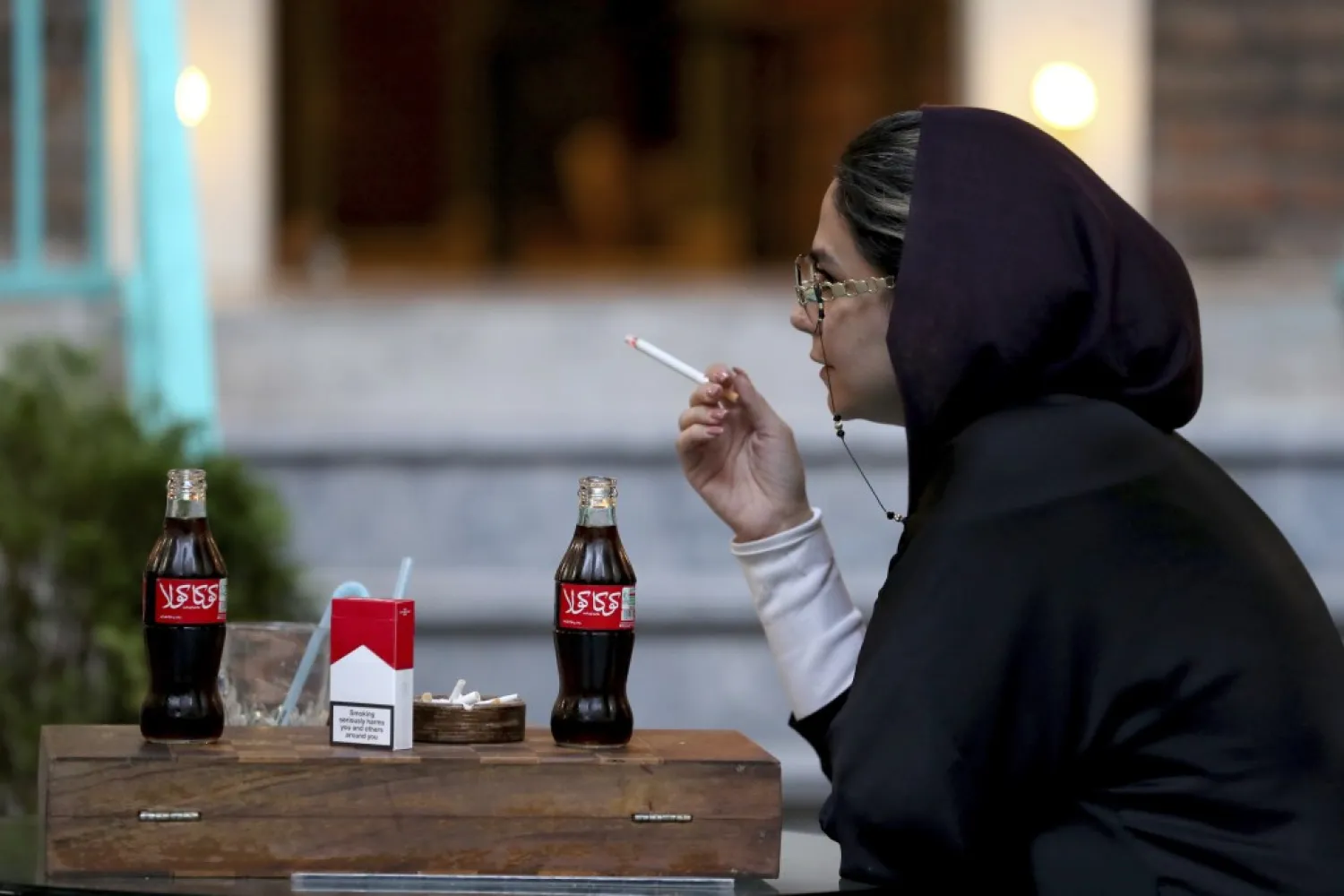
An Iranian smokes a Marlboro cigarette while two Coca-Cola stand on her table at a cafe in downtown Tehran, Iran, Wednesday, July 10, 2019. (AP Photo/Ebrahim Noroozi)
TT

From Hot Sauce to Pop Gloss, US Products Seep Into Iran

An Iranian smokes a Marlboro cigarette while two Coca-Cola stand on her table at a cafe in downtown Tehran, Iran, Wednesday, July 10, 2019. (AP Photo/Ebrahim Noroozi)

At a trendy restaurant in Iran's capital, customers sip Coca-Cola through bending straws as waiters bring caddies to their tables full of Heinz ketchup and two types of Tabasco sauce.

Welcome to dining in the Islamic Republic, brought to you by America.

Whether at upscale restaurants or corner stores, American brands like Coca-Cola and Pepsi can be seen throughout Iran despite the heightened tensions between the two countries.

US sanctions have taken a heavy toll on oil and other major industries in the country of 80 million people, but Western food, movies, music, and clothing are still widely available. And 40 years after the Islamic Revolution and the takeover of the US Embassy, despite billboards and rallies declaring "Death to America," Iranians - particularly the young - embrace US products.

"The American lifestyle is very attractive," said Ahmad Rezaee, a 21-year-old student at Tehran University who drained two bottles of Coke while out with a friend. Coca-Cola "portrays that lifestyle for us."

Tensions have soared following the Trump administration's decision last year to withdraw from Iran's 2015 nuclear agreement with world powers and restore sanctions. In recent weeks Iran has begun openly breaching limits set by the accord, saying it cannot abide by the deal unless other signatories provide economic relief.

Despite that, drinking a "Coca" or a Pepsi after eating kebab in Iran comes as second nature, though the soft drinks don't taste quite as syrupy or sweet as their American counterparts. Both brands are bottled by local firms, Khoshgovar Mashhad Co. for Coca-Cola and Sasan Co. and Neysun Shargh Co. for Pepsi, which are affiliated with the Imam Reza Foundation, an economic conglomerate tied to the country's Shiite theocracy.

Coca-Cola held a 28% market share in Iran, according to a 2016 report by research firm Euromonitor International, while Pepsi had around 20%.

Asked about Coca-Cola sales in Iran, the Atlanta-based company said it had sold concentrate to Iran for over 20 years in line with US sanctions policies.

"The authorizations are very restrictive in nature," Coca-Cola said. "The company does not have any ownership interest in the Iran bottler and does not have any tangible assets in Iran."

Pepsi did not respond to requests for comment. Pittsburgh-based Kraft Heinz Co. said that "like many Western companies, a few of our products are made available via a local Iranian distributor." The McIlhenny Co. of Avery Island, Louisiana, the maker of Tabasco, said it "expressly prohibits its distributors from reselling Tabasco brand products in Iran."

"Unfortunately, as is the case with all manufacturers, McIlhenny Co. has only a limited ability to stop illegal third-party distribution networks from secretly diverting our products to Iran and often must rely on US agencies and law enforcement to identify front companies and individuals engaged in sanctions evasion," CEO Harold Osborn told The Associated Press in a statement.

At V Café near Tehran University, diners drank Coca-Colas and lathered their food with American condiments as videos played on a giant screen of travel destinations from around the world. Rezaee and a friend, Sima Najafzadeh, a 21-year-old fellow student, each drank Cokes, saying they enjoyed the taste. They also would like to see more iPhones, McDonald's restaurants and other trappings of Americana.

"We love Americans," Najafzadeh said.

That goes for American films as well. Rezaee acknowledged having to find a pirated copy of "Avengers: Endgame" online as it never played in Iran. Others without a strong internet connection can find recently released films like "John Wick: Chapter 3 - Parabellum" for under 40 cents apiece on Tehran's busy Enghelab Street, where hawkers also sell portraits of a young Al Pacino. Western pop and rock music seeps out of the occasional passing car.

Iranian state television channels even air older American movies dubbed in Farsi. The 2000 Dennis Quaid film "Frequency" was on one recent night.

At the city's Grand Bazaar, the capital's beating heart, a beach towel showing Mickey Mouse with a surfboard in "So Cal" - southern California - hung on one rafter. Stacks of blue jeans were also on offer, but American brands like Levi Strauss have largely disappeared in recent months as Iran's currency has plummeted.

That's been a boon for the Par Group, a local jean manufacturer that produces some 3 million square meters of jeans a month from locally sourced and foreign material. Sales associates at their shop in the bazaar acknowledged the product's roots in American cowboy culture but said jeans remain popular on the streets of Tehran.

"All over the world, people want jeans," said Amin Moradi, a salesman at the shop. "Iranians are very fashionable."

At Tehran's massive Iran Mall, a store called TOMSon sells what appears to be the eponymous slip-on Toms shoes. The firm did not respond to requests for comment.

Of all the American imports, the most unlikely might be the Tehran Research Reactor, a nuclear gift from America that arrived in 1967 as part of its "Atoms for Peace" program, and which still runs today.



Russia: Man Suspected of Shooting Top General Detained in Dubai

An investigator works outside a residential building where the assassination attempt on Russian Lieutenant General Vladimir Alexeyev took place in Moscow, Russia February 6, 2026. REUTERS/Anastasia Barashkova
TT

Russia: Man Suspected of Shooting Top General Detained in Dubai

An investigator works outside a residential building where the assassination attempt on Russian Lieutenant General Vladimir Alexeyev took place in Moscow, Russia February 6, 2026. REUTERS/Anastasia Barashkova

Russia's Federal Security Service (FSB) said on Sunday that the man suspected of shooting top Russian military intelligence officer Vladimir Alexeyev in Moscow has been detained in Dubai and handed over to Russia.

Lieutenant General Vladimir Alexeyev, deputy head of the GRU, ⁠Russia's military intelligence arm, was shot several times in an apartment block in Moscow on Friday, investigators said. He underwent surgery after the shooting, Russian media ⁠said.

The FSB said a Russian citizen named Lyubomir Korba was detained in Dubai on suspicion of carrying out the shooting.

Russian Foreign Minister Sergei Lavrov accused Ukraine of being behind the assassination attempt, which he said was designed to sabotage peace talks. ⁠Ukraine said it had nothing to do with the shooting.

Alexeyev's boss, Admiral Igor Kostyukov, the head of the GRU, has been leading Russia's delegation in negotiations with Ukraine in Abu Dhabi on security-related aspects of a potential peace deal.


Factory Explosion Kills 8 in Northern China

Employees work on an electric vehicle (EV) production line at the Volkswagen Anhui factory in Hefei, Anhui province, China, February 4, 2026. REUTERS/Florence Lo
TT

Factory Explosion Kills 8 in Northern China

Employees work on an electric vehicle (EV) production line at the Volkswagen Anhui factory in Hefei, Anhui province, China, February 4, 2026. REUTERS/Florence Lo

An explosion at a biotech factory in northern China has killed eight people, Chinese state media reported Sunday, increasing the total number of fatalities by one.

State news agency Xinhua had previously reported that seven people died and one person was missing after the Saturday morning explosion at the Jiapeng biotech company in Shanxi province, citing local authorities.

Later, Xinhua said eight were dead, adding that the firm's legal representative had been taken into custody.

The company is located in Shanyin County, about 400 kilometers west of Beijing, AFP reported.

Xinhua said clean-up operations were ongoing, noting that reporters observed dark yellow smoke emanating from the site of the explosion.

Authorities have established a team to investigate the cause of the blast, the report added.

Industrial accidents are common in China due to lax safety standards.
In late January, an explosion at a steel factory in the neighboring province of Inner Mongolia left at least nine people dead.


Iran Warns Will Not Give Up Enrichment Despite US War Threat

Traffic moves through a street in Tehran on February 7, 2026. (Photo by ATTA KENARE / AFP)
TT

Iran Warns Will Not Give Up Enrichment Despite US War Threat

Traffic moves through a street in Tehran on February 7, 2026. (Photo by ATTA KENARE / AFP)

Iran will never surrender the right to enrich uranium, even if war "is imposed on us,” its foreign minister said Sunday, defying pressure from Washington.

"Iran has paid a very heavy price for its peaceful nuclear program and for uranium enrichment," Abbas Araghchi told a forum in Tehran.

"Why do we insist so much on enrichment and refuse to give it up even if a war is imposed on us? Because no one has the right to dictate our behavior," he said, two days after he met US envoy Steve Witkoff in Oman.

The foreign minister also declared that his country was not intimidated by the US naval deployment in the Gulf.

"Their military deployment in the region does not scare us," Araghchi said.