


Nigeria Could Claim Glory in a Cup of Nations Higher on Drama Than Quality

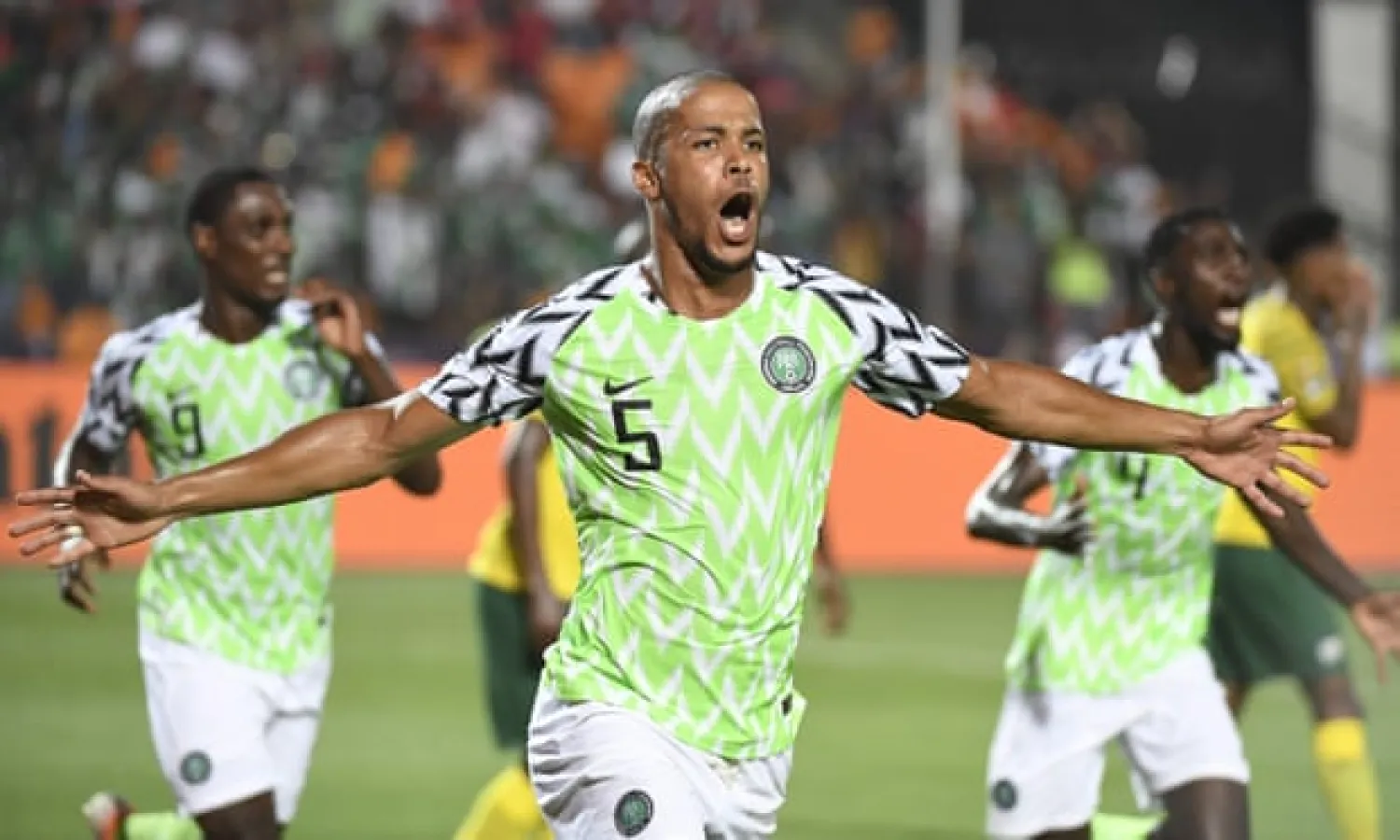
 William Troost-Ekong celebrates after scoring Nigeria’s late winner in their Africa Cup of Nations quarter-final against South Africa. Photograph: Khaled Desouki/AFP/Getty Images
William Troost-Ekong celebrates after scoring Nigeria’s late winner in their Africa Cup of Nations quarter-final against South Africa. Photograph: Khaled Desouki/AFP/Getty Images
TT

Nigeria Could Claim Glory in a Cup of Nations Higher on Drama Than Quality

 William Troost-Ekong celebrates after scoring Nigeria’s late winner in their Africa Cup of Nations quarter-final against South Africa. Photograph: Khaled Desouki/AFP/Getty Images
William Troost-Ekong celebrates after scoring Nigeria’s late winner in their Africa Cup of Nations quarter-final against South Africa. Photograph: Khaled Desouki/AFP/Getty Images

Nigeria are in the semi-finals of the Cup of Nations. A week come Friday, they could win the trophy for the second time in six years which, given they had won it only twice in the first 55 years of its existence, would be in some bluntly statistical way the most successful period in their history. Yet nobody can seriously believe this Nigeria side to be anywhere near the stature of some of their sides of the past. Nigeria’s record of underachievement in the Cup of Nations always seemed slightly freakish; it may be that this current spell of achievement comes to seem equally weird.

That’s not to say that Nigeria don’t deserve to be in the semi-finals, where they face Ivory Coast or Algeria. After a lackadaisical defeat by Madagascar in the final group game, when qualification had been secured – only their second defeat by African opposition in three years under Gernot Rohr – they have come through dramatic ties against Cameroon and South Africa.

“They go down but they come back in the last minutes – it’s fantastic,” Rohr said after the quarter-final victory on Wednesday. “The attitude of the players is wonderful.”

He was in giddily high spirits, attempting to initiate some arch coaching banter about the relative merits of zonal- and man-marking at set plays after both sides had leaked soft goals from corners, only to find Stuart Baxter, South Africa’s robustly Wulfrunian coach, who thanks to CAF’s policy of dual press conferences was seated alongside him, unwilling to engage.

But the qualities of this Nigeria are spirit and, for the most part, organisation. They are not the high-class artists of a couple of decades ago. There are no players with the individual qualities of Sunday Oliseh, Jay-Jay Okocha and Nwankwo Kanu. The highest-profile player remains Mikel John Obi, who has been restricted to a supporting role, starting against Burundi and Madagascar but left out of the other three matches, although he delivered a stern team talk amid the celebrations that followed the 3-2 win over Cameroon. There could yet be a glorious finale to his international career in the country where he made his Nigeria debut in the 2006 Cup of Nations.

In that sense, Nigeria reflect a wider trend in the development of African football. The best teams are nowhere near the quality they were 10-20 years ago: there is no side to match the Cameroon of Geremi, Rigobert Song and Patrick Mbomba or the Egypt of Ahmed Hassan, Hosny Abd Rabo and Mohamed Aboutrika. The Nigeria, Senegal and Ivory Coast sides of the early part of the century, you suspect, would have been far more successful had they come along 15 years later. But equally the minnows are far better than they used to be. That teams such as Burkina Faso, Cape Verde and Gabon have failed to qualify suggests significant strength in depth.

It may not be the sort of progress that would offer the easy headline of an African side reaching a World Cup semi-final but it is progress nonetheless. The truth is that there isn’t a huge difference in quality between, say, the third-best team in the confederation and the 30th-best, the result of which is that where Cameroon and Egypt won five of the six Cups of Nations played between 2000 and 2010, the tournament has become a crap shoot, rather higher on drama and upsets than on quality.

That in turn has meant the oddity of Nigeria’s situation. It may soon get even odder. Nigeria won the Under-17 World Cup in 2013 and 2015. Players such as Kelechi Iheanacho, Isaac Success and Musa Mohammed, who played in the earlier triumph, have begun to establish themselves in the senior game. There is a sense now of Nigeria being between generations; this, after all, is a side that failed to qualify for three of the previous four Cups of Nations.

Rohr’s side’s greatest strength, perhaps, is an awareness of their limitations. Ahmed Musa had repeatedly got in behind the South Africa right-back Thamsanqa Mkhize but it was Alex Iwobi’s cross from that position that led to Samuel Chukwueze, an exciting right-sided forward who was part of the 2015 Under-17 World Cup-winning side, opening the scoring.

They then sat back, allowing South Africa the ball, denying them the space to counter as they had so effectively in eliminating Egypt in the last 16, and seemed set to grind it out when Bongani Zungu was rendered onside by a touch from Odion Ighalo and levelled. But as against Cameroon, when they leaked two goals in three minutes just before half-time, when a brief lapse looked like being their undoing they managed to reverse the momentum. As South Africa suddenly began to play with self-confidence, Nigeria resisted and then, thanks to a horrible misjudgment from the goalkeeper Ronwen Williams, found a winner.

Nigeria for a long time were a team that played in brilliant flurries but kept falling short in semi-finals. The current side are far less talented and far less consistent and yet they may somehow end up doubling Nigeria’s tally of success in the Cup of Nations in the space of six years.

The Guardian Sport


Saudi Arabia: RCU Partners with ASICS to Support Sports Development

The MoU was signed at the Cultural Oasis in AlUla. SPA
TT

Saudi Arabia: RCU Partners with ASICS to Support Sports Development

The MoU was signed at the Cultural Oasis in AlUla. SPA

Saudi Arabia’s Royal Commission for AlUla (RCU) has signed a Memorandum of Understanding (MoU) with ASICS, aimed at strengthening strategic cooperation to support the development of AlUla’s sports ecosystem and enhance talent pathways, in line with RCU’s long-term vision and future ambitions.

The MoU, signed at the Cultural Oasis in AlUla, establishes a framework for future collaboration through which RCU will explore opportunities to leverage ASICS’ technical, operational, and specialized advisory expertise across sports development and performance services, including assessment and analysis, to enhance the quality of sporting experiences in AlUla.

The cooperation includes joint efforts to support a more integrated sports ecosystem through initiatives that strengthen training environments, enhance athletic performance, and advance athlete development pathways and talent programs. RCU and ASICS will also explore opportunities to develop distinctive events and initiatives and attract regional and international competitions that contribute to AlUla’s growing profile on global sporting calendars.

The MoU further supports collaboration on community engagement through grassroots programs and social impact initiatives that encourage participation and wellbeing. It also enables exploration of digital enhancements that improve event delivery and participant engagement, including smarter registration, data management, and participant tracking for the AlUla Trail Race and other events across AlUla’s calendar.

This step is part of RCU’s ongoing efforts to develop the sports ecosystem in AlUla and increase community participation in sporting activities, in line with the objectives of Saudi Vision 2030 to advance the sports sector and enhance the quality of life.


Hospital: Vonn Had Surgery on Broken Leg from Olympics Crash

This handout video grab from IOC/OBS shows US Lindsey Vonn crashing during the women's downhill event at the Milano Cortina 2026 Winter Olympic Games on February 8, 2026. (Photo by Handout / various sources / AFP)
TT

Hospital: Vonn Had Surgery on Broken Leg from Olympics Crash

This handout video grab from IOC/OBS shows US Lindsey Vonn crashing during the women's downhill event at the Milano Cortina 2026 Winter Olympic Games on February 8, 2026. (Photo by Handout / various sources / AFP)

Lindsey Vonn had surgery on a fracture of her left leg following the American's heavy fall in the Winter Olympics downhill, the hospital said in a statement given to Italian media on Sunday.

"In the afternoon, (Vonn) underwent orthopedic surgery to stabilize a fracture of the left leg," the Ca' Foncello hospital in Treviso said.

Vonn, 41, was flown to Treviso after she was strapped into a medical stretcher and winched off the sunlit Olimpia delle Tofane piste in Cortina d'Ampezzo.

Vonn, whose battle to reach the start line despite the serious injury to her left knee dominated the opening days of the Milano Cortina Olympics, saw her unlikely quest halted in screaming agony on the snow.

Wearing bib number 13 and with a brace on the left knee she ⁠injured in a crash at Crans Montana on January 30, Vonn looked pumped up at the start gate.

She tapped her ski poles before setting off in typically aggressive fashion down one of her favorite pistes on a mountain that has rewarded her in the past.

The 2010 gold medalist, the second most successful female World Cup skier of all time with 84 wins, appeared to clip the fourth gate with her shoulder, losing control and being launched into the air.

She then barreled off the course at high speed before coming to rest in a crumpled heap.

Vonn could be heard screaming on television coverage as fans and teammates gasped in horror before a shocked hush fell on the packed finish area.

She was quickly surrounded by several medics and officials before a yellow Falco 2 ⁠Alpine rescue helicopter arrived and winched her away on an orange stretcher.


Meloni Condemns 'Enemies of Italy' after Clashes in Olympics Host City Milan

Demonstrators hold smoke flares during a protest against the environmental, economic and social impact of the Milano-Cortina 2026 Winter Olympics in Milan, Italy, February 7, 2026. REUTERS/Kevin Coombs
TT

Meloni Condemns 'Enemies of Italy' after Clashes in Olympics Host City Milan

Demonstrators hold smoke flares during a protest against the environmental, economic and social impact of the Milano-Cortina 2026 Winter Olympics in Milan, Italy, February 7, 2026. REUTERS/Kevin Coombs

Italian Prime Minister Giorgia Meloni has condemned anti-Olympics protesters as "enemies of Italy" after violence on the fringes of a demonstration in Milan on Saturday night and sabotage attacks on the national rail network.

The incidents happened on the first full day of competition in the Winter Games that Milan, Italy's financial capital, is hosting with the Alpine town of Cortina d'Ampezzo.

Meloni praised the thousands of Italians who she said were working to make the Games run smoothly and present a positive face of Italy.

"Then ⁠there are those who are enemies of Italy and Italians, demonstrating 'against the Olympics' and ensuring that these images are broadcast on television screens around the world. After others cut the railway cables to prevent trains from departing," she wrote on Instagram on Sunday.

A group of around 100 protesters ⁠threw firecrackers, smoke bombs and bottles at police after breaking away from the main body of a demonstration in Milan.

An estimated 10,000 people had taken to the city's streets in a protest over housing costs and environmental concerns linked to the Games.

Police used water cannon to restore order and detained six people.

Also on Saturday, authorities said saboteurs had damaged rail infrastructure near the northern Italian city of Bologna, disrupting train journeys.

Police reported three separate ⁠incidents at different locations, which caused delays of up to 2-1/2 hours for high-speed, Intercity and regional services.

No one has claimed responsibility for the damage.

"Once again, solidarity with the police, the city of Milan, and all those who will see their work undermined by these gangs of criminals," added Meloni, who heads a right-wing coalition.

The Italian police have been given new arrest powers after violence last weekend at a protest by the hard-left in the city of Turin, in which more than 100 police officers were injured.
