
This Salzburg Palace Is More Than a Scene in ‘The Sound of Music’

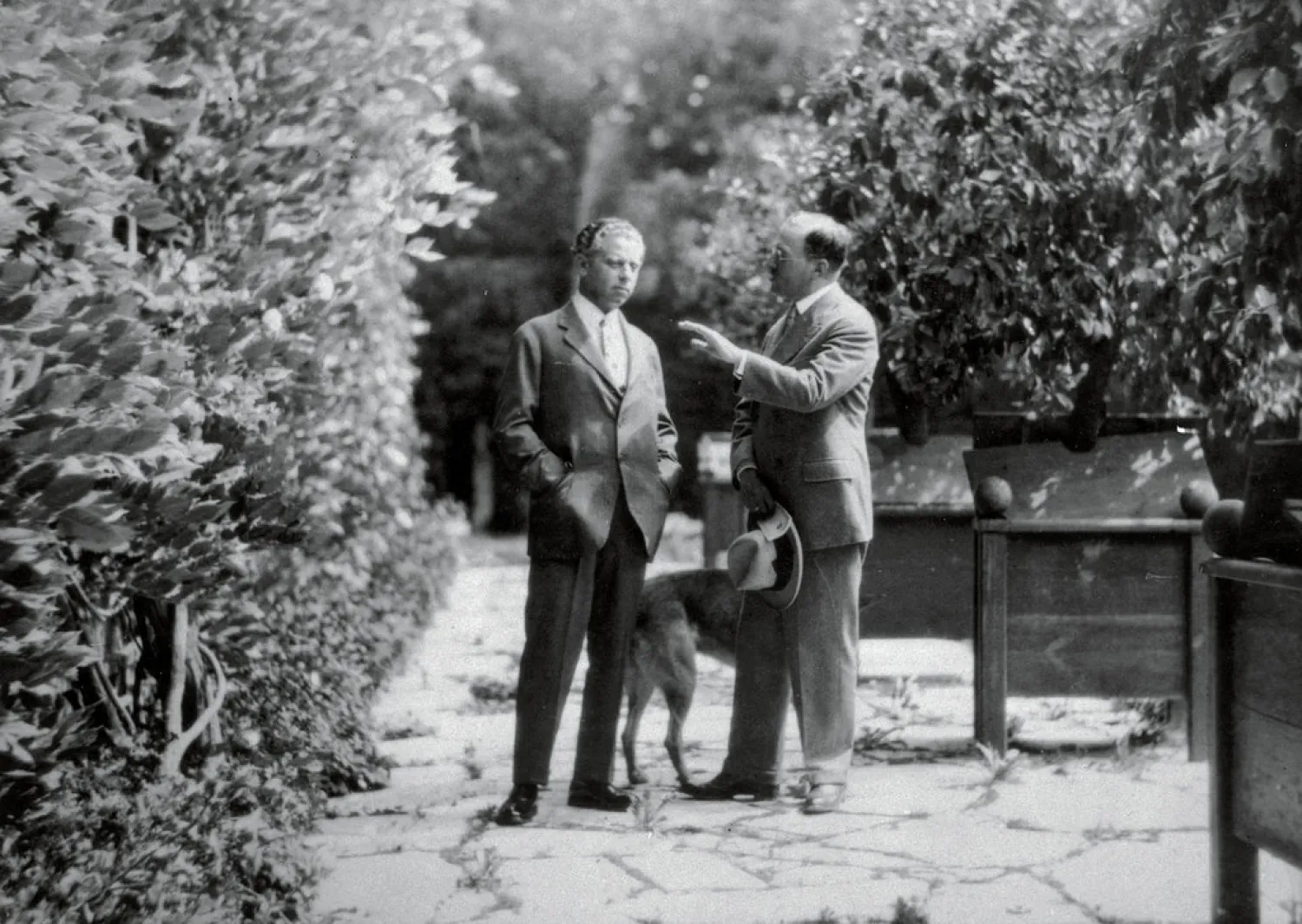
Max Reinhardt and Hugo von Hofmannsthal on the grounds of the Schloss Leopoldskron, circa 1920. The two men, along with Richard Strauss, created the Salzburg Festival.CreditImagno/Getty Images
TT

This Salzburg Palace Is More Than a Scene in ‘The Sound of Music’

Max Reinhardt and Hugo von Hofmannsthal on the grounds of the Schloss Leopoldskron, circa 1920. The two men, along with Richard Strauss, created the Salzburg Festival.CreditImagno/Getty Images

From central Salzburg, it is a short but scenic bike ride — with the Eastern Alps as a breathtaking backdrop — to the 18th-century rococo palace of Schloss Leopoldskron. While it may not look very notable from the road, from the lakeside it is a spectacular vision of manicured lawns, hedges and giant trees.

The palace has also served as a setting for famous moments in the region. The Salzburg Festival was conceived here almost 100 years ago. During World War II, the palace was taken over by the Nazis as a summer residence.

The rowboat scene in “The Sound of Music” was filmed here in 1964, on the adjacent Meierhof property, while the ornate Venetian room inside the palace was meticulously recreated on a soundstage in London as the ballroom in the film. In 2014, it was the setting for both Chanel’s December 2014 métier d’arts fashion show and Melinda Gates’ 50th birthday party.

But possibly its most important function is as the home of the Salzburg Global Seminar, a nonprofit organization that hosts programs on topics from climate change and health care to the role that the arts can play in community development.

This month, for example, the seminar is holding a two-and-a-half-week program titled “The Cost of Disbelief: Fracturing Societies and the Erosion of Trust,” where 75 journalists and media experts through presentations and workshops will examine the current role of media in a world where many now believe truth is subjective.

Since its founding by two Harvard students and an instructor in 1947 under the premise of being a “Marshall Plan for the mind,” luminaries have attended workshops and lectures and discussed some of society’s most difficult and pervasive questions. Past participants include Kofi Annan, the former United Nations secretary general; Hillary Clinton; Justice Ruth Bader Ginsburg; and Kristalina Georgieva, the World Bank’s chief executive.

The palace also operates as a high-end hotel that is owned by the seminar. Though the property is private, it is open to the public a few times a year, and it is the location for the Salzburger Landestheater’s “Shakespeare im Park” every summer.

Guests can stay in either the recently refurbished rooms in the Schloss or on the Meierhof property right next door. They can also see the horse statues that the Von Trapp children ran past on their way to greet their father in “The Sound of Music.”

“We are a well-kept secret in some respects, while in others we are becoming better known publicly,” said Stephen Salyer, the seminar’s president and chief executive. “We are trying to walk the line between keeping this place special, maintaining enough privacy for the conversations we want to have, and on the other, we are a nonprofit publicly oriented institution, so we want to welcome people from every walk of life.”

Construction on the family estate for Leopold Anton Freiherr von Firmian, the prince archbishop of Salzburg, started in 1736, and after his death, Count Laktanz — who was one of the first sponsors of Leopold Mozart and his son Wolfgang — moved in. Over the course of the 19th century, the home was owned by King Ludwig II of Bavaria and a well-known Salzburg banker, and later by two waiters who tried to run the palace as a hotel.

By the time Max Reinhardt, the Baden-born film and theater director, took over the Schloss in 1918, it was in a desperate state. He spent the next 20 years lovingly renovating everything from the Venetian room to the stunning Library and Marble Hall.

Mr. Reinhardt put on site-specific theater productions in the Schloss, and it became a place where writers, composers, actors and designers from Europe and abroad would converge for conversation and inspiration. It was in the Schloss where Mr. Reinhardt, the composer Richard Strauss and the poet Hugo von Hofmannsthal came up with the idea to create a music festival that they hoped would bring people together from across Europe who had been at war. (Mr. Reinhardt, who was Jewish, later fled to the United States after the annexation of Austria by the Nazis in 1938.)

“When I think of our institution, I think of cycles of power, persecution and renewal,” said Clare Shine, the seminar’s vice president and chief program officer. “So after the Victorian age of dilapidation of the Schloss, Max was an act of renewal at the end of the First World War. And then came the cycle again of persecution and the Nazis and the Schloss. And the act of founding the seminar was an act of renewal, courage and risk-taking.”

Over the years, the Salzburg Global Seminar (originally called the Salzburg Seminar in American Studies) has grown from one-off workshops to multiyear, multicomponent projects.

“When you are looking at a world that is increasingly complex, volatile, unequal, you want to be able to go deep into that complexity,” Ms. Shine said. “We work in interdisciplinary and inter-regional way, and by committing ourselves to say we are going to put a stake in the ground for five or 10 years around this particular area of transformation. That gives us the flexibility to bring disrupters, establishment figures, different types of partners together on an organically-evolving basis and that feeds right through in how we think about impact.”

After each seminar, a report is put together by participants (who become fellows). Fellows have produced work on everything from creating a Pan-African educational project on countering extremism to teaching coexistence and peace building through the arts. The institution’s archive was transferred to Harvard two years ago.

“What was transformative about the seminar was spending time getting to know other professionals in the field of arts and culture coming from all around the world, and gathering to reflect together,” Phloeun Prim, the executive director of Cambodian Living Arts, a cultural organization based in Phnom Penh, wrote in an email.

“There was so much more than talking — it wasn’t the typical conference where you go and listen, but you had to participate in a meaningful way.”

The New York Times



UK's Prince William and Son George Volunteer at Homelessness Charity

FILE PHOTO: Britain's Prince William, Prince of Wales and Prince George join Second World War veterans at a tea party in Buckingham Palace, central London, following the military procession to mark the 80th anniversary of VE Day, May 5, 2025. Jordan Pettitt/Pool via REUTERS/File Photo
TT

UK's Prince William and Son George Volunteer at Homelessness Charity

FILE PHOTO: Britain's Prince William, Prince of Wales and Prince George join Second World War veterans at a tea party in Buckingham Palace, central London, following the military procession to mark the 80th anniversary of VE Day, May 5, 2025. Jordan Pettitt/Pool via REUTERS/File Photo

Britain's Prince William took his oldest son, Prince George, to a homelessness charity in London where the pair helped make Christmas lunch for people in need, Kensington Palace said on Saturday.

The visit was particularly poignant for William, heir to the throne, because his late mother Princess Diana had taken him to the same charity when he was 11 years old, an experience which inspired him to set up a ⁠program aimed at ending homelessness.

During the trip to the charity's center, named The Passage, George signed the visitor's book on the same page previously signed by Diana, who was killed in a car crash in Paris in 1997 when William ⁠was 15 years old, Reuters reported.

Wearing aprons, George, 12, and his father worked in the kitchen, placing food in baking trays, while they talked and laughed with the center’s catering staff, before heading out to lay long tables with napkins and Christmas crackers.

"It was important to The Prince of Wales to share with Prince George the work of The Passage and to spend ⁠time volunteering alongside the team," a spokesperson for Kensington Palace said.

"They both greatly enjoyed meeting staff, volunteers and service users as well as learning more about the charity’s work."

As well as working to try to stop people becoming homeless, William also champions environmental causes and campaigns for more openness about mental health issues.

William, his wife Kate and their three children are expected to spend Christmas at King Charles' Sandringham estate in eastern England.


Paraplegic Engineer Becomes the First Wheelchair User to Blast Off for Space

This image provided by Blue Origin, Michaela Benthaus poses after the Blue Origin's capsule landed on Saturday, Dec. 20, 2025 in West Texas. (Blue Origin via AP)
TT

Paraplegic Engineer Becomes the First Wheelchair User to Blast Off for Space

This image provided by Blue Origin, Michaela Benthaus poses after the Blue Origin's capsule landed on Saturday, Dec. 20, 2025 in West Texas. (Blue Origin via AP)

A paraplegic engineer from Germany blasted off on a dream-come-true rocket ride with five other passengers Saturday, leaving her wheelchair behind to float in space while beholding Earth from on high.

Severely injured in a mountain bike accident seven years ago, Michaela Benthaus became the first wheelchair user to launch to space, soaring from West Texas with Jeff Bezos’ company Blue Origin. She was accompanied by a retired SpaceX executive also born in Germany, Hans Koenigsmann, who helped organize and, along with Blue Origin, sponsored her trip. Their ticket prices were not divulged, The AP news reported.

The 10-minute space-skimming flight required only minor adjustments to accommodate Benthaus, according to the company. That’s because the autonomous New Shepard capsule was designed with accessibility in mind, “making it more accessible to a wider range of people than traditional spaceflight,” said Blue Origin’s Jake Mills, an engineer who trained the crew and assisted them on launch day.

Among Blue Origin’s previous space tourists: those with limited mobility and impaired sight or hearing, and a pair of 90-year-olds.

For Benthaus, Blue Origin added a patient transfer board so she could scoot between the capsule’s hatch and her seat. The recovery team also had a carpet to lay on the desert floor following touchdown, providing immediate access to her wheelchair, which she left behind at liftoff. She practiced in advance, with Koenigsmann taking part with the design and testing. An elevator was already in place at the launch pad to ascend the seven stories to the capsule perched atop the rocket.

Benthaus, 33, part of the European Space Agency’s graduate trainee program in the Netherlands, experienced snippets of weightlessness during a parabolic airplane flight out of Houston in 2022. Less than two years later, she took part in a two-week simulated space mission in Poland.

“I never really thought that going on a spaceflight would be a real option for me because even as like a super healthy person, it’s like so competitive, right?” she told The AP ahead of the flight.

Her accident dashed whatever hope she had. “There is like no history of people with disabilities flying to space," she said.

When Koenigsmann approached her last year about the possibility of flying on Blue Origin and experiencing more than three minutes of weightlessness on a space hop, Benthaus thought there might be a misunderstanding. But there wasn't, and she immediately signed on.

It’s a private mission for Benthaus with no involvement by ESA, which this year cleared reserve astronaut John McFall, an amputee, for a future flight to the International Space Station. The former British Paralympian lost his right leg in a motorcycle accident when he was a teenager.

An injured spinal cord means Benthaus can’t walk at all, unlike McFall who uses a prosthetic leg and could evacuate a space capsule in an emergency at touchdown by himself. Koenigsmann was designated before flight as her emergency helper; he also was tapped to help her out of the capsule and down the short flight of steps at flight’s end.

Benthaus was adamant about doing as much as she could by herself. Her goal is to make not only space accessible to the disabled, but to improve accessibility on Earth too.

While getting lots of positive feedback within “my space bubble,” she said outsiders aren't always as inclusive.

“I really hope it’s opening up for people like me, like I hope I’m only the start," she said.

Besides Koenigsmann, Benthaus shared the ride with business executives and investors, and a computer scientist. They raised Blue Origin’s list of space travelers to 86.

Bezos, the billionaire founder of Amazon, created Blue Origin in 2000 and launched on its first passenger spaceflight in 2021. The company has since delivered spacecraft to orbit from Cape Canaveral, Florida, using the bigger and more powerful New Glenn rocket, and is working to send landers to the moon.


Everything about Christmas, and How it Has Evolved into a Global Holiday

 People browse products at a Christmas market stall in downtown Madrid, Spain, 18 December 2025 (issued 20 December 2025). People continue to do last-minute shopping ahead of Christmas. EPA/SERGIO PEREZ
People browse products at a Christmas market stall in downtown Madrid, Spain, 18 December 2025 (issued 20 December 2025). People continue to do last-minute shopping ahead of Christmas. EPA/SERGIO PEREZ
TT

Everything about Christmas, and How it Has Evolved into a Global Holiday

 People browse products at a Christmas market stall in downtown Madrid, Spain, 18 December 2025 (issued 20 December 2025). People continue to do last-minute shopping ahead of Christmas. EPA/SERGIO PEREZ
People browse products at a Christmas market stall in downtown Madrid, Spain, 18 December 2025 (issued 20 December 2025). People continue to do last-minute shopping ahead of Christmas. EPA/SERGIO PEREZ

Christmas is a Christian holiday that observes the birth of Jesus. But did you know that the earliest followers of Jesus did not annually commemorate his birth? Or that Santa Claus is inspired by the acts of kindness of a fourth-century Christian saint? And have you heard about the modern-day Japanese tradition of eating Kentucky Fried Chicken on Christmas?

Since the early 20th century, Christmas has evolved from a religious holiday to a hugely popular cultural holiday observed by Christian and secular people across the globe who gather with families, exchange gifts and cards and decorate Christmas trees.

Here’s a look at the history, beliefs and the evolution of Christmas according to the AP news:

Origins and early history of Christmas Early followers of Jesus did not annually commemorate his birth but instead focused on commemorating their belief in his resurrection at Easter.

The story of the birth of Jesus appears only in two of the four Gospels of the New Testament: Matthew and Luke. They provide different details, though both say Jesus was born in Bethlehem.

The exact day, month and even year of Jesus’s birth are unknown, said Christine Shepardson, a professor at the University of Tennessee who studies early Christianity.

The tradition of celebrating Jesus’ birth on Dec. 25, she said, only emerged in the fourth century.

“It’s hard to overemphasize how important the fourth century is for constructing Christianity as we experience it in our world today,” Shepardson said. It was then, under Emperor Constantine, that Christians began the practice of gathering at churches instead of meeting at homes.

Some theories say the date coincides with existing pagan winter solstice festivals, including the Roman celebration of Sol Invictus, or the “Unconquered Sun,” on Dec 25.

While most Christians celebrate Christmas on Dec. 25, some Eastern Orthodox traditions celebrate the holy day on Jan. 7. That’s because they follow the ancient Julian calendar, which runs 13 days behind the Gregorian calendar, used by Catholic and Protestant churches as well as by much of the secular world.
For centuries, especially during the Middle Ages, Christmas was associated with rowdy street celebrations of feasting and drinking, and for many Christians, it “was not in good standing as a holiday,” said Thomas Ruys Smith, a professor of American literature and culture at the University of East Anglia in England.

“Puritans,” he said, “were not fond of Christmas.”

But in the 19th century, he said, Christmas became “respectable” with “the domestic celebration that we understand today — one centered around the home, the family, children, gift-giving.”

The roots of modern-day Christmas can be traced back to Germany. In the late 19th century, there are accounts of Christmas trees and gift-giving that, according to Smith, later spread to Britain and America, helping to revitalize Christmas on both sides of the Atlantic.

Christmas became further popularized with the publication of “A Christmas Carol” by Charles Dickens in 1843, and the writings of Washington Irving, who was a fan of St. Nicholas and helped popularize the celebration of Christmas in America.

The first Rockefeller Center Christmas tree was put up by workers in 1931 to raise spirits during the Great Depression. The tradition stuck as the first tree-lighting ceremony was held in 1933 and remains one of New York City’s most popular holiday attractions.

America’s secular Santa is inspired by a Christian saint St. Nicholas was a fourth-century Christian bishop from the Mediterranean port city of Myra (in modern-day Türkiye). His acts of generosity inspired the secular Santa Claus legend.

The legends surrounding jolly old St. Nicholas — celebrated annually on Dec. 6 — go way beyond delivering candy and toys to children. He is believed to have interceded on behalf of wrongly condemned prisoners and miraculously saved sailors from storms.

Devotion to St. Nicholas spread during the Middle Ages across Europe and he became a favorite subject for medieval artists and liturgical plays. He is the patron saint of sailors and children, as well as of Greece, Russia and New York.

Devotion to St. Nicholas seems to have faded after the 16th century Protestant Reformation, except in the Netherlands, where his legend remained as Sinterklaas. In the 17th century, Dutch Protestants who settled in New York brought the Sinterklaas tradition with them.

Eventually, St. Nicholas morphed into the secular Santa Claus.

It’s not just Santa who delivers the gifts In the UK, it’s Father Christmas; in Greece and Cyprus, St. Basil (who arrives on New Year’s Eve). In some parts of Italy, it’s St. Lucy (earlier in December) and in other Italian regions, Befana, a witch-like figure, who brings presents on the Epiphany on Jan. 6.

Instead of a friendly Santa Claus, children in Iceland enjoy favors from 13 mischievous troll brothers, called the Yule Lads. They come down from their mountain cave 13 days before Christmas, according to folklore.

One of the oldest traditions around Christmas is bringing greenery — holly, ivy or evergreen trees — into homes. But determining whether it’s a Christian tradition is harder. “For many people, the evergreen can symbolize Christ’s promise of eternal life and his return from death,” Smith said. “So, you can interpret that evergreen tradition within the Christian concept.”

The decorating of evergreen trees is a German custom that began in the 16th century, said Maria Kennedy, a professor at Rutgers University—New Brunswick’s  Department of American Studies. It was later popularized in England and America.

“Mistletoe, an evergreen shrub, was used in celebrations dating back to the ancient Druids — Celtic religious leaders — some 2,000 years ago,” Kennedy writes in The Surprising History of Christmas Traditions.

“Mistletoe represented immortality because it continued to grow in the darkest time of the year and bore white berries when everything else had died.”

Other traditions include Christmas services and Nativity scenes at homes and churches. More recently, Nativity scenes — when erected on public property in the US — have triggered legal battles over the question of the separation of church and state.

Christmas caroling, Kennedy writes, can also be traced back to European traditions, where people would go from home to home during the darkest time of the year to renew relationships within their communities and give wishes for good luck, health and wealth for the forthcoming year.

“They would recite poetry, sing and sometimes perform a skit. The idea was that these acts would bring about good fortune to influence a future harvest,” Kennedy writes.

Kentucky Fried Chicken for Christmas in Japan Among the many Christmas traditions that have been adopted and localized globally, there’s one that involves KFC.

In 1974, KFC launched a Christmas campaign where they began to sell fried chicken with a bottle of wine so it could be used for a Christmas party.

KFC says the idea for the campaign came from an employee who overheard a foreign customer at one of its Tokyo restaurants saying that since he couldn’t get turkey in Japan, he’d have to celebrate Christmas with Kentucky Fried Chicken.

“That really stuck,” Smith said. “And still today, you have to order your KFC months in advance to make sure that you’re going to get it at Christmas Day.”