


The Apollo 11 Mission Was Also a Global Media Sensation

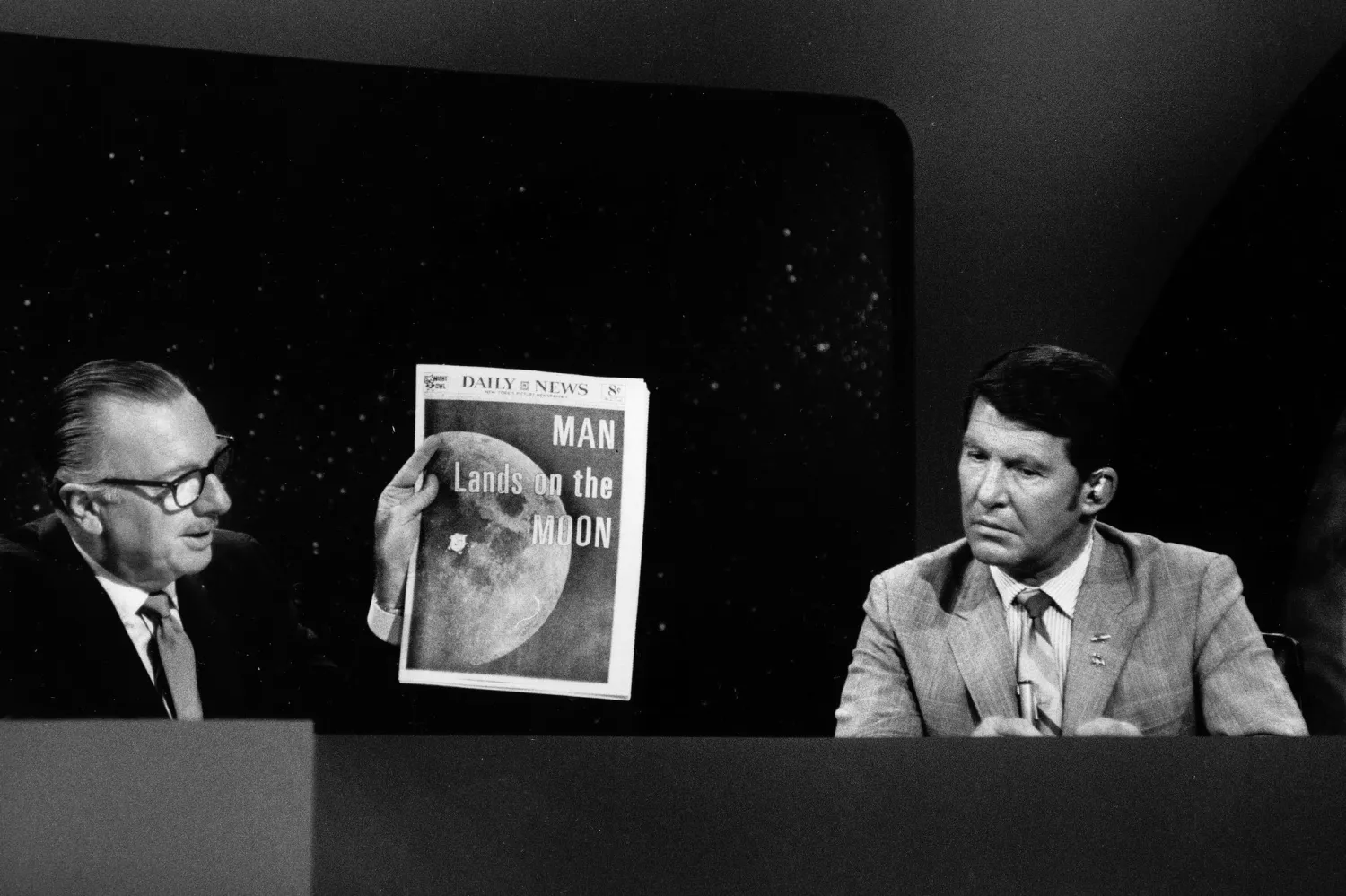
TV news anchor Walter Cronkite, left, with astronaut Walter Schirra during coverage of Apollo 11 on CBS on July 20, 1969.CreditCBS Photo Archive/Getty Images
TT

The Apollo 11 Mission Was Also a Global Media Sensation

TV news anchor Walter Cronkite, left, with astronaut Walter Schirra during coverage of Apollo 11 on CBS on July 20, 1969.CreditCBS Photo Archive/Getty Images

The satellites were finally ready to beam images back to Earth in 1969. And some 600 million people watched the event live.

The television news director Joel Banow absorbed endless hours of “terrible old B movies” filled with extraterrestrials and rocket ships long before he oversaw the production of an authentic space opera.

While the astronauts Neil Armstrong, Buzz Aldrin and Michael Collins were making history above, Mr. Banow played his part on the ground, helming the coverage of the Apollo 11 mission for CBS News while standing on his feet like an orchestra conductor.

Mr. Banow treated the 32 hours of programming on July 20 and July 21, 1969, like “a big blockbuster kind of motion picture,” he said in an interview, which meant days of rehearsal, custom animation and a cast of correspondents and producers so large that the end credits lasted seven minutes.

It was one of the first global news media spectaculars. The director said he had prepared for the job by having helped with the coverage of the previous Apollo missions and several Gemini and Mercury launches.

As the Eagle module touched down on the moon, applause flared up behind Mr. Banow in the CBS News studio on West 57th Street in Manhattan. He cut to Wally Schirra, a Project Mercury astronaut working as a CBS News consultant, catching the retired spaceman in the act of wiping away a tear. Mr. Banow followed that shot with a glimpse of the network’s star anchor, the usually composed Walter Cronkite, who grabbed his nose and shook his head, momentarily at a loss for words.

Hours later, at 10:56 p.m., a hazy black-and-white image flashed on the screen of Armstrong advancing gingerly down a ladder. When he stepped onto the lunar surface, Mr. Banow finally took a seat.

“I felt pride that I was a part of this, and also wonder that NASA managed to do it without a glitch,” Mr. Banow, now 84, said. “They did it. We did it. It was really kind of a relief.”

The coverage of the event had come about thanks to recent advances in media technology. In 1962, the first live trans-Atlantic broadcast — showing images of the Statue of Liberty, President Kennedy and a baseball game — was transmitted via satellite. A more ambitious live satellite broadcast, in 1967, showed the Beatles performing “All You Need Is Love” at Abbey Road Studios in London. More than 350 million people around the world were watching.

Roughly 600 million people, a fifth of the world’s population, saw Armstrong set foot on the moon, a viewership record that held until Lady Diana Spencer married Prince Charles in 1981.

All three major American broadcast networks — CBS, NBC and ABC — covered the Apollo 11 mission, with CBS dominating the ratings. In the United States, 94 percent of people watching television were tuned into the event.

People who did not own TV sets or found themselves away from home kept up with the coverage from bars, town squares and department stores, said David Meerman Scott, the co-author of the 2014 book “Marketing the Moon.”

Many astronauts and engineers resisted the live-broadcast plan, expressing concerns about the extra weight of the filming equipment. But at NASA’s insistence, Armstrong’s moonwalk was captured by a Westinghouse camera covered in a protective thermal blanket and tucked into the lunar module. The signal bounced from the module’s antenna through microwave links, satellites and landlines around the world. The picture was degraded before it reached viewers.

The BBC covered the event with less reverence than its American counterparts, dubbing David Bowie’s just-released single, “Space Oddity,” onto the footage beamed back from the moon. During a break in the action, the BBC gave viewers about five minutes of Pink Floyd jamming live from the network’s studio on a bluesy song called “Moonhead,” as well as dramatic readings with a lunar theme from Ian McKellen and Judi Dench.

Networks in the United States rounded out their coverage with hours of analysis and moon-related entertainment. On ABC, the science-fiction writer Isaac Asimov chatted with Rod Serling, the creator of “The Twilight Zone” television series. The network had also commissioned Duke Ellington to create something new for the occasion. He made his television debut as a vocalist, performing the song he had composed, “Moon Maiden,” live on the air.

Headline writers conveyed the news with attempts at deadline poetry. The Kokomo Tribune, in Indiana, went with “Astronauts Etch Names Beside History’s Great Explorers.” The Oil City Derrick, in Pennsylvania, was more succinct: “Yanks Land on Moon.” The New York Times’s banner headline — the straightforward “Men Walk on Moon” — was set in some of the largest type ever used in the paper.

The coverage of Apollo 11 was subdued in Moscow. “It was not secret, but it was not shown to the public,” Sergei Khrushchev, the son of the former Soviet leader Nikita Khrushchev, told Scientific American in 2009.

In the United States, NASA had spent years molding its astronauts into mythic figures, giving Life magazine exclusive access as part of its attempt to shape public opinion. Americans became emotionally invested in the crew members thanks to cover stories documenting the “making of a brave man” and the “inner thoughts and worries” of the spacemen’s wives.

“That had a large effect in showing how big a deal it is to go to space, and it helped to make the astronaut-as-celebrity culture come alive,” Mr. Scott, the author, said. “You’d flip through magazine pages and see Joe DiMaggio, a hero of baseball, and then a few pages later, an astronaut. That’s mythmaking.”

The New York Times


Louvre Thieves Escaped With 30 Seconds to Spare, Probe Reveals

The daring robbery at the Louvre took place in broad daylight © Dimitar DILKOFF / AFP
TT

Louvre Thieves Escaped With 30 Seconds to Spare, Probe Reveals

The daring robbery at the Louvre took place in broad daylight © Dimitar DILKOFF / AFP

The thieves who stole priceless crown jewels from the Louvre in October escaped with just 30 seconds to spare due to avoidable security failures at the Paris museum, a damning investigation revealed on Wednesday.

The probe, ordered by the culture ministry after the embarrassing daylight heist, revealed that only one of two security cameras was working near the site where the thieves broke in on the morning of Sunday October 19, according to AFP.

Agents in the security headquarters also did not have enough screens to follow the images in real-time, while a lack of coordination meant police were initially sent to the wrong place once the alarm was raised, the report unveiled at the French Senate's Culture Commission, stated.

"It highlights an overall failure of the museum, as well as its supervisory authority, to address security issues," the head of the commission, Laurent Lafon, said at the start of a hearing.

One of the most startling revelations was that the robbers left only 30 seconds before police and private security guards arrived on the scene.

"Give or take 30 seconds, the Securitas (private security) guards or the police officers in a car could have prevented the thieves from escaping," the head of the investigation, Noel Corbin, told senators.

He said that measures such as a modern security camera system, more resistant glass in the door cut open with angle grinders, or better internal coordination could have prevented the loss of the crown jewels -- worth an estimated $102 million -- which have still not been found.

Security risks were highlighted in several reports commissioned by management of the Louvre, including a 2019 audit by the jewellery company Van Cleef & Arpels.

The evaluation said the balcony used by the thieves was a weak point in security and could be reached by using an extendable ladder -- exactly what transpired in the heist.

Corbin confirmed that under-fire Louvre boss Laurence des Cars had been unaware of the audit which was carried out by her predecessor, Jean-Luc Martinez.

"The recommendations were not acted on and they would have enabled us to avoid this robbery," Corbin said, adding that there had been a lack of coordination between the two state-appointed administrators.

Police believe they have arrested all four thieves, who escaped on powerful motorbikes, having carried out the heist in the Apollo Gallery in around 10 minutes in total.

The revelations on Wednesday are likely to pile more pressure on des Cars, who was already facing calls to resign.


Prince Mohammed bin Salman Royal Reserve Launches Live Turtle Tracking Program

This data will fill a critical regional knowledge gap and drive unified, cross-border conservation strategies for these globally endangered species - SPA
TT

Prince Mohammed bin Salman Royal Reserve Launches Live Turtle Tracking Program

This data will fill a critical regional knowledge gap and drive unified, cross-border conservation strategies for these globally endangered species - SPA

In a milestone for marine conservation, Prince Mohammed bin Salman Royal Reserve has launched a live satellite tracking program for hawksbill and green turtles, including the first known tagging of a pre-nesting, egg-carrying green turtle in the Red Sea, SPA reported.

This data will fill a critical regional knowledge gap and drive unified, cross-border conservation strategies for these globally endangered species.

The team, led by Senior Marine Ecologist at Prince Mohammed bin Salman Royal Reserve Dr. Ahmed Mohammed and KAUST Beacon Development’s Senior Marine Megafauna Specialist Dr. Hector Barrios-Garrido, successfully in-water captured and tagged three critically endangered (IUCN) hawksbill turtles and seven green turtles. The tags transmit real-time movement data identifying foraging grounds, migratory corridors, and most crucially the nesting site of the egg-carrying green turtle, ensuring the appropriate protection and management is in place. The program continues the reserve’s long-term commitment to marine conservation, expanding its turtle nest monitoring and protection program in operation since 2023.

The reserve protects 4,000km² of Red Sea waters, 1.8% of the Kingdom’s marine area, and a coastline of 170km, the longest coastline under management by a single entity in the Kingdom. Linking NEOM and Red Sea Global, this forms an 800km corridor of protected Red Sea coastline. It is a refuge for five of the world’s seven turtle species and a breeding ground for green and hawksbill turtles. The reserve’s ranger teams monitor turtle activity both on shore and at sea, protecting nesting sites critical to natal homing, the biological instinct that drives turtles to return to the same beaches where they were born.

‘’Critically endangered hawksbill turtles face an extremely high risk of extinction in the wild within our lifetime. With fewer than 200 breeding-age females remaining in the Red Sea, their survival depends on closing vital knowledge gaps to enable their effective conservation,” said CEO of Prince Mohammed bin Salman Royal Reserve Andrew Zaloumis.

He added, “Hawksbill turtles hatching on the reserve’s protected beaches range across 438,000 km² of open sea bordered by eight MENA countries, before returning some three decades later to the same sandy beach to lay their eggs. Our satellite tagging and tracking program is a game-changer, providing the real-time data needed to identify their critical staging, foraging, and rookery areas across the Red Sea. The data will support national and regional conservation efforts to drive forward a much-needed unified ecosystem-wide turtle conservation management plan.’’

The reserve’s ongoing turtle conservation supports Saudi Arabia’s commitments under the UNEP Convention on Migratory Species and the IOSEA Marine Turtle Memorandum of Understanding by strengthening habitat protection and regional cooperation through scientific knowledge-sharing across the Red Sea.

Senior Marine Ecologist at the reserve Dr. Ahmed Mohammed stated, ‘’These state-of-the-art, lightweight tags are designed to operate for at least 12 months, providing continuous data that will enable detailed analysis of seasonal patterns, developmental habitats, and contribute valuable insights to regional and global sea turtle research. Additionally, depth sensors will reveal sea grass meadows, essential foraging grounds for green turtles and critical blue carbon sinks."

Despite the recent global reclassification of green turtles by the IUCN, regionally, they are still regarded as vulnerable and conservation dependent. All five marine turtle species resident in the Red Sea are listed under the Convention on Migratory Species (CMS), to which Saudi Arabia became a party in 1979. Turtles remain at risk from entanglement in fishing nets, habitat degradation, and illegal poaching. While these threats are absent within the reserve’s protected waters, ecosystem-wide management strategies that span political boundaries are necessary and the reserve continues to share data with the wider conservation and scientific community and partner with SHAMS on local and regional conservation strategies.

One of eight Royal Reserves, the 24,500 km² Prince Mohammed bin Salman Royal Reserve stretches from the lava plains of the Harrats to the deep Red Sea in the west, connecting NEOM, Red Sea Global, and AlUla. It is home to the Public Investment Fund's (PIF) Wadi Al Disah project and Red Sea Global’s Destination AMAALA.

The reserve encompasses 15 distinct ecosystems. At just 1% of the Kingdom’s terrestrial area and 1.8% of its marine area, it boasts over 50% of the Kingdom’s species, making it one of the most biodiverse protected areas in the Middle East.

Prince Mohammed bin Salman Royal Reserve is one of eight royal reserves established by royal decree and overseen by the Royal Reserves Council chaired by His Royal Highness Prince Mohammed bin Salman bin Abdulaziz Al Saud, Crown Prince and Prime Minister. The reserve’s program is integrated with Saudi Arabia’s wider sustainability and conservation programs, including the Saudi Green and Middle East Green Initiatives.


National Greening Program to Plant 400,000 Seedlings in North Riyadh Geopark

The projects falls in line with the objectives of the Kingdom’s Vision 2030 - SPA
TT

National Greening Program to Plant 400,000 Seedlings in North Riyadh Geopark

The projects falls in line with the objectives of the Kingdom’s Vision 2030 - SPA

The National Greening Program, affiliated with the National Center for Vegetation Cover Development and Combating Desertification (NCVC), has launched its first afforestation project in the North Riyadh Geopark, located in Thadiq Governorate.

The project aims to plant 400,000 seedlings by 2030 as part of the program’s efforts to help rehabilitate environmentally degraded sites, in line with the objectives of the Kingdom’s Vision 2030, SPA reported.

Representatives from government agencies, environmental associations, and some students and staff from the local schools participated in the first phase of the afforestation project.
