


Sudan Footballers Hope for Revolution Boost

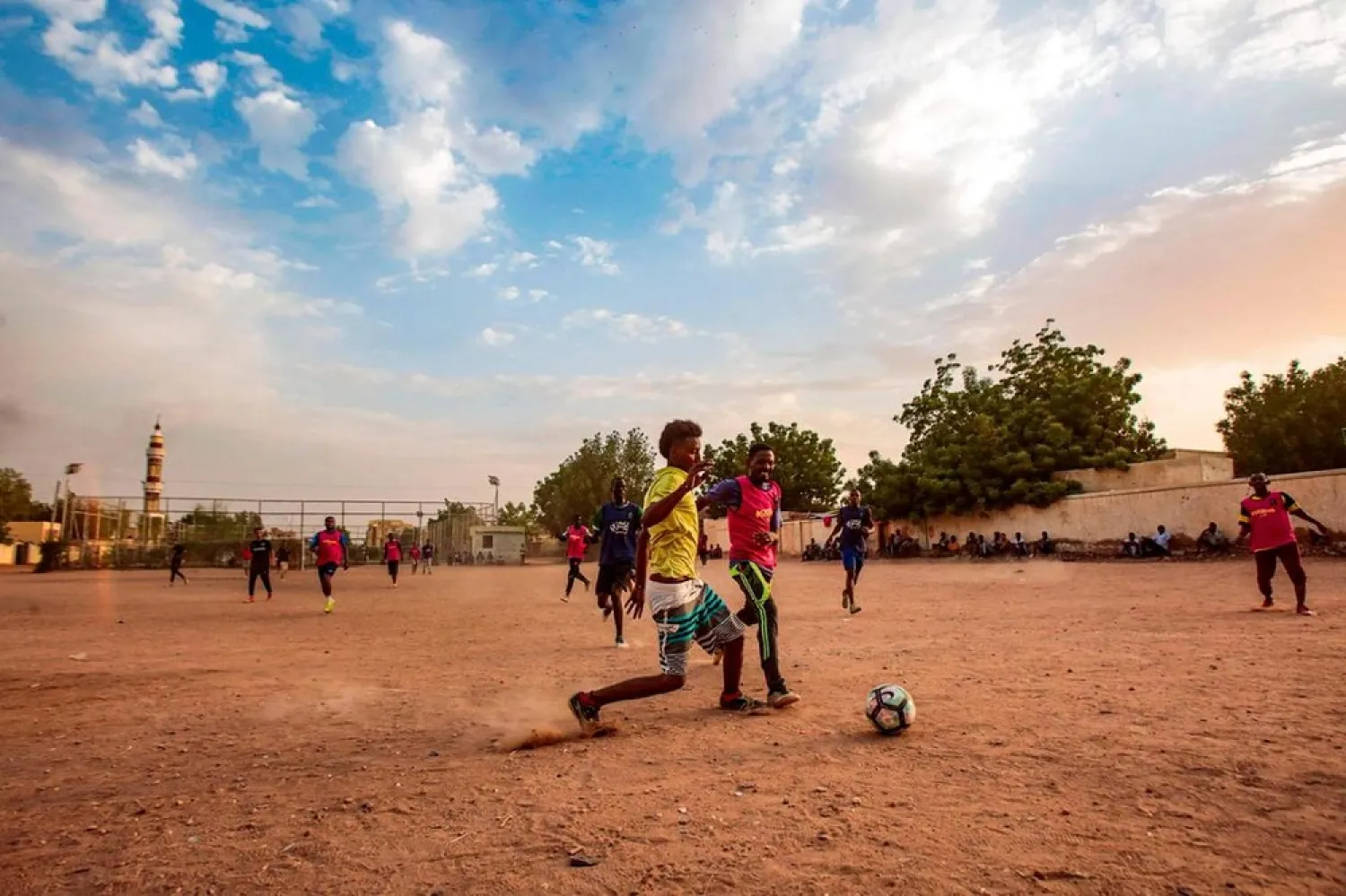
Sudanese youths play football on a dirt field in the capital Khartoum on July 28, 2019. (AFP)
TT

Sudan Footballers Hope for Revolution Boost

Sudanese youths play football on a dirt field in the capital Khartoum on July 28, 2019. (AFP)

He has no kit or support system but 17-year-old footballer Emad Salim hopes Sudan's uprising will bring a boost to his beloved sport and help its players step onto the world stage.

"There are no facilities or the equipment we need," said Salim, son of a farmer, before booting a ball across a dirt pitch in a Khartoum neighborhood.

"I need shoes, equipment and proper training, but there's nothing,” he said, according to AFP.

At sunset, friendly football matches are played on patches of open ground across the capital, with teenagers like Salim kicking up clouds of dust.

The pitches have no markings, are full of holes and the goal posts are almost always without a net.

"There is nobody to motivate me," said Salim, a resident of Tuti Island, where the Blue Nile and White Nile meet in the capital.

"I hope the revolution changes this," he said, referring to the months-long mass protest movement that led to the ouster of longtime president Omar al-Bashir in April.

Many say Bashir's three decades of iron-fisted rule sidelined the sport -- a national pastime.

There are no competitive youth leagues in Sudan, meaning young players like Salim can only play in friendly matches between local clubs.

Their skills are further cramped by poorly maintained pitches, which cause regular injuries that often end many talented players' careers before they even take off.

The matches are "disorganized" and players lack any kind of training or management, said the vice president of the Sudanese Football Association, Al-Fatih Bani.

Local clubs avoid improving facilities because there are no competitive leagues for youths, he said.

While there are some 30 well-maintained pitches in the country, they are privately owned and open only to the elite, Bani added.

Poor record

Sudan has never qualified for the World Cup, even though the country was a pioneer of the sport on the continent.

Along with Egypt and Ethiopia, it helped to found the African Football Confederation, but has only won the African Cup of Nations once in 1970 when it hosted the tournament.

The last time Sudan qualified for the continent's biennial tournament was in 2012, even though it has been expanded to a 24-nation format.

In 1989, Omdurman-based Al-Merrikh became the only Sudanese team to win an African club trophy.

Sudanese football fans are often seen sporting the shirts of international clubs instead of their national team, the result of its poor record brought on by decades of official neglect, according to Bani.

"Many talented players do not get the opportunity to improve and advance," said Monzer Hassan, a coach of a youth team.

"A complete lack of football academies deprives these talented players from honing their skills," he said, adding that every player dreams of playing for the two leading Sudanese clubs, Al-Hilal and Al-Merrikh.

A Sudanese player has never been picked up by a European club, said Bani, but the country is a lucrative destination for foreign players as Sudanese clubs are hungry for professionals.

"Bashir's regime hurt the sport immensely," said Mohamed Harun, an Al-Hilal board member.

For those like Salim or Bani, the revolution that ousted Bashir could herald a turnaround.

"I hope the revolution gives a strong push to football in Sudan," said Bani.


FIFA Bans Reusable Bottles at World Cup Venues Citing Safety Concerns

FIFA World Cup signage is displayed at LA Live in downtown Los Angeles, California, USA, 03 June 2026. EPA/CHRIS TORRES
TT

FIFA Bans Reusable Bottles at World Cup Venues Citing Safety Concerns

FIFA World Cup signage is displayed at LA Live in downtown Los Angeles, California, USA, 03 June 2026. EPA/CHRIS TORRES

Attendees of the World Cup will not be allowed to carry reusable water bottles into venues due to safety concerns, FIFA said on Thursday, following a last-minute change to its Stadium Code of Conduct.

The governing body, which had earlier permitted empty, transparent, reusable plastic bottles inside stadiums, said the updated code - effective from Tuesday - now prohibits them.

Other items like bottles, cups, jars and cans are also banned to prevent the risk of injury if thrown.

"FIFA is committed to protecting the health ⁠and safety of ⁠all players, referees, fans, volunteers, and staff," it told Reuters in a statement. "FIFA made the decision to prohibit bottles to prevent risk and injury to players and attendees."

"Outside bottles are already prohibited at several of these venues for safety considerations and FIFA ⁠is applying this consideration across its tournament stadiums."

The move has raised concerns among supporters about coping with heat, with temperatures at a few venues expected to range between 26 and 28 degrees Celsius, as well as access to drinking water inside stadiums.

FIFA said measures would be in place to deal with the conditions.

"FIFA works closely with each Host City Committee and local authorities on heat mitigation factors for fans ⁠traveling to ⁠the stadium, which can include resources such as misting stations, fans, hydration stations, cooling tents and more around the stadium footprint," the statement said.

"Inside the stadium footprint, pricing for water bottles for the FIFA World Cup 2026 will remain consistent with other events held at each stadium."

The 48-team World Cup, co-hosted by the US, Canada, and Mexico, will run from June 11 to July 19. The tournament will feature 104 matches, up from 64 previously, including an additional knockout round.


Konate Opens Up on Depression after Deaths of Jota and Father

FILE PHOTO: Soccer Football - UEFA Champions League - Quarter Final - Second Leg - Liverpool v Paris St Germain - Anfield, Liverpool, Britain - April 14, 2026 Liverpool's Ibrahima Konate reacts Action Images via Reuters/Lee Smith/File Photo/File Photo
TT

Konate Opens Up on Depression after Deaths of Jota and Father

FILE PHOTO: Soccer Football - UEFA Champions League - Quarter Final - Second Leg - Liverpool v Paris St Germain - Anfield, Liverpool, Britain - April 14, 2026 Liverpool's Ibrahima Konate reacts Action Images via Reuters/Lee Smith/File Photo/File Photo

France defender Ibrahima Konate said on Wednesday he battled depression following the deaths of Liverpool teammate Diogo Jota and his father while continuing to fulfil his football duties.

Portugal forward Jota and his brother Andre Silva died in a car crash last July, while Konate's father, Hamady, passed away in January after a long illness.

"There are low points, there's depression. You can suffer from depression in football too; there's no need to be ashamed to say so," Konate told France Inter radio.

"It's true that I've often heard players say they were suffering from depression and that fans or people on the outside didn't understand because ⁠they were earning ⁠a lot of money. But that's rubbish and you shouldn't say that."

The 27-year-old, who confirmed earlier this week he will leave Liverpool this summer, said Jota's death had taken a heavy toll on him.

"It devastated me. I didn't have any interest in anything else at that point," Reuters quoted him as saying.

"You go back to football because you ⁠have no choice. We're employees at a club that pays us every month, so we have duties.

"We had no choice but to go back on the field and play for him and his family – as well as ourselves. There's no way of getting over it, but you learn to live with it."

At the same time, Konate was coping with his father's illness, leaving him unsure how to balance personal grief with professional commitments.

"I didn't know what to do. I didn't know whether I should go home and stop ⁠playing, because ⁠the team needed me too," he said.

"I didn't know who to talk to about it, so I kept it all to myself."

He lost his father in January and returned early from compassionate leave to help Liverpool through an injury crisis but admitted he did not feel fully recovered.

"There was never a moment when I felt like I was on the mend. All of these tragic events happened so quickly and as soon as I felt like I was getting my head above water, something else happened," he said.

Konate, who has 27 caps for France, is a part of Didier Deschamps' 26-man squad for the World Cup.


Spain Coach Confident Lamine Yamal Will Be Fit for World Cup Opener

Spanish national soccer player Lamine Yamal attends the training session of the team in Las Rozas, Madrid, Spain, 31 May 2026. (EPA)
TT

Spain Coach Confident Lamine Yamal Will Be Fit for World Cup Opener

Spanish national soccer player Lamine Yamal attends the training session of the team in Las Rozas, Madrid, Spain, 31 May 2026. (EPA)

Spain coach Luis de la Fuente expects Lamine Yamal to be fit to play in the team's World Cup opener.

De la Fuente said Wednesday that Yamal will not play in Thursday's warmup match against Iraq in A Coruña, but all signs point to him being available to face Cape Verde in the team's opener in Atlanta on June 15.

“If nothing changes, he could be ready to play on June 15,” De la Fuente said. “It doesn't mean that for sure he will play, we'll see. Maybe a few minutes, maybe just practice so he can improve his condition for the second match. We will have to evaluate.”

Yamal injured his left hamstring while converting a penalty kick for Barcelona in a Spanish league match on April 22. He said this week he was scared of missing the World Cup and prayed that he could recover in time for the tournament that begins on June 11 in North America.

The 18-year-old Yamal is expected to lead the Spain squad that will try to win its second world title.

De la Fuente said the two other injured players in the squad — Nico Williams and Víctor Muñoz — also won't play on Wednesday, nor will the ones who took part in the Champions League final.

Spain's final warmup match will be against Peru in Mexico on Monday. De la Fuente did not say who is expected to play in that match.

After opening against Cape Verde in Group H, Spain will face Saudi Arabia on June 21 in Atlanta and Uruguay on June 26 in Guadalajara.

Spain has never gone past the round of 16 at the World Cup since it won its lone title in 2010.

“We are all excited to get started and try to do well at the tournament,” De la Fuente said.
