
An Art Museum in Your Hotel Lobby

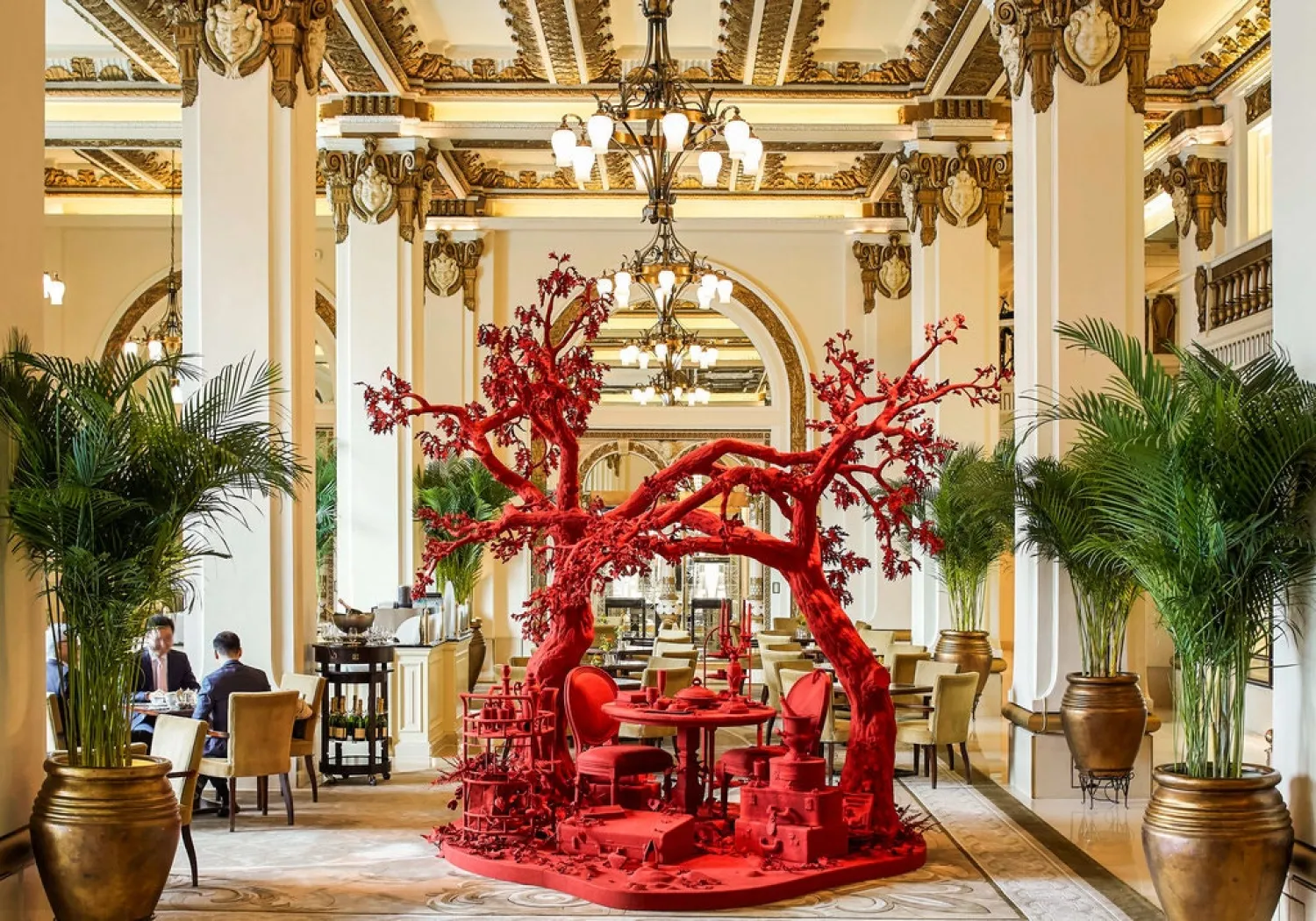
Timothy Paul Myers’s “Alizarin” was on display in the lobby of The Peninsula Hong Kong. It will be displayed at the Tokyo location next spring. | Simon J. Nicol for The Peninsula Hotels
TT

An Art Museum in Your Hotel Lobby

Timothy Paul Myers’s “Alizarin” was on display in the lobby of The Peninsula Hong Kong. It will be displayed at the Tokyo location next spring. | Simon J. Nicol for The Peninsula Hotels

Procuring and exhibiting art in all forms has been synonymous with the hotel experience for several decades now, with both luxury and midlevel brands highlighting local artwork and museum-quality pieces rather than predictable poster reprints.

Guests like it: In a 2018 survey conducted by the nonprofit organization, Americans for the Arts, 72 percent of respondents said they enjoyed the arts in “non-arts” venues including hotels.

Art-centric hotels are popping up in many cities, including the ART in Denver and the upcoming Hall Arts Hotel in Dallas, hoping to attract a new breed of clients who want to be surrounded by sculptures, video installations, paintings and mixed media.

But of late, some properties have begun to push the boundaries of what it means to be a hotel with great art.

Actively Supporting Artists
Artists once depended only on galleries to showcase their work and be “discovered,” but more hotels now actively seek and support new talent in that role.

“We didn’t want to commission art merely for the purposes of decoration,” said Carson Glover, vice president of brand marketing at The Peninsula Hotels. The company created the “Art in Resonance” program, highlighting midcareer artists whose works were unveiled at the Hong Kong property in March.

“Nurturing the artist is an aspect that is so often lost in the business,” he added.

For the first installment of “Art in Resonance,” the American sculptor Janet Echelman created a netlike sculpture whose shape constantly changes with the wind. The Australian-born artist Timothy Paul Myers hand-wrapped everyday items like cups, saucers, and chairs in red felt, creating a site-specific sculpture called “Alizarin” that stood out in the neutral tones of the lobby. And Shanghai-based MINAX architects created a modern version of the traditional Chinese teahouse using 999 pine and bamboo wooden pieces.

“For over twenty years I found myself making these large environmental installations that I can’t afford to build on my own,” says Mr. Paul Myers. His work and that of the other artists will travel to other Peninsula locations over the next few years, much like a museum exhibit.

Rotating Exhibits
Two contemporary art collectors, Laura Lee Brown and Steve Wilson, opened The 21c Museum Hotels in 2006 in Louisville, Ky., with a vision to save the downtown.

The hotel has amassed more than 3,000 works, now spread over public areas, lounges, and rooms, and exhibits are open to the public 24 hours a day, seven days a week. In this aspect, this group of museum hotels — opening its ninth location this year — operates differently than a traditional gallery, which typically has more restricted exhibit hours.

The brand also co-curates exhibitions with museums like the North Carolina Museum of Art with the mind-set that hotel art does not necessarily need to take the place of gallery art.

After the film and video artist Christina Zeidler took over the Gladstone Hotel in Toronto, Canada, the 37-room boutique hotel began holding rotating exhibits annually as well as live events. Artists also helped with the interior design of the rooms.

“Artists are given free rein to think about the design of the furniture, window coverings, wallpaper or wall treatment,” said the exhibitions director Lee Petrie, who explains that apart from the permanent room art, the hotel shies away from commissioning anything. They believe continuously changing exhibits are draws for repeat visits.

Murals
Installing murals has become an increasingly popular way for hotels to spice up room design.

In Philadelphia, the artist King Saladeen grew up as a “super inner-city, super low-income kid,” and became the first artist-in-residence at the new Fitler Club, a “work/stay/play” destination. His gym mural is hard to miss; he used house paint, acrylics and spray paint to create “a burst of energy to stay motivated,” he said.

Rates at the Fitler Club start at $450 for a King-size room; there is a monthly membership to use the club and workspaces from $225.

Philanthropic Efforts
As funding for the arts is always a struggle, some properties have taken to raising contributions in more creative ways.

Saint Kate, the Arts Hotel that opened in Milwaukee, Wis., in July, invited local artists to each design and decorate its “Canvas” rooms. Each Canvas room stay has a percentage of proceeds donated to organizations including The Milwaukee Repertory Theater, Artists Working in Education and even a local radio station.

Large-Scale Installations
Suzi Cordish, who runs more than 70 properties under the Live! Casino & Hotel brand, proudly displays her personal art collection in her hotels. Of late, she’s put her energies into more large-scale installations and supporting emerging and mid-career artists.

She commissioned the Brooklyn-based Chris Doyle to create an animated moving image called “Games of Skill and Chance” on a 9-foot-tall, 40 feet-wide screen at the Maryland Live! property.

Mr. Doyle said that rather than focusing his energies on trying to raise capital, he had peace of mind and free rein working with the hotel. In this instance “the cost of making the video wall was far more expensive than the artist fee,” he said.

The Mexican artist Bosco Sodi created a 16-foot-tall, eight-feet-wide “Blue Pangaea” painting that hangs in the library of Hotel Matilda in San Miguel del Allende.

“If the hotel is a good hotel and you (as an artist) are in a position of putting your conditions with this kind of installation, that helps because a lot of people will see the work,” Mr. Sodi said.

Room rates for Hotel Matilda from $340 per night based on double occupancy, including taxes and fees.

(The New York Times)


'Call of Duty' Co-creator Vince Zampella Killed in Car Crash

Vince Zampella died while driving his Ferrari north of Los Angeles. Frederick M. Brown / GETTY IMAGES NORTH AMERICA/AFP
TT

'Call of Duty' Co-creator Vince Zampella Killed in Car Crash

Vince Zampella died while driving his Ferrari north of Los Angeles. Frederick M. Brown / GETTY IMAGES NORTH AMERICA/AFP

Vince Zampella, the acclaimed co-creator of video gaming juggernaut "Call of Duty," has died in a car crash, gaming giant Electronic Arts confirmed on Monday. He was 55.

The developer and executive died on Sunday while driving his Ferrari on a scenic road north of Los Angeles, according to local broadcaster NBC4.

"For unknown reasons, the vehicle veered off the roadway, struck a concrete barrier, and became fully engulfed," the California Highway Patrol said in a statement, without identifying the two victims in the crash.

The CHP added that both the driver and a passenger who was ejected from the vehicle succumbed to their injuries, reported AFP.

Witnesses posted video of the mangled cherry-red Ferarri, engulfed in flames, on the mountain road. The cause of the crash remains under investigation.

His studios created some of the world's best-selling video games, and Zampella was considered an innovator in first-person military shooter style games.

This year, when his "Battlefield 6" video game set a new sales record for the franchise, Zampella expressed gratitude, saying "we never take moments like this for granted" -- despite a long career of success in gaming.

The mass-combat game has won over 100 million players in the past two decades, in its various iterations.

And yet, that number isn't a first. To this day, "Call of Duty" boasts more than 100 milion active players, monthly.

"You have that dream of the game being popular, but I don't think you're ever ready for that level of success," Zampella told gaming site IGN in a 2016 interview.

Profound, far-reaching

Zampella was best known for co-creating the "Call of Duty" franchise and founding Respawn Entertainment, the studio behind "Titanfall,Apex Legends," and the "Star Wars Jedi" games.

After starting out in the 1990s as a designer on shooter games, he co-founded Infinity Ward in 2002 and helped launch "Call of Duty" in 2003. Activision later acquired his studio.

He left Activision under contentious circumstances and established Respawn in 2010, which Electronic Arts acquired in 2017.

At EA, he eventually took charge of revitalizing the "Battlefield" franchise, cementing his reputation as one of the most influential figures in modern first-person shooter games.

"This is an unimaginable loss, and our hearts are with Vince's family, his loved ones, and all those touched by his work," Electronic Arts said in a statement.

"Vince's influence on the video game industry was profound and far-reaching," the company said, adding that "his work helped shape modern interactive entertainment."

A statement by Respawn, posted on the "Battlefield" X account, praised Zampella "for how he showed up every day, trusting his teams, encouraging bold ideas, and believing in Battlefield and the people building it."

Zampella "championed what he believed was right for the people behind those studios and our players because it mattered."

"It was a bold, transgressive method of storytelling, of a moment in time that was political, that was violent and that was impactful," Washington Post video game reporter Gene Park told NBC4.

"He really knew how to create stories and create experiences, that really hit at the heart of human experience -- whether it was terror, dread, heroism. I think he was really able to kindof encapsulate that through the designs of the video games that he made," Park said.


GEA Chairman Named 2025 ‘Promoter of the Year’ by Boxing News

Turki Alalshikh, Chairman of the General Entertainment Authority (GEA) and Saudi Boxing Federation President, was named “Promoter of the Year” for 2025 by the Britain-based Boxing News magazine. (SPA)
TT

GEA Chairman Named 2025 ‘Promoter of the Year’ by Boxing News

Turki Alalshikh, Chairman of the General Entertainment Authority (GEA) and Saudi Boxing Federation President, was named “Promoter of the Year” for 2025 by the Britain-based Boxing News magazine. (SPA)

Turki Alalshikh, Chairman of the General Entertainment Authority (GEA) and Saudi Boxing Federation President, was named “Promoter of the Year” for 2025 by the Britain-based Boxing News magazine, the Saudi Press Agency reported on Tuesday.

The recognition reflects Alalshikh influential contributions and growing role in advancing the global boxing industry, built on a series of initiatives led by him in recent years.

It celebrates his efforts in elevating the stature of major fight cards, raising organizational standards, and enhancing both the sporting and media experience of boxing events, with a vision and strong international partnerships that have been instrumental in attracting the sport’s biggest global names.


Al-Qatif Street Food Festival Celebrates Saudi Culinary Arts

The event features six pavilions that allow visitors to explore a wide variety of foods and beverages made from local ingredients, reflecting the Kingdom’s diverse environments and regional flavors - SPA
TT

Al-Qatif Street Food Festival Celebrates Saudi Culinary Arts

The event features six pavilions that allow visitors to explore a wide variety of foods and beverages made from local ingredients, reflecting the Kingdom’s diverse environments and regional flavors - SPA

The Culinary Arts Commission launched Al-Qatif Street Food Festival, which runs until December 30, 2025, offering visitors a rich cultural experience that highlights Saudi culinary arts in a setting that reflects the authenticity and diversity of the Kingdom’s national cuisine, while reinforcing the presence of heritage within the contemporary cultural landscape.

The festival showcases Saudi food culture as a vital component of national identity through live cooking stations where traditional dishes are prepared and presented by culinary experts, SPA reported.

The event features six pavilions that allow visitors to explore a wide variety of foods and beverages made from local ingredients, reflecting the Kingdom’s diverse environments and regional flavors.

In addition to the culinary offerings, the festival presents a range of accompanying cultural experiences designed to enrich the visitor journey and encourage engagement with food as both an artistic and knowledge-based experience.

These include a dedicated children’s pavilion, interactive tasting spaces for dishes, and innovative beverage experiences inspired by Saudi agricultural products.