


China, Pakistan Slam India's Move to Change Kashmir's Special Status

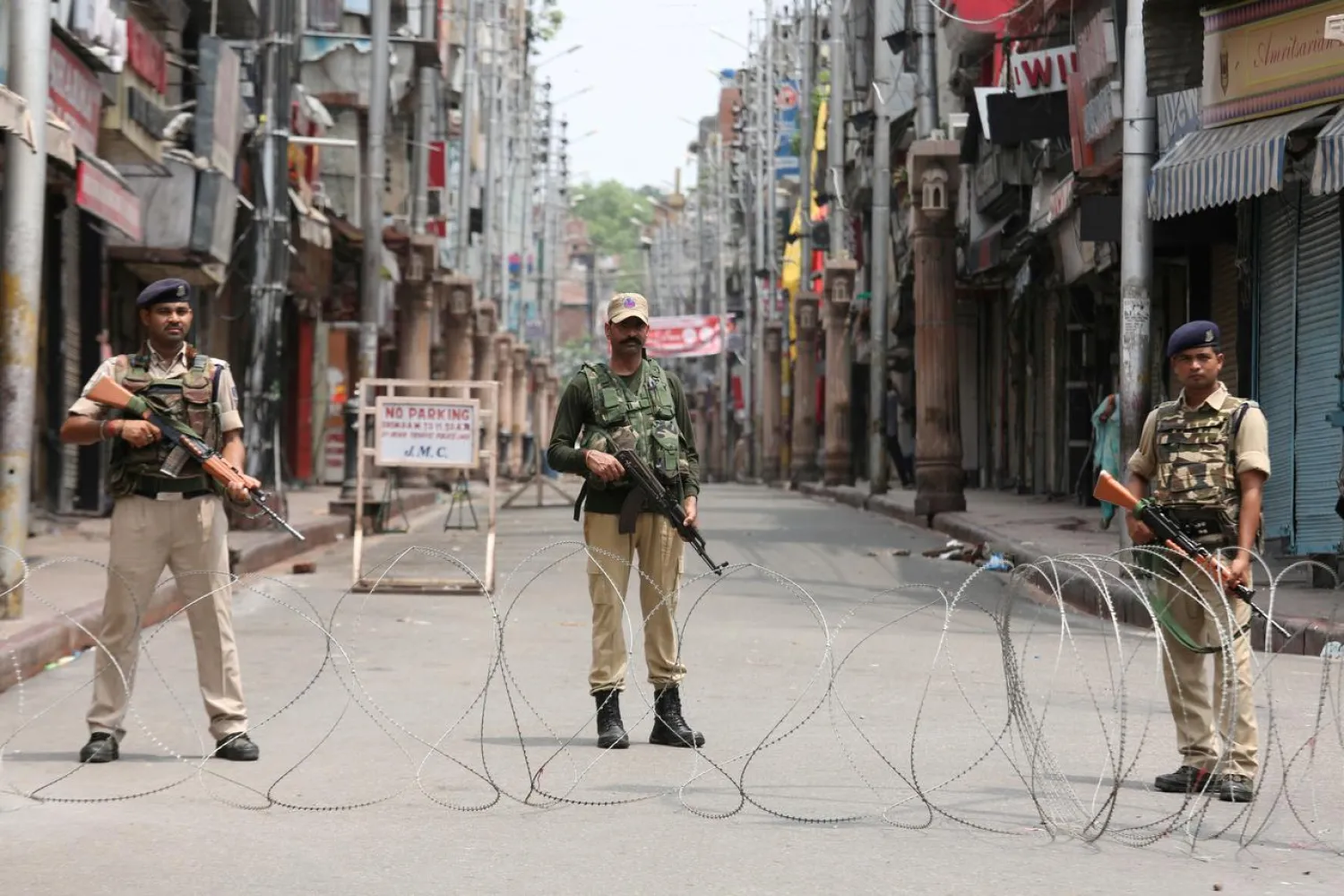
Indian security personnel stand guard along a deserted street during restrictions in Jammu, August 5, 2019. (Reuters)
TT

China, Pakistan Slam India's Move to Change Kashmir's Special Status

Indian security personnel stand guard along a deserted street during restrictions in Jammu, August 5, 2019. (Reuters)

Indian Prime Minister Narendra Modi’s plan to change the status of Kashmir ran into fierce opposition from China and its ally Pakistan on Tuesday as the disputed territory lay under a telecoms blackout to forestall protests for a second day.

In a move to tighten its grip on Jammu and Kashmir, parts of which are claimed by Pakistan and China, India dropped a constitutional provision that allowed the country’s only Muslim-majority state to make its own laws.

The changes imposed by Modi’s Hindu nationalist-led government are the most sweeping in the nearly 30 years that India has been battling a revolt in Kashmir. The government also broke up the state into two federally administered territories.

China said it opposed India’s decision to revoke Kashmir’s special status and that New Delhi needed to be cautious on border issues.

“India’s action is unacceptable and would not have any legal effect,” Foreign Ministry spokeswoman Hua Chunying said in a statement, drawing an immediate rebuke from Delhi that Kashmir was an internal affair.

The Himalayan region is divided between India, which rules the populous Kashmir Valley and the Hindu-dominated region around Jammu city, Pakistan, which controls a wedge of territory in the west, and China, which holds a thinly populated high-altitude area in the north.

China urged India to strictly abide by the agreements reached by both countries in order to avoid any actions that would further complicate boundary issues, Hua said. India and China have a longstanding dispute over the border including in Ladakh, the high altitude area.

Indian foreign ministry spokesman Raveesh Kumar said splitting Jammu and Kashmir into federal territories was a domestic issue.

“India does not comment on the internal affairs of other countries and similarly expects other countries to do likewise.”

Thousands of paramilitary troops have been deployed in Kashmir and phone and internet services have been suspended, prompting criticism the government is trying to stifle all dissent.

Video images by Reuters partner ANI showed deserted streets on Tuesday in Srinagar, the main city of the region at the heart of the decades-long armed revolt which India accuses Pakistan of helping. Islamabad says it gives only moral and diplomatic support to the Kashmiri people in their struggle for self-determination.

After a meeting with top commanders in the city of Rawalpindi, Pakistan’s army chief expressed support for the people of Kashmir, and the prime minister said he was weighing an approach to the United Nations Security Council.

“The Pakistan Army firmly stands by the Kashmiris in their just struggle to the very end,” said General Qamar Javed Bajwa. “We are prepared and shall go to any extent to fulfil our obligations in this regard.”

The nuclear-armed neighbors have fought two of their three wars over the territory, and engaged in an aerial clash in February after a militant group based in Pakistan claimed responsibility for an attack on an Indian military convoy.

“We will fight it (Modi’s policy) at every forum. We’re thinking how we can take it to International Court (of Justice) ... to the United Nations Security Council,” Prime Minister Imran Khan told Pakistan’s parliament.

The Indian government has said Kashmir’s special status hindered its development because it barred people from outside the state from buying property, investing and settling there.

“We will make Jammu and Kashmir into one of our most developed states,” Home Minister Amit Shah told parliament to loud cheers from supporters.

Armed police on Tuesday patrolled every few hundred meters in Srinagar, where a ban on public gatherings of more than four people stayed in force. Educational institutions and most shops in residential neighborhoods were shut.

Some shopkeepers said stocks were running out after days of panic-buying.

“No provisions are left in my shop, and no fresh supplies are coming,” said grocery store owner Jehangir Ahmad.

At a Srinagar hospital hit by the crackdown on telephone, television and internet communications, staff were working overtime, with ambulances sent to bring in doctors and nurses.

“We are managing for now,” said a senior official at the 500-bed Lal Ded hospital who sought anonymity as he was not authorized to speak to media.

In Muzaffarabad, the capital of Pakistan-governed Kashmir about 45 km (28 miles) from the neighbors’ contested border, protests entered a second day, with hundreds of people, including children, shouting anti-India slogans.

Many Kashmiris have relatives on both sides of the border, but those on the Pakistani side say they have been unable to reach people in India for days.

Tanveer-ul-Islam, who migrated to Muzaffarabad in 1990, said he had lost touch with his mother in Indian Kashmir since Sunday.

“You can’t even imagine my pain,” he added. “We do not know about the well-being of anyone across the divide.”



Top Trump Iran Negotiator Says Visits US Aircraft Carrier in Middle East

US Special Envoy Steve Witkoff delivers a press conference upon the signing of the declaration on deploying post-ceasefire force in Ukraine, during the so-called "Coalition of the Willing" summit, at the Elysee Palace in Paris, France, January 6, 2026. (Reuters)
TT

Top Trump Iran Negotiator Says Visits US Aircraft Carrier in Middle East

US Special Envoy Steve Witkoff delivers a press conference upon the signing of the declaration on deploying post-ceasefire force in Ukraine, during the so-called "Coalition of the Willing" summit, at the Elysee Palace in Paris, France, January 6, 2026. (Reuters)

US President Donald Trump's lead Iran negotiator Steve Witkoff on Saturday said he visited the USS Abraham Lincoln aircraft carrier currently in the Arabian Sea, with Washington and Tehran due to hold further talks soon.

"Today, Adm. Brad Cooper, Commander of US Naval Forces Central Command, Jared Kushner, and I met with the brave sailors and Marines aboard the USS Abraham Lincoln, her strike group, and Carrier Air Wing 9 who are keeping us safe and upholding President Trump's message of peace through strength," said Witkoff in a social media post.

Iranian Foreign Minister Abbas Araghchi said on Saturday he hoped talks with the United States would resume soon, while reiterating Tehran's red lines and warning against any American attack.


Israel’s Netanyahu Expected to Meet Trump in US on Wednesday and Discuss Iran

Israeli Prime Minister Benjamin Netanyahu delivers a speech during a special session to mark the 77th anniversary of the Knesset's establishment and the 60th anniversary of the dedication of the current building at the Knesset, the Israeli parliament, in Jerusalem, 02 February 2026. (EPA)
TT

Israel’s Netanyahu Expected to Meet Trump in US on Wednesday and Discuss Iran

Israeli Prime Minister Benjamin Netanyahu delivers a speech during a special session to mark the 77th anniversary of the Knesset's establishment and the 60th anniversary of the dedication of the current building at the Knesset, the Israeli parliament, in Jerusalem, 02 February 2026. (EPA)

Israeli Prime Minister Benjamin Netanyahu is expected to meet US President Donald Trump on Wednesday in Washington, where they will discuss negotiations with Iran, Netanyahu's office said on Saturday.

Iranian and US officials held indirect nuclear ‌talks in the ‌Omani capital ‌Muscat ⁠on Friday. ‌Both sides said more talks were expected to be held again soon.

A regional diplomat briefed by Tehran on the talks told Reuters Iran insisted ⁠on its "right to enrich uranium" ‌during the negotiations with ‍the US, ‍and that Tehran's missile capabilities ‍were not raised in the discussions.

Iranian officials have ruled out putting Iran's missiles - one of the largest such arsenals in the region - up ⁠for discussion, and have said Tehran wants recognition of its right to enrich uranium.

"The Prime Minister believes that any negotiations must include limiting ballistic missiles and halting support for the Iranian axis," Netanyahu's office said in a ‌statement.


Italy FM Rules Out Joining Trump’s ‘Board of Peace’

Italy's Minister for Foreign Affairs Antonio Tajani speaks to the press during the EPP Leaders’ meeting, in Zagreb, Croatia, 30 January 2026. (EPA)
TT

Italy FM Rules Out Joining Trump’s ‘Board of Peace’

Italy's Minister for Foreign Affairs Antonio Tajani speaks to the press during the EPP Leaders’ meeting, in Zagreb, Croatia, 30 January 2026. (EPA)

Italy will not take part in US President Donald Trump's "Board of Peace", Italian Foreign Minister Antonio Tajani said Saturday, citing "insurmountable" constitutional issues.

Trump launched his "Board of Peace" at the World Economic Forum in Davos in January and some 19 countries have signed its founding charter.

But Italy's constitution bars the country from joining an organization led by a single foreign leader.

Prime Minister Giorgia Meloni, a Trump ally, last month noted "constitutional problems" with joining, but suggested Trump could perhaps reopen the framework "to meet the needs not only of Italy, but also of other European countries".

Tajani appeared Saturday to rule that out.

"We cannot participate in the Board of Peace because there is a constitutional limit," he told the ANSA news agency.

"This is insurmountable from a legal standpoint," he said, the day after meeting US Secretary of State Marco Rubio and US Vice President JD Vance at the Olympics in Milan.

Although originally meant to oversee Gaza's rebuilding, the board's charter does not limit its role to the Palestinian territory and appears to want to rival the United Nations.