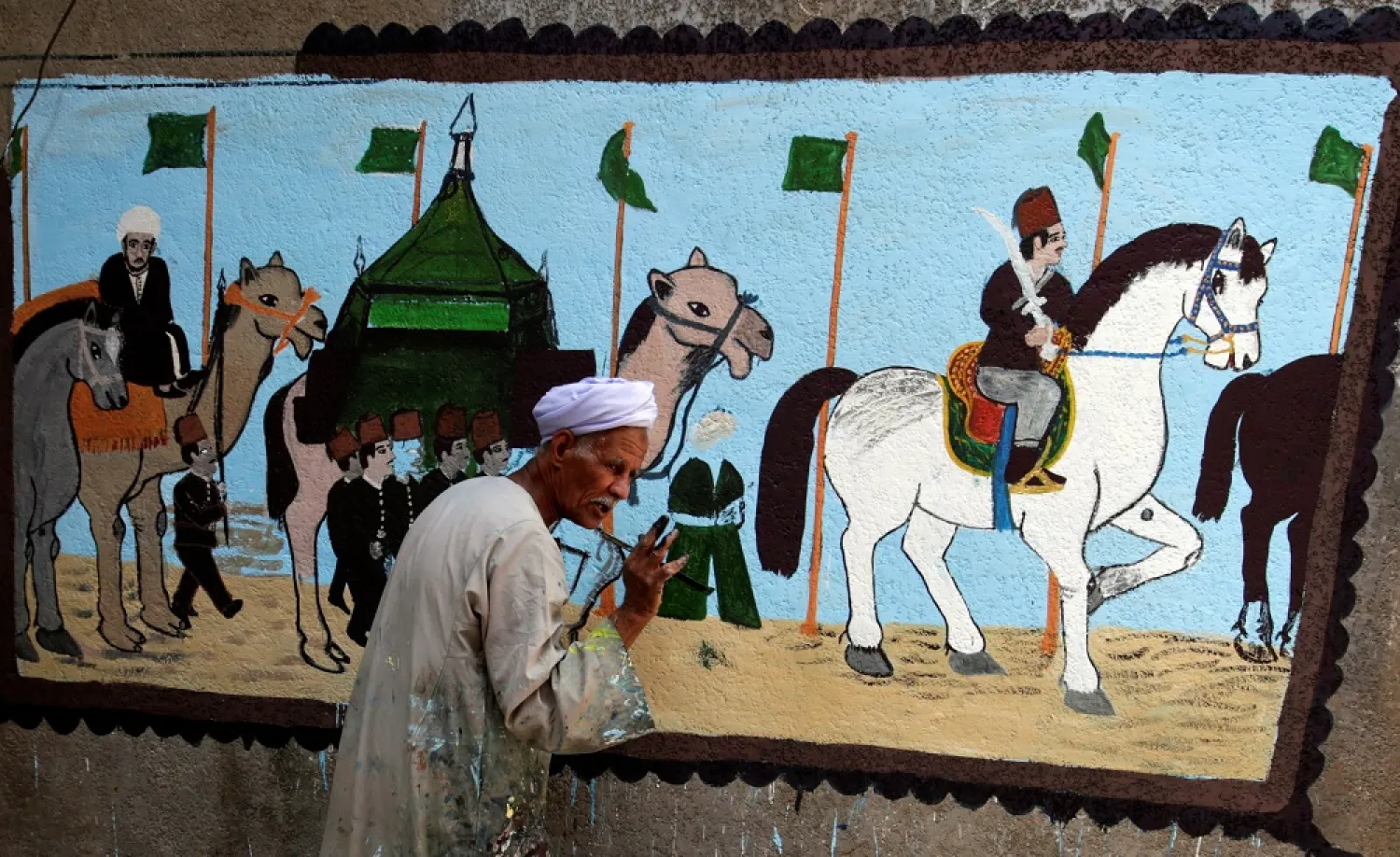
Egyptian Artist Paints Murals on Houses to Celebrate Hajj

The artist Eid Al Salwaawi paints murals about the holy Kaaba and the rituals of the Hajj pilgrimage to Makkah, in Cairo, Egypt, July 17, 2019. (Reuters)
TT

Egyptian Artist Paints Murals on Houses to Celebrate Hajj

The artist Eid Al Salwaawi paints murals about the holy Kaaba and the rituals of the Hajj pilgrimage to Makkah, in Cairo, Egypt, July 17, 2019. (Reuters)

Eid Al Salwaawi, 69, paints murals of the rituals of the Hajj pilgrimage on the walls of a house in Cairo’s Sayeda Zainab neighborhood.

Sometimes he volunteers to paint scenes that celebrate the Hajj and religious stories and lessons, other times he is paid, reported Reuters Wednesday.

Every year, Muslims travel from around the world to the holy city of Makkah in Saudi Arabia to complete the Hajj, one of the five pillars of their faith. This year’s Hajj begins on Friday.

Salwaawi said the Hajj scenes he saw on the walls of houses in his home village as a child in northern Aswan captured his imagination.

“So I draw camel caravans and soldiers wearing traditional hats guarding them,” he said.

He uses simple tools like a handmade palm frond brush and a mixture of paint, vinegar, rosewater, gum Arabic and glue.

One mural depicts women as they embark on the pilgrimage, dressed in bright colors, another shows a caravan carrying the tapestry that covers the Kaaba, the holiest site in Islam. He adorns his works with prayers and Quranic verses.

Each mural takes him between two and three hours.


Measles Cases in Europe, Central Asia Drop 75% in 2025

University students wait to receive measles vaccine at a university in Guadalajara, Mexico, February 9, 2026. REUTERS/Michelle Freyria
TT

Measles Cases in Europe, Central Asia Drop 75% in 2025

University students wait to receive measles vaccine at a university in Guadalajara, Mexico, February 9, 2026. REUTERS/Michelle Freyria

Measles cases across ‌Europe and Central Asia fell 75% in 2025 from a year earlier, preliminary data from 53 countries in the WHO European Region showed, though UN children's agency UNICEF and the World Health Organization warned the risk of fresh outbreaks remains.

The countries reported 33,998 measles cases in 2025, a significant drop from 127,412 cases in 2024, the agencies said.

Despite the drop, the ‌number of ‌cases in 2025 was higher than ‌in ⁠most years since ⁠2000, and several countries reported increases from 2024.

Measles cases continue to be detected in 2026 in the WHO European Region, the agency said, according to Reuters.

UNICEF regional director Regina De Dominicis said many cases could be prevented with stronger routine vaccination ⁠and faster action during outbreaks.

"Until all ‌children are reached ‌with vaccination, and hesitancy fueled by misinformation is addressed, children ‌will remain at risk of death or ‌serious illness," she said.

At a September 2025 meeting, the European Regional Verification Commission for Measles and Rubella Elimination found that the number of countries with ‌ongoing or re-established endemic measles transmission rose to 19 from 12 the year before — ⁠the ⁠region's biggest setback in recent years.

WHO regional director Hans Henri Kluge said the virus will continue to spread unless communities reach the 95% vaccination coverage needed to prevent outbreaks.
"Unless immunity gaps across all ages are closed, this highly contagious virus will keep circulating," he said.

UNICEF and WHO said they continue to work with governments and partners, including the vaccine alliance, Gavi, and the European Union to strengthen immunization, surveillance and outbreak preparedness.


British Museum to Keep Pendant Linked to Henry VIII

The Tudor Heart pendant, linked to Britain's King Henry VIII and his first wife Katherine of Aragon, which the British Museum acquired after raising 3.5 million pounds, in this undated handout image. The British Museum/Handout via REUTERS.
TT

British Museum to Keep Pendant Linked to Henry VIII

The Tudor Heart pendant, linked to Britain's King Henry VIII and his first wife Katherine of Aragon, which the British Museum acquired after raising 3.5 million pounds, in this undated handout image. The British Museum/Handout via REUTERS.

The British Museum has successfully raised £3.5 million ($4.8 million) to keep a gold pendant linked to King Henry VIII's marriage to his first wife, Katherine of Aragon, according to BBC.

The central London museum launched a fundraising appeal in October so it could permanently acquire the Tudor Heart, found by a metal detectorist in a Warwickshire field in 2019.

It has now announced that it reached its fundraising goal after receiving £360,000 in public donations and a string of donations from grants, trusts and arts organizations.

Museum director Nicholas Cullinan said: “The success of the campaign shows the power of history to spark the imagination and why objects like the Tudor Heart should be in a museum.”

Research led by the British Museum has revealed that the Tudor Heart pendant may have been made to celebrate the betrothal of their two-year-old daughter Princess Mary to the eight-month-old French heir-apparent in 1518.

The pendant unites the Tudor rose with Katherine's pomegranate symbol and features a banner that reads “tousiors,” the old French for “always.”

After it was found, the pendant was reported under the Treasure Act 1996, which gives museums and galleries in England a chance to acquire historical objects and put them on display.

In order to put the pendant on permanent display, the museum had to pay a reward to the metal detectorist who made the discovery and the owner of the land it was found on.

The museum was keen to keep the Tudor Heart as it believed that few artifacts related to Henry VIII's marriage to Katherine of Aragon have survived.

Since the appeal, it said, more than 45,000 members of the public had contributed to the cause, helping it raise just over 10% of its £3.5 million goal.

It also received £1.75 million from The National Heritage Memorial Fund, which aims to save the UK's most outstanding, at-risk heritage treasures.

Other donors include the charity Art Fund, the Julia Rausing Trust and The American Friends of the British Museum.

Cullinan told BBC Radio 4's Today program: “The fact 45,000 members of the public have got behind this and donated money to keep it on the country on public display shows the enthusiasm for this object - it really is unique.”


New York Seeks Rights for Beloved but Illegal ‘Bodega Cats’

Guest Dan Rimada, founder of Bodega Cats of New York holds a cat named Ashley in a bodega corner store on December 17, 2025 in New York City. (AFP)
TT

New York Seeks Rights for Beloved but Illegal ‘Bodega Cats’

Guest Dan Rimada, founder of Bodega Cats of New York holds a cat named Ashley in a bodega corner store on December 17, 2025 in New York City. (AFP)

Simba, a large cat with thick ginger and white fur, is one of thousands of felines that live in New York's corner shops known as "bodegas" -- even if their presence is illegal.

Praised for warding off pests, so-called bodega cats are also a cultural fixture for New Yorkers, some of whom are now pushing to enshrine legal rights for the little store helpers.

"Simba is very important to us because he keeps the shop clean of the mice," Austin Moreno, a shopkeeper in Manhattan, told AFP from behind his till.

The fluffy inhabitant also helps to entice customers.

"People, very often, they come to visit to ask, what is his name? The other day, some girls saw him for the first time and now they come every day," said Moreno.

Around a third of the city's roughly 10,000 bodegas are thought to have a resident cat despite being liable to fines of $200-$350 for keeping animals in a store selling food, according to Dan Rimada, founder of Bodega Cats of New York.

Rimada photographs the felines for his social media followers and last year launched a petition to legalize bodega cats, which drew nearly 14,000 signatures.

"These cats are woven into the fabric of New York City, and that's an important story to tell," he said.

- Pressure point -

Inspired by Rimada's petition, New York City council member Keith Powers has proposed a measure to shield the owners of bodega cats from penalties.

His legislation would also provide free vaccinations and spay or neuter services to the felines.

But animal shelters and rights groups say this wouldn't go far enough.

While Simba can nap in the corner of his shop with kibble within paw's reach, many of his fellow cats are locked in basements, deprived of food or proper care, and abandoned when they grow old or fall ill.

Becky Wisdom, who rescues cats in New York, warned that lifting the threat of fines could remove "leverage" to encourage bodega owners to better care for the animals.

She also opposes public funds being given to business owners rather than low-income families who want their cats spayed or neutered.

The latter is a big issue in New York, where the stray cat population is estimated at around half a million.

- Radical overhaul -

Regardless of what the city decides, it is the state of New York that has authority over business rules, said Allie Taylor, president of Voters for Animal Rights.

Taylor said she backs another initiative proposed by state assembly member Linda Rosenthal, a prominent animal welfare advocate, who proposes allowing cats in bodegas under certain conditions.

These would include vet visits, mandatory spaying or neutering, and ensuring the cats have sufficient food, water and a safe place to sleep.

Beyond the specific case of bodega cats, Taylor is pushing for a more radical overhaul of animal protection in New York.

"Instead of focusing on one subset of cats, we need the city to make serious investments, meaning tens of millions of dollars per year into free or low cost spay, neuter and veterinary care," she said.