


Saudi Red Sea Development Company Constructing Residential Village for Workers

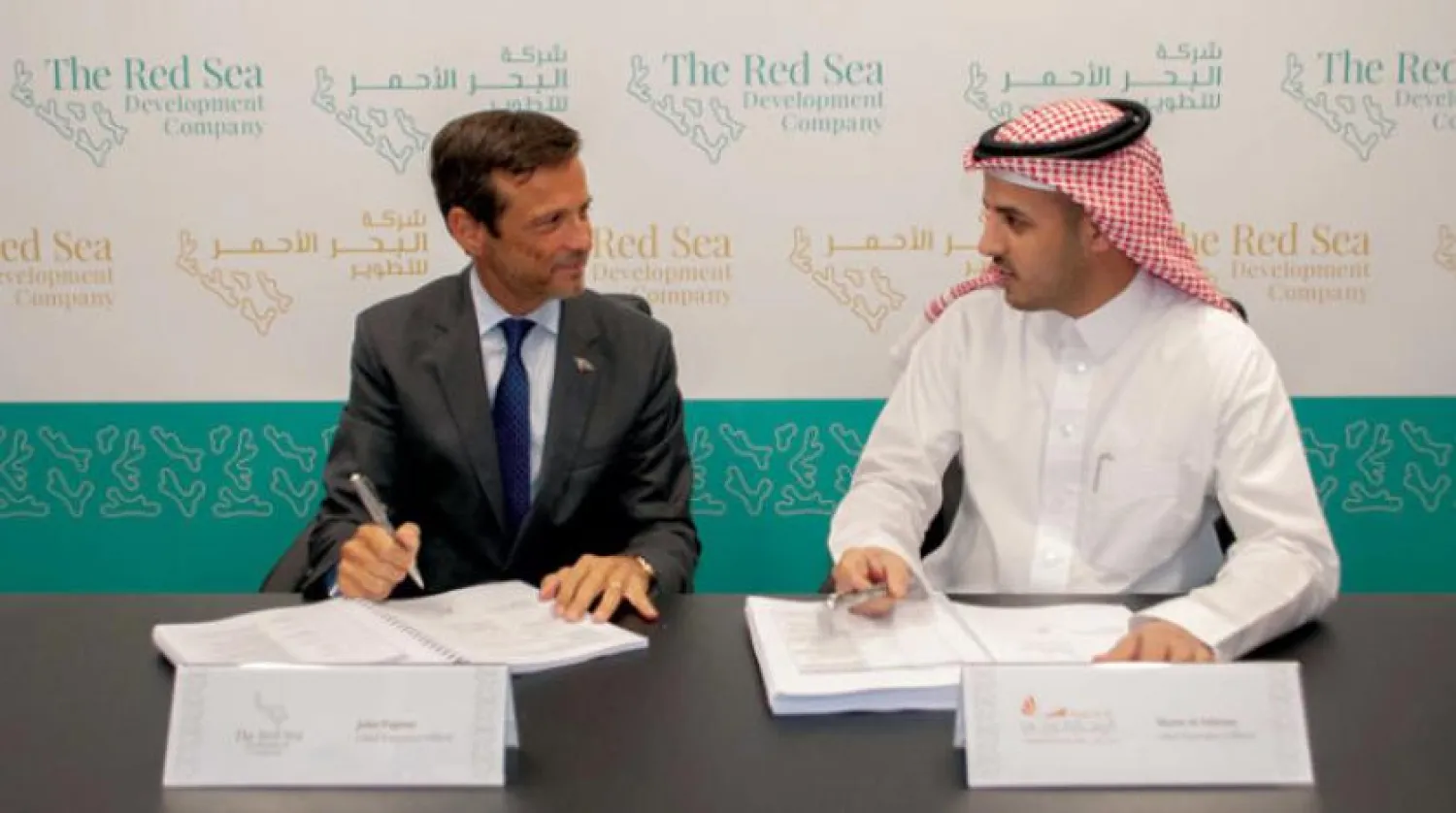
John Pagano, CEO of TRSDC during the signing of the contract with Mazen al-Zahrani, CEO of al-Majal al-Arabi Holding (Asharq al-Awsat)
TT

Saudi Red Sea Development Company Constructing Residential Village for Workers

John Pagano, CEO of TRSDC during the signing of the contract with Mazen al-Zahrani, CEO of al-Majal al-Arabi Holding (Asharq al-Awsat)

The Red Sea Development Company (TRSDC) has announced beginning the construction of a residential village for workers.

The village includes administrative offices, residential units, and commercial facilities that will serve the company's employees in addition to the workers at the project site.

It pointed out that the Saudi al-Majal al-Arabi Holding Group will work on developing management offices that will accommodate 500 employees and be delivered by the second quarter of 2020.

According to a statement by TRSDC on Wednesday, the management area, which covers 7,000 square meters, will be the operation center of the project’s development plan.

Three locations were selected in a way employees can benefit from the unique climate of the project area and the ease of their mobility.

The administration area will also include many facilities, such as a restaurant hall with a capacity of 160 people and a meeting room for 100 people.

In this context, Saudi Amana Contracting Co, which has recently signed a contract to design and construct a special hotel for TRSDC’s employees, and third-party companies operating in the destination have won the first contract to develop residential units in the staff city.

The contract stipulates that Amana Contracting shall develop the first 10 residential units with 300 apartments in two phases.

The first phase will include the delivery of five residential units by the third quarter of 2020.

While the second phase will include the completion of the remaining half by the fourth quarter of the same year.

Some of these units will initially be used to house construction workers on site and later be occupied by hotel staff, commercial assets, retailers, and leisure facilities.

“As we progress with construction of the first phase of The Red Sea Project, we are not losing sight of the need to provide a high standard of living for the workers and employees who will deliver and work at the destination while maintaining our commitment to protecting the environment,” said the CEO of TRSDC, John Pagano.



FII Institute Names Princess Maha bint Mishari Al Saud as CEO

Princess Maha bint Mishari bin Abdulaziz Al Saud (Asharq Al-Awsat file photo)
TT

FII Institute Names Princess Maha bint Mishari Al Saud as CEO

Princess Maha bint Mishari bin Abdulaziz Al Saud (Asharq Al-Awsat file photo)

The FII institute, run by a global nonprofit foundation of ⁠Saudi sovereign wealth ⁠fund PIF, has named ⁠Princess Maha bint Mishari bin Abdulaziz Al Saud as its CEO, according to ⁠the ⁠institute's website.

“With more than 25 years of leadership experience spanning healthcare, academia, strategic partnerships, and international engagement, Dr. Al Saud has built a distinguished career centered on creating impact through collaboration and institution-building. She has worked across the public, private, and nonprofit sectors to advance initiatives that strengthen organizations, expand opportunity, and improve lives,” the website said.

Before joining FII Institute, she served as Vice President of External Relations and Advancement at Alfaisal University.

She has helped expand strategic partnerships, deepen international engagement, and elevate the university’s global standing in education, research, and innovation.

“A recognized advocate for leadership, healthcare transformation, education, and human development, Dr. Al Saud has represented Saudi Arabia at major international forums, including the G20, and the fourth Eurasian Women’s Forum,” FII Institute said.

“Dr. Al Saud holds an MBBS degree and is certified by the American Board of Internal Medicine, having completed her residency training at George Washington University. Her executive credentials include the Senior Executive Leadership Program at Harvard Business School, IMD Business School and she holds the prestigious, peer-reviewed distinction of Master of the American College of Physicians (MACP),” it added.


Egypt Clears Arrears to Oil and Gas Companies

People walk past a shop selling football jerseys in Khan el-Khalily Bazar in Cairo on June 9, 2026. (AFP)
TT

Egypt Clears Arrears to Oil and Gas Companies

People walk past a shop selling football jerseys in Khan el-Khalily Bazar in Cairo on June 9, 2026. (AFP)

Egypt's Minister of Petroleum Karim Badawi said on Wednesday that the full settlement of arrears owed to oil and gas partners marked a turning point for the sector.

Badawi ‌said payment ‌of the arrears, "restores ‌investor confidence ⁠and paves the ⁠way for increased upstream activity and accelerated project development".

Egypt had accumulated about $6.1 billion in arrears to foreign oil companies by June ⁠30, 2024 due to ‌a ‌prolonged foreign currency shortage that delayed payments ‌and weighed on investment and ‌gas output. The shortage has since eased, though some companies have said that arrears kept ‌accumulating.

The minister said clearing the debt removed ⁠a ⁠key obstacle to new investment inflows and would support increased exploration, drilling and field development activity, including projects in the Mediterranean where development typically requires significant capital spending and years of work before production begins.


Saudi Economy Demonstrates Competitive Strength, Expands 3% in First Quarter

A view of the Saudi capital, Riyadh. (SPA)
TT

Saudi Economy Demonstrates Competitive Strength, Expands 3% in First Quarter

A view of the Saudi capital, Riyadh. (SPA)

Saudi Arabia’s economy has once again demonstrated the strength of its fundamentals and its ability to withstand regional shocks, posting real GDP growth of 3 percent year-on-year in the first quarter of 2026, despite escalating tensions across the Middle East that have disrupted supply chains and global trade flows.

The final official figures surpassed the earlier flash estimate of 2.8 percent. The upward revision reflected higher estimates from the General Authority for Statistics (GASTAT), which raised growth projections for both oil and non-oil activities to 2.9 percent. The Kingdom had recorded growth of 5.2 percent in the fourth quarter of 2025.

Saudi Arabia’s performance amid logistical challenges, including shipping disruptions through the Strait of Hormuz, recently received backing from an International Monetary Fund mission.

Following consultations in Riyadh, IMF experts said the Kingdom had successfully mitigated the effects of regional conflict and eased logistical bottlenecks through resilient infrastructure, the rapid deployment of the East-West pipeline and Red Sea ports, and strong financial buffers provided by the Public Investment Fund and a stable banking sector.

The IMF nevertheless revised its 2026 growth forecast for Saudi Arabia to 2 percent from a previous estimate of 3.1 percent, citing regional instability.

Broad-based expansion

According to GASTAT, first-quarter growth was driven by gains across all major sectors of the economy. Oil and non-oil activities each expanded 2.9 percent year-on-year, while government activities rose 1.5 percent.

On a seasonally adjusted basis, real GDP declined 1.2 percent from the fourth quarter of 2025, reflecting a 6.8 percent contraction in oil activities. Government and non-oil sectors, however, continued to post quarterly growth of 1.4 percent and 0.3 percent, respectively.

Financial services, insurance and business services recorded the strongest performance among detailed sectors, growing 5.4 percent year-on-year and 1.1 percent quarter-on-quarter.

Manufacturing activities, excluding oil refining, expanded 4 percent annually. Crude oil and natural gas activities grew 3.6 percent from a year earlier, despite a 7 percent quarterly decline linked to shipping disruptions.

Consumption and investment remain strong

Government final consumption expenditure rose 11.3 percent year-on-year and 8.5 percent quarter-on-quarter, while private consumption increased 5.3 percent annually.

Gross fixed capital formation climbed 3.9 percent year-on-year and 7.5 percent quarter-on-quarter, underscoring continued investment momentum. Exports increased 1.4 percent from a year earlier, while imports fell 5.5 percent.

Non-oil activities remained the primary driver of economic growth, contributing 1.7 percentage points to overall GDP expansion. Oil activities added 0.8 percentage points, while government activities and net taxes contributed 0.3 and 0.2 percentage points, respectively.

The IMF also praised the Saudi Central Bank (SAMA) for maintaining a countercyclical capital buffer of 100 basis points, noting that the Saudi riyal’s peg to the US dollar continues to bolster monetary-policy credibility and financial stability.

On structural reforms, the fund welcomed the recalibration of the Public Investment Fund’s 2026-2030 strategy, aimed at allocating capital more selectively and encouraging greater private sector participation.

It said continued progress toward the objectives of Vision 2030, including deeper capital markets, stronger alignment between education and labor market needs, and broader adoption of artificial intelligence and logistics technologies, remains essential to achieving sustainable economic diversification and safeguarding prosperity for future generations.