

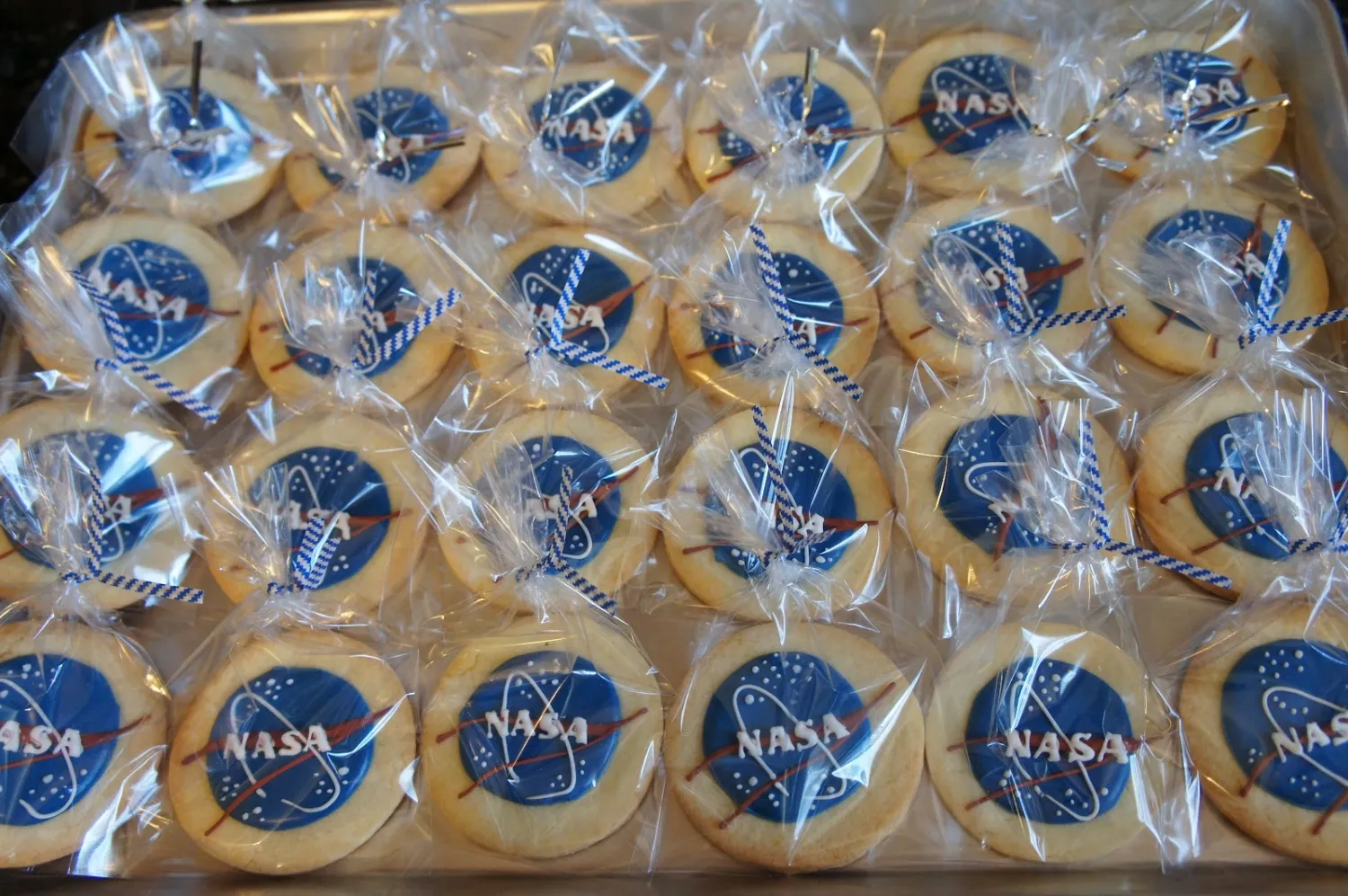

The Great NASA Bake-Off

The Great NASA Bake-Off
TT

The Great NASA Bake-Off

The Great NASA Bake-Off

The sight of a cookie had never made me grimace until this one showed up in my email inbox.

DoubleTree by Hilton, the hotel chain, was announcing that it would soon send a little oven and a batch of cookie dough to the International Space Station so that astronauts could, for the first time, bake chocolate-chip cookies in space. The cookies, which the hotel gives guests for free when they check in, are “the perfect food to make the cosmos a more welcoming place,” DoubleTree said.

Call me a grump, but the endeavor felt gimmicky, the latest in a long line of attempts to promote a company’s product, from Tang to KFC sandwiches, against the dreamy backdrop of outer space. The plan reminded me most of the efforts by Coca-Cola and Pepsi to make space-travel-friendly soda cans for astronauts flying on the now-retired space shuttles. The companies poured a staggering amount of money into the design—millions, in Pepsi’s case—but it wasn’t exactly successful; the cans leaked and sputtered, and the soda was warm. Carbonated drinks are lousy in space even without a special can; gas bubbles don’t float to the top and fizz out like they do on Earth, so astronauts consume more gas when they sip, which means they burp more. And without gravity to anchor the contents of their stomach, burping could bring some of them back up.

Raw cookie dough seemed similarly unpredictable. Charles Bourland, a retired NASA scientist, says the agency never tried to develop a space-friendly oven, because it was just too risky. Bourland spent 30 years developing food for astronauts, starting with the Apollo program, before retiring in 1999.

“If something catches on fire and starts burning, you’re going to have to have some way of overcoming that,” Bourland says. “You can’t just open the window and let the smoke out.”

But as I spoke with astronauts and others in the space community, my skepticism about the space cookies softened. Bourland says that many astronauts he worked with liked cooking. And that they missed doing it in space.

Today astronauts on the ISS have varied breakfast, lunch, and dinner menus, plus snacks and desserts, and NASA’s food lab regularly tests new recipes that can withstand the space environment. (It never managed to get cheesecake right, though.) But astronauts don’t do any cooking or baking.

Those hotel chocolate-chip cookies will be the closest astronauts have come to truly baking something in their high-flying kitchens. NASA says astronauts won’t actually eat the cookies, because they are, technically, a science experiment. The treats will be returned home for examination.

But imagine if someday, space travelers, whether they’re orbiting in a space station high above Earth or living in domes on Mars, could really make their own food. Not just to survive, like Matt Damon using his own waste to grow potatoes in "The Martian," but to enjoy themselves.

Astronauts on the ISS already do things to make the place feel more like home, such as playing board games and binge-watching TV shows. They often eat meals together, especially during the holidays. Cooking would provide another distinctly human experience in a strange, alien place. It might bring comfort, and even ease stress. It could, for a short time, distract them from their unusual surroundings, which, given the chance, would probably kill them.

For now, meals are mostly made for them, back on Earth. On the ISS, food comes thermo-stabilized or freeze-dried in disposable pouches, the products of years’ worth of testing and tinkering at NASA’s food labs. Astronauts inject water into the freeze-dried entrees and warm them up in a small oven that doesn’t get hotter than 170 degrees Fahrenheit. Salt and pepper come in liquid form. There are no refrigerators. Some simple cooking is possible, but even the easiest recipes take a lot of work. Sandy Magnus, a retired NASA astronaut, once tried making cooked onions and garlic, a process that involved repurposed foil packets from the Russians, bits of onion sticking to her hand, and hours of waiting.

Eating requires considerable care, too. The food “can just float anywhere, and sometimes you find yourself using your spoon or your mouth to chase around the food and make sure you get it all in your mouth, instead of stuck against the wall or somebody’s face,” explains Drew Feustel, a NASA astronaut who returned from his most recent visit to the space station last year.

For the chocolate-chip cookies, astronauts will receive detailed instructions for using the experimental oven, built by NanoRacks, a space company that helps develop experiments for the ISS. They’ll also get a heavy-duty oven mitt.

“It looks like something you get at a hardware store for welders,” says Ian Fichtenbaum, a co-founder of Zero G Kitchen, which paid NanoRacks to develop its oven concept. (“Zero gravity” is actually a misnomer for the environment on the space station, or anywhere around Earth; if there were no gravity at all, we’d lose the moon. Astronauts experience weightlessness because the station moves so fast—17,500 miles an hour—that everything on board is in constant free fall.)

In microgravity, ovens lose the efficacy of their most important properties: convection, the tendency of hot air to rise, and fans to circulate that air to evenly distribute the heat. There’s also the matter of keeping whatever you’re baking in place. “Here on Earth, it’s pretty easy: You grab cookie dough and you plop it on a tray and you slide it into the oven,” says Mary Murphy, a payloads manager at NanoRacks who helped develop the space oven. “Our concern was, if you push the cookie in the center of the oven, where does it go? Is it going to stay there in the center? Is it going to slide off to the side somewhere?”

NanoRacks created a cylinder-shaped oven lined with heating components that can bring the interior temperature to 350 degrees Fahrenheit. It bakes one slab of cookie dough, which is held in place inside a sealed tray, at a time. The oven will plug into an apparatus about the size of carry-on luggage that supports scientific experiments with electricity, cooling, and other needs.

The yummy baking smells will vent into this compartment, Murphy says, so astronauts won’t get a whiff until the cookie is done and the oven has cooled enough to open. (They’ll need to gesture a bit more vigorously for the aroma to waft over them, since the warm air won’t rise like it does on Earth.)

Unlike most space-station food, the cookie dough hasn’t been modified for the special dietary restrictions of space travel. No one knows for sure how the cookies will turn out. Murphy predicts that the cookies will be spherical. Fingers crossed that they don’t shed too many crumbs, which are free-floating nuisances on the space station, liable to get swept into air filters and even the crew’s lungs. During the space-shuttle era, astronauts asked Bourland, the food scientist, to stop sending pecan sandies, a delicious nosh on Earth but a crumbly nightmare in orbit.

The oven cleared NASA safety reviews in the spring and could hitch a ride to the space station on a resupply mission in October. Jordana Fichtenbaum, the other half of Zero G Kitchen and Ian’s wife, imagines a future where astronauts bring an assortment of kitchen appliances to their new homes beyond Earth. High-tech farming will keep spacefarers fed, but bustling around the kitchen will keep them happy.

“As longer-duration spaceflight becomes more real and more common, you want to think about how to make astronauts more comfortable, and what you can add to make it feel more like Earth and more like home,” Jordana says.

They’re thinking about a blender next.

(Tribune Media Services)


An Iconic Puzzle Comes Home as Production of the Rubik’s Cube Returns to Hungary

Hungarian architect and inventor Ernő Rubik attends the opening event of Rubik's Cube production line of the Jasz-Plasztik plastic processing company in Jaszbereny, Hungary, 10 November 2026. (EPA)
TT

An Iconic Puzzle Comes Home as Production of the Rubik’s Cube Returns to Hungary

Hungarian architect and inventor Ernő Rubik attends the opening event of Rubik's Cube production line of the Jasz-Plasztik plastic processing company in Jaszbereny, Hungary, 10 November 2026. (EPA)

More than half a century ago, a Hungarian architect, sculptor and professor invented what would become one of the world's most popular and beloved puzzles whose appeal has spanned generations: the colorful, mind-bending, six-sided Rubik's Cube.

Now, after selling more than half a billion units and becoming a worldwide cultural touchstone, production of the cube is returning to Hungary, where its inventor, Ernő Rubik, first conceived of the iconic object that bears his name.

Hungary “is the home of the cube. The cube was born here,” Rubik, 82, said on Tuesday at the opening of a new, fully automated Rubik's Cube production line in the Hungarian city of Jászberény.

The journey of the Rubik's Cube began in 1974, when Rubik was teaching design at the Academy of Applied Arts and Design in Budapest. Seeking to create a three-dimensional object that was “infinite,” he said, he completed a prototype — then made of wood — of a cube that could rotate on multiple axes and was made up of 27 blocks.

Recognizing its consumer value, Rubik soon began producing more of the puzzles. Beginning in 1977, an initial 5,000 units of what was then called the “Magic Cube” were sold at specialty shops in the Hungarian capital.

The invention — or what Rubik prefers to describe as a “discovery” — gained popularity, and after having difficulties procuring materials for the cubes in then-socialist Hungary, he realized: “We were not prepared for that size of production ... We can’t fulfill the needs of the market worldwide.”

The cube was licensed to a British and then a US toy company, and its production was moved abroad. By the early 1980s, its popularity had exploded in what Rubik called “the first big wave,” in which he said 200 million units were sold between 1980 and 1983.

While sales of the cube dipped after its initial success, it still attracts plenty of users eager to try their hand at solving the puzzle. Millions are sold every year.

At the new production line in Hungary, a series of robotic arms assembles the cubes and tests them for functionality and durability — a level of automation Rubik said was “very different” than in the early days when the cubes were assembled by hand.

The new line in Jászberény plans to produce 1 million cubes annually.

Steve Radewych, a senior vice president with Canadian toy company Spin Master, which owns the Rubik's Cube trademark, said at Tuesday's opening that the theme of the day was: “Back to its roots: The cube comes home.”

“Ernő, your discovery is more than a toy,” Radewych told Rubik. “It's a global social phenomenon.”

Radewych noted the “incredible staying power” of the Rubik's Cube, and the fact that the puzzle continues to hold the fascination of young people even today.

“The cube represents an intellectual journey, a symbol of intelligence, problem-solving and cognitive discipline,” he added, which “has brought joy — and frustration — to many generations.”

The cube has enjoyed another surge in popularity in recent years as global competitions have proliferated, measuring who can solve the puzzle the fastest.

The current record, set only last month in China by nine-year-old Xuanyi Geng, is 2.51 seconds, according to the World Cube Association, which organizes and certifies competitions across the world.

Rubik, who does not consider himself a speed competitor, said that for him, the cube represents a “transformable sculpture,” the place where art and engineering meet and users can manipulate and change the cube in nearly endless variations.

“If you are doing something, creating something, you have the chance to do something that is meaningful — that’s one part — and beautiful,” he said.


SpaceX Starship Test to Attempt First-Ever Spaceship ‘Catch'

SpaceX's mega rocket Starship is stacked and prepared for a test flight from Starbase, Texas, Thursday, Nov. 12, 2026. (AP)
TT

SpaceX Starship Test to Attempt First-Ever Spaceship ‘Catch'

SpaceX's mega rocket Starship is stacked and prepared for a test flight from Starbase, Texas, Thursday, Nov. 12, 2026. (AP)

Elon Musk's SpaceX was poised Friday to carry out its latest test of the world's biggest and most powerful rocket, the Starship, with plans for a groundbreaking "catch" of the spaceship following a day in orbit.

A successful capture of the Starship upper stage would mark a significant milestone in the space industry's decades-long pursuit of fully reusable spacecraft that can drastically reduce mission costs and make frequent travel possible.

"If successful, this will mark the first full recovery of an orbital launch system and a breakthrough moment in making Starship a reliable, rapidly reusable rocket," SpaceX said.

For the 15th Starship test flight Friday, SpaceX aims to recover both stages of the massive 124-meter (407-foot) launch vehicle.

The company has caught the booster, dubbed Super Heavy, on three previous occasions, with the first stage descending vertically back to the launch site shortly after blastoff and nestling into mechanical "chopstick" arms.

It will now attempt to do the same with the spaceship. Some versions of the vessel are designed to launch internet satellites and data centers into orbit, while others will be made to ferry people to the Moon and Mars.

A spacecraft that can be fully reused is the "Holy Grail" of the space industry, said Clayton Swope, an aerospace expert at the Center for Strategic and International Studies.

"No one's really been able to do that so far," he said. "People have been trying to do that since the (NASA) space shuttle. But the space shuttle ended up being kind of a compromise because a lot of the vehicle wasn't reusable."

Reusing the Starship spacecraft would require the vessel to withstand the extreme heat of reentering Earth's atmosphere and then return to service without extensive refurbishment.

- Refueling challenge -

Musk, the world's richest person, has already revolutionized the space sector with the partially reusable Falcon rockets, which are regularly employed to launch satellites and carry astronauts to the International Space Station.

The Starship project, however, has been plagued by years-long delays as SpaceX grapples with novel engineering challenges -- even as NASA is counting on the spaceship to serve as a lunar lander for its Artemis program.

Other technical challenges include transferring fuel to Starship in orbit -- a requirement for any journey to the Moon or Mars.

Following SpaceX's high-profile stock market debut in June, the company carried out the first orbital flight of Starship in September, though the mission was cut short due to an engine issue.

It is also investing heavily in additional launch sites for its mega-rocket in Louisiana and Florida.

- Complex capture -

Friday's launch is scheduled to take place at SpaceX's "Starbase" in southern Texas at 4:45 pm (2245 GMT).

Following liftoff and the mid-air separation of the two stages, SpaceX plans to bring Super Heavy back to Earth six and a half minutes later, catching it at the launch site on the Gulf of Mexico coastline.

The spaceship will continue to reach Earth's orbit, where it will deploy 26 satellites into Musk's Starlink satellite internet constellation that has become a major revenue stream for SpaceX.

It will then circle the planet 14 times, before returning 22 hours later and -- SpaceX hopes -- descending safely into the chopstick arms.

This capture attempt is more complex than that of the booster, as the spaceship will be descending much faster and from a much greater altitude.

SpaceX has said it would proceed with these maneuvers only if conditions are optimal, and in the past has made last-minute changes to test flights under Musk's "fail fast" strategy of learning through crashes, explosions and other mishaps.

As of late Thursday, the US Federal Aviation Administration had not yet given its final approval for the test flight.


Delhi Overtakes Lahore as World’s Most Polluted City as Air Quality Drops

Traffic moves on a smoggy morning as air pollution spikes in New Delhi, India, November 13, 2026. (Reuters)
TT

Delhi Overtakes Lahore as World’s Most Polluted City as Air Quality Drops

Traffic moves on a smoggy morning as air pollution spikes in New Delhi, India, November 13, 2026. (Reuters)

India's capital Delhi overtook Lahore in Pakistan to become the world's most polluted city on Friday, with air quality reaching hazardous levels and visibility dropping as smog blanketed the city of 20 million people.

Air quality index (AQI) in Delhi was "hazardous" at 334, making ‌it the ‌most polluted global major ‌city, ⁠according to Swiss group ⁠IQAir, which measures air quality levels based on the concentration of toxins.

An AQI reading up to 50 is considered good with little or no ⁠health risk.

India's official ‌Central Pollution ‌Control Board pegged the AQI higher at ‌403 and rated it "severe".

The ‌Swiss and Indian readings vary due to the different AQI scales and methodologies used to calculate and ‌classify air pollution levels.

Cars and motorcycles emerged from dense ⁠smog, ⁠which also appeared to obscure streetlights on the city's main roads, videos from news agency ANI showed.

Pollution is a seasonal problem in many parts of northern India and neighboring Pakistan, as the cold, heavy air of winter traps vehicle emissions, construction dust and smoke from agricultural burning.
