

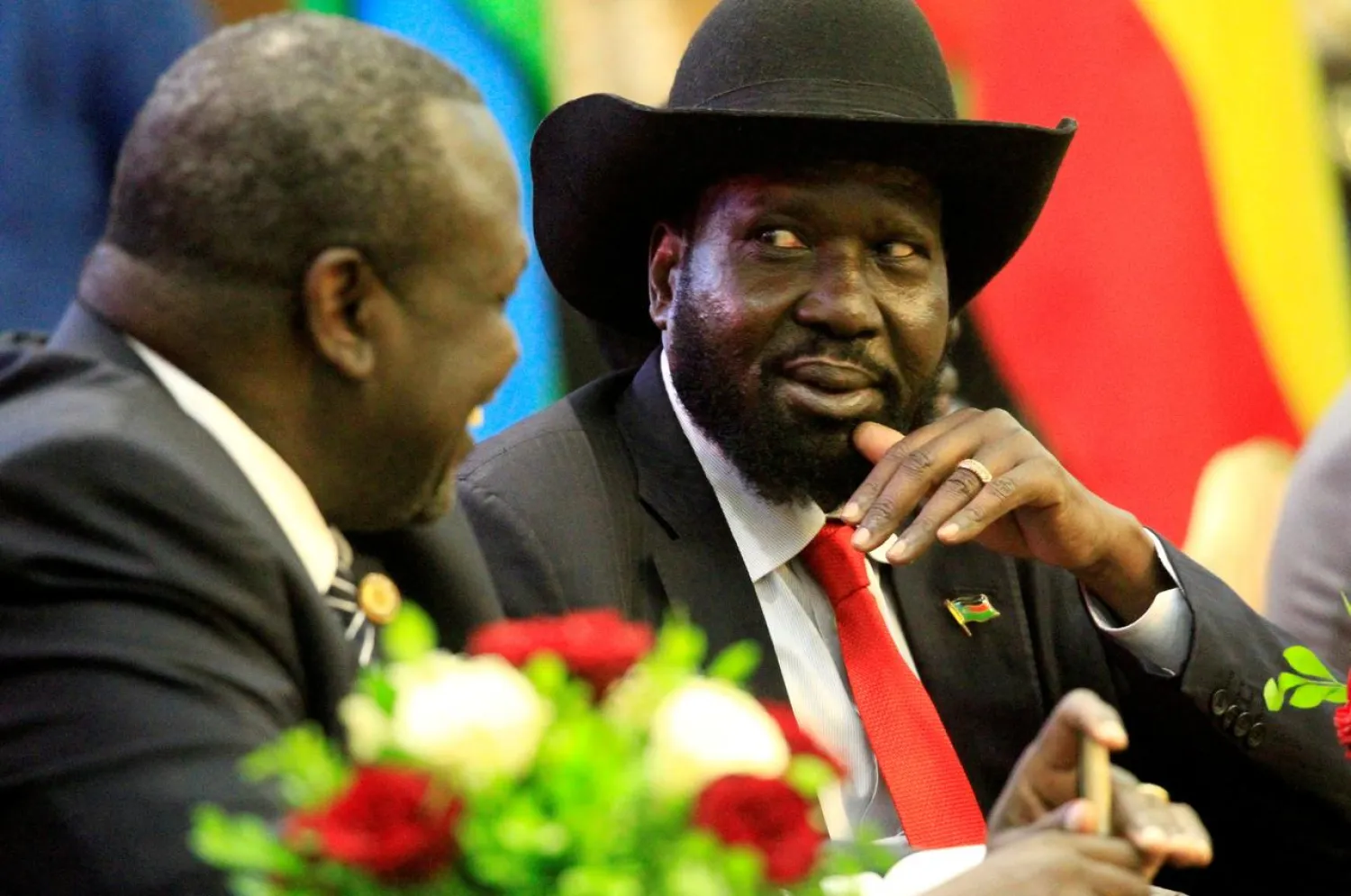

Juba Unites Revolutionary Front Leaders

South Sudan's President Salva Kiir talks to South Sudan's rebel leader Riek Machar (File Photo: Reuters)
TT

Juba Unites Revolutionary Front Leaders

South Sudan's President Salva Kiir talks to South Sudan's rebel leader Riek Machar (File Photo: Reuters)

The Juba meeting between leaders of the Revolutionary Front on the peace process with the Forces for Freedom and Change (FFC) and the Sudanese Transitional Military Council (TMC) is likely to witness developments, according to a South Sudan official.

South Sudan’s President Salva Kiir Mayardit invited leaders Malik Agar, Yasir Arman, Jibril Ibrahim, and Minni Minnawi as part of his efforts to help Sudanese parties reach a common ground.

South Sudan's Presidential Advisor Tut Galwak announced that President Kiir and South Sudan government are sponsoring the meeting between FFC and factions of Sudan People's Liberation Movement-North (SPLM-N), hoping it will unite the forces currently in Juba.

Speaking to Asharq Al-Awsat, Galwak noted that if the two factions led by Abdel Aziz al-Hilu and Malik Agar do not unite, they will sit at the same table with the FCC delegation, just like the factions of South Sudan held talks in Khartoum resulting in a peace treaty.

For his part, spokesman for the South Sudan National Movement for Change (SSNMC) Stephen Leal Naqour, told Asharq Al-Awsat that members of the Revolutionary Front responded to Juba’s request and this came within the framework of President Kiir initiative to mediate between the Sudanese parties.

The initiative was announced last year to address issues of peace and war in Sudan.

Naqour indicated that Kiir's invitation to the Revolutionary Front will likely succeed in strengthening the will of all Sudanese parties and forces to reach a consensus on the political agreement and the constitutional charter.

South Sudan is a pivotal area and accepted by all parties.

He noted that the Revolutionary Front, Darfur movements, FFC, and the TMC agreed on Kiir’s mediation, which will facilitate reaching a comprehensive peace agreement.

Naqour noted that the mediation in Juba provided the parties with a complement to the negotiating platforms in Addis Ababa and Egypt. The parties were given a starting point for an integrated negotiation to bring about comprehensive peace in the country.

He pointed out that this step facilitated the mediation of President Kiir to persuade FFC and armed movements in Darfur to engage in direct negotiations.

The first meeting brought together the Sudanese parties represented by FFC and the Revolutionary Front on one hand, and the Military Council on the other, resulted in supportive steps for the peace process in Sudan, most notably the parties' agreement on a ceasefire and its extension for six months.

Naqour explained that Kiir’s initiative included the factions of Agar and Hilu as representatives of the SPLM-N to reunify and enter the negotiations as a single bloc.

The agreement between Sudanese parties in Juba as well as the stability process in the two regions of Southern Kordofan and Blue Nile were represented in the six-months agreement to ceasefire and end hostilities between the SPLM-N and the Sudanese government, according to Naqour.

He noted that this period is sufficient to address all the controversial points, most notably the war, security arrangements, inclusion of SPLM-N and Revolutionary Front's vision in the negotiation, and achieving peace that meets the aspirations of the Sudanese people.



Appeal Trial of Tunisia Jailed Prominent Lawyer Starts

People stand outside a closed court during a nationwide strike in Tunis, Tunisia November 22, 2018. REUTERS/Zoubeir Souissi
TT

Appeal Trial of Tunisia Jailed Prominent Lawyer Starts

People stand outside a closed court during a nationwide strike in Tunis, Tunisia November 22, 2018. REUTERS/Zoubeir Souissi

The appeal trial of a prominent Tunisian lawyer jailed on anti-terror charges started on Thursday, after the judge rejected the defense's demand of his provisional release on health grounds.

Ahmed Souab's lawyers and relatives said his health condition had become critical since his jailing in April last year as part of what many said was a crackdown on political dissent.

The court rejected his provisional release and postponed the hearing to February 23, his lawyer, Fedi Snene, told AFP.

Souab -- also a rights advocate and a former judge -- was detained after claiming that judges were under political pressure to hand down hefty sentences last year in a mass trial of critics of President Kais Saied.

He had been a member of the defense team during the high-profile mass trial, and last October he was sentenced to five years in prison in a speedy trial that lasted less than two minutes.

UN Special Rapporteur on human rights defenders Mary Lawlor said on Wednesday Souab had been convicted on "baseless charges" and called for his "immediate release".

Snene rejected accusations against Souab, saying "he should not be in prison".

"He is a well-known man of law, who served for nearly 30 years as a judge before becoming a lawyer," Snene added.

Souab's son, Saeb, told AFP the family had submitted a "substantial medical file" asking the judge for his release pending a verdict.

Saeb said his father suffered a heart attack in 2022 and that his cardiologist had certified that prison conditions could worsen his health.

Souab had accused authorities of putting "a knife to the throat of the judge who was to deliver the verdict" during the mass trial that saw around 40 public figures sentenced to long terms on charges including plotting against the state.


At Least 21 Drown in Nile Boat Sinking in Sudan

At least 21 people drowned when a boat sank in the Nile River in northern Sudan, according to the local state government and eyewitnesses interviewed by AFP. (REUTERS)
TT

At Least 21 Drown in Nile Boat Sinking in Sudan

At least 21 people drowned when a boat sank in the Nile River in northern Sudan, according to the local state government and eyewitnesses interviewed by AFP. (REUTERS)

At least 21 people drowned when a boat sank in the Nile River in northern Sudan, according to the local state government and eyewitnesses interviewed by AFP.

River Nile State said Thursday that 21 bodies had been recovered after the accident, listed their names and warned that some passengers were still missing.

The boat was crossing the river between the villages of Tayba al-Khawad and Deim al-Qarai, according to the local government's statement.

The statement did not explain the cause of the accident.

Eyewitnesses told AFP the boat was carrying 30 people.

The Sudanese Doctors Network said in a statement that six of the boat's passengers survived.

The group said the incident exposes "the fragility of river transport and the absence of basic safety requirements, as well as the complete absence of local authorities and civil defense rescue teams in the early hours of the incident".

Many Sudanese rely on river transport via single-engine boats captained by solo operators.

The country's infrastructure has been collapsing due to a war that has been ongoing for nearly three years.

The war has divided the country between the army and their enemy, the paramilitary Rapid Support Forces, with road closures and a severe deterioration in public services and medical and educational infrastructure.


Syria Affirms Deep Ties with Saudi Arabia

Saudi Ambassador to Damascus Dr. Faisal Al-Mujfel visits the Kingdom’s pavilion, guest of honor at the Damascus International Book Fair (Saudi Embassy account). 
TT

Syria Affirms Deep Ties with Saudi Arabia

Saudi Ambassador to Damascus Dr. Faisal Al-Mujfel visits the Kingdom’s pavilion, guest of honor at the Damascus International Book Fair (Saudi Embassy account). 

Syria has reaffirmed the strength of its relations with Saudi Arabia during a visit by the Saudi ambassador to Damascus, Dr. Faisal Al-Mujfel, to the Saudi pavilion, guest of honor at the 2026 Damascus International Book Fair.

Saudi Arabia’s participation in the fair, held from Feb. 6-16, is led by the Literature, Publishing and Translation Commission.

At the start of the visit, Al-Mujfel met Syria’s Minister of Culture, Mohammad Yassin Saleh, who welcomed the Kingdom’s designation as guest of honor as a clear affirmation of the depth of Saudi-Syrian cultural relations, based on partnership and mutual respect.

Saleh praised Saudi Arabia’s cultural efforts and commended the pavilion for showcasing activities that reflect the richness and diversity of Saudi cultural heritage.

He noted that the Saudi program highlights the Kingdom’s commitment to supporting culture and literature at both the Arab and international levels. The pavilion features a wide range of events, including seminars and poetry evenings, with the participation of leading Saudi writers and intellectuals.

During a guided tour, the Saudi ambassador was briefed on the creative diversity presented at the pavilion. Exhibits include a collection of manuscripts, a section dedicated to traditional Saudi attire, displays of archaeological replicas, and a selection of publications issued by the Literature, Publishing and Translation Commission.

Among the featured works are titles from the “Translate” initiative, the “Saudi Literature Comics” series, and short story collections from Saudi authors, offering visitors insight into the Kingdom’s contemporary literary scene.

The commission is overseeing Saudi Arabia’s participation as guest of honor at the 2026 book fair, presenting what it described as a vibrant cultural experience that celebrates Saudi creativity and promotes dialogue through books.

The program aligns with the Kingdom’s National Culture Strategy under Vision 2030, which emphasizes cultural exchange, knowledge sharing, and constructive dialogue among nations, while reinforcing Saudi Arabia’s role in the Arab and global cultural landscape.

The visit was attended by several Arab diplomats accompanying the Saudi ambassador, including the ambassadors of Bahrain, Oman and Lebanon, as well as the chargé d’affaires of the United Arab Emirates embassy in Damascus.