

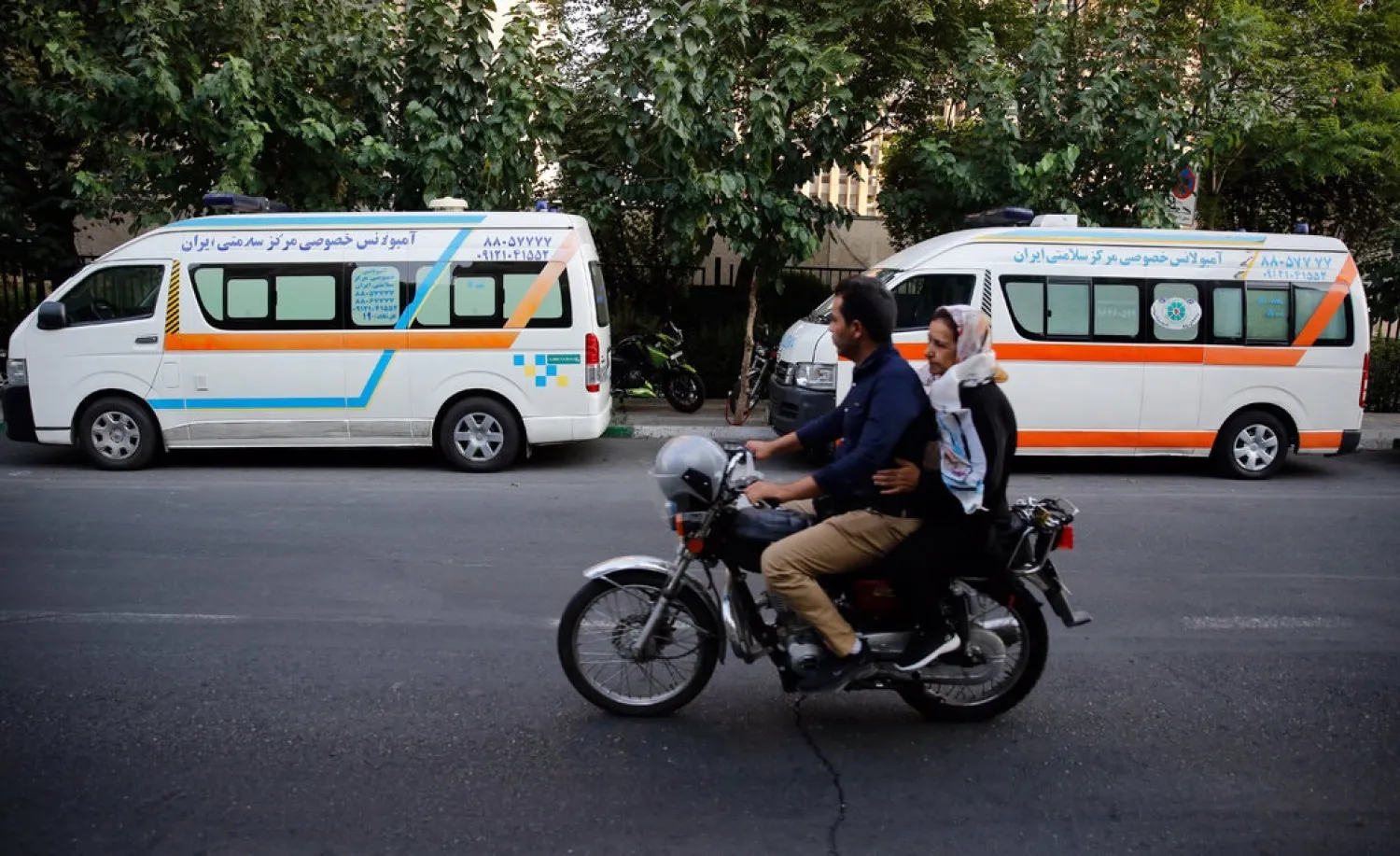

Iran’s Wealthy Use Ambulances to Beat Capital’s Traffic

Private ambulances in Tehran.Credit: Abedin Taherkenareh/EPA
TT

Iran’s Wealthy Use Ambulances to Beat Capital’s Traffic

Private ambulances in Tehran.Credit: Abedin Taherkenareh/EPA

When the phone rang at a private ambulance center in Tehran, a famous Iranian soccer player was on the line. The operator recognized him instantly and expressed sympathy for the presumed medical emergency in his family.

The soccer star laughed and said nobody was sick. He was requesting a reservation for an ambulance for a day to run errands around the city. He wanted to avoid the choking traffic that can turn a 10-minute ride into a two-hour trek. The money he was offering was equivalent to a teacher’s monthly salary, the New York Times reported.

For wealthy Iranians and even private tutors preparing students for national university exams, hiring an ambulance as one’s own private car and chauffeur has become the latest trend in a country with no shortage of time-consuming and frustrating traffic jams.

The practice is illegal. All the ambulance companies reached by phone this past week expressed concern that the abuse of the emergency-services vehicles — with their ability to run through red lights and be allowed a clear path to their destinations — would create a serious breach of public trust and impede the speedy transfer of patients to and from medical facilities.

Many Iranians are calling for the authorities to crack down, but the hiring of ambulances for nonemergency purposes continues. The phenomenon spilled into the news this past week when Tehran’s head of ambulance services spoke about it, but companies said they have been getting the requests for a year now.

Mahmoud Rahimi, the head of Naji private ambulance service in Tehran, which recently received the call from the famous soccer player, said, “Unfortunately, we get these kinds of calls, from rich people and from celebrities like actors and athletes.”

Rahimi, who has been in charge of reservations at Naji for 15 years, said the company declines such requests because “our job is to transport sick people.”
“We are not a taxi service with a siren for the rich,” he told the Times.

Tehran is a city of 14 million, and unregulated construction and development have turned it into one of world’s worst places for traffic jams and the resulting pollution. Major highways can resemble a parking lot with stalled vehicles at any hour of the day.

The city has deployed creative methods to curb traffic problems — to no avail. Drivers into central Tehran, for example, require a special permit, and for a while cars were allowed on the roads at various times depending on whether the last number in their license plate was odd or even.

In general, Iranians have become adept at breaking and bending rules. The average citizen has been engaged in a cat-and-mouse game of some kind for 40 years to defy social and religious restrictions imposed by the authorities, analysts say.

Around Tehran, cars routinely speed down the opposite direction on one-way lanes, drive backward on highway exits and blow through speed limits. When a police officer issues a ticket, the first impulse is often to bribe the officer and implore him to tear up the ticket, residents say.

The ambulance scandal, however, may have been a step too far — a violation of civic order. The public backlash has been severe on social media and in local newspapers. Many Iranians have criticized the government for its inability to detect and end the ambulance violations.

“What a nightmare. They’ve ruined the city, the economy, health care and now ambulance service,” Araz Ghorbanoghli wrote on Twitter.

“Shameless,” Ehsan Teymourpour tweeted, accusing celebrities of insulting “hard-working emergency workers.”

The head of Tehran’s private ambulance services, Mojtaba Loharsebi, told Iranian news outlets this past week that the phenomenon was widespread and not limited to celebrities. Loharsebi said that private tutors regularly used the ambulance as a taxi service to get to their classes on time.

“Police forces in Tehran are so busy that they have not been able to cooperate for ending the illegal trend,” he said.

The identity of the celebrities and the private ambulance services violating the law have not been revealed. It is also unclear what measures the ambulances take to make sure the wealthy can travel in the same vehicles used to transport sick or bleeding patients. Calls to more than a dozen private ambulance services in Tehran drew denials that they would take such unorthodox requests.

The business of private ambulance services started about two decades ago in response to a shortage of government ambulances, which respond to emergency calls and transport only critically ill patients to hospitals.

Private ambulances are booked privately their own reservation systems, and in addition to transporting the critically ill, they offer expanded services such as driving patients to a doctor’s office, a radiology center or lab.

One private ambulance service in the city, Behrouyan, said the business of transporting patients was strictly regulated and required permits, as well as a log of each destination. It said the authorities must investigate and crack down on violators in order to restore public trust.

Iranian news outlets reported that Tehran’s prosecutor general had issued an order to end the ambulance violations. The police have been told to stop and confiscate ambulances that are found to be transporting people who are not patients and to refer the company to court.

All the ambulance companies reached by phone expressed concern that the abuse of services would interfere with the transfer of real patients.

Rahimi, of Naji ambulance service, said company drivers had reported an increase in cars refusing to make way for the ambulance.

“People see an ambulance and may think this is not a patient in a life-or-death situation; it’s a celebrity going to get a haircut,” Rahimi said. “They don’t pull over to let us pass.”

Still, some Iranians reacted to the scandal by joking on Twitter and Facebook that perhaps SNAP, the country’s popular taxi app, should start offering an ambulance option.




US Astronaut to Take her 3-year-old's Cuddly Rabbit Into Space

FILE PHOTO: An evening launch of a SpaceX Falcon 9 rocket carrying 20 Starlink V2 Mini satellites, from Space Launch Complex at Vandenberg Space Force Base is seen over the Pacific Ocean from Encinitas, California, US, June 23, 2024. REUTERS/Mike Blake/File Photo
TT

US Astronaut to Take her 3-year-old's Cuddly Rabbit Into Space

FILE PHOTO: An evening launch of a SpaceX Falcon 9 rocket carrying 20 Starlink V2 Mini satellites, from Space Launch Complex at Vandenberg Space Force Base is seen over the Pacific Ocean from Encinitas, California, US, June 23, 2024. REUTERS/Mike Blake/File Photo

When the next mission to the International Space Station blasts off from Florida next week, a special keepsake will be hitching a ride: a small stuffed rabbit.

American astronaut and mother, Jessica Meir, one of the four-member crew, revealed Sunday that she'll take with her the cuddly toy that belongs to her three-year-old daughter.

It's customary for astronauts to go to the ISS, which orbits 250 miles (400 kilometers) above Earth, to take small personal items to keep close during their months-long stint in space.

"I do have a small stuffed rabbit that belongs to my three-year-old daughter, and she actually has two of these because one was given as a gift," Meir, 48, told an online news conference.

"So one will stay down here with her, and one will be there with us, having adventures all the time, so that we'll keep sending those photos back and forth to my family," AFP quoted her as saying.

US space agency NASA says SpaceX Crew-12 will lift off on a SpaceX Falcon 9 rocket from Cape Canaveral in Florida to the orbiting scientific laboratory early Wednesday.

The mission will be replacing Crew-11, which returned to Earth in January, a month earlier than planned, during the first medical evacuation in the space station's history.

Meir, a marine biologist and physiologist, served as flight engineer on a 2019-2020 expedition to the space station and participated in the first all-female spacewalks.

Since then, she's given birth to her daughter. She reflected Sunday on the challenges of being a parent and what is due to be an eight-month separation from her child.

"It does make it a lot difficult in preparing to leave and thinking about being away from her for that long, especially when she's so young, it's really a large chunk of her life," Meir said.

"But I hope that one day, she will really realize that this absence was a meaningful one, because it was an adventure that she got to share into and that she'll have memories about, and hopefully it will inspire her and other people around the world," Meir added.

When the astronauts finally get on board the ISS, they will be one of the last crews to live on board the football field-sized space station.

Continuously inhabited for the last quarter century, the aging ISS is scheduled to be pushed into Earth's orbit before crashing into an isolated spot in the Pacific Ocean in 2030.

The other Crew-12 astronauts are Jack Hathaway of NASA, European Space Agency astronaut Sophie Adenot, and Russian cosmonaut Andrey Fedyaev.


iRead Marathon Records over 6.5 Million Pages Read

Participants agreed that the number of pages read was not merely a numerical milestone - SPA
TT

iRead Marathon Records over 6.5 Million Pages Read

Participants agreed that the number of pages read was not merely a numerical milestone - SPA

The fifth edition of the iRead Marathon achieved a remarkable milestone, surpassing 6.5 million pages read over three consecutive days, in a cultural setting that reaffirmed reading as a collective practice with impact beyond the moment.

Hosted at the Library of the King Abdulaziz Center for World Culture (Ithra) and held in parallel with 52 libraries across 13 Arab countries, including digital libraries participating for the first time, the marathon reflected the transformation of libraries into open, inclusive spaces that transcend physical boundaries and accommodate diverse readers and formats.

Participants agreed that the number of pages read was not merely a numerical milestone, but a reflection of growing engagement and a deepening belief in reading as a daily, shared activity accessible to all, free from elitism or narrow specialization.

Pages were read in multiple languages and formats, united by a common conviction that reading remains a powerful way to build genuine connections and foster knowledge-based bonds across geographically distant yet intellectually aligned communities, SPA reported.

The marathon also underscored its humanitarian and environmental dimension, as every 100 pages read is linked to the planting of one tree, translating this edition’s outcome into a pledge of more than 65,000 trees. This simple equation connects knowledge with sustainability, turning reading into a tangible, real-world contribution.

The involvement of digital libraries marked a notable development, expanding access, strengthening engagement, and reinforcing the library’s ability to adapt to technological change without compromising its cultural role. Integrating print and digital reading added a contemporary dimension to the marathon while preserving its core spirit of gathering around the book.

With the conclusion of the iRead Marathon, the experience proved to be more than a temporary event, becoming a cultural moment that raised fundamental questions about reading’s role in shaping awareness and the capacity of cultural initiatives to create lasting impact. Three days confirmed that reading, when practiced collectively, can serve as a meeting point and the start of a longer cultural journey.


Imam Turki bin Abdullah Royal Reserve Launches Fifth Beekeeping Season

Jazan’s Annual Honey Festival - File Photo/SPA
TT

Imam Turki bin Abdullah Royal Reserve Launches Fifth Beekeeping Season

Jazan’s Annual Honey Festival - File Photo/SPA

The Imam Turki bin Abdullah Royal Nature Reserve Development Authority launched the fifth annual beekeeping season for 2026 as part of its programs to empower the local community and regulate beekeeping activities within the reserve.

The launch aligns with the authority's objectives of biodiversity conservation, the promotion of sustainable environmental practices, and the generation of economic returns for beekeepers, SPA reported.

The authority explained that this year’s beekeeping season comprises three main periods associated with spring flowers, acacia, and Sidr, with the start date of each period serving as the official deadline for submitting participation applications.

The authority encouraged all interested beekeepers to review the season details and attend the scheduled virtual meetings to ensure organized participation in accordance with the approved regulations and the specified dates for each season.