


Juventus's Star Signings Mask Unease While Inter and Napoli Can Challenge

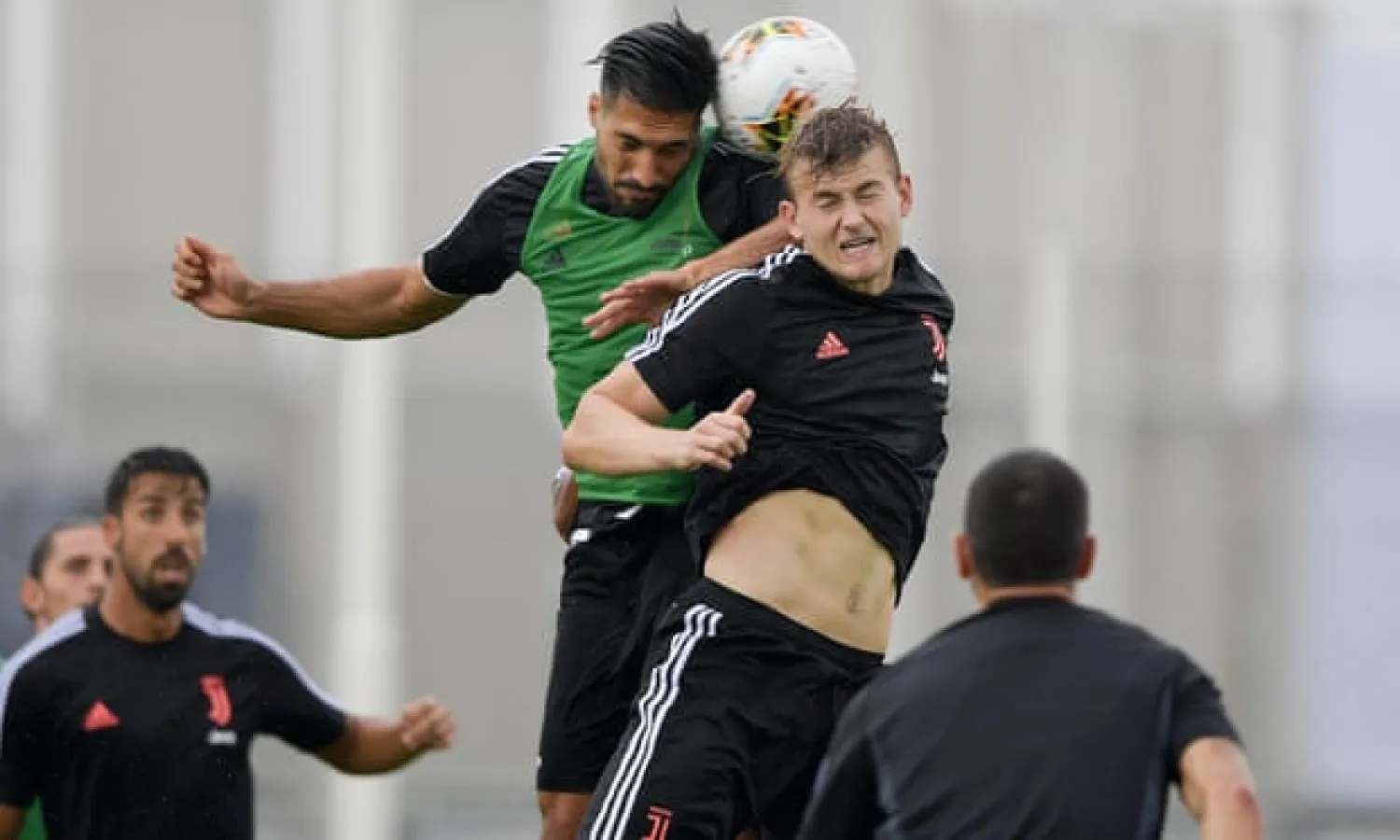
 Matthijs de Ligt goes up for an aerial challenge with Emre Can in training. The Dutch defender is the marquee signing of the summer but Juve have an unwieldy squad. Photograph: Daniele Badolato - Juventus FC/Juventus FC via Getty Images
Matthijs de Ligt goes up for an aerial challenge with Emre Can in training. The Dutch defender is the marquee signing of the summer but Juve have an unwieldy squad. Photograph: Daniele Badolato - Juventus FC/Juventus FC via Getty Images
TT

Juventus's Star Signings Mask Unease While Inter and Napoli Can Challenge

 Matthijs de Ligt goes up for an aerial challenge with Emre Can in training. The Dutch defender is the marquee signing of the summer but Juve have an unwieldy squad. Photograph: Daniele Badolato - Juventus FC/Juventus FC via Getty Images
Matthijs de Ligt goes up for an aerial challenge with Emre Can in training. The Dutch defender is the marquee signing of the summer but Juve have an unwieldy squad. Photograph: Daniele Badolato - Juventus FC/Juventus FC via Getty Images

Italian football’s summer break began in much the same way as the season had ended: with Juventus way out in front. By 1 July they had concluded the free agent signings of Aaron Ramsey and Adrien Rabiot. Then they did something far more audacious: signing Matthijs de Ligt from Ajax for €75m.

Even for a club that signed Cristiano Ronaldo one year previously, it felt like a landmark deal. When did an Italian side last win a bidding war for one of European football’s most coveted young talents? At 19 years old, De Ligt had already started in a Champions League semi-final, a Europa League final and a Nations League final – not to mention winning a domestic double in the Netherlands. The centre-back was expected to land in Barcelona, Madrid, Munich or Paris. Instead, he came to Turin.

As De Ligt put pen to paper, the gap between Juventus and their domestic rivals looked as wide as it has at any point during this eight-year stretch of consecutive Serie A titles. A team that finished 11 points clear of second place last season, and 21 ahead of third, had strengthened even further. How was anyone supposed to keep up?

Five weeks later, however, the picture does not look so clear. Such additions were supposed to be offset by subtractions. Two days out from the start of the season, too few sales have been completed, leaving the new manager, Maurizio Sarri, with a bloated and unwieldy playing squad.

“We need to cut six players from our Champions League list – and that puts us in difficulty,” he acknowledged this month. “It’s an embarrassing and difficult situation. We risk having to leave some really high-level players off the list.”

Ramsey and Rabiot join a midfield group in which Miralem Pjanic, Emre Can, Blaise Matuidi, Rodrigo Bentancur and Sami Khedira were already competing for places. Khedira, at least, was presumed to be on his way out after a lacklustre 2018-19 campaign, but insisted in an interview with Kicker this week that he intends to stay put.

Up front, Ronaldo’s potential supporting cast includes Paulo Dybala, Gonzalo Higuaín, Mario Mandzukic, Douglas Costa, Federico Bernardeschi and Juan Cuadrado. Sarri’s efforts to build something coherent from that group has been complicated by not knowing which will still be available to him beyond the end of this month.

Pre-season friendlies should always be taken with a pinch of salt, but performances have not been impressive. Preparations were disrupted further after Sarri contracted pneumonia. Juventus have said he will not be well enough to sit on the bench for the season opener against Parma or the second match against Napoli.

It is easy to imagine a scenario in which fans might turn on Sarri if Juventus were to drop points early. The club’s decision to hand the reins to a former rival, who had never won a major trophy before his Europa League triumph at Chelsea this May, was unpopular with many from the start.

There are reasons to believe that the competition will be stiffer in Serie A this season as well. The manager who launched Juventus’s winning cycle has returned to the peninsula on a mission to end it. Antonio Conte told GQ Italia that he would not have accepted the Internazionale job unless he believed there was at least a chance to depose his former club as champions.

His top transfer targets have been delivered. Not everyone is sold on Inter’s recruitment of Romelu Lukaku – and potentially Alexis Sánchez – to lead the line, but Conte has wanted to work with the Belgian ever since he was in charge of Juventus. Nicolò Barella and Stefano Sensi will bring a much-needed injection of dynamism to midfield and Diego Godín can provide leadership to an already sturdy defence.

The enduring presence of Mauro Icardi, however, gives Inter an unwanted distraction of their own. The striker has been told in no uncertain terms that he is not part of the club’s plans, yet if no buyer can be found in the next fortnight Conte may have to reintegrate him.

Napoli had presented themselves as potential suitors for Icardi, but are expected to abandon their interest unless he offers them some encouragement soon. Regardless, the Partenopei might be a greater threat than Inter to Juventus retaining the Scudetto.

The addition of Kostas Manolas, to play alongside Kalidou Koulibaly, means that last year’s runners-up boast the best centre-back tandem in the division. Behind them, it is reasonable to expect the 22-year-old goalkeeper Alex Meret to continue his improvement. The team that concede the fewest goals have finished top of Serie A in each of the past 12 seasons.

Napoli will have more options going forward, too, with the arrival of Hirving Lozano. And although Carlo Ancelotti has not won a Scudetto as recently as Conte, he knows a thing or two about what is required. “Second place is not enough any more,” he told reporters recently. “Now we need to win something.”

It is hard to imagine Atalanta, with their more modest resources, crashing the title race, but they may not be easily dislodged from the top four. Gianluca Mancini’s sale to Roma has been their only major departure, while Luis Muriel offers a different option up front.

The Giallorossi themselves will be fascinating to watch under Paulo Fonseca, whose high press and vertical approach served him so well at Shakhtar Donetsk. Pau López can only be an upgrade over Robin Olsen in goal, and Edin Dzeko surprised many by deciding to sign a new contract after all.

Milan also have a new manager, Marco Giampaolo, as well as a refreshed squad. It might seem odd to cite the arrival of two players from relegated Empoli as a cause for optimism, but Rade Krunic scored five goals and set up seven more from central midfield last season. Ismaël Bennacer was named player of the tournament at this summer’s Africa Cup of Nations.

Lazio have had a quieter transfer window, though Manuel Lazzari is a quality addition on the right. Torino, largely unchanged from last season, landed a tough draw against Wolves in their Europa League qualifier, but may yet surprise if they can make an asset of their continuity.

There are plenty of fascinating subplots to keep an eye on, as Franck Ribéry teams up with Kevin-Prince Boateng at Fiorentina, Radja Nainggolan returns to Cagliari and Mario Balotelli comes back to Serie A. The striker told reporters that his mother started crying when he told her that he was signing for Brescia – his hometown club.

Balotelli hopes the move will help him win back a place in the Italy team before the 2020 European Championship. First, though, he will have to find his place in a side that already boasts a prolific No 9, Alfredo Donnarumma (no relation to Gianluigi), who scored 25 goals last season to fire the team to promotion.

If Balotelli succeeds, it could become one of the great romantic stories in European football this season. If not, then it may all end, as it started, in tears.

The Guardian Sport


Milano Cortina Finds Fix for Medal Defects, Repairs Offered

Silver medalist Eric Perrot, of France, from left, gold medalist Johan-Olav Botn, of Norway, and bronze medalist Sturla Holm Laegreid, of Norway, pose after the men's 20-kilometer individual biathlon race at the 2026 Winter Olympics in Anterselva, Italy, Tuesday, Feb. 10, 2026. (AP)
TT

Milano Cortina Finds Fix for Medal Defects, Repairs Offered

Silver medalist Eric Perrot, of France, from left, gold medalist Johan-Olav Botn, of Norway, and bronze medalist Sturla Holm Laegreid, of Norway, pose after the men's 20-kilometer individual biathlon race at the 2026 Winter Olympics in Anterselva, Italy, Tuesday, Feb. 10, 2026. (AP)

A fix has been found to stop Milano Cortina Olympic medals from coming apart, and athletes will be able to return any damaged ones for repair, local organizers said on Tuesday.

The problems with the cherished medals have been one of the talking points of the opening days of competition at a Games that have otherwise run smoothly.

Local organizers investigated the medals mishaps with the Italian State Mint, which is responsible for producing them.

"A solution was identified and a targeted ‌intervention was ‌implemented," Milano Cortina 2026 Communications Director Luca Casassa ‌said, ⁠adding that ‌only a limited number of medals had suffered defects.

Athletes whose medals were affected could return them "so that they can be promptly repaired," he added.

"Milano Cortina 2026 confirms its commitment to ensuring that the medals, which symbolize the highest achievement in every athlete's career, meet the highest standards of quality and attention to detail."

PROBLEM WITH THE CLASP

Organizers did not specify what the problem was. ⁠However, a source close to the situation had suggested on Monday that the issue may stem ‌from the medal's clasp and ribbon, which is ‍fitted with a breakaway mechanism ‍required by law to avoid the risk of strangulation or other ‍injury.

That tallied with the experience of US Alpine skier Jacqueline Wiles, who won a bronze in the women's team combined on Tuesday and became the latest competitor to suffer a medal mishap.

Wiles said some boisterous celebrations were to blame.

"Some arms were swinging and I was jumping. And it got out of hand a little quickly. But that's OK. They ⁠fixed it already," she said.

A spokesperson for her team said the problem was with the clasp on her medal and she had been given a replacement.

Local organizers were very pleased with operations at the Games, spread over a wide area of northern Italy from Milan to a series of venues in the Alps.

"What we have found in these first four days is really encouraging, the stadiums and the competitions are often sold out, fan zones are full of people who are in a party mood and want to enjoy the Games' atmosphere," Casassa said.

"The feedback that we are getting ‌from the real protagonists, the athletes, at the moment is extremely positive," he added.


Soccer Returns to Gaza Pitch Scarred by War and Loss

Palestinians play soccer on a pitch, near buildings destroyed during the two-year Israeli offensive, in Gaza City. REUTERS/Mahmoud Issa
TT

Soccer Returns to Gaza Pitch Scarred by War and Loss

Palestinians play soccer on a pitch, near buildings destroyed during the two-year Israeli offensive, in Gaza City. REUTERS/Mahmoud Issa

On a worn-out five-a-side pitch in a wasteland of ruined buildings and rubble, Jabalia Youth took on Al-Sadaqa in the Gaza Strip's first organized soccer tournament in more than two years.

The match ended in a draw, as did a second fixture featuring Beit Hanoun vs Al-Shujaiya. But the spectators were hardly disappointed, cheering and shaking the chain-link fence next to the Palestine Pitch in the ruins of Gaza City's Tal al-Hawa district.

Boys climbed a broken concrete wall or peered through holes in the ruins to get a look. Someone was banging on a drum, Reuters reported.

Youssef Jendiya, 21, one of the Jabalia Youth players from a part of Gaza largely depopulated and bulldozed by Israeli forces, described his feeling at being back on the pitch: "Confused. Happy, sad, joyful, happy."

"People search for water in the morning: food, bread. Life is a little difficult. But there is a little left of the day, when you can come and play soccer and express some of the joy inside you," he said.

"You come to the stadium missing many of your teammates... killed, injured, or those who travelled for treatment. So the joy is incomplete."

Four months since a ceasefire ended major fighting in Gaza, there has been almost no reconstruction. Israeli forces have ordered all residents out of nearly two-thirds of the strip, jamming more than 2 million people into a sliver of ruins along the coast, most in makeshift tents or damaged buildings.

The former site of Gaza City's 9,000-seat Yarmouk Stadium, which Israeli forces levelled during the war and used as a detention centre, now houses displaced families in white tents, crowded in the brown dirt of what was once the pitch.

For this week's tournament the Football Association managed to clear the rubble from a collapsed wall off a half-sized pitch, put up a fence and sweep the debris off the old artificial turf.

By coming out, the teams were "delivering a message", said Amjad Abu Awda, 31, a player for Beit Hanoun. "That no matter what happened in terms of destruction and genocidal war, we continue with playing, and with life. Life must continue."


Malinin Made History with His Olympic Backflip, but Some Say the Glory Was Owed to a Black Skater

Milano Cortina 2026 Olympics - Figure Skating - Team Event - Men Single Skating - Free Skating - Milano Ice Skating Arena, Milan, Italy - February 08, 2026. Ilia Malinin of United States performs during the men's single free skating. (Reuters)
TT

Malinin Made History with His Olympic Backflip, but Some Say the Glory Was Owed to a Black Skater

Milano Cortina 2026 Olympics - Figure Skating - Team Event - Men Single Skating - Free Skating - Milano Ice Skating Arena, Milan, Italy - February 08, 2026. Ilia Malinin of United States performs during the men's single free skating. (Reuters)

Ilia Malinin, the US figure skater, became the first person to legally land a backflip on one skate in the Olympics although one trailblazing woman pulled it off when the move was still forbidden.

The 21-year-old from Virginia delivered a crucial free skate on Sunday night for the winning American team, filled with his trademark quadruple jumps, and punctuated the gold medal-clinching performance with his dramatic backflip.

It’s a move known today as “the Bonaly flip” — named for France’s Surya Bonaly.

Nevertheless, it is Malinin getting showered with praise, prompting many on social media to lament the way his achievement has eclipsed that of Bonaly, who is Black, and wondering if that is due to the color of her skin.

Ari Lu, 49, was among those on TikTok saying the figure skating world owed Bonaly an apology. Where Malinin is praised for his athleticism, Bonaly was judged, she told The Associated Press in a text message on Monday.

“Something a Black person used to be derided for is now celebrated when done by a white person,” said Lu, who is Black herself. She added that critiques of Bonaly at the time appeared related to her appearance rather than her skills.

A ban, and a backflip to end a career

The first person to pull off a backflip at the Olympics was former US champion Terry Kubicka, in 1976, and he landed on two skates. The International Skating Union swiftly banned the backflip, considering it too dangerous.

Over 20 years later, at the 1998 Nagano Games, France’s Surya Bonaly flouted the rules and executed a backflip, this time landing on a single blade — an exclamation point to mark her final performance as a professional figure skater. The crowd cheered, and one television commentator exclaimed, “I think she's done that because she wants to, because it's not allowed. So good on her.”

Bonaly knew the move meant judges would dock her points, but she did it anyway. The moment would cement her legacy as a Black athlete in a sport that historically has lacked diversity.

New rules allow for the backflip's return

For decades, Bonaly’s thrilling move could only be witnessed at exhibitions. That changed two years ago, when the ISU lifted its ban in a bid to make the sport more exciting and popular among younger fans.

Malinin, who is known for his high-flying jumps, soon put the backflip into his choreographed sequences for competitions. And on Sunday it was a part of a gold medal-winning free skate.

Bonaly, for her part, ended her professional career with a 10th place finish. Some argue the punishment of Bonaly back then and praise of Malinin today underscores a double standard that still exists in the figure skating world.

In a telephone interview from Minnesota, Bonaly told the AP on Monday that it was great to see someone do the backflip on Olympic ice, because skating needs to be taken to an upper level.

Regarding the criticism she received during her career, Bonaly said she was “born too early,” arriving on the Olympic scene at a time when people weren't used to seeing something different or didn’t have open minds.

“I broke ice for other skaters,” Bonaly said. “Now everything is different. People welcome anyone as long as they are good and that is what life is about.”

Bonaly's legacy

Before Bonaly there was Mabel Fairbanks, whose Olympic dreams were dashed by racist exclusion from US Figure Skating in the 1930s, and also Debi Thomas, the first African American to win a medal at the Winter Olympics. They and others have paved the road for more representation in the sport.

But there are still few professional Black figure skaters, and none competing for the US this year; popular skater Starr Andrews failed to make the team, finishing seventh at nationals. The team does include five Asian American skaters.

Malinin’s teammate, Amber Glenn, said that while she thinks backflips are fun and is interested in learning how to do one after she’s done competing, the three-time and reigning US champion does not plan to do them any time soon.

“I want to learn one once I’m done competing,” the 26-year-old Glenn said. “But the thought of practicing it on a warmup or in training, it just scares me.”

Both the ISU and the International Olympic Committee have apparently begun to embrace Bonaly's backflip, sometimes posting it to social media in conjunction with Bonaly's own account.

“Backflips on ice? No problem for figure skating icon Surya Bonaly!” says one from last May.

Another from November 2024 says: “Surya Bonaly’s backflip has been a topic of discussion, awe, and admiration for over two decades and continues to inspire young skaters to never give up on their dreams.”
