

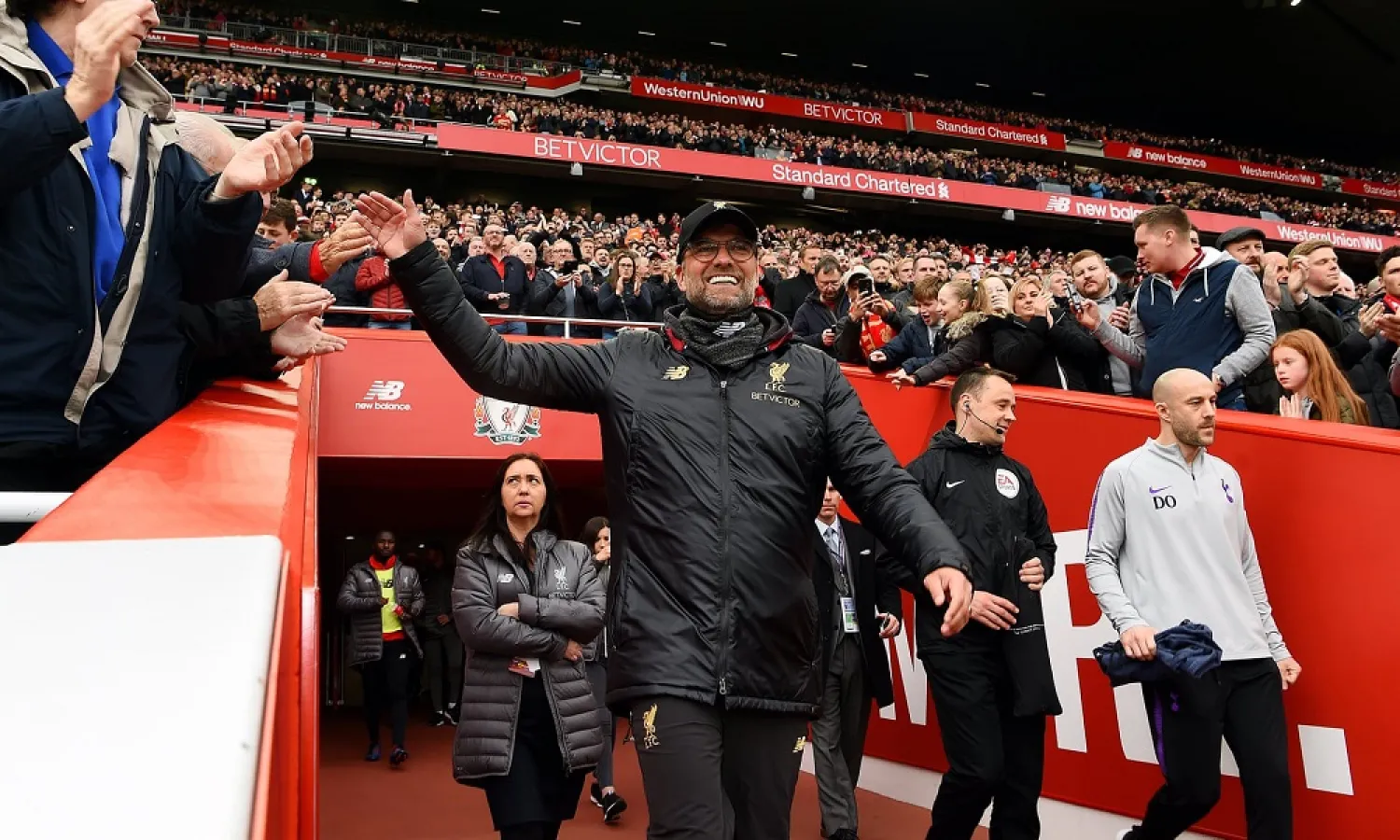

New World Order? Welcome to Premier League's New Era of Excellence

Liverpool manager Jurgen Klopp. (Getty Images)
TT

New World Order? Welcome to Premier League's New Era of Excellence

Liverpool manager Jurgen Klopp. (Getty Images)

Bring me my bow of burning gold. Bring me my all-English Euro finals. Bring me my £5bn three-year domestic TV rights cycle. Bring me my Amazon stick of fire.

The Premier League has always been an imperial, expansionist force. From the start the aim has been to fill the skies, to build a luminous new global super league in England’s own green and pleasantly deregulated land.

At times this has felt like little more than a sales pitch, the Premier League beaming its best Don King smile and declaring itself the biggest, most splendiferous of all the football leagues, even as great teams and great players have raised their own eras of European club football dominance elsewhere.

Until now, that is. Welcome to the new world. As the new season kicked into gear last month it is worth remembering where we left off. Four English teams had already made it to the Champions League quarter-finals before Liverpool and Tottenham met in Madrid on the first day of June. Arsenal and Chelsea blocked out the Europa League final in Baku. By the time spring arrived Manchester City and Liverpool were providing the only proper title race in any of Europe’s major leagues.

Meanwhile the cash registers continue to ping, that miraculous tide of high finance sluices through English football’s double-drum machine. According to Forbes magazine nine of the top 20 most lucrative clubs in the world are in England, including six of the top 10. The league has even begun to produce – of all things – home-grown talent, its elite academies the envy of the same European teams English football looked upon with a hand-wringing sense of inadequacy a few years back.

Look on our works, you mighty and … well, what exactly? If this feels like the culmination of something, a moment to draw a breath and look down, briefly, at the view, it is also a point of uncertainty on several fronts

Last season’s title race was, of course, something of a chimera. The top two went toe to toe, but the gap to third-placed Chelsea was a startling 25 points. Seventh-placed Wolves ended up 41 points behind the champions. A genuine title race should be evidence of shared strength, of a system able to produce equivalent champion contenders from its own resources. Last year was thrilling. But it was also a bit of a fluke, a rare coincidence of two best-of-generation teams in the same season.

It might seem odd to be alarmed by excellence. City’s champion brilliance, and Liverpool’s ability to match them stride for stride, have been marvels of the club football age. Both teams produce passages of football to match or exceed the best of recent times.

But it is a challenge every team outside that elite pocket must strive to meet. The good health of the league relies on genuine competitiveness. Key to this is the idea that it can still provide sport in its pure form, that all teams are capable of beating one another rather than simply providing a dutiful canvas for the brilliance of the elite.

The Premier League has increasingly split itself into segments in recent years: A-listers; eager second raters; mid-table fodder; imperilled minority. Within this there has been a surge in the number of matches where possession becomes tediously skewed, where to escape with a respectable defeat is a desirable outcome.

There were notable exceptions last year: Crystal Palace’s willingness to press Manchester City home and away, for example. But the fact these were notable tells its own story. It is a process that will only grow more pronounced with the increased slice of overseas TV rights money for the bigger clubs and moves among club owners to dilute the equal-share principle.

Can anyone close the gap on the top two? Manchester United’s ghost ship of a squad continues to list, unable either to shed its skeleton crew or add sufficient new life. Chelsea have entered a fascinating kind of standby mode, one that might ultimately prove beneficial. Tottenham are probably best placed. Harry Kane is in one of his fit periods in between the injured periods. Tanguy Ndombele may take time to settle but he already looks a fine addition.

Similarly Nicolas Pépé is an ambitious signing for Arsenal, and another indication of the vogue for well-judged moderate-to-big-money buys that has been a feature of City’s own planning over the last few years.

Still, challenging the top two looks a vertiginous task. Rodri will strengthen the seams of that wonderful City midfield. And both the champions and Liverpool will improve just by dint of another summer in the hands of Pep Guardiola and Jürgen Klopp.

Best of all would be another break-out team. Currently Leicester and Wolves look the best placed to press the teams who finished above them last season. Below will be the usual pack of middleweights roped together like survivors on the raft of the Medusa, concerned with little more than staying afloat, continuing to benefit from the extraordinary rewards of Premier League stasis.

It is a concentration of wealth that affects everything else around it, from devalued domestic cups, to the basic good health of the ever-narrowing pyramid below. On the up-side there will once again be plenty of fine entertaining football played in that middling pack. It is a sign of the Premier League’s riches that there can be a fear of stagnation even while teams like Bournemouth and Watford have such fine attacking talent in their ranks and a club with Burnley’s managerial expertise continues to perform to such a high level.

The promoted teams will once again face a significant step up. There has already been a degree of fatalism about the prospects of Sheffield United and Norwich, but Aston Villa look a decent bet to expand the growing Midlands revival. The strange scenes at Newcastle over the summer suggest a good start might be essential to avoid a painful season.

Beyond this the most notable change will come via another televisual intrusion. For the first time the Video Assistant Referee will stalk the pitch. The issues with VAR remain the same: bad VAR is really bad; good VAR is a welcome addition. The obvious fear is that the same problems apparent at the Women’s World Cup will overshadow such tedious matters as the actual football.

This is a sport of rough edges, played out constantly at the edge of the rules, some of which now seem mutable and vague when subjected to this level of unblinking scrutiny. The balance here is delicate. As ever VAR’s failure or otherwise will be dependent on the humans who design and operate the system.

The other major change is the introduction of a winter break in February. This has been a cause celebre for so long its arrival has perhaps gone a little under-trumpeted. In truth the winter break was never really the answer to much, and certainly not to the repeated failures of the England team, product of generations of inadequate coaching, tactics and management. If players are allowed to rest, if it stops one set of ligaments from pinging, a hamstring or two from entering the red zone, then it will be a sensible addition.

The Guardian Sport


Tottenham Hotspur Sack Head Coach Thomas Frank

(FILES) Tottenham Hotspur's Danish head coach Thomas Frank gestures on the touchline during the English Premier League football match between Burnley and Tottenham Hotspur at Turf Moor in Burnley, north-west England on January 24, 2026. (Photo by Oli SCARFF / AFP)/
TT

Tottenham Hotspur Sack Head Coach Thomas Frank

(FILES) Tottenham Hotspur's Danish head coach Thomas Frank gestures on the touchline during the English Premier League football match between Burnley and Tottenham Hotspur at Turf Moor in Burnley, north-west England on January 24, 2026. (Photo by Oli SCARFF / AFP)/

Thomas Frank was fired by Tottenham on Wednesday after only eight months in charge and with his team just five points above the relegation zone in the Premier League.

Despite leading Spurs to the round of 16 in the Champions League, Frank has overseen a desperate domestic campaign. A 2-1 loss to Newcastle on Tuesday means Spurs are still to win in the league in 2026.

“The Club has taken the decision to make a change in the Men’s Head Coach position and Thomas Frank will leave today,” Tottenham said in a statement. “Thomas was appointed in June 2025, and we have been determined to give him the time and support needed to build for the future together.

“However, results and performances have led the Board to conclude that a change at this point in the season is necessary.”

Frank’s exit means Spurs are on the lookout for a sixth head coach in less than seven years since Mauricio Pochettino departed in 2019.


Marseille Coach De Zerbi Leaves After Humiliating 5-0 Loss to PSG 

Marseille's Italian coach Roberto De Zerbi looks on from the technical area during the French Cup round of 32 football match between FC Bayeux and Olympique de Marseille (OM) at the Michel-d'Ornano Stadium in Caen on January 13, 2026. (AFP) 
TT

Marseille Coach De Zerbi Leaves After Humiliating 5-0 Loss to PSG 

Marseille's Italian coach Roberto De Zerbi looks on from the technical area during the French Cup round of 32 football match between FC Bayeux and Olympique de Marseille (OM) at the Michel-d'Ornano Stadium in Caen on January 13, 2026. (AFP) 

Marseille coach Roberto De Zerbi is leaving the French league club in the wake of a 5-0 thrashing at the hands of PSG in French soccer biggest game.

The nine-time French champions said on Wednesday that they have ended “their collaboration by mutual agreement.”

The heavy loss Sunday at the Parc des Princes restored defending champion PSG’s two-point lead over Lens after 21 rounds, with Marseille in fourth place after the humiliating defeat.

De Zerbi's exit followed another embarrassing 3-0 loss at Club Brugge two weeks ago that resulted in Marseille exiting the Champions League.

De Zerbi, who had apologized to Marseille fans after the loss against bitter rival PSG, joined Marseille in 2024 after two seasons in charge at Brighton. After tightening things up tactically in Marseille during his first season, his recent choices had left many observers puzzled.

“Following consultations involving all stakeholders in the club’s leadership — the owner, president, director of football and head coach — it was decided to opt for a change at the head of the first team,” Marseille said. “This was a collective and difficult decision, taken after thorough consideration, in the best interests of the club and in order to address the sporting challenges of the end of the season.”

De Zerbi led Marseille to a second-place finish last season. Marseille did not immediately announce a replacement for De Zerbi ahead of Saturday's league match against Strasbourg.

Since American owner Frank McCourt bought Marseille in 2016, the former powerhouse of French soccer has failed to find any form of stability, with a succession of coaches and crises that sometimes turned violent.

Marseille dominated domestic soccer in the late 1980s and early 1990s. It was the only French team to win the Champions League before PSG claimed the trophy last year. It hasn’t won its own league title since 2010.


Olympic Fans Hunt for Plushies of Mascots Milo and Tina as They Fly off Shelves 

Fans take selfies with the Olympic mascot Tina at the finish area of an alpine ski, slalom portion of a women's team combined race, at the 2026 Winter Olympics, in Cortina d'Ampezzo, Italy, Tuesday, Feb. 10, 2026. (AP)
TT

Olympic Fans Hunt for Plushies of Mascots Milo and Tina as They Fly off Shelves 

Fans take selfies with the Olympic mascot Tina at the finish area of an alpine ski, slalom portion of a women's team combined race, at the 2026 Winter Olympics, in Cortina d'Ampezzo, Italy, Tuesday, Feb. 10, 2026. (AP)

For fans of the Milan Cortina Olympic mascots, the eponymous Milo and Tina, it's been nearly impossible to find a plush toy of the stoat siblings in Milan and Cortina d’Ampezzo.

Many of the official Olympics stores in the host cities are already sold out, less than a week into the Winter Games.

“I think the only way to get them is to actually win a medal,” Julia Peeler joked Tuesday in central Milan, where Tina and Milo characters posed for photos with fans.

The 38-year-old from South Carolina is on the hunt for the plushies for her niece. She's already bought some mascot pins, but she won't wear them on her lanyard. Peeler wants to avoid anyone trying to swap for them in a pin trade, a popular Olympic pastime.

Tina, short for Cortina, is the lighter-colored stoat and represents the Olympic Winter Games. Her younger brother Milo, short for Milano, is the face of the Paralympic Winter Games.

Milo was born without one paw but learned to use his tail and turn his difference into a strength, according to the Olympics website. A stoat is a small mustelid, like a weasel or an otter.

The animals adorn merchandise ranging from coffee mugs to T-shirts, but the plush toys are the most popular.

They're priced from 18 to 58 euros (about $21 to $69) and many of the major official stores in Milan, including the largest one at the iconic Duomo Cathedral, and Cortina have been cleaned out. They appeared to be sold out online Tuesday night.

Winning athletes are gifted the plush toys when they receive their gold, silver and bronze medals atop the podium.

Broadcast system engineer Jennifer Suarez got lucky Tuesday at the media center in Milan. She's been collecting mascot toys since the 2010 Vancouver Games and has been asking shops when they would restock.

“We were lucky we were just in time,” she said, clutching a tiny Tina. “They are gone right now.”

Friends Michelle Chen and Brenda Zhang were among the dozens of fans Tuesday who took photos with the characters at the fan zone in central Milan.

“They’re just so lovable and they’re always super excited at the Games, they are cheering on the crowd,” Chen, 29, said after they snapped their shots. “We just are so excited to meet them.”

The San Franciscan women are in Milan for the Olympics and their friend who is “obsessed” with the stoats asked for a plush Tina as a gift.

“They’re just so cute, and stoats are such a unique animal to be the Olympic mascot,” Zhang, 28, said.

Annie-Laurie Atkins, Peeler's friend, loves that Milo is the mascot for Paralympians.

“The Paralympics are really special to me,” she said Tuesday. “I have a lot of friends that are disabled and so having a character that also represents that is just incredible.”
