


Exclusive - Construction and Politics: New Cities Shape Egypt’s Future

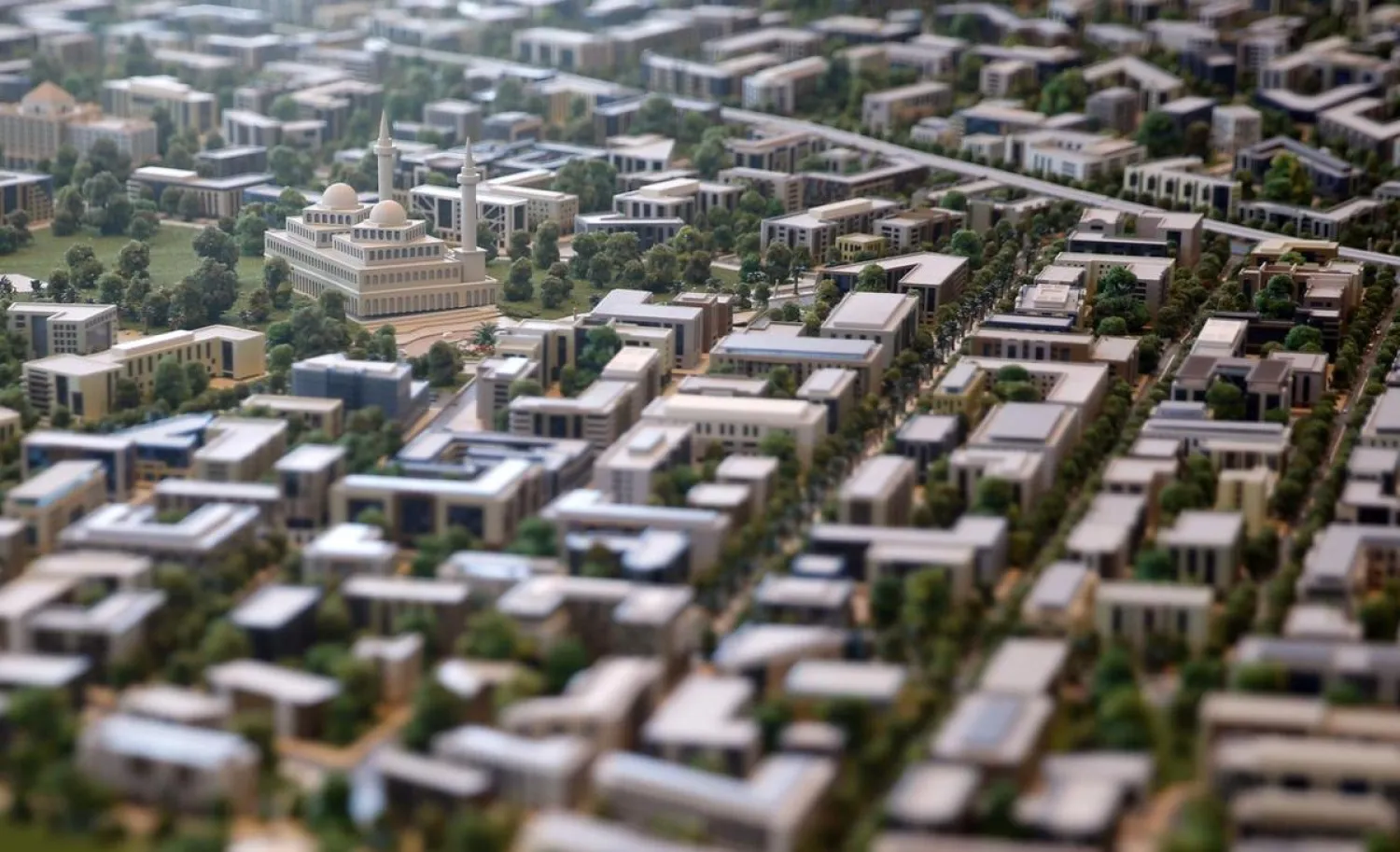
A model of a planned new capital for Egypt is displayed for investors during the final day of the Egypt Economic Development Conference (EEDC) in Sharm El-Sheikh, March 15, 2015. (Reuters)
TT

Exclusive - Construction and Politics: New Cities Shape Egypt’s Future

A model of a planned new capital for Egypt is displayed for investors during the final day of the Egypt Economic Development Conference (EEDC) in Sharm El-Sheikh, March 15, 2015. (Reuters)

Egyptian President Abdul Fattah al-Sisi is seeking to shape his country’s future through 14 new fourth generation cities that have been designed according to the latest global standards. Since assuming power five years ago, Sisi has embarked on a mission to comprehensively reshape the country, defying political, economic and social challenges.

The New Administrative Capital, located 75 kilometers east of Cairo, is among the president’s most ambitious projects. The development of the capital does not mean that Cairo, with its historic, cultural and touristic importance, will be abandoned. The new capital will in fact only highlight the old city’s significance.

Other projects include the New Alamein City, dubbed the icon of the Mediterranean, and al-Jalalah City in the East.

Egypt is pursuing its Vision 2030 which calls for increasing construction in the country from 6 to 12 percent in order to accommodate its growing population, ease traffic in old cities and promote economic growth through major projects that will provide thousands of job opportunities for the people.

Sisi believes the construction projects are the “first line of defense” against terrorist groups that only seek to spread chaos in Egypt. Addressing critics, he said the projects are being funded by selling real estate to investors. Critics have said that the government was spending state funds on the new projects instead of tackling more pressing issues in the health and education sectors, among others.

Political science Professor at the American University in Cairo Saeed Sadiq said that the construction expansion was a primary goal for many previous governments, but none were able to achieve it.

“None of them have shown the political will displayed by Sisi,” he told Asharq Al-Awsat.

The Egyptians have since ancient times lived on some 6 percent of the country’s area and governments have longed to expand it to 20 percent, he added.

Several cities were unveiled by former President Hosni Mubarak, including 6th of October City, Sharm El-Sheikh and others.

The idea was therefore, always there, but its implementation was slow, said Sadiq.

Sisi is now pushing forward this operation and he hopes it will promote economic growth, not just a construction boom, he remarked.

Furthermore, he noted that the current cities will be unable to accommodate the growing population, which is growing at a rate of 2.6 million per year.

This demands the construction of a strong infrastructure and the inevitable move to new cities, explained Sadiq.

Former Minister of Sports Alieddine Hilal said the accomplishments achieved by Egypt exceed those reached by Brazil, Nigeria and Kazakhstan that also moved their capitals to new cities.

Egypt will be doing this at a faster rate, he told Asharq Al-Awsat.

He credited this success to Sisi and the military that is overseeing the execution of projects by hundreds of private companies.

The new capital is expected to take in some 500,000 people during its first phase, in addition to some 40,000 to 50,000 government employees who will be transferred to new headquarters. The capital is planned to accommodate 6.5 million people in an area of 170,000 feddan.

Sadiq acknowledged that the move to the new city could sharply expose the divide between social classes in Egypt, whereby the wealthy would be able to move to the new capital. It would also deepen the divide between the people and authority.

Hilal said the construction of new cities should be seen from a broader angle and as part of a greater plan to rehabilitate infrastructure and shift towards digital transformation.

Moreover, the authorities have started to hold televised events and campaigns that raise awareness among the people about the new cities and therefore, make them part of their collective memory and conscience.


Saudi Industry Ministry Concludes Ninth Licensing Round, with 24 Companies and Consortia Awarded 172 Mining Sites

Saudi Industry Ministry Concludes Ninth Licensing Round, with 24 Companies and Consortia Awarded 172 Mining Sites
TT

Saudi Industry Ministry Concludes Ninth Licensing Round, with 24 Companies and Consortia Awarded 172 Mining Sites

Saudi Industry Ministry Concludes Ninth Licensing Round, with 24 Companies and Consortia Awarded 172 Mining Sites

The Saudi Ministry of Industry and Mineral Resources announced on Wednesday the names of 24 companies and consortia that have won licenses in the ninth exploration licensing round, the largest in the Kingdom’s history to date.

The winning entities were awarded 172 mining sites, including 76 sites that advanced to a multi-round public auction, across three mineralized belts in the regions of Riyadh, Madinah, and Qassim, with total committed exploration spend of over SAR671 million during the first two years of their work programs.

This milestone comes as part of the ministry’s ongoing efforts to accelerate mineral exploration and development in the Kingdom, in line with the objectives of Vision 2030, which positions the mining sector as the third pillar of the national industrial economy, said the ministry in a statement.

The ninth round offered over 24,000 km2, spanning the Ad-Duwaihi/Nabitah gold belt in Riyadh Region, as well as the Nuqrah and Sukhaybirah/As-Safra gold belts in Madinah and Qassim regions. These areas are rich in strategic minerals, including gold, copper, silver, zinc, and nickel. The round witnessed strong interest and high-quality competition from leading local and international companies, reflecting growing confidence in Saudi Arabia’s mining investment environment and its attractiveness at both regional and global levels.

The list of winning companies includes several leading international firms and prominent local companies, namely: Desert EX Pty Ltd Company; Batin Alard for Gold Company; Royal Roads Arabia Company; Sierra Nevada Gold Inc. Company; Aurum Global Group; Brunswick Exploration Incorporated; EQLEED-INDOTAN Mining Company; Helderberg Limited Company; Rawafed Alola for Mining Company; Saudi Gold Refinery Limited Company; Arabian Discovery Mining Company; Al Ghazal Al Arabi Mining Company; Almasar Minerals Holding Limited Company; Al Tasnim Enterprises LLC Company; Arabian Gulf Skylark. The Distinguished Consortium Mining Company, Two Limited Company; Maaden Ivanhoe Electric Exploration and Development Limited Company.

Several newly formed consortia also emerged winners in the licensing round, such as Demir Engineering Ltd, Dahrouge Geological Consulting Ltd, and Kaz United Mining LLC Consortium; KENZ Global Resources Ltd, and Manahil Al Sharq Mining and Al Rayyan Mining Resources Co. Consortium; Maaden Barrick Technology Experts Co. and Andiamo Exploration Ltd Company; Shandong Gold (Beijing) Industrial Investment Co., Ltd., Development Co., Ltd., and Ajlan & Bros Company for Mining; Midana Exploration Pty Ltd and Saudi Arabian Mining Company (Maaden) Consortium; and McEwen Mining Inc. and Sumou Holding Company Consortium.

The ninth round saw 26 qualified companies participate via the electronic bidding platform. The round was conducted in several stages with the highest levels of transparency: prequalification, site selection via the platform, and a multi-round public auction for sites attracting more than one bidder.

The ministry further noted that the scale of investment commitments in this round supports the development of underexplored greenfield areas and helps unlock the Kingdom’s estimated mineral wealth of SAR9.4 trillion, thereby strengthening the resilience of mineral supply chains.

The ministry confirmed that licensing will continue through the 10th round, spanning 13,000 km2 across Madinah, Makkah, Riyadh, Qassim, and Hail. It will include new sites that extend the mineralized belts offered in the ninth round.

The ministry will announce additional exploration and investment opportunities for 2026 at the fifth edition of the Future Minerals Forum (FMF), scheduled to take place in Riyadh from January 13 to 15.

These efforts are part of the Kingdom’s comprehensive strategy for the mining and mineral industries, aimed at maximizing the value of mineral resources, attracting global investment, creating jobs, enhancing value-chain integration, and reinforcing Saudi Arabia’s position as a global mining hub, in line with the ambitions of Vision 2030, it stressed.


Expo 2030 Riyadh Awards the Main Utilities and Infrastructure Works Package

The milestone demonstrates the project’s increasing momentum as it shifts from early works to large-scale construction activity. (SPA)
TT

Expo 2030 Riyadh Awards the Main Utilities and Infrastructure Works Package

The milestone demonstrates the project’s increasing momentum as it shifts from early works to large-scale construction activity. (SPA)

In a step aimed at advancing construction activities, Expo 2030 Riyadh awarded its Main Utilities and Civil Works package to Nesma and Partners - marking a significant moment in the journey to bring to life one of the most ambitious global mega-events ever developed.

The milestone demonstrates the project’s increasing momentum as it shifts from early works to large-scale construction activity.

In a statement on Wednesday, Expo 2030 Riyadh Company said the Main Utilities and Infrastructure Works package aims to prepare the site for subsequent construction phases and supports the operational requirements of the event itself.

The scope of work includes constructing roads within the Expo site and installing essential utilities that will form the infrastructure backbone of the entire development.

Around 50 kilometers of infrastructure networks will be delivered as part of this package – including water, sewage, EV charging stations, and electrical and communication systems. Together, these works are essential to support the next stages of master plan development and allow Expo 2030 Riyadh’s experience-defining structures to take shape.

CEO of Expo 2030 Riyadh Company Talal Al-Marri said: “This milestone marks an important step in accelerating construction activities in the Expo 2030 Riyadh site. By moving early on the infrastructure that underpins the entire site, we are creating the conditions for safe, coordinated, and high-quality delivery across all future phases of development, while ensuring a lasting legacy well beyond 2030.”

“The contract has been awarded ahead of schedule to accelerate the delivery timeline as part of a phased approach that will see construction across infrastructure, buildings, and public spaces advance steadily through 2026 and into early 2027,” he stressed.

President and Chief Executive Officer of Nesma and Partners Samer Abdul Samad said: “We are proud to be entrusted with delivering this phase of infrastructure for Expo 2030 Riyadh. This project is not only about scale, but also about precision, integration, and responsibility.”

“Our focus will be on delivering high-quality infrastructure that supports the ambition of Expo 2030 Riyadh and sets a strong foundation for everything that follows,” he added.

Expo 2030 Riyadh Company has embedded high standards for quality, sustainability, innovation, worker welfare, and health and safety into the delivery of the works, reinforcing its commitment to responsible construction and creating a safe, inclusive environment for everyone involved in the program.


Saudi Arabia Closes 2025 with Historic Industrial Reform, Global Digital Leadership, Record-Breaking Economic Activity

As 2025 draws to a close, Saudi Arabia records a year defined not merely by statistical growth, but by structural transformation across every major sector. (SPA)
TT

Saudi Arabia Closes 2025 with Historic Industrial Reform, Global Digital Leadership, Record-Breaking Economic Activity

As 2025 draws to a close, Saudi Arabia records a year defined not merely by statistical growth, but by structural transformation across every major sector. (SPA)

The second half of December marked a transformative conclusion to the year for Saudi Arabia, defined by a major policy shift to empower the industrial sector, world-class recognition in digital governance, and unprecedented levels of commercial and religious tourism activity.

Industrial empowerment and economic surge

In a decisive move to boost the competitiveness of the national industry, the Cabinet approved the cancellation of the expat levy for licensed industrial establishments. This decision builds on six years of exemptions that have already driven a 56% increase in industrial GDP to over SAR501 billion and a 74% rise in industrial employment.

Global leadership in tech and health

The Kingdom’s digital transformation strategy achieved a major milestone, ranking second globally in the World Bank’s GovTech Maturity Index with a score of 99.64%, placing it in the "very advanced" category.

In healthcare, the King Faisal Specialist Hospital and Research Center (KFSHRC) was ranked first in the Middle East for oncology and orthopedics and successfully pioneered a novel 3D-printing technique to treat inner ear disorders.

The period by numbers:

SAR30.7 billion: The record value of e-commerce sales in October 2025, marking a 68% annual increase.

68.7 million: The total number of worshippers and visitors received at the two holy mosques during the month of Jumada Al-Akhira.

8 million: The number of visitors to Riyadh Season 2025 since its launch in October.

32.3%: The year-on-year growth in non-oil exports for October 2025.

11.9 million: The number of Umrah performances completed in the month of Jumada Al-Akhira.

95 tons: The quantity of seasonal seeds stored by the Kingdom, setting a new Guinness World Record.

26: The number of awards won by Saudi students at the World Artificial Intelligence Competition for Youth (WAICY), taking 1st place globally.

$160 million: The total value of development loans signed with Mauritania for water and electricity projects.

158,000 tons: The volume of citrus production in the Kingdom as the new season launches.
.9%: The annual inflation rate in Saudi Arabia for November 2025.

12,000+: The number of industrial facilities now operating in the Kingdom, up from 8,822 in 2019.

2: The number of new Dark Sky Reserves accredited in AlUla (Sharaan and Wadi Nakhlah).

As 2025 draws to a close, Saudi Arabia records a year defined not merely by statistical growth, but by structural transformation across every major sector. From welcoming record numbers of tourists and pilgrims to securing top global rankings in digital governance and industrial competitiveness, the Kingdom has effectively translated strategic planning into tangible reality.

These milestones, spanning economic diversification, technological leadership, and international diplomacy, serve as cumulative evidence of a maturing ecosystem.

With every regulatory reform implemented and every global partnership secured this year, Saudi Arabia has done more than catalogue achievements; it has systematically narrowed the distance to its ultimate goals, moving one decisive year closer to the complete realization of Vision 2030.