


Google Glass May Have an Afterlife as a Device to Teach Autistic Children

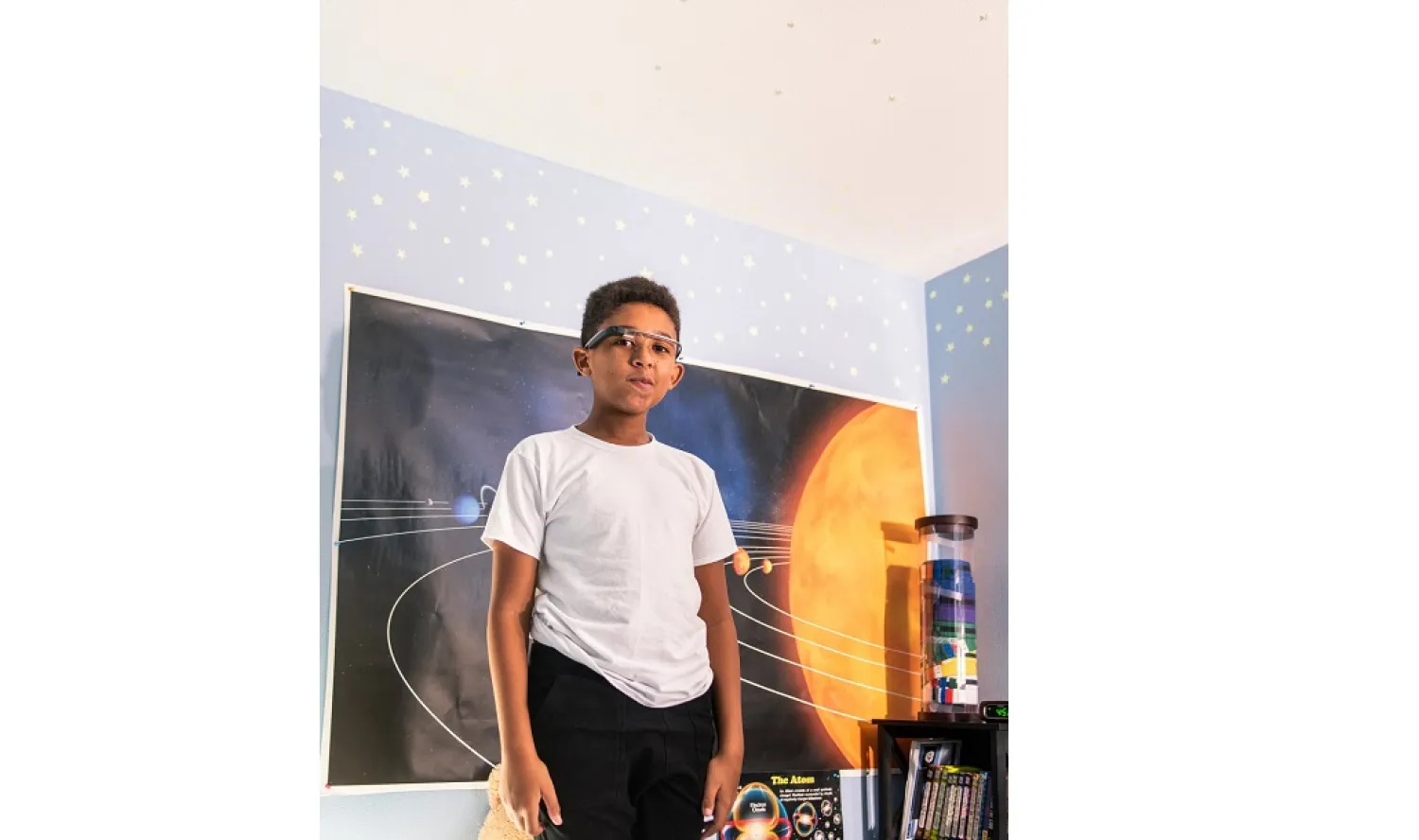
Esaïe Prickett wearing Google Glass at home in Morgan Hill, Calif. He and his family tested the device in a clinical trial.CreditCreditCayce Clifford for The New York Times
TT

Google Glass May Have an Afterlife as a Device to Teach Autistic Children

Esaïe Prickett wearing Google Glass at home in Morgan Hill, Calif. He and his family tested the device in a clinical trial.CreditCreditCayce Clifford for The New York Times

When Esaïe Prickett sat down in the living room with his mother, father and four older brothers, he was the only one wearing Google Glass.

As Esaïe, who was 10 at the time and is 12 now, gazed through the computerized glasses, his family made faces — happy, sad, surprised, angry, bored — and he tried to identify each emotion. In an instant, the glasses told him whether he was right or wrong, flashing tiny digital icons that only he could see.

Esaïe was 6 when he and his family learned he had autism. The technology he was using while sitting in the living room was meant to help him learn how to recognize emotions and make eye contact with those around him. The glasses would verify his choices only if he looked directly at a face.

He and his family tested the technology for several weeks as part of a clinical trial run by researchers at Stanford University in and around the San Francisco Bay Area. Recently detailed in The Journal of the American Medical Association, Pediatrics, the trial fits into a growing effort to build new technologies for children on the autism spectrum, including interactive robots and computerized eyewear.

The Stanford study’s results show that the methods have promise and indicate that they could help children like Esaïe understand emotions and engage in more direct ways with those around them. They could also measure changes in behavior, something that has historically been difficult to do.

Experts believe that other new technologies may help in similar ways. Talking digital assistants like Amazon’s Alexa, for example, could help children who misuse their pronouns. But even as these ideas spread, researchers warn that they will require rigorous testing before their effects are completely understood.

Catalin Voss started building software for Google Glass in 2013, not long after Google unveiled the computerized eyewear amid much hullabaloo from the national media. An 18-year-old Stanford freshman at the time, Mr. Voss began building an application that could automatically recognize images. Then he thought of his cousin, who had autism.

Growing up, Mr. Voss’s cousin practiced recognizing facial expressions while looking into a bathroom mirror. Google Glass, Mr. Voss thought, might improve on this common exercise. Drawing on the latest advances in computer vision, his software could automatically read facial expressions and keep close track of when someone recognized an emotion and when they did not.

“I was trying to build software that could recognize faces,” Mr. Voss said. “And I knew that there were people who struggled with that.”

At the time, the brief moment Google Glass spent in the national spotlight was already coming to an end. Google stopped selling the device to consumers amid concerns that its built-in camera would compromise personal privacy.

But Google Glass lived on as something to be used by researchers and businesses, and Mr. Voss, now a Ph.D. student, spent the next several years developing his application with Dennis Wall, a Stanford professor who specializes in autism research, and others at the university.

Their clinical trial, conducted over two years with 71 children, is one of the first of its kind. It spanned everything from severe forms of autism, including children with speech impairments and tactile sensitivities, to much milder forms. Children who used the software in their homes showed a significant gain on the Vineland Adaptive Behavior Scales, a standard tool for tracking the behavior of those on the autism spectrum, Mr. Voss said.

The gain was in line with improvements by children who received therapy in dedicated clinics through more traditional methods. The hope is that Mr. Voss’s application and similar methods can help more children in more places, without regular visits to clinics.

“It is a way for families to, on some level, provide their own therapy,” Mr. Voss said.

Jeffrey Prickett, Esaïe’s father, said he had been drawn to the study because he had known it would appeal to his son, who enjoys using iPad apps and watching DVD movies.

“He does fine interacting with people,” Mr. Prickett said. “But he does better interacting with technology.”

Mr. Prickett found it hard to judge whether the Google device helped his son recognize emotions, but he saw a marked improvement in Esaïe’s ability to make eye contact.

Heather Crowhurst, who lives near Sacramento, said she had experienced something similar with her 8-year-old son, Thomas, who also participated in the trial. But Thomas was not entirely captivated with the digital therapy. “It was kind of boring,” he said.

The concern with such studies is that they rely on the observations of parents who are helping their children use the technology, said Catherine Lord, a clinical psychologist at the University of California, Los Angeles, who specializes in the diagnosis and treatment of autism. The parents are aware of the technological intervention, so their observations may not be reliable.

Still, the Stanford team considers its study a first step toward wider use of this and other technologies in autism. It has licensed the technology to Cognoa, a Silicon Valley start-up founded by Dr. Wall. The company hopes to commercialize the method once it receives approval from the Food and Drug Administration, which oversees the use of medical devices in the United States. That may still be years away.

Other companies are taking a different approach. Brain Power, a start-up in Massachusetts that has built similar software for Google Glass, is selling its technology to local schools. The company considers it a teaching tool, not a medical device.

Patrick Daly, the assistant superintendent of the school district in North Reading, Mass., is testing Brain Power’s technology after watching its effect on his 9-year-old son, who is on the spectrum. The district intends to test the technology over the next few years.

Previously, the district tried to teach similar skills through iPad computer tablets. Mr. Daly sees Google Glass as a big improvement.

“It can actually maintain eye contact,” he said. “They are not looking down while they try to learn an emotion.”

Robokind, a start-up in Dallas, applies the same philosophy to different hardware. The company spent the past several years designing a robot that attempts to teach many of the same skills as technologies built for digital eyewear. Called Milo, the doll-like, two-foot-tall robot mimics basic emotions and tries to make eye contact with students. It also asks questions and tries to engage students in simple conversations.

Robokind has sold hundreds of the robots to schools for testing. Each one costs $12,000, plus more than $3,500 for additional software.

In some ways, such a device is a poor substitute for real human interaction. But the strength of this and other technologies is that they can repeat tasks time and again, without getting tired or bored or angry. They can also measure behavior in precise ways, said Pam Feliciano, the scientific director of the nonprofit Simons Foundation Powering Autism Research.

For these reasons, Ms. Feliciano also sees promise in Amazon’s Alexa. Her 14-year-old son is on the spectrum and struggles with his pronouns. He sometimes calls himself “you,” not “I.”

Her task is to correct him each time he makes a mistake. But she’s human and gets tired. She does not always remember. A device like Alexa could help, she said, provided that researchers can show it is reliable and effective.

“The technologies are there,” she said. “It is just a matter of the right technologists working with the right clinicians.”

The New York Times


Olympic Tourists in Cortina Can Explore the Dolomites with the New ‘Uber Snowmobile’ Service

 The peaks of the Dolomites are seen from the Cortina Sliding Centre during the Milano Cortina 2026 Winter Olympic Games in Cortina d'Ampezzo on February 5, 2026. (AFP)
The peaks of the Dolomites are seen from the Cortina Sliding Centre during the Milano Cortina 2026 Winter Olympic Games in Cortina d'Ampezzo on February 5, 2026. (AFP)
TT

Olympic Tourists in Cortina Can Explore the Dolomites with the New ‘Uber Snowmobile’ Service

 The peaks of the Dolomites are seen from the Cortina Sliding Centre during the Milano Cortina 2026 Winter Olympic Games in Cortina d'Ampezzo on February 5, 2026. (AFP)
The peaks of the Dolomites are seen from the Cortina Sliding Centre during the Milano Cortina 2026 Winter Olympic Games in Cortina d'Ampezzo on February 5, 2026. (AFP)

The peaks of the Dolomites are seen from the Cortina Sliding Centre during the Milano Cortina 2026 Winter Olympic Games in Cortina d'Ampezzo on February 5, 2026. (AFP)

For one month starting on Saturday, Olympic spectators keen for a side trip to a UNESCO World Heritage Site can use Uber to reserve a ride on a snowmobile along the snow-covered road to the base of the Three Peaks of Lavaredo.

The dramatic, jagged limestone pinnacles stand just 23 kilometers (14.3 miles) from the Cortina venues where athletes are competing in the 2026 Winter Olympics and Paralympics.

One of the Olympic torchbearers, Giulia Baffetti, runs snowmobiling tours through Cortina-based winter activities outfit Snowdreamers. The company partnered with Uber, the official ride-hailing sponsor for the Games, to offer free tours on the weekends in February to people in town.

"Uber Snowmobile" tours, which can only be booked through Uber, include a ride in an Uber transfer bus for up to eight people from Cortina to the spot where riders mount their snowmobiles for departure. Tourgoers then follow the instructor, who leads the line of snowmobiles.

The first slots offered went fast, but Uber spokesperson Caspar Nixon said Friday that it planned to add more.

The three peaks are a magical place, Baffetti said, and this is a way for more people to experience it. Hikers and climbers flock there in the warmer months. In the winter, it’s a prime spot for cross-country skiing, snowshoeing and sledding. Snowmobiling is allowed in a limited area in order to protect the environment.

"We want to give an experience to the tourists, so they can feel the mountains in a different way," she said.

The Associated Press took the one-hour tour on Thursday, ahead of the Saturday launch, along with one other person. Helmets are essential, while heated handgrips are a most welcome feature. And that red button? Passengers can push it to stop the snowmobile if it veers off course or they feel unsafe.

The adrenaline-filled ride reaches speeds up to 40 kph (25 mph) when zooming past snow-covered trees, and drivers are instructed to slow when coming upon cross-country skiers and sledders. Deer and wolves are sometimes seen along the 7-kilometer (4.3-mile) route up to the base of the peaks.

Also visible on Thursday was the southernmost of the three Lavaredo peaks, rising sharply out of the fog. While the Dolomites are breathtaking from Cortina — and on Friday, the sun shone and the view was clear from town — they are even more impressive up close.

The route back includes a short loop around Lake Antorno. Before traversing all the ups and downs, the snowmobile instructor leading the tour offers a reminder about that red button.

Saher Deeb, an Israeli tourist, was along for the ride Thursday, one day after his 29th birthday. It was his first time on a snowmobile, and he was all smiles as he climbed off at the end.

"It was perfect," he said.


French Duo Finish Walking from France to Shanghai After 1.5 Years

 Performers throw molten iron to create sparks during a performance on the Bund promenade along the Huangpu river, ahead of the upcoming Lunar New Year of the Horse in Shanghai on February 2, 2026. (AFP)
Performers throw molten iron to create sparks during a performance on the Bund promenade along the Huangpu river, ahead of the upcoming Lunar New Year of the Horse in Shanghai on February 2, 2026. (AFP)
TT

French Duo Finish Walking from France to Shanghai After 1.5 Years

 Performers throw molten iron to create sparks during a performance on the Bund promenade along the Huangpu river, ahead of the upcoming Lunar New Year of the Horse in Shanghai on February 2, 2026. (AFP)
Performers throw molten iron to create sparks during a performance on the Bund promenade along the Huangpu river, ahead of the upcoming Lunar New Year of the Horse in Shanghai on February 2, 2026. (AFP)

Two French adventurers reached the end of an epic walk from France to Shanghai on Saturday, after nearly a year and a half crossing 16 countries almost entirely on foot.

Loic Voisot and Benjamin Humblot embraced as they stood by the river on the Bund promenade, the financial hub's distinctive skyline glittering in the background.

Voisot and Humblot set off from Annecy in September 2024.

"We were thinking about this moment almost every day for more than a year now, so it's a really strong feeling," Humblot said of reaching their destination.

Hanging out after work one day, the two friends realized they both yearned for a "great adventure".

They wanted to visit China -- but without flying, which they believe is too harmful to the environment.

A plan to set out on foot was hatched, and except for a stretch in Russia which was done by bus for safety reasons, 518 days and around 12,850 kilometers (7,980 miles) later they took the last steps to completing it.

Around 50 people gathered at the start point for the last 10km stretch of their odyssey, many local people who have been following them on social media.

Along the way their numbers swelled, as media, French residents of Shanghai and others joined.

"If your dreams are crazy, just take it step by step and sometimes you will not succeed, but sometimes you will," said Voisot.

Asked what he would do first now the walk was over, he joked: "Sleep a lot!"


Annual Orchids Show Brings Vivid Color to Chicago Winter

Orchids adorn a Volkswagen Beetle as finishing touches are placed on the 12th annual Chicago Botanic Garden Orchid Show, Friday, Feb. 6, 2026, in Glencoe, Ill. (AP)
TT

Annual Orchids Show Brings Vivid Color to Chicago Winter

Orchids adorn a Volkswagen Beetle as finishing touches are placed on the 12th annual Chicago Botanic Garden Orchid Show, Friday, Feb. 6, 2026, in Glencoe, Ill. (AP)

A soft layer of white snow blankets the grounds of the Chicago Botanic Garden. The air is chilly, the sky gray.

Inside, however, the air is warm and lights illuminate more than 10,000 vividly colored orchids. Staff members move in and out of greenhouses, preparing to open the garden’s 12th annual Orchid Show on Saturday.

This year’s theme is “Feelin’ Groovy" with several installations calling back to the 1970s, including a yellow Volkswagen Beetle filled with orchids.

“It’s just a really great way to get out of the winter cold and come into our greenhouses,” said Jodi Zombolo, associate vice president of visitor events and programs. “I think people are really looking for something to kind of bring happiness and something that they will enjoy and find whimsy in.”

The orchid family is one of the largest in the plant world and some of the species in the show are rare, exhibits horticulturist Jason Toth said. One example is the Angraecum sesquipedale, also known as Darwin’s orchid, on display in the west gallery.

Toth said the orchid led Darwin to correctly conclude that pollinators have adapted in order to reach down the flower's very long end.

"It has a great story and it’s quite remarkable-looking,” said Toth.

Elsewhere, massive, gnarly roots dangle from purple, pink and yellow Vanda orchids in the south greenhouse. These epiphytic orchids grow on the surface of trees instead of in soil.

“I think everyone’s tired of the winter,” said Toth. “So having some kind of flower show at this point is what we’re all craving. And 'Orchids' fits the bill.”

The show is expected to draw 85,000 visitors this year.
