

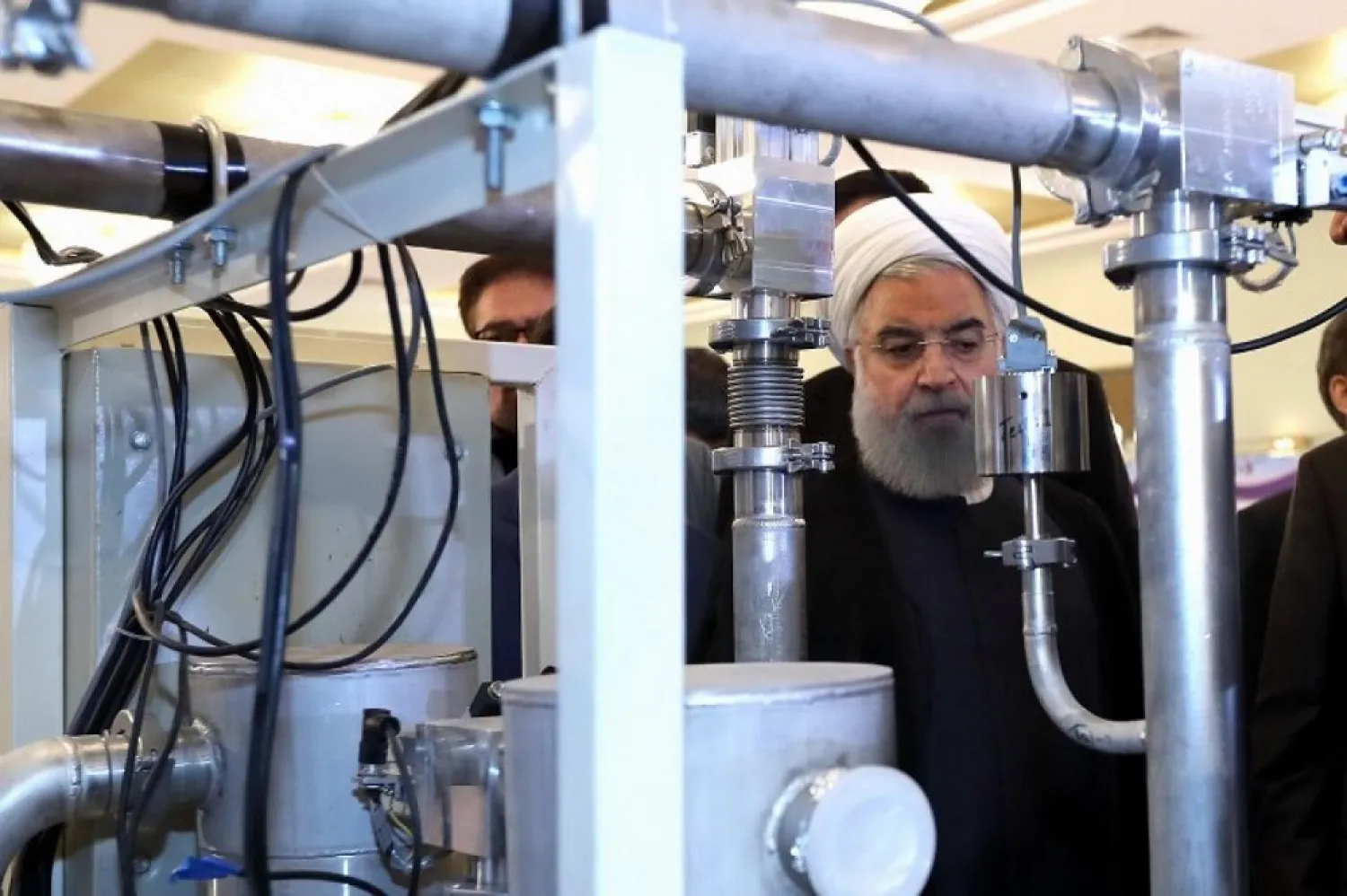

IAEA: Iran Installing More Advanced Centrifuges for Uranium Enrichment

Iran is moving towards enriching uranium by installing more advanced centrifuges in breach of the 2015 nuclear deal. (AFP)
TT

IAEA: Iran Installing More Advanced Centrifuges for Uranium Enrichment

Iran is moving towards enriching uranium by installing more advanced centrifuges in breach of the 2015 nuclear deal. (AFP)

Iran is moving towards enriching uranium by installing more advanced centrifuges in breach of the 2015 nuclear deal with world powers, the International Atomic Energy Agency said on Monday.

The deal only lets Iran produce enriched uranium with just over 5,000 of its first-generation IR-1 centrifuge machines. It can use far fewer advanced centrifuges for research but without accumulating enriched uranium.

But in response to US sanctions imposed since Washington withdrew from the deal in May last year, Iran has been breaching the limits it imposed on its atomic activities step by step.

Last week Tehran said it would breach the deal’s limits on research and development, the term applied to Iran’s use of advanced centrifuges.

An IAEA spokesman said Iran had informed it that it was making modifications to accommodate cascades - or interconnected clusters - of 164 of the IR-2m and IR-4 centrifuge. Cascades of the same size and type were scrapped under the deal.

Inspectors from the UN nuclear watchdog have verified that smaller numbers of various advanced centrifuges had been or were being installed, the spokesman added.

“All of the installed centrifuges had been prepared for testing with UF6,” though none of them were being tested with UF6 on Sept. 7 and 8, he said, referring to the uranium hexafluoride feedstock for centrifuges.

He added that Iran had told the agency it would modify lines of research centrifuges so that enriched uranium was produced, which is not allowed under the deal.

In a confidential report to member states, the IAEA also said Iran had made those modifications on some lines.

Iran defended Sunday its decision to use advanced centrifuges as IAEA acting chief Cornel Feruta urged Tehran to offer "time and active cooperation" with his inspectors.

Feruta met with Iranian Foreign Minister Mohammad Javad Zarif and Ali Akbar Salehi, the head of Iran's nuclear program, while in Tehran.

He is serving as the IAEA's acting director after the death of late director-general Yukiya Amano in July.

While Iran continues to pull away from the deal, Tehran has made clear it wants IAEA inspectors to continue their work. But officials blamed European leaders for being unable so far to offer a way for Iran to sell its crude oil around US sanctions.

A proposal by France to offer a $15 billion line of credit failed to materialize. China, Britain, France, Germany and Russia all were parties to the accord.



Putin Says Russia will Achieve War Goals, Keep Expanding 'Buffer Zone'

Russian President Vladimir Putin attends a meeting with Kazbek Kokov, head of the North Caucasus region of Kabardino-Balkaria, in Moscow, Russia December 16, 2025. Sputnik/Mikhail Metzel/Pool via REUTERS
TT

Putin Says Russia will Achieve War Goals, Keep Expanding 'Buffer Zone'

Russian President Vladimir Putin attends a meeting with Kazbek Kokov, head of the North Caucasus region of Kabardino-Balkaria, in Moscow, Russia December 16, 2025. Sputnik/Mikhail Metzel/Pool via REUTERS

President Vladimir Putin said on Wednesday that Russia would achieve its goals in Ukraine by diplomatic or military means, and would seek to expand a "security buffer zone" there.

"First, the goals of the special military operation will undoubtedly be achieved. We would prefer to do this and address the root causes of the conflict through diplomacy," Putin said.

"If the opposing side and their foreign patrons refuse to engage in substantive discussions, Russia will achieve the liberation of its historical lands by military means. The task of creating and expanding a security buffer zone will also be consistently addressed."

Of the regions of Ukraine that Russia has claimed as its own territory, it currently controls Crimea, around 90% of the Donbas region and 75% of Kherson and Zaporizhzhia, Reuters reported.

In addition, Russia holds some territory in the adjoining regions of Kharkiv, Sumy, Dnipropetrovsk and Mykolaiv. Putin's comments signalled that Moscow would seek further gains on some of these fronts.

With the war at a key juncture as US President Donald Trump pushes hard for a quick peace agreement, Putin said Russia was advancing on all fronts.

But his defense minister, Andrei Belousov, acknowledged that Ukrainian forces were trying to take back control of the northeastern town of Kupiansk - an effort he said was not succeeding.

Ukraine said on Wednesday it had taken 90% of the town, which Russia said it had captured in November.

Putin said people in Europe were being indoctrinated with fears of a war with Russia, and accused their leaders of whipping up hysteria.

"I have repeatedly stated: this is a lie, nonsense, pure nonsense about some imaginary Russian threat to European countries. But this is being done quite deliberately," he said.

Putin has said Russia is not seeking war with Europe, but is ready for war if that is Europe's choice.


Pakistan Says ‘Hostile Countries’ behind False Online Claims Linking it to Australia Shootings

A man waves Pakistan's flag as he along with others gather in support of Pakistan Army, day after the ceasefire announcement between India and Pakistan, in Islamabad, Pakistan, May 11, 2025. REUTERS/Akhtar Soomro
TT

Pakistan Says ‘Hostile Countries’ behind False Online Claims Linking it to Australia Shootings

A man waves Pakistan's flag as he along with others gather in support of Pakistan Army, day after the ceasefire announcement between India and Pakistan, in Islamabad, Pakistan, May 11, 2025. REUTERS/Akhtar Soomro

Pakistan’s information minister said Wednesday that his country has been the victim of a coordinated online disinformation campaign following the mass shooting at Australia’s Bondi Beach.

Attaullah Tarar accused “hostile countries,” including India, of spreading false claims that one of the two attackers was a Pakistani national.

Speaking at a news conference in Islamabad, Tara said Pakistan's leadership strongly condemned Sunday's attack, which killed 15 people in an antisemitic shooting targeting Jews celebrating Hanukkah, The AP news reported.

The minister said misleading information began circulating almost immediately after the attack, with social media posts falsely identifying one of the suspects as a Pakistani national named Naveed Akram. He said the claims spread rapidly across digital platforms and were repeated by some media outlets without verification.

Tarar said subsequent findings, including confirmation by Indian police, established that one of the attackers, Sajid Akram, was from India, while his 24-year-old son, Naveed Akram — who was also involved — was born in Australia.

The minister said the misinformation appeared to stem from a case of mistaken identity, as a Pakistani man living in Sydney shares the same name as one of the two suspects.

“How do we restore the situation to where it was before the Bondi Beach attack?” Tarar asked, adding that the Pakistani man — also named Naveed Akram — had released a video denying any involvement and urging the public not to associate him with the attack.

Tara said the Pakistani man was “a victim of a malicious and organized campaign” and that the disinformation effort originated in India.

There was no immediate response from Indian officials.

Tarar called on media outlets that published the false reports to issue apologies and said Pakistan had not yet decided whether to pursue legal action.

Pakistan and India, nuclear-armed rivals, have a long history of strained relations and have fought three wars since gaining independence from British rule in 1947, most of them over the disputed Himalayan region of Kashmir. The two sides came close to war in May before US President Donald Trump brokered a ceasefire.


UK Removes Duplicate Entries from Sanctions Lists, Designations Remain in Place

All affected individuals and entities remained subject to sanctions under other regimes - Reuters/File photo
TT

UK Removes Duplicate Entries from Sanctions Lists, Designations Remain in Place

All affected individuals and entities remained subject to sanctions under other regimes - Reuters/File photo

Britain removed duplicate entries from some of its sanctions lists on Wednesday, the government said in a notice, as it moves to consolidate its designations under a single authority, Reuters reported.

The update, which does no affect any restrictions already in place, eliminated four duplicate listings under the Syria sanctions regime and one under the Iran nuclear sanctions regime.

All affected individuals and entities remained subject to sanctions under other regimes, including Iran, Iran Nuclear or Chemical Weapons, according to the government notice.