

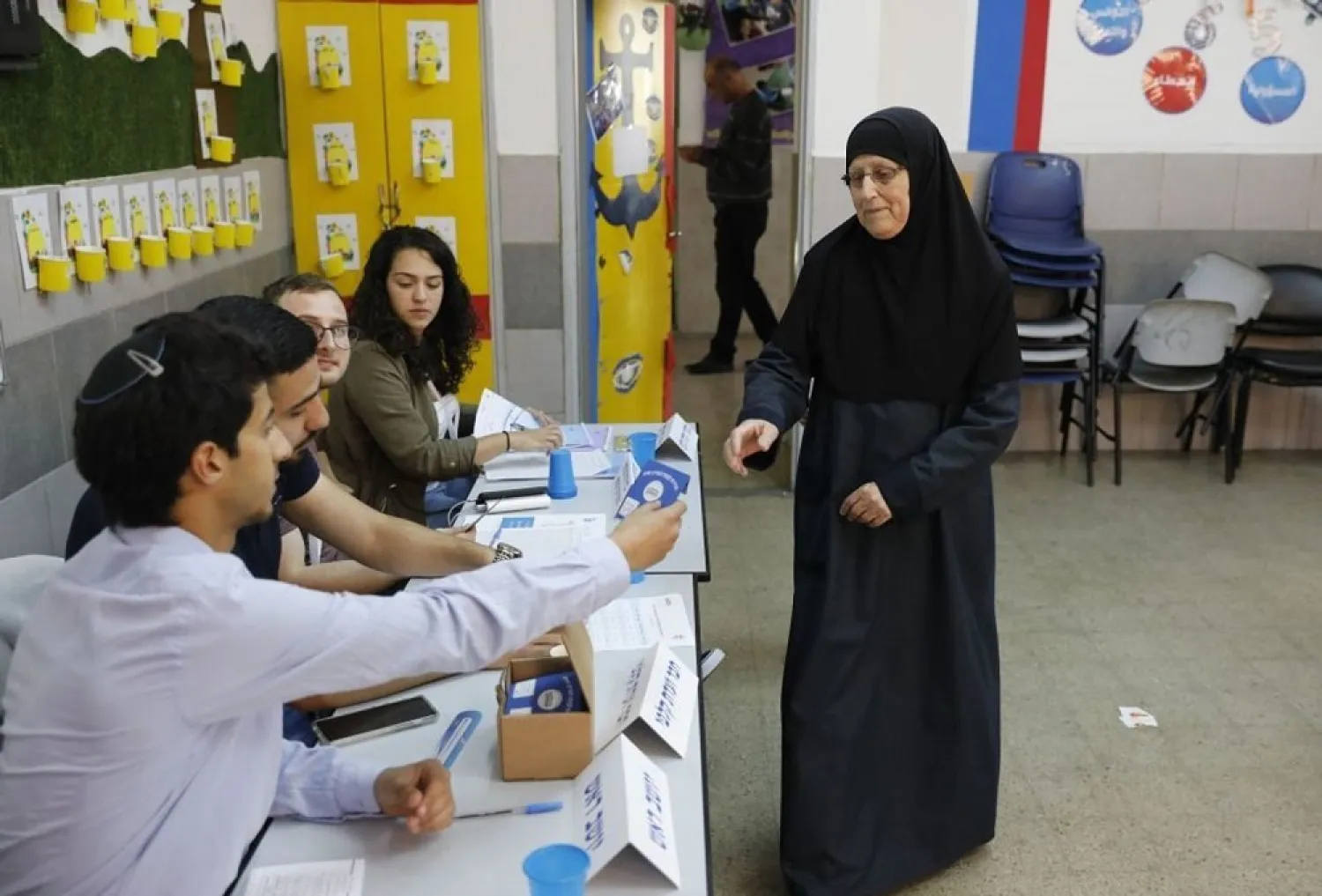

Newly Unified, Israel's Arab Parties Seek to Boost Turnout

Israel's Arab parties seek to boost turnout in upcoming elections. (Getty Images)
TT

Newly Unified, Israel's Arab Parties Seek to Boost Turnout

Israel's Arab parties seek to boost turnout in upcoming elections. (Getty Images)

At his butcher's stall in Nazareth, Bassem Zahrur shrugged when asked if he would be enticed to vote for Israel's newly reunited Arab parties in upcoming elections.

"I stopped voting for them. People have lost confidence," he said, before evoking the marginalization felt by Israel's Arab population.

"Whether the right or left wins... no one wants us,” he said, according to AFP.

It is a sentiment Israeli Arab politicians are seeking to counter ahead of elections next Tuesday.

The country's main Arab parties have again formed an alliance in hopes of repeating or beating their performance in 2015 elections, which saw them become the third-largest force in parliament.

But they must tackle low turnout figures like those registered in April elections, when their parties were divided.

They also face what are widely seen as attempts by Prime Minister Benjamin Netanyahu's Likud party to deter Arabs from voting -- allegations that have become a major focus in campaigning in recent days.

Netanyahu pushed for last-minute legislation to allow party officials to bring cameras to polling stations, ostensibly to prevent fraud.

Many saw it as a bid to depress Arab turnout by intimidating members of the minority into staying away.

The legislation ultimately failed in parliament, but during a debate on the measure Wednesday, the head of the mainly Arab Joint List alliance Ayman Odeh used the opportunity to make a point.

Odeh approached Netanyahu in parliament and stuck his phone in the premier's face as if filming him.

'Let's go'

"Look at how much they are afraid of our votes!" Odeh said recently at his office in the mixed northern city of Haifa, surrounded by posters of Che Guevara and iconic Palestinian poet Mahmoud Darwish.

"So come on, let's go!" he said.

But his efforts to urge Arabs to vote come after an April poll that saw just 49 percent turnout by the minority, which represents around 20 percent of the country's nearly nine million people.

They are descendants of Palestinians who remained on their land after the Israel's creation in 1948.

They largely support the Palestinian cause, though Odeh says he wants his party to be for both Arabs and Jews, backing a two-state solution to the Israeli-Palestinian conflict.

Israel's second election in five months comes because Netanyahu was unable to form a coalition after April's vote.

Many Arab Israelis recall what happened during that election, when Likud members brought cameras into polling places in Arab areas.

Samy Talal monitored the vote at a school in Umm al-Fahm, an Arab city of 55,000 people.

Alerted by text message, he said he discovered that the head of the voting station, a Likud member, had hidden a camera-pen in his shirt pocket.

Confusion followed and voting was suspended for around half an hour. Talal said some voters left and never came back.

A PR firm behind the Likud operation later boasted on Facebook of what it said was an operation to place cameras in Arab polling places to keep the vote clean.

"And thanks to observers placed on our behalf at every polling station, the percentage of voting has dropped to under 50 percent, the lowest seen in recent years!" said the post, which included a photo featuring the operation's head Sagi Kaizler and the Netanyahu couple.

Sawsan Zaher of Arab Israeli rights group Adalah, which challenged it in court, said the episode led to a more general anti-Arab climate.

'Destroy us all'

Netanyahu has been repeatedly accused of demonizing Arab Israelis during campaigns.

The veteran premier warned on election day in 2015 that Israeli Arabs were voting in "droves," a comment for which he later apologized.

This week, a post on Netanyahu's Facebook account that said Arabs "want to destroy us all".

It was deleted by Likud, and Netanyahu said a staffer had published it without his knowledge. Facebook said it violated its hate-speech policy.

While a newly unified Arab Joint List has given hope to some, candidate Ahmad Tibi says there have been other reasons for the drop in participation.

The prominent Joint List member cites polls showing the main reason Arabs abstain is their lack of confidence in parliament, with party divisions accounting for only nine percent.

Beyond that, a number of the 960,000 eligible Arab voters abstain for ideological reasons, refusing to participate in Israeli politics.

Zaher said an Israeli law approved last year declaring the country the nation-state of the Jewish people has discouraged Arabs from voting.

But at his office in Haifa, Odeh remained upbeat.

In April's polls, "the fact that we were divided lowered turnout. But this time we are united," he said.



Top Trump Iran Negotiator Says Visits US Aircraft Carrier in Middle East

US Special Envoy Steve Witkoff delivers a press conference upon the signing of the declaration on deploying post-ceasefire force in Ukraine, during the so-called "Coalition of the Willing" summit, at the Elysee Palace in Paris, France, January 6, 2026. (Reuters)
TT

Top Trump Iran Negotiator Says Visits US Aircraft Carrier in Middle East

US Special Envoy Steve Witkoff delivers a press conference upon the signing of the declaration on deploying post-ceasefire force in Ukraine, during the so-called "Coalition of the Willing" summit, at the Elysee Palace in Paris, France, January 6, 2026. (Reuters)

US President Donald Trump's lead Iran negotiator Steve Witkoff on Saturday said he visited the USS Abraham Lincoln aircraft carrier currently in the Arabian Sea, with Washington and Tehran due to hold further talks soon.

"Today, Adm. Brad Cooper, Commander of US Naval Forces Central Command, Jared Kushner, and I met with the brave sailors and Marines aboard the USS Abraham Lincoln, her strike group, and Carrier Air Wing 9 who are keeping us safe and upholding President Trump's message of peace through strength," said Witkoff in a social media post.

Iranian Foreign Minister Abbas Araghchi said on Saturday he hoped talks with the United States would resume soon, while reiterating Tehran's red lines and warning against any American attack.


Israel’s Netanyahu Expected to Meet Trump in US on Wednesday and Discuss Iran

Israeli Prime Minister Benjamin Netanyahu delivers a speech during a special session to mark the 77th anniversary of the Knesset's establishment and the 60th anniversary of the dedication of the current building at the Knesset, the Israeli parliament, in Jerusalem, 02 February 2026. (EPA)
TT

Israel’s Netanyahu Expected to Meet Trump in US on Wednesday and Discuss Iran

Israeli Prime Minister Benjamin Netanyahu delivers a speech during a special session to mark the 77th anniversary of the Knesset's establishment and the 60th anniversary of the dedication of the current building at the Knesset, the Israeli parliament, in Jerusalem, 02 February 2026. (EPA)

Israeli Prime Minister Benjamin Netanyahu is expected to meet US President Donald Trump on Wednesday in Washington, where they will discuss negotiations with Iran, Netanyahu's office said on Saturday.

Iranian and US officials held indirect nuclear ‌talks in the ‌Omani capital ‌Muscat ⁠on Friday. ‌Both sides said more talks were expected to be held again soon.

A regional diplomat briefed by Tehran on the talks told Reuters Iran insisted ⁠on its "right to enrich uranium" ‌during the negotiations with ‍the US, ‍and that Tehran's missile capabilities ‍were not raised in the discussions.

Iranian officials have ruled out putting Iran's missiles - one of the largest such arsenals in the region - up ⁠for discussion, and have said Tehran wants recognition of its right to enrich uranium.

"The Prime Minister believes that any negotiations must include limiting ballistic missiles and halting support for the Iranian axis," Netanyahu's office said in a ‌statement.


Italy FM Rules Out Joining Trump’s ‘Board of Peace’

Italy's Minister for Foreign Affairs Antonio Tajani speaks to the press during the EPP Leaders’ meeting, in Zagreb, Croatia, 30 January 2026. (EPA)
TT

Italy FM Rules Out Joining Trump’s ‘Board of Peace’

Italy's Minister for Foreign Affairs Antonio Tajani speaks to the press during the EPP Leaders’ meeting, in Zagreb, Croatia, 30 January 2026. (EPA)

Italy will not take part in US President Donald Trump's "Board of Peace", Italian Foreign Minister Antonio Tajani said Saturday, citing "insurmountable" constitutional issues.

Trump launched his "Board of Peace" at the World Economic Forum in Davos in January and some 19 countries have signed its founding charter.

But Italy's constitution bars the country from joining an organization led by a single foreign leader.

Prime Minister Giorgia Meloni, a Trump ally, last month noted "constitutional problems" with joining, but suggested Trump could perhaps reopen the framework "to meet the needs not only of Italy, but also of other European countries".

Tajani appeared Saturday to rule that out.

"We cannot participate in the Board of Peace because there is a constitutional limit," he told the ANSA news agency.

"This is insurmountable from a legal standpoint," he said, the day after meeting US Secretary of State Marco Rubio and US Vice President JD Vance at the Olympics in Milan.

Although originally meant to oversee Gaza's rebuilding, the board's charter does not limit its role to the Palestinian territory and appears to want to rival the United Nations.