


Turning Our Clubs Into Global Brands Means There Will Be More Burys

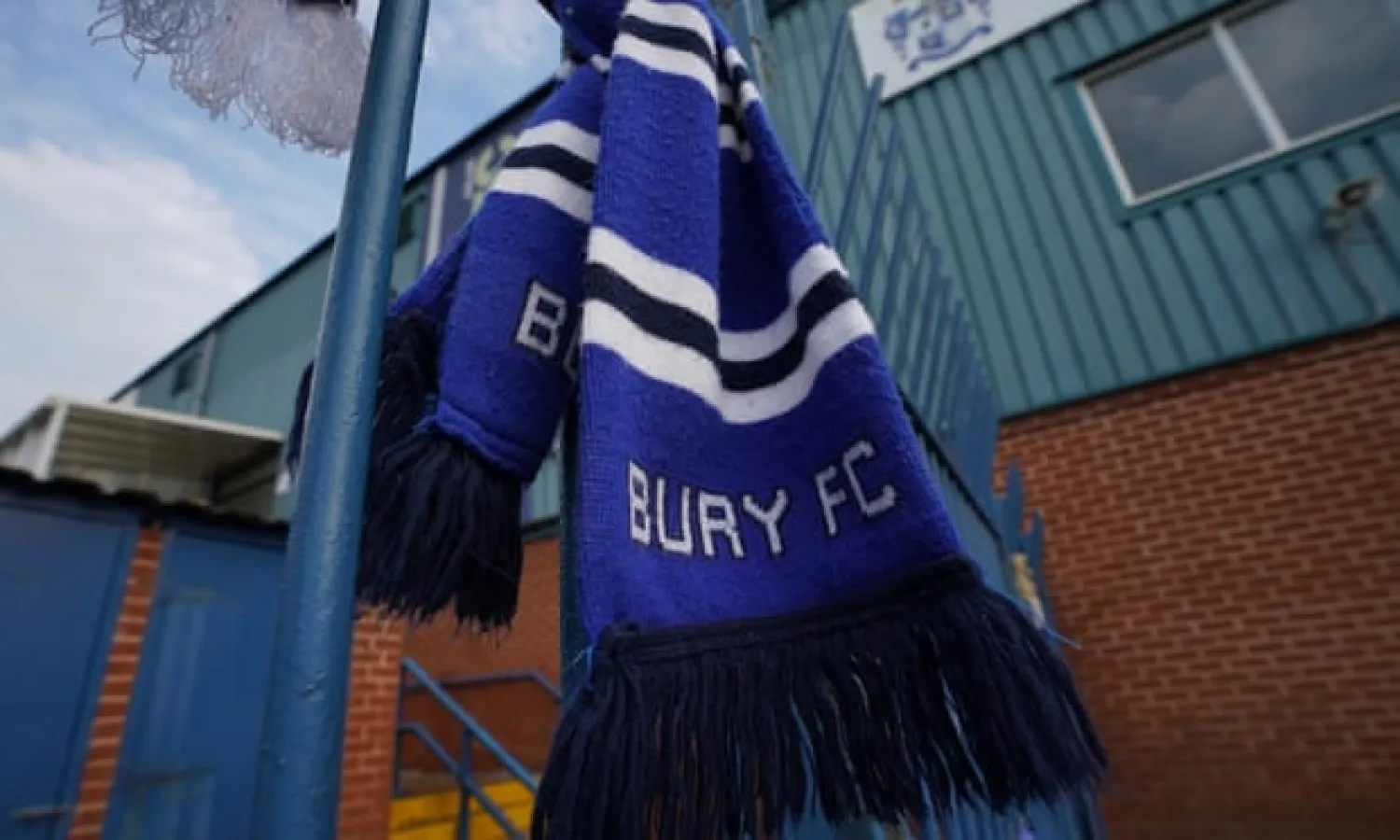
 A scarf hanging at Bury’s Gigg Lane ground this week. Photograph: Jon Super/The Guardian
A scarf hanging at Bury’s Gigg Lane ground this week. Photograph: Jon Super/The Guardian
TT

Turning Our Clubs Into Global Brands Means There Will Be More Burys

 A scarf hanging at Bury’s Gigg Lane ground this week. Photograph: Jon Super/The Guardian
A scarf hanging at Bury’s Gigg Lane ground this week. Photograph: Jon Super/The Guardian

A recent Set-Piece Menu podcast eloquently made the case for fandom as a broad church. When the Premier League is marketed so aggressively all over the world, when overseas television rights bring it so much revenue, when players and managers and owners are often foreign, they argued – quite reasonably – who is to deny the travelling supporter from Baltimore or Bangalore their seat in the stadium, the right to call themselves a fan? All of that made sense.

On an intellectual level I agreed with it. It fitted my general liberal, globalised worldview. And yet, I realised, viscerally I disagreed: of course, I paid lip service to all that but actually I regarded my form of fandom as being more authentic and more important.

Sunderland is part of me in a way that is beyond choice. I grew up there and my family is from there. Sunderland is the unsatisfactory repository for the emotions linked to memories of my dad and of all the mates I went to games with as a teenager.

But it is also for something less rational, for a nebulous and no doubt over-romanticised sense of home, for the family who long ago came from Ireland and Scotland looking for work in the shipyards and found belonging by going to games. Sunderland is who I am in a way that matters far more than individual results or whichever clowns happen to be wearing the shirts this season.

That is why it matters and it is why Bury matter and Bolton matter: if a clod be washed away by the sea, football is less. And frankly I find it hard to reconcile that sense with respecting the rights and feelings of a fan from outside who had a choice. I am also aware that this places me uncomfortably on the opposite side of the current cultural struggle to the one I would usually occupy.

But we should not be naive. Money has always played a significant role in football. The clubs who dominated the league in its early days – Preston, Sunderland and Aston Villa – did so largely by buying in the best Scottish talent. When, as English champions, Sunderland beat the Scottish champions, Hearts, 5-3 at Tynecastle in the first club world cup in 1895, all 22 players were Scots. Liverpool and Chelsea were established by stadium owners with the specific aim of getting people to pay to watch them play. The league was never some cosy alliance of community ventures.

Yet the gulf between football’s rich and poor has never been so stark. The agglomeration of highly remunerated talent at the top end of the game is producing football of exceptional quality and recent Champions Leagues, at least in the knockout stages, have produced extraordinary drama. The question is, is it worth it?

At Bury and Bolton, specific mistakes have been made by specific owners in an environment that has done little to regulate who is allowed to own clubs or how they behave. But the issues that have taken them to the brink are not unique to them. This is a systemic problem. There are those who would shrug and point out no other country sustains a league of 92 clubs (plus other professional teams in non-league) and that a certain natural wastage is inevitable. But that is one of the great joys of English football: the economic logic of the vast supermarket chains gobbling up the corner shop should not apply.

As David Goldblatt’s new book The Age of Football makes clear, this is part of a much wider trend, as everything – players, managers, investment, attention – is sucked towards a handful of clubs in a handful of leagues in western Europe. To watch an Argentinian or Brazilian league game is to be shocked by how low the quality is given the global familiarity of their best players.

Africa Cups of Nations are habitually played out in front of empty stadiums, in large part because, across the continent, the culture of going to games has gone. The football people care about is played in Europe and so it is consumed via satellite television in bars and video halls. So little consideration is the match-going fan given that the rash of new stadiums built for each Cup of Nations tend to be built on the outskirts of towns: fine for VIPs and television, rather less convenient for locals who may want to attend matches.

The terrible irony is that the pressure on smaller clubs in England is intensifying even though attendances across the four divisions are as good as they have been in four decades. The crisis stems from the chasm between the Premier League and the rest, and the various gambles being taken to try to bridge it. It is a result of the greed of the breakaway clubs in 1992.

What are those clubs now? With foreign owners, foreign managers, foreign players and, increasingly, foreign fans, they are global brands that happen to be based in England. Even at Liverpool, where the community feel is far stronger than at most of the superclubs, the dead hand of finance lurks. It is there in the slogan “This means more”, the sort of self-absorbed scouse exceptionalism that has always raised wry smiles among fans of other clubs repackaged and delivered back to fans as a (non‑ironic) marketing campaign. And it is there in the ill-judged attempt to trademark the word “Liverpool”, as though the city itself could somehow be taken from its people and transformed into a token to be bought and sold. And, frankly, even that is probably preferable to being a propaganda tool for a nation state.

What place has my irrational sense of Sunderland identity in the modern game? Is it possible to have the benefits of globalisation without the rich-getting-richer creed that underpins it, to be cosmopolitan without destroying communities? That feels the central cultural question of our age, and football is nowhere near answering it.

The standard of play has never been better but the cost is devastating.

The Guardian Sport


Swiss Haenni Takes over RB Leipzig as First Female CEO of a Bundesliga Club 

Tatjana Haenni, FIFA deputy director of the competitions division and head of women's football, listens during the opening news conference for the FIFA Women's World Cup in Vancouver, British Columbia, on Thursday, June 4, 2015. (AP)
TT

Swiss Haenni Takes over RB Leipzig as First Female CEO of a Bundesliga Club 

Tatjana Haenni, FIFA deputy director of the competitions division and head of women's football, listens during the opening news conference for the FIFA Women's World Cup in Vancouver, British Columbia, on Thursday, June 4, 2015. (AP)

Former Switzerland international and experienced football administrator, Tatjana Haenni, became the first female CEO of a Bundesliga club after she was appointed to the post at RB Leipzig on Wednesday.

Haenni has decades of experience following her playing career, having held various posts in women's football at global governing body FIFA for more than a decade.

She was also in charge of women's football at the Swiss football association and sports director at the National Women's Soccer League (NWSL) in the United States among others until her departure earlier this year.

"In our discussions, she impressed us and the committees with her expertise, as well as her combination of specialist knowledge, leadership strength and strategic thinking," said Oliver Mintzlaff, chair of RB Leipzig's supervisory board in a club statement.

The 59-year-old will take up her role on January 1, 2026.

Leipzig, owned by energy drinks maker Red Bull, are currently in second place in the Bundesliga, eight points behind leaders Bayern Munich. The Bundesliga will go into a winter break between December 21 and January 9.

"I am very much looking forward to this new role. I am convinced that with strong teamwork and a focus on RB Leipzig’s strengths, we can tap into significant potential," Haenni said.

"I can’t wait to get started in January and to get to know the club on a deeper level," Haenni said. "Together, we want to continue on what is already a successful path, and achieve our ambitious goals."


Egypt Teammates Rally Behind Unsettled Salah before AFCON 

Liverpool's Egyptian striker #11 Mohamed Salah warms up ahead of the English Premier League football match between Leeds United and Liverpool at Elland Road in Leeds, northern England on December 6, 2025. (AFP)
TT

Egypt Teammates Rally Behind Unsettled Salah before AFCON 

Liverpool's Egyptian striker #11 Mohamed Salah warms up ahead of the English Premier League football match between Leeds United and Liverpool at Elland Road in Leeds, northern England on December 6, 2025. (AFP)

While the future of Mohamed Salah at Liverpool hangs in the balance, Egypt teammates have rallied behind the national team captain ahead of the 2025 Africa Cup of Nations in Morocco.

The record seven-time continental champions are in Group B with Angola, South Africa and Zimbabwe, and will be based in southern coastal city Agadir throughout the first round.

"Players like him do not get benched," said striker Ahmed "Kouka" Hassan on social media, referring to Salah being a substitute in the last three Liverpool fixtures, and coming on only once.

"If he starts on the bench, you must make sure he is the first to come on, after 60 minutes, 65 at the latest.

"Mo is not just a teammate, he is a leader, a legend for club and country. Keep working hard brother, every situation in life is temporary, moments like this pass, what stays is your greatness."

Head coach and former star Hossam Hassan posted a photograph of himself and Salah and a message: "Always a symbol of perseverance and strength."

"The greatest Liverpool legend of all time," wrote winger Ahmed "Zizo" El Sayed. Goalkeeper Mohamed Sobhy called Salah "always the best".

Liverpool have struggled in their title defense this season and lie 10th after 15 rounds, 10 points behind leaders Arsenal. Salah has also battled with just four goals in 13 top-flight appearances.

After twice surrendering the lead in a 3-3 draw at Leeds United last Saturday, Salah told reporters "it seems like the club has thrown me under the bus".

"I think it is very clear that someone wanted me to get all of the blame (for the slump)... someone does not want me in the club."

Salah was omitted from the squad that travelled to Milan for a Champions League clash with Inter on Tuesday and has hinted that he may not play for Liverpool again.

- 'Great feeling' -

Although Egypt last won the AFCON 15 years ago in Luanda, Salah, 33, believes they will lift the trophy again before he retires.

"It will happen -- that is what I believe. It is a great feeling every time you step on the field wearing the Egyptian colors."

Salah has suffered much heartbreak in four AFCON tournaments as Egypt twice finished runners-up and twice exited in the round of 16.

He created the goal that put the Pharaohs ahead in the 2017 final, but Cameroon clawed back to win 2-1 in Libreville.

Hosts and title favorites Egypt were stunned by South Africa in the first knockout round two years later, conceding a late goal to lose 1-0.

Egypt reached the final again in 2022 only to lose on penalties to Senegal after 120 goalless minutes in Yaounde.

In Ivory Coast last year, Salah suffered a hamstring injury against Ghana and took no further part in the tournament. Egypt lost on penalties to the Democratic Republic of Congo in a last-16 clash.

This year, Egypt boast an array of attacking talent with Salah, Omar Marmoush from Manchester City, Mostafa Mohamed of Nantes and Mahmoud "Trezeguet" Hassan and Zizo from Cairo giants Al Ahly.

Group B is the only one of the six in Morocco featuring two qualifiers for the 2026 World Cup, with Egypt and South Africa heading to the global showpiece in North America.

South Africa exceeded expectations by finishing third at the 2024 AFCON, but Belgian coach Hugo Broos expects a tougher campaign in a tournament that kicks off on December 21.

"It will be harder because every opponent will be more motivated to beat us after our bronze medals," said the tactician who guided Cameroon to the 2017 AFCON title.

Angola and Zimbabwe recently changed coaches with France-born Patrice Beaumelle and Romanian Mario Marinica hired.

The Angolans have reached the quarter-finals three times, including last year, while the Zimbabweans have never gone beyond the first round.


Pressure Is on Real Madrid Coach Xabi Alonso Ahead of Champions League Match Against Man City 

Real Madrid's head coach Xabi Alonso in action during a training session at Valdebebas sports city in Madrid, Spain, 09 December 2025. (EPA)
TT

Pressure Is on Real Madrid Coach Xabi Alonso Ahead of Champions League Match Against Man City 

Real Madrid's head coach Xabi Alonso in action during a training session at Valdebebas sports city in Madrid, Spain, 09 December 2025. (EPA)

The pressure is mounting on Real Madrid coach Xabi Alonso ahead of Wednesday's Champions League match with Manchester City.

Madrid has won just two of its last seven in all competitions including a 2-0 loss to Celta Vigo over the weekend.

Ahead of the City match, Alonso had to contend with reports in the Spanish media that he had lost control of the locker room.

“This is a team, and we all stand together,” he said. “In soccer, you can change perspective quickly, and we’re at that point.”

Doubts over Kylian Mbappé's availability added to Alonso's concerns. The France striker trained separately to the rest of the team on Tuesday, having reportedly had issues with his left leg.

City manager Pep Guardiola sympathized with Alonso, who he coached as a player at Bayern Munich.

“Barcelona and Real Madrid are the toughest clubs to be manager of because of the environment,” he said. “It’s a difficult place but he knows it — it’s the reality of being here."

Other games on Wednesday include defending champion Paris Saint-Germain at Athletic Bilbao, Arsenal at Club Brugge and Italian champion Napoli at Benfica.
