
Keenly Fought Presidential Election Gets Underway in Tunisia

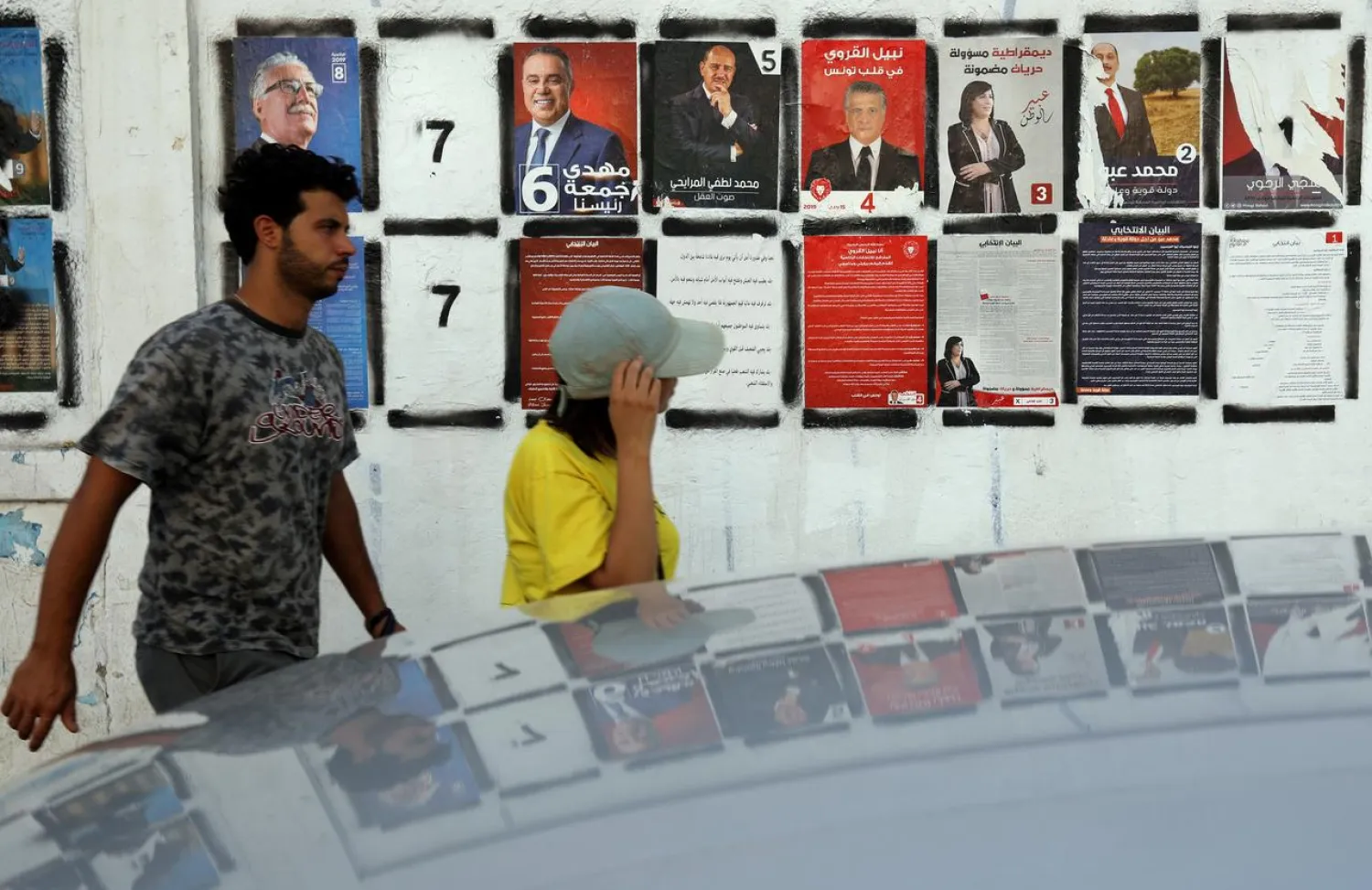
People walk past election campaign posters for presidential candidates in Tunis, Tunisia, September 13, 2019. (Reuters)
TT

Keenly Fought Presidential Election Gets Underway in Tunisia

People walk past election campaign posters for presidential candidates in Tunis, Tunisia, September 13, 2019. (Reuters)

Polling stations opened in Tunisia in Sunday in a fiercely fought presidential election.

Rarely has the outcome of an election been so uncertain in Tunisia, the cradle and partial success story of the Arab Spring, as some seven million voters are to choose from a crowded field.

Key players include media mogul Nabil Karoui -- behind bars due to an ongoing money laundering probe -- Abdelfattah Mourou, who heads a first-time bid on behalf of his Islamist inspired Ennahdha party, and Prime Minister Youssef Chahed.

The premier's popularity has been tarnished by a sluggish economy and a high cost of living, and he has found himself having to vehemently deny accusations that Karoui's detention since late August is politically inspired, said AFP.

The election follows an intense campaign beset by personality clashes, albeit one with few clear political differences, brought forward by the death in July of 92-year-old president Beji Caid Essebsi.

He had been elected in the wake of the 2011 revolt that overthrew former ruler Zine El Abidine Ben Ali.

Publication of opinion polls has officially been banned since July, but one thing appears sure -- many voters remain undecided, due to difficulties in reading a shifting political landscape.

"I am undecided between two candidates -- I will decide in the polling booth," smiled one citizen, Sofiene, who added "honest candidates don't have much chance of winning".

Some hopefuls have tried to burnish anti-establishment credentials in a bid to distance themselves from a political elite discredited by personal quarrels.

One key newcomer is Kais Saied, a 61-year-old law professor and expert on constitutional affairs, who has avoided attaching his bid to a political party.

Instead, he has gone door-to-door to drum up support for his conservative platform.

Last minute withdrawals

Another independent candidate is Defense Minister Abdelkarim Zbidi, a technocrat who is running for the first time.

However, he has the backing of Essebsi's Nidaa Tounes party.

The crowded field of 26 has been narrowed slightly by the last minute withdrawal of two candidates in favor of Zbidi -- former political adviser Mohsen Marzouk and businessman Slim Riahi, just ahead of Saturday's campaign blackout.

But it is Karoui's detention, just 10 days ahead of the start of the campaign, which has been one of the biggest talking points.

Studies suggest his arrest boosted his popularity.

A controversial businessman, Karoui built his appeal by using his Nessma television channel to launch charity campaigns, handing out food aid to some of the country's poorest.

But his detractors portray him as a would-be Silvio Berlusconi, the former Italian premier who they allege partly owns his channel.

On Friday, an appeal to have the Tunisian mogul released from prison ahead of the election was rejected, his party and lawyers said, two days after he began what his defense team said was a hunger strike.

The polarization between the different camps risks a derailment of the electoral process, according to Michael Ayari, an analyst for the International Crisis Group.

'Divisive' candidates

Isabelle Werenfels, a researcher at the German Institute for International and Security Affairs, has called the vote a democratic "test" because "it may require accepting the victory of a polarizing candidate", such as Karoui.

Distrust of the political elite has been deepened by an unemployment rate of 15 percent and a rise in the cost of living of close to a third since 2016.

Extremist attacks have exacted a heavy toll on the key tourism sector.

Overseas voting stations for Tunisia's sizable expatriate population have been open since Friday.

Some 70,000 security agents will be deployed on Sunday, including 50,000 focused solely on polling stations, according to the interior ministry.

Exit polls are expected overnight Sunday into Monday, but preliminary results are not expected from the electoral commission until Tuesday.

The date of the second round, which will decide the presidency, is not yet known, but it must happen by October 23 at the latest and may even take place on the same day as legislative polls -- October 6.

Those polls are supposed to be more significant, as Tunisia is an emerging parliamentary democracy.

But several candidates have called for presidential powers to be beefed up.


Atrocities in Sudan's El-Fasher were 'Preventable Human Rights Catastrophe'

Sudanese displaced people who left El Fasher after its fall, sit in the shade in Tawila at the Rwanda camp reception point on December 17, 2025. (Photo by AFP)
TT

Atrocities in Sudan's El-Fasher were 'Preventable Human Rights Catastrophe'

Sudanese displaced people who left El Fasher after its fall, sit in the shade in Tawila at the Rwanda camp reception point on December 17, 2025. (Photo by AFP)

The atrocities unleashed on El-Fasher in Sudan's Darfur region last October were a "preventable human rights catastrophe", the United Nations said Monday, warning they now risked being repeated in the neighbouring Kordofan region.

"My office sounded the alarm about the risk of mass atrocities in the besieged city of El-Fasher for more than a year ... but our warnings were ignored," UN rights chief Volker Turk told the Human Rights Council in Geneva.

He added that he was now "extremely concerned that these violations and abuses may be repeated in the Kordofan region".


Arab League Condemns Israel's Decisions to Alter Legal, Administrative Status of West Bank

A general view shows the opening session of the meeting of Arab foreign ministers at the Arab League Headquarters (Reuters)
TT

Arab League Condemns Israel's Decisions to Alter Legal, Administrative Status of West Bank

A general view shows the opening session of the meeting of Arab foreign ministers at the Arab League Headquarters (Reuters)

The General Secretariat of the Arab League strongly condemned decisions by Israeli occupation authorities to impose fundamental changes on the legal and administrative status of the occupied Palestinian territories, particularly in the West Bank, describing them as a dangerous escalation and a flagrant violation of international law, international legitimacy resolutions, and signed agreements, SPA reported.

In a statement, the Arab League said the measures include facilitating the confiscation of private Palestinian property and transferring planning and licensing authorities in the city of Hebron and the area surrounding the Ibrahimi Mosque to occupation authorities.

It warned of the serious repercussions of these actions on the rights of the Palestinian people and on Islamic and Christian holy sites.

The statement reaffirmed the Arab League’s firm support for the legitimate rights of the Palestinian people, foremost among them the establishment of their independent state on the June 4, 1967 borders, with East Jerusalem as its capital.


UN: 53 Migrants Dead or Missing in Shipwreck Off Libya

(FILES) Migrants sit on board a RHIB (Rigid inflatable boat) after being evacuated by crew members of the “Ocean Viking” rescue ship from the oil tanker the 'Maridive 703' in the search-and-rescue zone of the international waters between Malta and Tunisia, on December 31, 2025. (Photo by Sameer Al-DOUMY / AFP)
TT

UN: 53 Migrants Dead or Missing in Shipwreck Off Libya

(FILES) Migrants sit on board a RHIB (Rigid inflatable boat) after being evacuated by crew members of the “Ocean Viking” rescue ship from the oil tanker the 'Maridive 703' in the search-and-rescue zone of the international waters between Malta and Tunisia, on December 31, 2025. (Photo by Sameer Al-DOUMY / AFP)

The UN migration agency on Monday said 53 people were dead or missing after a boat capsized in the Mediterranean Sea off the Libyan coast. Only two survivors were rescued.

The International Organization for Migration said the boat overturned north of Zuwara on Friday.

"Only two Nigerian women were rescued during a search-and-rescue operation by Libyan authorities," the IOM said in a statement, adding that one of the survivors said she lost her husband and the other said "she lost her two babies in the tragedy.”

According to AFP, the IOM said its teams provided the two survivors with emergency medical care upon disembarkation.

"According to survivor accounts, the boat -- carrying migrants and refugees of African nationalities departed from Al-Zawiya, Libya, at around 11:00 pm on February 5. Approximately six hours later, it capsized after taking on water," the agency said.

"IOM mourns the loss of life in yet another deadly incident along the Central Mediterranean route."

The Geneva-based agency said trafficking and smuggling networks were exploiting migrants along the route from north Africa to southern Europe, profiting from dangerous crossings in unseaworthy boats while exposing people to "severe abuse.”

It called for stronger international cooperation to tackle the networks, alongside safe and regular migration pathways to reduce risks and save lives.