

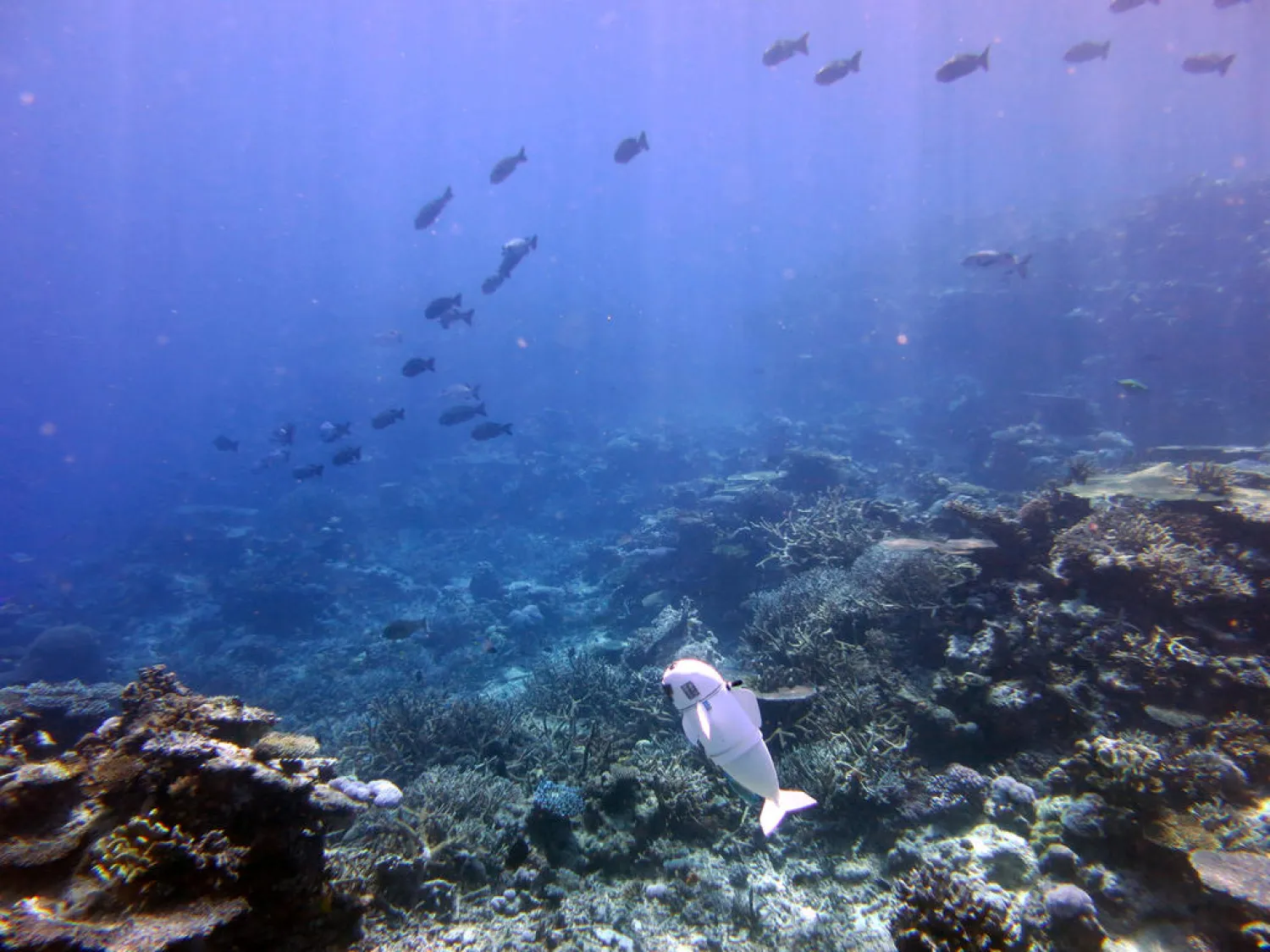

Flying Fish…New Swimming, Flying Robot

A robot fish dubbed SoFi, created by MIT's Computer Science and Artificial Intelligence Laboratory to explore marine environments, swims at Rainbow Reef off Taveuni, Fiji. Photo: MIT CSAIL handout via Reuters
TT

Flying Fish…New Swimming, Flying Robot

A robot fish dubbed SoFi, created by MIT's Computer Science and Artificial Intelligence Laboratory to explore marine environments, swims at Rainbow Reef off Taveuni, Fiji. Photo: MIT CSAIL handout via Reuters

A team of British researchers has created a bio-inspired bot that uses water from the environment to create a gas and launch itself from the water's surface.

The robot, which can travel 26 meters through the air after take-off, could be used to collect water samples in hazardous and cluttered environments, such as during flooding or when monitoring ocean pollution.

The Tech Xplore website reports that robots that can transition from water to air are desirable in these situations, but the launch requires a lot of power, which has been difficult to achieve in small robots.

The robot developed by researchers at Imperial College London is a system that requires just 0.2 grams of calcium carbide powder in a combustion chamber. The only moving part is a small pump that brings in water from the environment the robot is sat in, such as a lake or ocean, the website said.

The water and the calcium-carbide powder combine and produce a burnable acetylene gas. As the gas ignites, it expands, and propels the robot clear of the water, according to the German News Agency.

The Tech Xplore website cited Lead researcher Dr. Mirko Kovac, director of the Aerial Robotics Laboratory at Imperial College, saying "water-to-air transition is a power-intensive process, which is difficult to achieve on a small-scale flying vehicle that needs to be lightweight for flight."

"We have used water-reactive chemicals to reduce the materials that the robot needs to carry," he explained.

The team tested the robot in a lab, in a lake, and in a wave tank, showing that it can escape from the water's surface even under relatively rough conditions. According to the researchers, the robot, which weighs just 160 grams, can 'jump' multiple times after refilling its water tank. This could allow it to float on water and take samples at multiple points without additional power, saving energy over longer distances compared to an electrically powered robot.




Social Media Harms Teens, Watchdog Warns, as France Weighs Ban

The TikTok app logo is seen in this illustration taken January 16, 2025. (Reuters)
TT

Social Media Harms Teens, Watchdog Warns, as France Weighs Ban

The TikTok app logo is seen in this illustration taken January 16, 2025. (Reuters)

Social media harms the mental health of adolescents, particularly girls, France's health watchdog said Tuesday as the country debates banning children under 15 from accessing the immensely popular platforms.

The results of an expert scientific review on the subject were announced after Australia became the first country to prohibit big platforms including Instagram, TikTok and YouTube for under 16s last month, while other nations consider following its lead.

Using social media is not the sole cause of the declining mental health of teenagers, but its negative effects are "numerous" and well documented, the French public health watchdog ANSES wrote in its opinion, the result of five years of work by a committee of experts.

France is currently debating two bills, one backed by President Emmanuel Macron, that would ban social media for under 15s.

The ANSES opinion recommended "acting at the source" to ensure that children can only access social networks "designed and configured to protect their health".

This means that the platforms would have to change their personalized algorithms, persuasive techniques and default settings, according to the agency.

"This study provides scientific arguments for the debate about social networks in recent years: it is based on 1,000 studies," the expert panel's head Olivia Roth-Delgado told a press conference.

Social media can create an "unprecedented echo chamber" that reinforces stereotypes, promotes risky behavior and promotes cyberbullying, the ANSES opinion said.

The content also portrays an unrealistic idea of beauty via digitally altered images that can lead to low self-esteem in girls, which creates fertile ground for depression or eating disorders, it added.

Girls -- who use social media more than boys -- are subjected to more of the "social pressure linked to gender stereotypes," the opinion said.

This means girls are more affected by the dangers of social media -- as are people with pre-existing mental health conditions, it added.

On Monday, tech giant Meta urged Australia to rethink its teen social media ban, while reporting that it has blocked more than 544,000 Instagram, Facebook and Threads accounts under the new law.

Meta said parents and experts were worried about the ban isolating young people from online communities, and driving some to less regulated apps and darker corners of the internet.


New Process for Stable, Long-Lasting Batteries

The image shows a test cell used to fabricate and test the all-solid-state battery developed at PSI. (Paul Scherrer Institute PSI/Mahir Dzambegovic) 
TT

New Process for Stable, Long-Lasting Batteries

The image shows a test cell used to fabricate and test the all-solid-state battery developed at PSI. (Paul Scherrer Institute PSI/Mahir Dzambegovic) 

Researchers at the Paul Scherrer Institute PSI have achieved a breakthrough on the path to practical application of lithium metal all-solid-state batteries.

The team expects the next generation of batteries to store more energy, are safer to operate, and charge faster than conventional lithium-ion batteries.

The team has reported these results in the journal Advanced Science.

All-solid-state batteries are considered a promising solution for electromobility, mobile electronics, and stationary energy storage – in part because they do not require flammable liquid electrolytes and therefore are inherently safer than conventional lithium-ion batteries.

Two key problems, however, stand in the way of market readiness: On the one hand, the formation of lithium dendrites at the anode remains a critical point.

On the other hand, an electrochemical instability – at the interface between the lithium metal anode and the solid electrolyte – can impair the battery’s long-term performance and reliability.

To overcome these two obstacles, the team led by Mario El Kazzi, head of the Battery Materials and Diagnostics group at the Paul Scherrer Institute PSI, developed a new production process:

“We combined two approaches that, together, both densify the electrolyte and stabilize the interface with the lithium,” the scientist explained.

Central to the PSI study is the argyrodite type LPSCl, a sulphide-based solid electrolyte made of lithium, phosphorus, and sulphur. The mineral exhibits high lithium-ion conductivity, enabling rapid ion transport within the battery – a crucial prerequisite for high performance and efficient charging processes.

To densify argyrodite into a homogeneous electrolyte, El Kazzi and his team did incorporate the temperature factor, but in a more careful way: Instead of the classic sintering process, they chose a gentler approach in which the mineral was compressed under moderate pressure and at a moderate temperature of only about 80 degrees Celsius.

The result is a compact, dense microstructure resistant to the penetration of lithium dendrites. Already, in this form, the solid electrolyte is ideally suited for rapid lithium-ion transport.

To ensure reliable operation even at high current densities, such as those encountered during rapid charging and discharging, the all-solid-state cell required further modification.

For this purpose, a coating of lithium fluoride (LiF), only 65 nanometres thick, was evaporated under vacuum and applied uniformly to the lithium surface – serving as a ultra-thin passivation layer at the interface between the anode and the solid electrolyte.

In laboratory tests with button cells, the battery demonstrated extraordinary performance under demanding conditions.

“Its cycle stability at high voltage was remarkable,” said doctoral candidate Jinsong Zhang, lead author of the study.

After 1,500 charge and discharge cycles, the cell still retained approximately 75% of its original capacity.

This means that three-quarters of the lithium ions were still migrating from the cathode to the anode. “An outstanding result. These values are among the best reported to date.”

Zhang therefore sees a good chance that all-solid-state batteries could soon surpass conventional lithium-ion batteries with liquid electrolyte in terms of energy density and durability.

Thus El Kazzi and his team have demonstrated for the first time that the combination of solid electrolyte mild sintering and a thin passivation layer on lithium anode effectively suppresses both dendrite formation and interfacial instability.

This combined solution marks an important advance for all-solid-state battery research – not least because it offers ecological and economic advantages: Due to the low temperatures, the process saves energy and therefore costs.

“Our approach is a practical solution for the industrial production of argyrodite-based all-solid-state batteries,” said El Kazzi. “A few more adjustments – and we could get started.”


Meta Urges Australia to Change Teen Social Media Ban

Meta has called for Australia's social media for under-16s to target app stores. Saeed KHAN / AFP
TT

Meta Urges Australia to Change Teen Social Media Ban

Meta has called for Australia's social media for under-16s to target app stores. Saeed KHAN / AFP

Tech giant Meta urged Australia on Monday to rethink its world-first social media ban for under-16s, while reporting that it has blocked more than 544,000 accounts under the new law.

Australia has required big platforms including Meta, TikTok and YouTube to stop underage users from holding accounts since the legislation came into force on December 10 last year.

Companies face fines of Aus $49.5 million (US$33 million) if they fail to take "reasonable steps" to comply.

Billionaire Mark Zuckerberg's Meta said it had removed 331,000 underage accounts from Instagram, 173,000 from Facebook, and 40,000 from Threads in the week to December 11.

The company said it was committed to complying with the law.

"That said, we call on the Australian government to engage with industry constructively to find a better way forward, such as incentivizing all of industry to raise the standard in providing safe, privacy-preserving, age appropriate experiences online, instead of blanket bans," it said in statement.

Meta renewed an earlier call for app stores to be required to verify people's ages and get parental approval before under-16s can download an app.

This was the only way to avoid a "whack-a-mole" race to stop teens migrating to new apps to avoid the ban, the company said.

The government said it was holding social media companies to account for the harm they cause young Australians.

"Platforms like Meta collect a huge amount of data on their users for commercial purposes. They can and must use that information to comply with Australian law and ensure people under 16 are not on their platforms," a government spokesperson said.

Meta said parents and experts were worried about the ban isolating young people from online communities, and driving some to less regulated apps and darker corners of the internet.

Initial impacts of the legislation "suggest it is not meeting its objectives of increasing the safety and well-being of young Australians", it said.

While raising concern over the lack of an industry standard for determining age online, Meta said its compliance with the Australian law would be a "multilayered process".

Since the ban, the California-based firm said it had helped found the OpenAge Initiative, a non-profit group that has launched age-verification tools called AgeKeys to be used with participating platforms.