


Champions League is Back – but Don’t Expect a Real Match until February

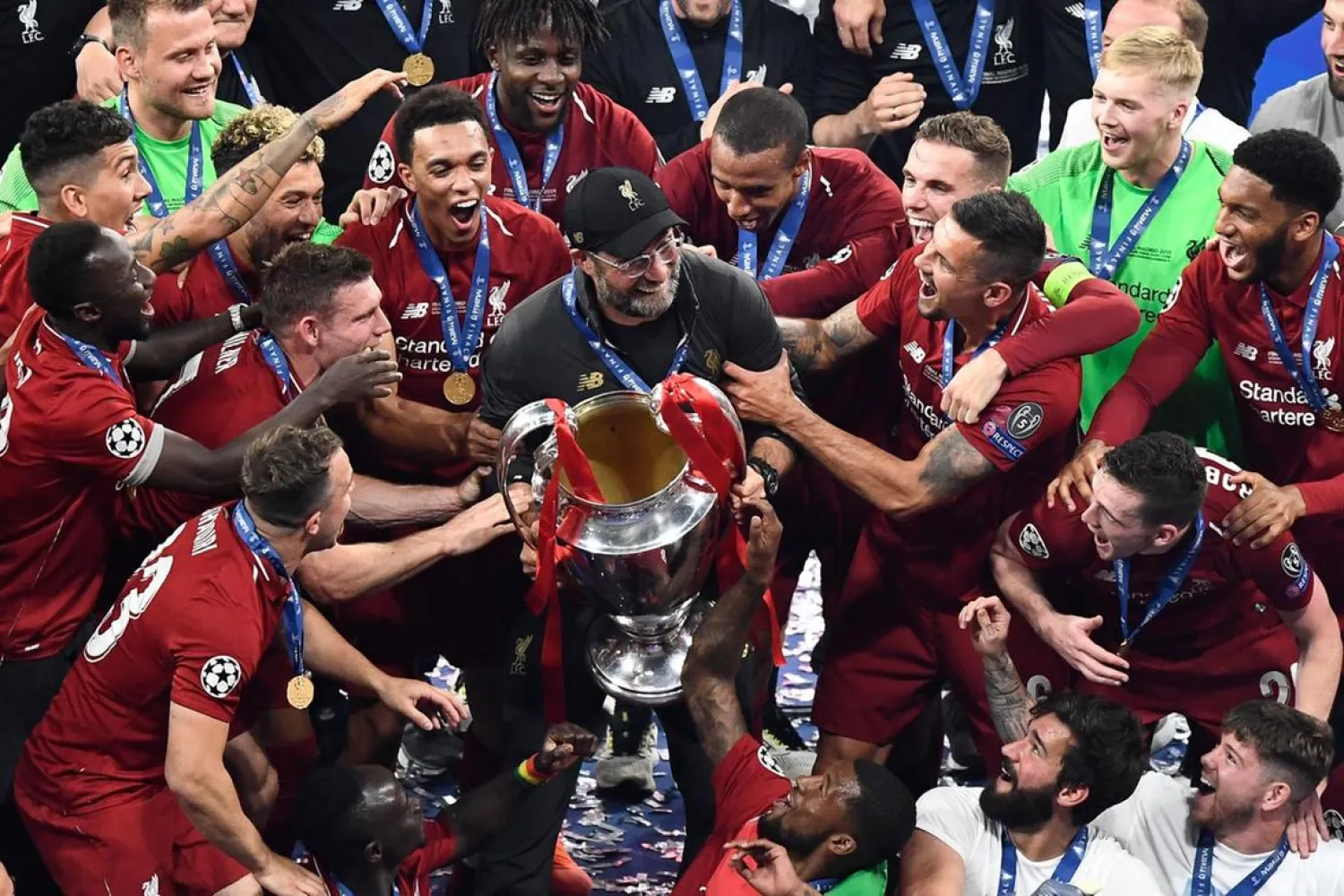
Jurgen Klopp and his Liverpool squad party with the European Cup after winning the Uefa Champions League final. (AFP)
TT

Champions League is Back – but Don’t Expect a Real Match until February

Jurgen Klopp and his Liverpool squad party with the European Cup after winning the Uefa Champions League final. (AFP)

In the distance the anthem swells. Inappropriate advertising hoardings are covered up. A continent prepares to give thanks to Gazprom for providing them with football. The Champions League returns on Tuesday, unleashing an excited flurry of anticipatory questions: Can Liverpool defend their crown? Will Pep Guardiola stop over-complicating things and, after a nine-year break, finally lift his third European title as a manager? Will Juventus’s gamble on Cristiano Ronaldo pay off? Are Barcelona and Real Madrid as shambolic as they appear? Who will Paris Saint‑Germain lose to hilariously this time? But mostly, when does the real stuff start?

Does any other competition that so regularly ends so brilliantly go through such a protracted clearing of the throat? Last season only one side managed to eliminate a club with a higher annual revenue in the group stage. The year before there were four sides eliminated by teams with lower annual revenues and before that just one again. Of the last 48 teams to reach the knockout stages, only six did not follow a remorseless financial logic – and even then it is hard to claim that Ajax or Basel putting out Benfica, or Roma qualifying ahead of Atlético Madrid, really counts as especially noteworthy.

Look at the bookmakers’ odds. Groups A, B, D and E are regarded as foregone conclusions, with even the second favorites to qualify 9-2 on or shorter. Only Group F appears as a genuine four-way battle, with Zenit, seeded in the highest pot by dint of winning the Russian championship, fourth favorites to go through at 6-4. That in effect means that in the other seven groups, there will be 84 matches to decide whether Atalanta’s high press can oust a Shakhtar in transition after the departure of Paulo Fonseca, whether Antonio Conte can bring enough focus to Internazionale to challenge Borussia Dortmund and whether Valencia can overcome the chaos prompted by the dismissal of their manager, Marcelino, to edge out Ajax.

Or to put that another way, in six of the eight groups one side is rated 50-1 or longer to come top. The Czech champions, Slavia Prague – drawn with Barcelona, Dortmund and Inter – are 100-1, which is to say the same starting price as Foinavon, the most outlandish Grand National winner in history.

This is the curse of the competition: it is not just that there is a small cabal of super-clubs far stronger than the rest; it is that there is also a small group of outsiders whose only chance is whatever the football equivalent of a pile-up at the 23rd fence would be. Dinamo Zagreb, for instance, have won the Croatian league in 13 of the last 14 seasons; in that time they have totaled four points in Champions League group games. Lose the game, take the money, go home, win the league, repeat, trapped on a mezzanine of futility.

Perhaps Dinamo and other sides like them are happy enough with the format. They make a lot of money without a lot of effort and that sustains their hegemony at home, while they also have a glitzy shop window in which to advertise any promising young talent they may be able to sell for profit. But as a report commissioned this summer by Uefa into the polarization of European football showed, attendances outside the big five leagues are falling, with the attention increasingly drawn to the elite.

For a time the biggest clubs seemed to be satisfied as well. Football, the game itself, the thing played on the pitch, it must always be remembered, tends to be a minor consideration.

Real Madrid’s director general, José Ángel Sánchez, has said the club must see itself like Disney, as a content producer. Champions League group games provide content. Delight as Cristiano Ronaldo scores a hat-trick! Marvel as Neymar nutmegs a full-back! Gasp as Lionel Messi skips by four defenders! Brief YouTube clips rarely convey that the opponent being outwitted is a Belarusian journeyman being paid 100 times less a week than the star.

But the remorseless logic of football’s neo-liberal economics has taken effect. The Champions League has made the rich richer to the point that domestic titles have become almost worthless. It is why Juventus took their gamble on Ronaldo last summer, paying €100m for a 33-year-old in order, as they saw it, to provide the attacking thrust that would transform appearances in two of the previous four finals into a first Champions League success since 1996. When the subsequent European campaign ended with a quarter-final defeat by Ajax, the manager, Max Allegri, despite five Serie A titles in a row, was replaced.

There is an epic quality to this, taking in the classic themes of greed and ambition, now set against the ticking clock of Ronaldo’s continued fitness as an elite athlete. It is undeniably great content. But in terms of football it unfortunately produces between two and seven intriguing games per super-club, beginning next February.

Little wonder, then, that Europe’s non-Premier League elite are so desperate to alter the format of the Champions League. It manifestly needs changing. A group stage in which roughly 80 percent of the games are largely meaningless while amplifying and rectifying preexisting financial inequalities cannot stand.

But the plan proposed by the Juventus chairman, Andrea Agnelli, for four groups of eight somehow managed to make worse the structural inequality while comprising a raft of games that earlier results could have rendered entirely meaningless (as opposed to the present structure, in which a lot of theoretically meaningful games are rendered meaningless because one side is so much stronger than the other).

That proposal appears to have been headed off by Premier League clubs – not, of course, for the good of the game, but because it threatened the financial advantages they have from being in the Premier League. The great irony is that, beyond the supreme marketing, the reason for the Premier League’s popularity, for all its imbalances, is that it remains far less predictable than any other major league. There may be a lesson there.

The Guardian Sport


Swiss Haenni Takes over RB Leipzig as First Female CEO of a Bundesliga Club 

Tatjana Haenni, FIFA deputy director of the competitions division and head of women's football, listens during the opening news conference for the FIFA Women's World Cup in Vancouver, British Columbia, on Thursday, June 4, 2015. (AP)
TT

Swiss Haenni Takes over RB Leipzig as First Female CEO of a Bundesliga Club 

Tatjana Haenni, FIFA deputy director of the competitions division and head of women's football, listens during the opening news conference for the FIFA Women's World Cup in Vancouver, British Columbia, on Thursday, June 4, 2015. (AP)

Former Switzerland international and experienced football administrator, Tatjana Haenni, became the first female CEO of a Bundesliga club after she was appointed to the post at RB Leipzig on Wednesday.

Haenni has decades of experience following her playing career, having held various posts in women's football at global governing body FIFA for more than a decade.

She was also in charge of women's football at the Swiss football association and sports director at the National Women's Soccer League (NWSL) in the United States among others until her departure earlier this year.

"In our discussions, she impressed us and the committees with her expertise, as well as her combination of specialist knowledge, leadership strength and strategic thinking," said Oliver Mintzlaff, chair of RB Leipzig's supervisory board in a club statement.

The 59-year-old will take up her role on January 1, 2026.

Leipzig, owned by energy drinks maker Red Bull, are currently in second place in the Bundesliga, eight points behind leaders Bayern Munich. The Bundesliga will go into a winter break between December 21 and January 9.

"I am very much looking forward to this new role. I am convinced that with strong teamwork and a focus on RB Leipzig’s strengths, we can tap into significant potential," Haenni said.

"I can’t wait to get started in January and to get to know the club on a deeper level," Haenni said. "Together, we want to continue on what is already a successful path, and achieve our ambitious goals."


Egypt Teammates Rally Behind Unsettled Salah before AFCON 

Liverpool's Egyptian striker #11 Mohamed Salah warms up ahead of the English Premier League football match between Leeds United and Liverpool at Elland Road in Leeds, northern England on December 6, 2025. (AFP)
TT

Egypt Teammates Rally Behind Unsettled Salah before AFCON 

Liverpool's Egyptian striker #11 Mohamed Salah warms up ahead of the English Premier League football match between Leeds United and Liverpool at Elland Road in Leeds, northern England on December 6, 2025. (AFP)

While the future of Mohamed Salah at Liverpool hangs in the balance, Egypt teammates have rallied behind the national team captain ahead of the 2025 Africa Cup of Nations in Morocco.

The record seven-time continental champions are in Group B with Angola, South Africa and Zimbabwe, and will be based in southern coastal city Agadir throughout the first round.

"Players like him do not get benched," said striker Ahmed "Kouka" Hassan on social media, referring to Salah being a substitute in the last three Liverpool fixtures, and coming on only once.

"If he starts on the bench, you must make sure he is the first to come on, after 60 minutes, 65 at the latest.

"Mo is not just a teammate, he is a leader, a legend for club and country. Keep working hard brother, every situation in life is temporary, moments like this pass, what stays is your greatness."

Head coach and former star Hossam Hassan posted a photograph of himself and Salah and a message: "Always a symbol of perseverance and strength."

"The greatest Liverpool legend of all time," wrote winger Ahmed "Zizo" El Sayed. Goalkeeper Mohamed Sobhy called Salah "always the best".

Liverpool have struggled in their title defense this season and lie 10th after 15 rounds, 10 points behind leaders Arsenal. Salah has also battled with just four goals in 13 top-flight appearances.

After twice surrendering the lead in a 3-3 draw at Leeds United last Saturday, Salah told reporters "it seems like the club has thrown me under the bus".

"I think it is very clear that someone wanted me to get all of the blame (for the slump)... someone does not want me in the club."

Salah was omitted from the squad that travelled to Milan for a Champions League clash with Inter on Tuesday and has hinted that he may not play for Liverpool again.

- 'Great feeling' -

Although Egypt last won the AFCON 15 years ago in Luanda, Salah, 33, believes they will lift the trophy again before he retires.

"It will happen -- that is what I believe. It is a great feeling every time you step on the field wearing the Egyptian colors."

Salah has suffered much heartbreak in four AFCON tournaments as Egypt twice finished runners-up and twice exited in the round of 16.

He created the goal that put the Pharaohs ahead in the 2017 final, but Cameroon clawed back to win 2-1 in Libreville.

Hosts and title favorites Egypt were stunned by South Africa in the first knockout round two years later, conceding a late goal to lose 1-0.

Egypt reached the final again in 2022 only to lose on penalties to Senegal after 120 goalless minutes in Yaounde.

In Ivory Coast last year, Salah suffered a hamstring injury against Ghana and took no further part in the tournament. Egypt lost on penalties to the Democratic Republic of Congo in a last-16 clash.

This year, Egypt boast an array of attacking talent with Salah, Omar Marmoush from Manchester City, Mostafa Mohamed of Nantes and Mahmoud "Trezeguet" Hassan and Zizo from Cairo giants Al Ahly.

Group B is the only one of the six in Morocco featuring two qualifiers for the 2026 World Cup, with Egypt and South Africa heading to the global showpiece in North America.

South Africa exceeded expectations by finishing third at the 2024 AFCON, but Belgian coach Hugo Broos expects a tougher campaign in a tournament that kicks off on December 21.

"It will be harder because every opponent will be more motivated to beat us after our bronze medals," said the tactician who guided Cameroon to the 2017 AFCON title.

Angola and Zimbabwe recently changed coaches with France-born Patrice Beaumelle and Romanian Mario Marinica hired.

The Angolans have reached the quarter-finals three times, including last year, while the Zimbabweans have never gone beyond the first round.


Pressure Is on Real Madrid Coach Xabi Alonso Ahead of Champions League Match Against Man City 

Real Madrid's head coach Xabi Alonso in action during a training session at Valdebebas sports city in Madrid, Spain, 09 December 2025. (EPA)
TT

Pressure Is on Real Madrid Coach Xabi Alonso Ahead of Champions League Match Against Man City 

Real Madrid's head coach Xabi Alonso in action during a training session at Valdebebas sports city in Madrid, Spain, 09 December 2025. (EPA)

The pressure is mounting on Real Madrid coach Xabi Alonso ahead of Wednesday's Champions League match with Manchester City.

Madrid has won just two of its last seven in all competitions including a 2-0 loss to Celta Vigo over the weekend.

Ahead of the City match, Alonso had to contend with reports in the Spanish media that he had lost control of the locker room.

“This is a team, and we all stand together,” he said. “In soccer, you can change perspective quickly, and we’re at that point.”

Doubts over Kylian Mbappé's availability added to Alonso's concerns. The France striker trained separately to the rest of the team on Tuesday, having reportedly had issues with his left leg.

City manager Pep Guardiola sympathized with Alonso, who he coached as a player at Bayern Munich.

“Barcelona and Real Madrid are the toughest clubs to be manager of because of the environment,” he said. “It’s a difficult place but he knows it — it’s the reality of being here."

Other games on Wednesday include defending champion Paris Saint-Germain at Athletic Bilbao, Arsenal at Club Brugge and Italian champion Napoli at Benfica.
