


Israel's Election Highlights Secular-Religious Divide

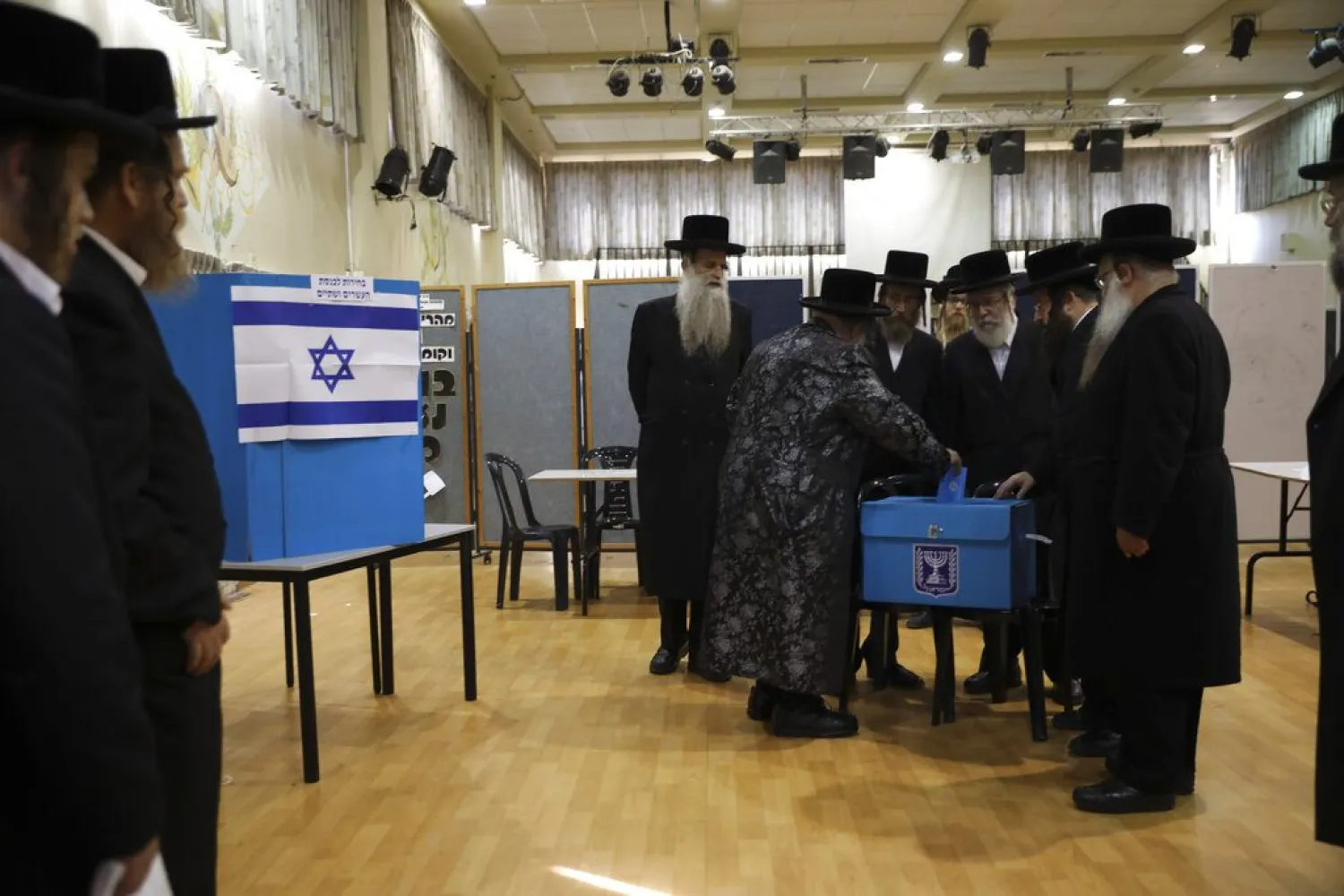
In this Tuesday, Sept. 17, 2019 file photo, ultra-Orthodox Jews watch Rabbi Israel Hager vote in Bnei Brak (AP Photo/Oded Balilty, File)
TT

Israel's Election Highlights Secular-Religious Divide

In this Tuesday, Sept. 17, 2019 file photo, ultra-Orthodox Jews watch Rabbi Israel Hager vote in Bnei Brak (AP Photo/Oded Balilty, File)

Yamit Dulberg considers herself a traditional Israeli woman with right-wing views who would usually vote for Prime Minister Benjamin Netanyahu's Likud Party. But this week the 37-year-old mother of two cast her ballot for his main rival, in part because she's sick of his ultra-Orthodox Jewish allies and their disproportionate power over daily life.

"Something has changed in recent years, the coercion has gone overboard," said Dulberg, who runs a small family-run jewelry business. "We are a Jewish state, but not a religious state."

In Israel's secular heartland, religion played a central role in this week's deadlocked election. For many, a vote for the opposition was driven by a desire to keep rabbis out of their schools, businesses and love lives.

With the Palestinian issue almost completely off the agenda, and a general consensus about security challenges, matters of religion and state took center stage.

Veteran firebrand Avigdor Lieberman positioned himself as the primary power broker by making these matters his signature cause and defecting from Netanyahu's camp over what he called its capitulation to the ultra-Orthodox. He now insists on a secular unity government to end their outsized influence, and neither Netanyahu nor former military chief Benny Gantz, whose centrist Blue and White party won the most seats, seems capable of forming a coalition government without him.

Ultra-Orthodox parties only represent about a tenth of the population, but larger parties have historically relied on them to assemble majority coalitions. That means the ultra-Orthodox are often in position to bring down the government if their demands are not met.

They use their political clout to sustain a segregated lifestyle centered on study and prayer, and raising large families on taxpayer-funded handouts. They also run a network of schools that often teach little math or English, and have blocked legislation to require their community to serve in the military, like most other Jewish citizens.

The ultra-Orthodox insist their young men serve the nation through prayer and study, thus preserving Jewish learning and heritage, and by maintaining a pious way of life that has kept the Jewish faith alive through centuries of persecution. They say they are unfairly targeted by the secular majority.

Arye Deri, whose ultra-Orthodox Shas party grew in power, accused Lieberman and others of inciting against his community.

"You'll tell us what to teach in our schools?" he told the YNet news site. "I wish upon his voters that they get some of our education and learn a little courtesy."

Experts say the cloistered communities of the ultra-Orthodox are being left behind by modern society, creating a culture of poverty that threatens the future well-being of the entire country.

On top of carrying the military and financial burden, the secular majority resents having the ultra-religious encroach upon their lifestyle and civil liberties. The ultra-Orthodox establishment prevents public transportation and most commerce on the Sabbath and wields a monopoly over matters of marriage, burials and conversions. In recent years, they've also delayed infrastructure projects and archaeological digs over religious concerns.

Dulberg said she was particularly troubled that Israelis could not have civil marriages and that gay couples have such difficulty marrying and raising children.

"This country is split down the middle and no one should force anything on the other," she said. "Just like I wouldn't drive a car through their neighborhood on the Sabbath and park in front of their synagogue, they should stay out of my life."

She said her husband, who was a leftist, even considered voting for the nationalist Lieberman because of the ultra-Orthodox. But eventually they both settled on Gantz's Blue and White party, which has also promised to advocate for the secular.

"My opinions are right-wing, but that's not the issue anymore," she said, seated outside City Hall in Kfar Saba, a midsized city northeast of Tel Aviv. "The world has changed but religion hasn't. That's a problem."

Shmuel Rosner, a senior fellow at the nonpartisan Jewish People Policy Institute in Israel, said Lieberman's rise showed that many right-wing Israelis are tired of their elected officials being so tightly bound to the ultra-religious.

"There is a large group of regular Israelis in the middle," he wrote in the Maariv daily. "This is what they said for the second consecutive time: we want normalcy."

In Kfar Saba, municipal elections have centered on issues such as budgets for religious authorities, whether shops should stay open on the Sabbath and how much faith should be discussed in schools.

On Tuesday, Blue and White earned 46% of the city's vote - 20% more than its national figure and twice as much as Likud. They were followed by the left-wing Labor and Democratic Union parties - both of which fared far worse nationally - and then Lieberman, according the figures released by the Central Election Committee.

"The ultra-Orthodox use religion for their own purposes," said 77-year-old retiree Eli Casspi, who voted Labor. "They can live their lives and let me live mine. But they don't. They force it on me."

Yohanan Plesner, president of the non-partisan Israel Democracy Institute think tank, said Netanyahu's iron-clad alliance with the ultra-Orthodox was starting to cost him politically.

"This time the agenda was different," he said. "Israelis voted more on religion and state as a result of the political growth and appetite of the ultra-Orthodox parties."

The ultra-Orthodox interpretations of piety have also created a rift with the Jewish Diaspora, alienating many who belong to the more liberal Reform and Conservative streams, which account for the majority of American Jews. Ultra-Orthodox rabbis have repeatedly questioned their faith and scuttled plans to upgrade a mixed-gender prayer area at Jerusalem's Western Wall.

Julietta Tolchinsky, a 47-year-old mother of three who emigrated from Argentina, said she feared religious influence creeping into the school curriculum.

"In the Diaspora, I felt Jewish. Here I feel Israeli, not Jewish, because they've taken Judaism for themselves," she said. "In Israel being Jewish means being religious. To me, being Jewish means being open-minded, progressive and tolerant."



Russia Evacuates 198 Workers from Iran Nuclear Plant Amid Airstrike

Rosatom State Atomic Energy Corporation Director General Alexey Likhachev arrives to attend the talks between Russian President Vladimir Putin and Armenian Prime Minister Nikol Pashinyan at the Kremlin in Moscow, Russia, 01 April 2026. (EPA/Pavel Bednyakov/AP Pool)
TT

Russia Evacuates 198 Workers from Iran Nuclear Plant Amid Airstrike

Rosatom State Atomic Energy Corporation Director General Alexey Likhachev arrives to attend the talks between Russian President Vladimir Putin and Armenian Prime Minister Nikol Pashinyan at the Kremlin in Moscow, Russia, 01 April 2026. (EPA/Pavel Bednyakov/AP Pool)

Russia started a planned evacuation of 198 workers from Iran's Bushehr atomic plant shortly after a US-Israeli projectile hit near the facility, Russian state media said on Saturday.

This was a third evacuation from the facility in southern Iran on the Gulf coast, which was built with Moscow's help, with about 100 Russian staff remaining there by now.

The area around Bushehr has been struck four times during this war. The latest attack on Saturday saw one person -- a guard at the facility -- killed, but did not damage the plant itself, according to Iranian state media.

"As planned, we began the main phase of the evacuation today," Russia's nuclear agency Rosatom head Alexey Likhachev was quoted as saying by Russia's TASS news agency.

"About 20 minutes after that ill-fated strike, buses set off from Bushehr station towards the Iranian-Armenian border (with) 198 people, to be precise -- this is the largest evacuation," he added.

Likhachev also said that Russia informed the US and Israel about the evacuation.

"The likelihood of a risk of damage or a potential nuclear incident is, unfortunately, only increasing, as has been confirmed by this morning's events," the Rosatom CEO said.

The agency plans to keep only a skeleton staff at Bushehr amid the threat of further strikes.

The Russian foreign ministry slammed the "evil" US-Israeli attack and urged a cessation of hostilities on Iranian nuclear facilities immediately.


Erdogan Says Middle East War Has Caused ‘Geostrategic Impasse’

This handout photograph taken and released by the Turkish presidential press service on April 4, 2026, shows Türkiye's President Recep Tayyip Erdogan (R) welcoming and shaking hands Ukraine's President Volodymyr Zelensky (L) upon arrival for a bilateral meeting on security at Dolmabahce Presidential Office, in Istanbul. (Turkish Presidential Press Service / AFP)
TT

Erdogan Says Middle East War Has Caused ‘Geostrategic Impasse’

This handout photograph taken and released by the Turkish presidential press service on April 4, 2026, shows Türkiye's President Recep Tayyip Erdogan (R) welcoming and shaking hands Ukraine's President Volodymyr Zelensky (L) upon arrival for a bilateral meeting on security at Dolmabahce Presidential Office, in Istanbul. (Turkish Presidential Press Service / AFP)

Türkiye's President Recep Tayyip Erdogan said the war in the Middle East had led to a "geostrategic impasse", during a telephone conversation with NATO chief Mark Rutte, his office said Saturday.

"President Erdogan said the process started by the intervention against Iran had led to a geostrategic impasse and that the international community had to redouble its efforts to bring an end to this war," said the statement.

Türkiye has attempted to mediate an end to the hostilities, notably through negotiations conducted with Pakistan and Egypt.

Erdogan said his country was also continuing efforts "to reach a peaceful outcome" to the conflict between Russia and Ukraine.

Ukrainian President Volodymyr Zelensky arrived in Istanbul Saturday for talks with Erdogan.

A senior Ukrainian official told AFP that the talks would not only be about drone interceptors but also about security cooperation in general.

The Turkish presidency said on X that the talks would focus "efforts towards a ceasefire and a lasting solution."


Several Injured in Israel by Iran Missile Fire

A picture shows the damage at a factory that got hit by a missile in Petah Tikva, east of Tel Aviv, on April 3, 2026. (AFP)
TT

Several Injured in Israel by Iran Missile Fire

A picture shows the damage at a factory that got hit by a missile in Petah Tikva, east of Tel Aviv, on April 3, 2026. (AFP)

Israeli emergency services said its crew treated five people who were injured Saturday in Tel Aviv and surrounding areas after Iran fired several rounds of missiles toward Israel.

Since midnight, seven waves of Iranian missiles have been launched towards Israel, according to the Israeli military.

Israel's Magen David Adom emergency services said a 45-year-old man was treated for minor injuries from glass shrapnel in the central city of Bnei Brak and taken to hospital.

As the day progressed, rescue teams said they had treated three additional casualties -- two men in their 20s hit by glass fragments and one injured by blast.

A 52-year-old man "lightly injured by the blast wave" was also transferred to a hospital in Ramat Gan, in central Israel, the emergency service said.

In a residential neighborhood of Ramat Gan, AFP images showed the top floor of a house completely blown out, exposing its gutted interior, with a crushed bookcase and an exercise bike amid the debris.

Numerous impact marks were visible on the walls.

Nearby, another home was largely destroyed, stripped of its outer walls, according to AFP photographs.

"All this is from shrapnel," Joy Frankel, a social worker told AFP near one of the impacted sites.

According to several local media outlets, including The Times of Israel, a cluster munition missile fired from Iran on Saturday morning landed near the Kirya military base in Tel Aviv, not far from the defense ministry.

The military said its air defenses were working to down missiles fired from Iran, each a time it announced incoming projectiles.

Since February 28, the United States and Israel have conducted joint strikes against Iran, prompting the Tehran to retaliate with daily missile barrages targeting Israel and several neighboring countries across the region.