


Israel Vote Deadlock Confirmed by Near-Complete Results

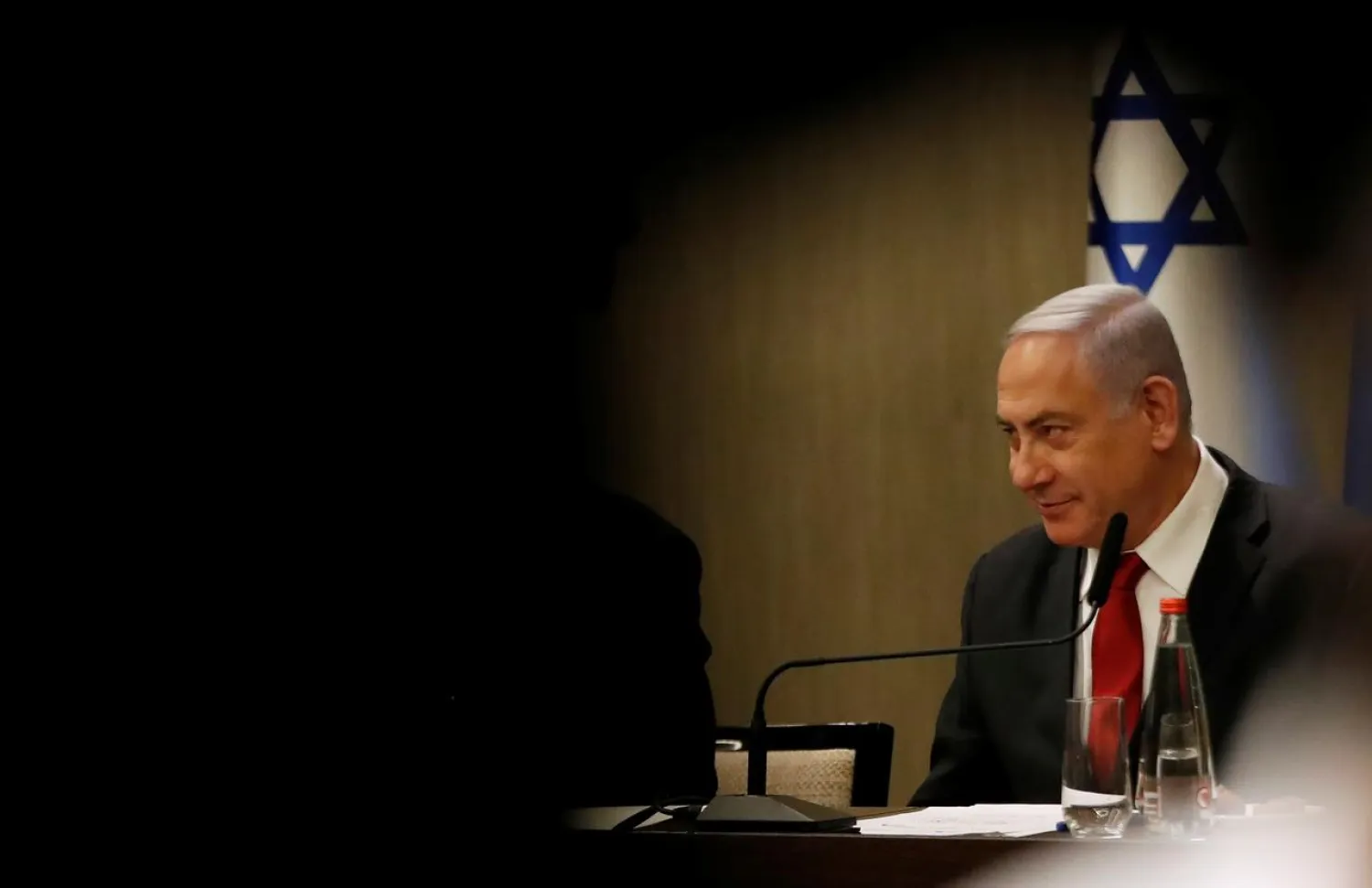
Israeli Prime Minister Benjamin Netanyahu delivers a statement during a news conference in Jerusalem September 18, 2019. (Reuters)
TT

Israel Vote Deadlock Confirmed by Near-Complete Results

Israeli Prime Minister Benjamin Netanyahu delivers a statement during a news conference in Jerusalem September 18, 2019. (Reuters)

Israeli vote results on Friday confirmed a deadlock in the country's general election and put Prime Minister Benjamin Netanyahu's Likud party as the second-largest, leaving him with a tough battle to extend his long tenure in office.

The near-complete official results from Tuesday's election gave ex-military chief Benny Gantz's centrist Blue and White alliance the most seats, with 33 out of parliament's 120.

Netanyahu's right-wing Likud won 31 seats, but neither had an obvious path to a majority coalition.

In a stark admission on Thursday, Netanyahu acknowledged he was unable to form a right-wing coalition as he hoped and called on Gantz to join him in a unity government instead.

Gantz responded by saying he would have to be prime minister in a unity government since Blue and White was the largest party.

The standoff has even raised the possibility of yet another election -- which would be the third to be held in a year following April polls that also ended inconclusively.

Israeli President Reuven Rivlin plans to begin consultations with all parties voted into parliament on Sunday to decide who to choose to try to form a government.

Major developments were not expected before then, particularly with the Sabbath, or weekly Jewish day of rest, beginning at sundown Friday.

Final results will be published on Wednesday and there could be changes before then, Israel's election committee said.

The committee said the results did not include 14 polling stations where verifications were still ongoing.

Israeli media said more than 99 percent of the votes had been counted.

The third-largest total was for the mainly Arab Joint List alliance, which won 13 seats.

Its strong showing opened the possibility that its leader Ayman Odeh could become the country's first Arab opposition chief if Likud and Blue and White form a unity government.

A number of analysts attributed the Joint List breakthrough to anger with Netanyahu over actions and rhetoric seen as demonizing the country's Arab population helping spur turnout.

'Won the election'

Following the Joint List, the country's two main ultra-Orthodox Jewish parties, Shas and United Torah Judaism, won nine and eight seats respectively.

Ex-defense minister Avigdor Lieberman's nationalist Yisrael Beitenu party also won eight seats, and he could potentially play a kingmaker role.

He has called for a unity government between his party, Likud and Blue and White, excluding the ultra-Orthodox parties, which he accuses of seeking to force religious law onto the country's secular population.

On Friday, he said he had not spoken to either Netanyahu or Gantz yet and did not plan to do so until next week.

He laid out his requirements for joining a coalition, including a demand for legislation to have the ultra-Orthodox perform mandatory military service like most Jewish Israelis.

Lieberman's refusal to budge on that issue caused coalition talks to fail after the April election.

"We will not accept any less than that even at the cost of sitting in the opposition," he said of his list of demands, which included other issues related to religion and state.

But the main focus in the coming days will be on Netanyahu, Israel's longest-serving prime minister but who is facing potential corruption charges in the weeks ahead.

He was widely seen as hoping to have the new parliament grant him immunity from prosecution, but that may now be impossible even if he does manage to remain premier.

"During the elections, I called for the establishment of a right-wing government," Netanyahu said in a video message on Thursday. "But unfortunately, the election results show that this is not possible."

He went on to call on Gantz to form a "broad unity government today."

The two men shook hands when they crossed paths at a memorial event later in the day, but Gantz made his position clear on Thursday afternoon.

Gantz too called for a unity government, but he insisted that he be prime minister.

"Blue and White, headed by me, has won the election," he said. "Blue and White is the largest party."

The results were the latest sign of Netanyahu's long dominance of Israeli politics weakening.

He suffered one of the biggest defeats of his political career after the April election.

His Likud along with its right-wing and religious allies won a majority, but he failed to form a coalition and opted for a second election rather than risk having Rivlin choose someone else to try.

The 69-year-old's survival as prime minister was far from being ruled out, however. With his sharp political instincts, he has repeatedly bested rivals in the past.



Nigeria's President to Make a Sate Visit to the UK in March

Nigeria’s President Bola Tinubu gives a joint statement with Brazil’s President Luiz Inacio Lula da Silva, at the Planalto presidential palace, in Brasilia, Brazil, Aug. 25, 2025. (AP Photo/Eraldo Peres, File)
TT

Nigeria's President to Make a Sate Visit to the UK in March

Nigeria’s President Bola Tinubu gives a joint statement with Brazil’s President Luiz Inacio Lula da Silva, at the Planalto presidential palace, in Brasilia, Brazil, Aug. 25, 2025. (AP Photo/Eraldo Peres, File)

Nigeria’s president is set to make a state visit to the UK in March, the first such trip by a Nigerian leader in almost four decades, Britain’s Buckingham Palace said Sunday.

Officials said President Bola Tinubu and first lady Oluremi Tinubu will travel to the UK on March 18 and 19, The AP news reported.

King Charles III and Queen Camilla will host them at Windsor Castle. Full details of the visit are expected at a later date.

Charles visited Nigeria, a Commonwealth country, four times from 1990 to 2018 before he became king. He previously received Tinubu at Buckingham Palace in September 2024.m

Previous state visits by a Nigerian leader took place in 1973, 1981 and 1989.

A state visit usually starts with an official reception hosted by the king and includes a carriage procession and a state banquet.

Last year Charles hosted state visits for world leaders including US President Donald Trump, French President Emmanuel Macron and German President Frank-Walter Steinmeier.


Iran Strikes Hard Line on US Talks, Saying Tehran's Power Comes From Saying 'No'

Traffic moves through a street in Tehran on February 7, 2026. (Photo by ATTA KENARE / AFP)
TT

Iran Strikes Hard Line on US Talks, Saying Tehran's Power Comes From Saying 'No'

Traffic moves through a street in Tehran on February 7, 2026. (Photo by ATTA KENARE / AFP)

Iran's top diplomat insisted Sunday that Tehran's strength came from its ability to “say no to the great powers," striking a maximalist position just after negotiations with the United States over its nuclear program and in the wake of nationwide protests.

Foreign Minister Abbas Araghchi, speaking to diplomats at a summit in Tehran, signaled that Iran would stick to its position that it must be able to enrich uranium — a major point of contention with President Donald Trump, who bombed Iranian atomic sites in June during the 12-day Iran-Israel war.

Iran will never surrender the right to enrich uranium, even if war "is imposed on us,” he noted.

"Iran has paid a very heavy price for its peaceful nuclear program and for uranium enrichment." 

Israeli Prime Minister Benjamin Netanyahu is expected to travel to Washington this week, with Iran expected to be the major subject of discussion, his office said.

While Iranian President Masoud Pezeshkian praised the talks Friday in Oman with the Americans as “a step forward,” Araghchi's remarks show the challenge ahead. Already, the US moved the aircraft carrier USS Abraham Lincoln, ships and warplanes to the Middle East to pressure Iran into an agreement and have the firepower necessary to strike the Islamic Republic should Trump choose to do so, according to The AP news.

“I believe the secret of the Islamic Republic of Iran’s power lies in its ability to stand against bullying, domination and pressures from others," Araghchi said.

"They fear our atomic bomb, while we are not pursuing an atomic bomb. Our atomic bomb is the power to say no to the great powers. The secret of the Islamic Republic’s power is in the power to say no to the powers.”

‘Atomic bomb’ as rhetorical device Araghchi's choice to explicitly use an “atomic bomb” as a rhetorical device likely wasn't accidental. While Iran has long maintained its nuclear program is peaceful, the West and the International Atomic Energy Agency say Tehran had an organized military program to seek the bomb up until 2003.

Iran had been enriching uranium up to 60% purity, a short, technical step to weapons-grade levels of 90%, the only non-weapons state to do so. Iranian officials in recent years had also been increasingly threatening that Tehran could seek the bomb, even while its diplomats have pointed to Iranian Supreme Leader Ali Khamenei’s preachings as a binding fatwa, or religious edict, that Iran wouldn’t build one.

Pezeshkian, who ordered Araghchi to pursue talks with the Americans after likely getting Khamenei's blessing, also wrote on X on Sunday about the talks.

“The Iran-US talks, held through the follow-up efforts of friendly governments in the region, were a step forward,” the president wrote. “Dialogue has always been our strategy for peaceful resolution. ... The Iranian nation has always responded to respect with respect, but it does not tolerate the language of force.”

It remains unclear when and where, or if, there will be a second round of talks. Trump, after the talks Friday, offered few details but said: “Iran looks like they want to make a deal very badly — as they should.”

Aircraft carrier in the Arabian Sea During Friday's talks, US Navy Adm. Brad Cooper, the head of the American military's Central Command, was in Oman. Cooper's presence was apparently an intentional reminder to Iran about US military power in the region. Cooper later accompanied US special envoy Steve Witkoff and Jared Kushner, Trump's son-in-law, to the Lincoln out in the Arabian Sea after the indirect negotiations.

Araghchi appeared to be taking the threat of an American military strike seriously, as many worried Iranians have in recent weeks. He noted that after multiple rounds of talks last year, the US “attacked us in the midst of negotiations."

“If you take a step back (in negotiations), it is not clear up to where it will go,” Araghchi said.


Russia: Man Suspected of Shooting Top General Detained in Dubai

An investigator works outside a residential building where the assassination attempt on Russian Lieutenant General Vladimir Alexeyev took place in Moscow, Russia February 6, 2026. REUTERS/Anastasia Barashkova
TT

Russia: Man Suspected of Shooting Top General Detained in Dubai

An investigator works outside a residential building where the assassination attempt on Russian Lieutenant General Vladimir Alexeyev took place in Moscow, Russia February 6, 2026. REUTERS/Anastasia Barashkova

Russia's Federal Security Service (FSB) said on Sunday that the man suspected of shooting top Russian military intelligence officer Vladimir Alexeyev in Moscow has been detained in Dubai and handed over to Russia.

Lieutenant General Vladimir Alexeyev, deputy head of the GRU, ⁠Russia's military intelligence arm, was shot several times in an apartment block in Moscow on Friday, investigators said. He underwent surgery after the shooting, Russian media ⁠said.

The FSB said a Russian citizen named Lyubomir Korba was detained in Dubai on suspicion of carrying out the shooting.

Russian Foreign Minister Sergei Lavrov accused Ukraine of being behind the assassination attempt, which he said was designed to sabotage peace talks. ⁠Ukraine said it had nothing to do with the shooting.

Alexeyev's boss, Admiral Igor Kostyukov, the head of the GRU, has been leading Russia's delegation in negotiations with Ukraine in Abu Dhabi on security-related aspects of a potential peace deal.