


Deaf People in Gaza Excel at Traditional Professions, Break Social Barriers

Deaf people in Gaza excel at traditional professions.
TT

Deaf People in Gaza Excel at Traditional Professions, Break Social Barriers

Deaf people in Gaza excel at traditional professions.

Every year, the UN celebrates the International Day of Sign Languages on September 23, to recognize its major role in achieving the goals of sustainable development and protecting the linguistic identity and cultural diversity of people using it.

According to statistics by the World Federation of the Deaf, nearly 72 million people around the world are deaf. Eighty percent of them live in developing countries and use over 300 sign languages.

Many recent research and studies on marketing and commerce have highlighted the importance of selecting the best manner and method to communicate with clients. This selection is the basis of any marketing process.

However, the situation is not the same for many deaf working people who suffer from hearing impairments and use sign language to communicate with others in the Gaza Strip.

Hashem Ghazal, 53, father of nine, heads the carpentry of the Our Deaf Children Association.

From a young age, the way others look at disabled people caused him many difficulties. However, he has worked hard to change it by learning and mastering commerce until he became a prominent merchant.

In an interview with Asharq Al-Awsat and with the help of a sign language interpreter, Hashem said: "We launched our project with modest capacities and limited support in 1993.”

It then expanded and now hires dozens of people with disabilities.

“We make all types of wooden furniture and organize regular galleries for the public," he added.

Speaking about sign language and its role in his life, he recalled that he struggles to communicate with people, especially with customers, so he has hired an interpreter.

He also highlighted the challenges he faces in the governmental and public facilities, which lack the expertise to address the needs of disabled people. But he said his family learned sign language and easily communicates with him.

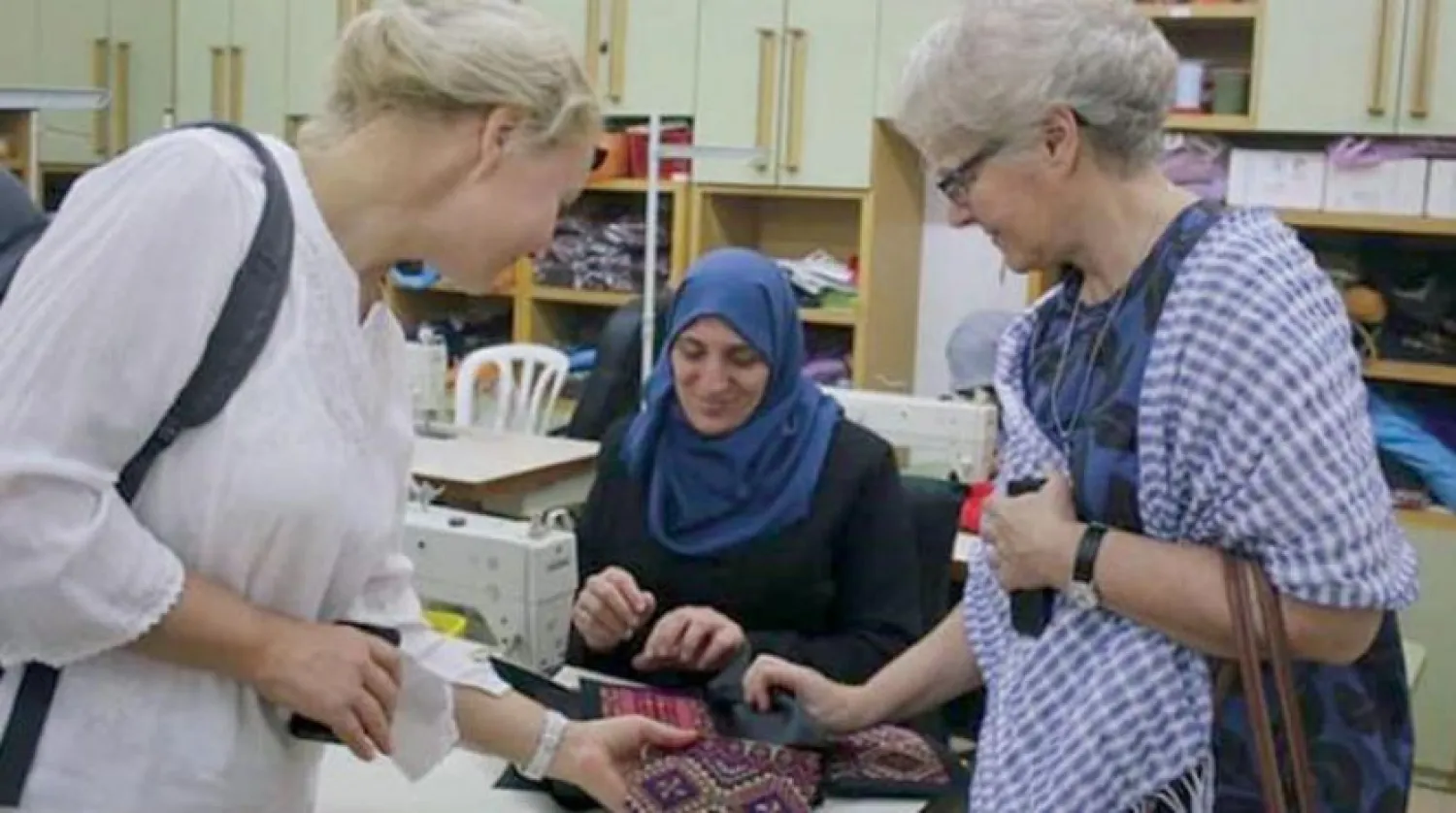
Sajida Ghazal, in her forties, works with a group of deaf women, who found their path to integrate in their society by working in a sewing factory that makes embroidered fabrics inspired by the Palestinian heritage.

Amidst the sewing machines, Sajida stands and uses her hand gestures to inform the working women about the required quantities and the details they have to stick to during their work so they can achieve the final design of the fabric. The other women communicate with her using sign language as well.

"I have worked here for many years with over 20 women. We share the details of our day and communicate with all people, including merchants and customers, through sign language," Sajida told Asharq Al-Awsat. She added that she uses sign language with her peers and family, hoping it will become widely used in Palestinian society one day.

According to Sajida, women in the sewing factory make special garments for children and female accessories featuring special details from the Palestinian heritage.

"This work provides an income that ensures them and their families a decent life amid the hard living conditions in the strip," she explained.

The Our Deaf Children Association was founded in 2009 to offer children and adults suffering from hearing impairments or loss opportunities of education and vocational training.

In a closed room with nothing but the sound of textile spinning apparatuses, Issam Shaldan, 47, works with two colleagues in installing or separating yarns based on their colors. They speed up their work pace so they can finish an order including carpets, wall carpets, and women accessories. They focus on the smallest details to provide the best and finest products.

Shaldan, who suffers from a hearing impairment since birth, said "learning this profession was challenging."

Shaldan has a family of seven. He said he graduated from the association's craftsmanship institute, and today, he is part of its team. Speaking about sign language, he said he never felt different for using it, especially since everybody respects him and easily communicates with him.



US Astronaut to Take her 3-year-old's Cuddly Rabbit Into Space

FILE PHOTO: An evening launch of a SpaceX Falcon 9 rocket carrying 20 Starlink V2 Mini satellites, from Space Launch Complex at Vandenberg Space Force Base is seen over the Pacific Ocean from Encinitas, California, US, June 23, 2024. REUTERS/Mike Blake/File Photo
TT

US Astronaut to Take her 3-year-old's Cuddly Rabbit Into Space

FILE PHOTO: An evening launch of a SpaceX Falcon 9 rocket carrying 20 Starlink V2 Mini satellites, from Space Launch Complex at Vandenberg Space Force Base is seen over the Pacific Ocean from Encinitas, California, US, June 23, 2024. REUTERS/Mike Blake/File Photo

When the next mission to the International Space Station blasts off from Florida next week, a special keepsake will be hitching a ride: a small stuffed rabbit.

American astronaut and mother, Jessica Meir, one of the four-member crew, revealed Sunday that she'll take with her the cuddly toy that belongs to her three-year-old daughter.

It's customary for astronauts to go to the ISS, which orbits 250 miles (400 kilometers) above Earth, to take small personal items to keep close during their months-long stint in space.

"I do have a small stuffed rabbit that belongs to my three-year-old daughter, and she actually has two of these because one was given as a gift," Meir, 48, told an online news conference.

"So one will stay down here with her, and one will be there with us, having adventures all the time, so that we'll keep sending those photos back and forth to my family," AFP quoted her as saying.

US space agency NASA says SpaceX Crew-12 will lift off on a SpaceX Falcon 9 rocket from Cape Canaveral in Florida to the orbiting scientific laboratory early Wednesday.

The mission will be replacing Crew-11, which returned to Earth in January, a month earlier than planned, during the first medical evacuation in the space station's history.

Meir, a marine biologist and physiologist, served as flight engineer on a 2019-2020 expedition to the space station and participated in the first all-female spacewalks.

Since then, she's given birth to her daughter. She reflected Sunday on the challenges of being a parent and what is due to be an eight-month separation from her child.

"It does make it a lot difficult in preparing to leave and thinking about being away from her for that long, especially when she's so young, it's really a large chunk of her life," Meir said.

"But I hope that one day, she will really realize that this absence was a meaningful one, because it was an adventure that she got to share into and that she'll have memories about, and hopefully it will inspire her and other people around the world," Meir added.

When the astronauts finally get on board the ISS, they will be one of the last crews to live on board the football field-sized space station.

Continuously inhabited for the last quarter century, the aging ISS is scheduled to be pushed into Earth's orbit before crashing into an isolated spot in the Pacific Ocean in 2030.

The other Crew-12 astronauts are Jack Hathaway of NASA, European Space Agency astronaut Sophie Adenot, and Russian cosmonaut Andrey Fedyaev.


iRead Marathon Records over 6.5 Million Pages Read

Participants agreed that the number of pages read was not merely a numerical milestone - SPA
TT

iRead Marathon Records over 6.5 Million Pages Read

Participants agreed that the number of pages read was not merely a numerical milestone - SPA

The fifth edition of the iRead Marathon achieved a remarkable milestone, surpassing 6.5 million pages read over three consecutive days, in a cultural setting that reaffirmed reading as a collective practice with impact beyond the moment.

Hosted at the Library of the King Abdulaziz Center for World Culture (Ithra) and held in parallel with 52 libraries across 13 Arab countries, including digital libraries participating for the first time, the marathon reflected the transformation of libraries into open, inclusive spaces that transcend physical boundaries and accommodate diverse readers and formats.

Participants agreed that the number of pages read was not merely a numerical milestone, but a reflection of growing engagement and a deepening belief in reading as a daily, shared activity accessible to all, free from elitism or narrow specialization.

Pages were read in multiple languages and formats, united by a common conviction that reading remains a powerful way to build genuine connections and foster knowledge-based bonds across geographically distant yet intellectually aligned communities, SPA reported.

The marathon also underscored its humanitarian and environmental dimension, as every 100 pages read is linked to the planting of one tree, translating this edition’s outcome into a pledge of more than 65,000 trees. This simple equation connects knowledge with sustainability, turning reading into a tangible, real-world contribution.

The involvement of digital libraries marked a notable development, expanding access, strengthening engagement, and reinforcing the library’s ability to adapt to technological change without compromising its cultural role. Integrating print and digital reading added a contemporary dimension to the marathon while preserving its core spirit of gathering around the book.

With the conclusion of the iRead Marathon, the experience proved to be more than a temporary event, becoming a cultural moment that raised fundamental questions about reading’s role in shaping awareness and the capacity of cultural initiatives to create lasting impact. Three days confirmed that reading, when practiced collectively, can serve as a meeting point and the start of a longer cultural journey.


Imam Turki bin Abdullah Royal Reserve Launches Fifth Beekeeping Season

Jazan’s Annual Honey Festival - File Photo/SPA
TT

Imam Turki bin Abdullah Royal Reserve Launches Fifth Beekeeping Season

Jazan’s Annual Honey Festival - File Photo/SPA

The Imam Turki bin Abdullah Royal Nature Reserve Development Authority launched the fifth annual beekeeping season for 2026 as part of its programs to empower the local community and regulate beekeeping activities within the reserve.

The launch aligns with the authority's objectives of biodiversity conservation, the promotion of sustainable environmental practices, and the generation of economic returns for beekeepers, SPA reported.

The authority explained that this year’s beekeeping season comprises three main periods associated with spring flowers, acacia, and Sidr, with the start date of each period serving as the official deadline for submitting participation applications.

The authority encouraged all interested beekeepers to review the season details and attend the scheduled virtual meetings to ensure organized participation in accordance with the approved regulations and the specified dates for each season.