
Turkish President Tacitly Criticizes US for Supporting Kurdish Forces

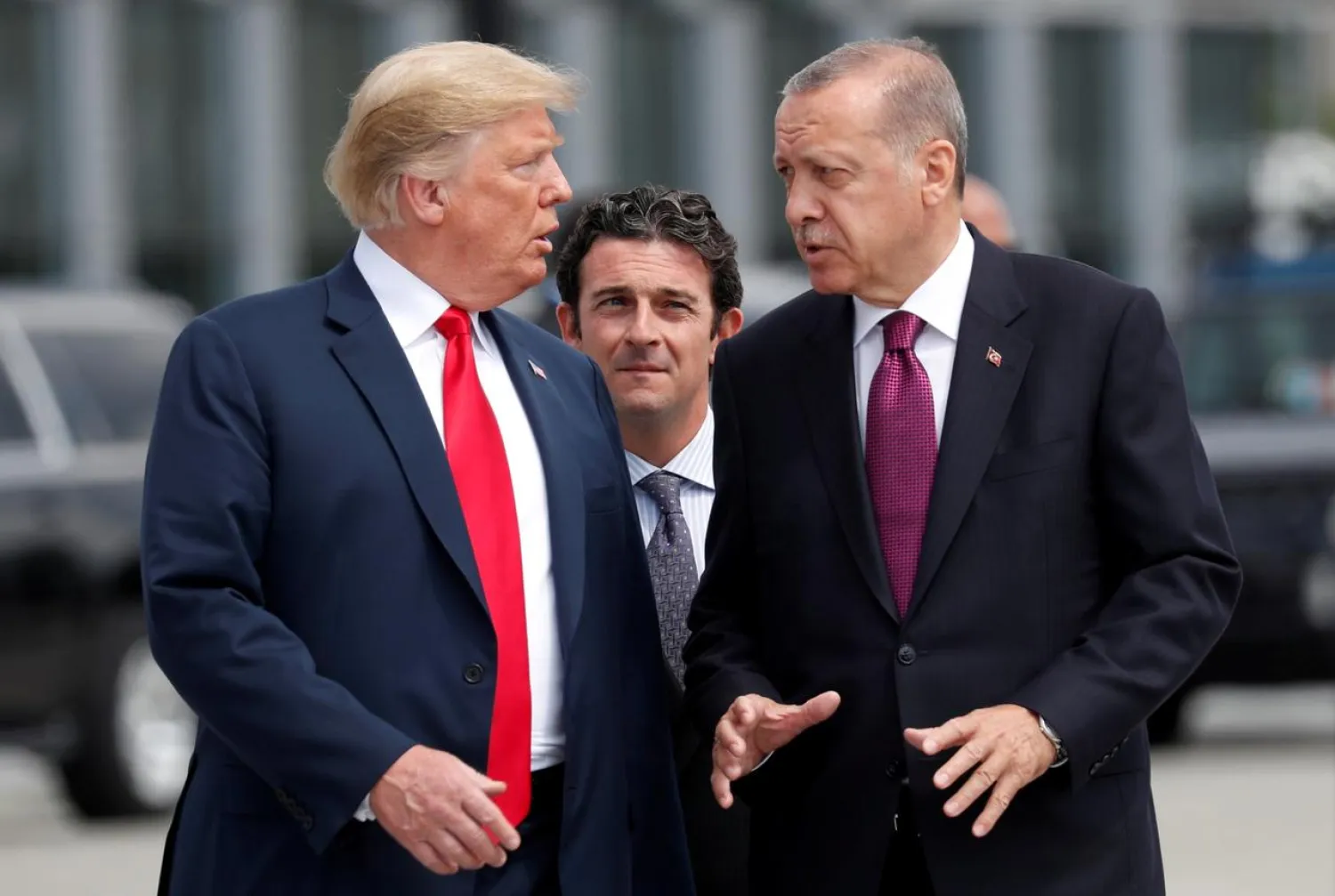
US President Donald Trump and Turkish President Tayyip Erdogan (File Photo: Reuters)
TT

Turkish President Tacitly Criticizes US for Supporting Kurdish Forces

US President Donald Trump and Turkish President Tayyip Erdogan (File Photo: Reuters)

Turkish President Recep Tayyip Erdogan continued his “tacit” criticism of the United States for supporting the Syrian Democratic Forces (SDF) coalition, mainly formed by the People's Protection Units (YPG), which Turkey classifies as a terrorist organization.

Ankara is demanding the expulsion of SDF from eastern Euphrates in northern Syria, as part of a Turkish-US plan to establish a safe zone in areas under the coalition’s control.

Washington continues to provide weapons and equipment to SDF, its closest ally in the war against ISIS.

Erdogan said the US continues to supply arms despite the Democratic Forces’ defeat and the readiness of US troops to leave Syria. He added that Washington repeatedly refuses to provide Turkey with weapons, a reference to Washington's previous rejection to sell Patriot missiles.

A convoy of new US military reinforcements entered northeastern Syria and headed to the bases of the international coalition. It contained dozens of trucks loaded with various vehicles and fuel tanks.

The convoy entered from the Kurdistan region of Iraq, through the Semalka Border Crossing with Syria, accompanied by SDF patrols.

This is the second convoy that enters northeast Syria in September, as four other convoys of military reinforcements entered the region last August, and headed to the bases of the international coalition.

The Syrian Democratic Forces control the eastern Euphrates, Manbij, and Tal Rifaat areas of Aleppo countryside.

On August 7, Turkish and US military officials agreed to set up a safe zone in northern Syria and develop a peace corridor to facilitate the movement of displaced Syrians who want to return home. They also agreed to establish a joint operations center. A month later, the first joint military patrol marched Tal Abyad area north of al-Raqqa.

On Saturday, Erdogan said he discussed with US President Donald Trump the issue of sending thousands of trucks loaded with ammunition and equipment free of charge to Kurdish forces in the east of Euphrates, under the pretext of fighting ISIS.

He noted that Turkey could not buy those weapons from Washington at their prices.

The Turkish President indicated that his country would establish a safe zone along 422 kilometers of its border with Syria, with a depth of 32 kilometers.

He explained that the depth of the safe zone is important for cleansing it from terrorists and handing it over to its original owners, such as Arabs who make up 85-90 percent of the population there.

The US opposes the establishment of a safe zone at this depth and such area, offering a depth of 5 to 14 kilometers.

It also rejects Turkey’s sole control of the proposed safe area, stressing however that it would work to meet its needs while protecting its Kurdish ally.

Erdogan on Sunday discussed Turkey-US bilateral relations, regional developments and Syria in a phone call with his US counterpart, according to the Turkish Presidency of Communications.

The two leaders are expected to meet on the sidelines of the UN General Assembly meetings.


Top Trump Iran Negotiator Says Visits US Aircraft Carrier in Middle East

US Special Envoy Steve Witkoff delivers a press conference upon the signing of the declaration on deploying post-ceasefire force in Ukraine, during the so-called "Coalition of the Willing" summit, at the Elysee Palace in Paris, France, January 6, 2026. (Reuters)
TT

Top Trump Iran Negotiator Says Visits US Aircraft Carrier in Middle East

US Special Envoy Steve Witkoff delivers a press conference upon the signing of the declaration on deploying post-ceasefire force in Ukraine, during the so-called "Coalition of the Willing" summit, at the Elysee Palace in Paris, France, January 6, 2026. (Reuters)

US President Donald Trump's lead Iran negotiator Steve Witkoff on Saturday said he visited the USS Abraham Lincoln aircraft carrier currently in the Arabian Sea, with Washington and Tehran due to hold further talks soon.

"Today, Adm. Brad Cooper, Commander of US Naval Forces Central Command, Jared Kushner, and I met with the brave sailors and Marines aboard the USS Abraham Lincoln, her strike group, and Carrier Air Wing 9 who are keeping us safe and upholding President Trump's message of peace through strength," said Witkoff in a social media post.

Iranian Foreign Minister Abbas Araghchi said on Saturday he hoped talks with the United States would resume soon, while reiterating Tehran's red lines and warning against any American attack.


Israel’s Netanyahu Expected to Meet Trump in US on Wednesday and Discuss Iran

Israeli Prime Minister Benjamin Netanyahu delivers a speech during a special session to mark the 77th anniversary of the Knesset's establishment and the 60th anniversary of the dedication of the current building at the Knesset, the Israeli parliament, in Jerusalem, 02 February 2026. (EPA)
TT

Israel’s Netanyahu Expected to Meet Trump in US on Wednesday and Discuss Iran

Israeli Prime Minister Benjamin Netanyahu delivers a speech during a special session to mark the 77th anniversary of the Knesset's establishment and the 60th anniversary of the dedication of the current building at the Knesset, the Israeli parliament, in Jerusalem, 02 February 2026. (EPA)

Israeli Prime Minister Benjamin Netanyahu is expected to meet US President Donald Trump on Wednesday in Washington, where they will discuss negotiations with Iran, Netanyahu's office said on Saturday.

Iranian and US officials held indirect nuclear ‌talks in the ‌Omani capital ‌Muscat ⁠on Friday. ‌Both sides said more talks were expected to be held again soon.

A regional diplomat briefed by Tehran on the talks told Reuters Iran insisted ⁠on its "right to enrich uranium" ‌during the negotiations with ‍the US, ‍and that Tehran's missile capabilities ‍were not raised in the discussions.

Iranian officials have ruled out putting Iran's missiles - one of the largest such arsenals in the region - up ⁠for discussion, and have said Tehran wants recognition of its right to enrich uranium.

"The Prime Minister believes that any negotiations must include limiting ballistic missiles and halting support for the Iranian axis," Netanyahu's office said in a ‌statement.


Italy FM Rules Out Joining Trump’s ‘Board of Peace’

Italy's Minister for Foreign Affairs Antonio Tajani speaks to the press during the EPP Leaders’ meeting, in Zagreb, Croatia, 30 January 2026. (EPA)
TT

Italy FM Rules Out Joining Trump’s ‘Board of Peace’

Italy's Minister for Foreign Affairs Antonio Tajani speaks to the press during the EPP Leaders’ meeting, in Zagreb, Croatia, 30 January 2026. (EPA)

Italy will not take part in US President Donald Trump's "Board of Peace", Italian Foreign Minister Antonio Tajani said Saturday, citing "insurmountable" constitutional issues.

Trump launched his "Board of Peace" at the World Economic Forum in Davos in January and some 19 countries have signed its founding charter.

But Italy's constitution bars the country from joining an organization led by a single foreign leader.

Prime Minister Giorgia Meloni, a Trump ally, last month noted "constitutional problems" with joining, but suggested Trump could perhaps reopen the framework "to meet the needs not only of Italy, but also of other European countries".

Tajani appeared Saturday to rule that out.

"We cannot participate in the Board of Peace because there is a constitutional limit," he told the ANSA news agency.

"This is insurmountable from a legal standpoint," he said, the day after meeting US Secretary of State Marco Rubio and US Vice President JD Vance at the Olympics in Milan.

Although originally meant to oversee Gaza's rebuilding, the board's charter does not limit its role to the Palestinian territory and appears to want to rival the United Nations.