
Birds Are Vanishing From North America

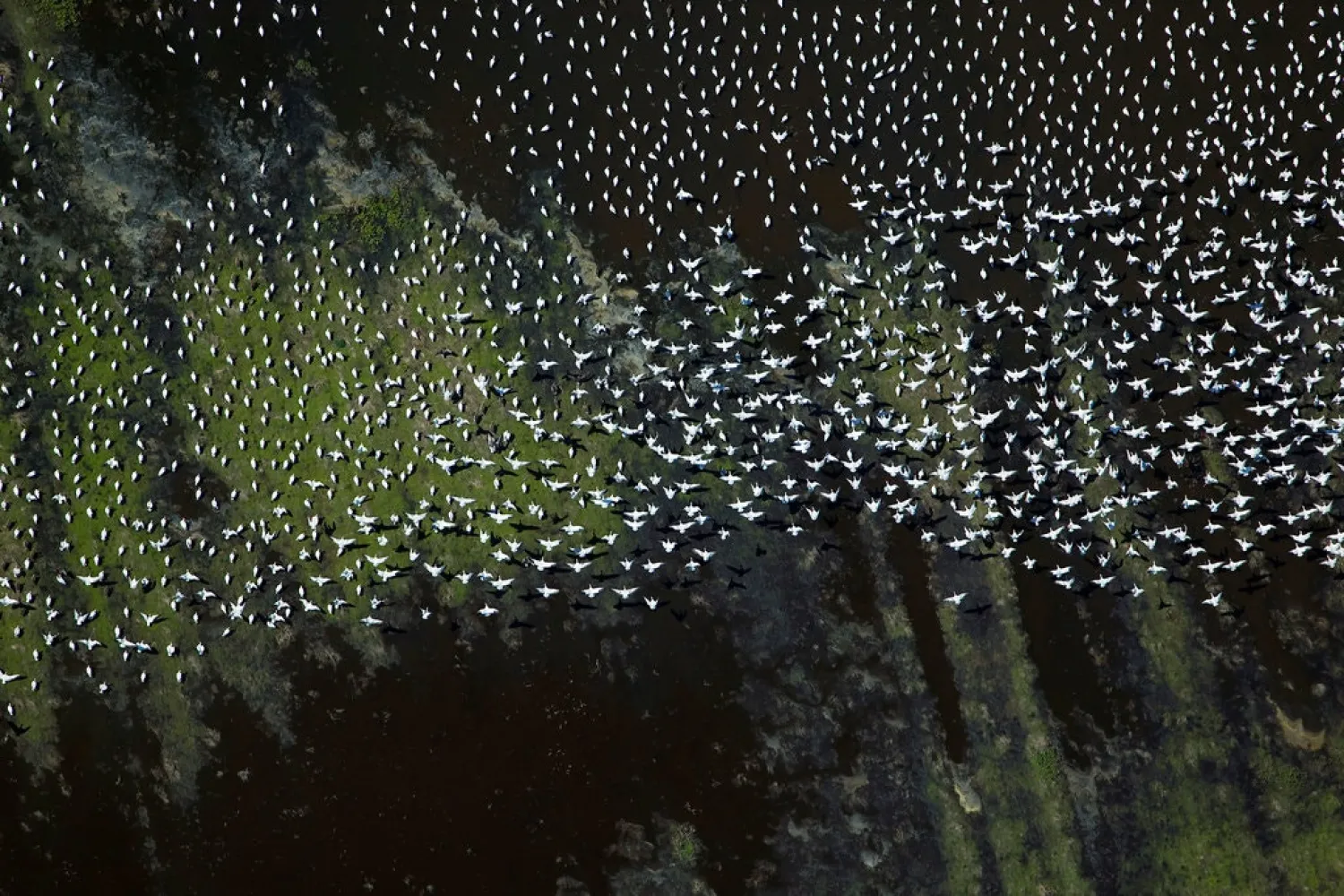
Wintering snow geese in the Sacramento Valley.
Credit
Aerial Archives/Alamy
Wintering snow geese in the Sacramento Valley. Credit Aerial Archives/Alamy
TT

Birds Are Vanishing From North America

Wintering snow geese in the Sacramento Valley.
Credit
Aerial Archives/Alamy
Wintering snow geese in the Sacramento Valley. Credit Aerial Archives/Alamy

The number of birds in the United States and Canada has declined by 3 billion, or 29 percent, over the past half-century, scientists find. The skies are emptying out. The number of birds in the United States and Canada has fallen by 29 percent since 1970, scientists reported on Thursday. There are 2.9 billion fewer birds taking wing now than there were 50 years ago.

The analysis, published in the journal Science, is the most exhaustive and ambitious attempt yet to learn what is happening to avian populations. The results have shocked researchers and conservation organizations. In a statement on Thursday, David Yarnold, president and chief executive of the National Audubon Society, called the findings “a full-blown crisis.” Experts have long known that some bird species have become vulnerable to extinction. But the new study, based on a broad survey of more than 500 species, reveals steep losses even among such traditionally abundant birds as robins and sparrows.

There are likely many causes, the most important of which include habitat loss and wider use of pesticides.

“Silent Spring,” Rachel Carson’s prophetic book in 1962 about the harms caused by pesticides, takes its title from the unnatural quiet settling on a world that has lost its birds: “On the mornings that had once throbbed with the dawn chorus of robins, catbirds, doves, jays, wrens, and scores of other bird voices, there was now no sound.” Kevin Gaston, a conservation biologist at the University of Exeter, said that new findings signal something larger at work: “This is the loss of nature.” Common bird species are vital to ecosystems, controlling pests, pollinating flowers, spreading seeds and regenerating forests. When these birds disappear, their former habitats often are not the same.

“Declines in your common sparrow or other little brown bird may not receive the same attention as historic losses of bald eagles or sandhill cranes, but they are going to have much more of an impact,” said Hillary Young, a conservation biologist at the University of California, Santa Barbara, who was not involved in the new research. A team of researchers from universities, government agencies and nonprofit organizations collaborated on the new study, which combined old and new methods for counting birds. While some species grew, the researchers found, the majority declined — often by huge numbers.

“We were stunned by the result — it’s just staggering,” said Kenneth V. Rosenberg, a conservation scientist at Cornell University and the American Bird Conservancy, and the lead author of the new study.

“It’s not just these highly threatened birds that we’re afraid are going to go on the endangered species list,” he said. “It’s across the board.” Weather radar offered another way to track bird populations. Dr. Rosenberg and his colleagues counted birds recorded on radar at 143 stations across the United States from 2007 to 2018. They focused on springtime scans, when birds were migrating in great numbers.

The team measured a 14 percent decline during that period, consistent with the drop recorded in the bird-watching records. “If we have two data sets showing the same thing, it’s a home run,” said Nicole Michel, a senior quantitative ecologist at the Audubon Society who was not involved in the study. Among the worst-hit groups were warblers, with a population that dropped by 617 million.

There are 440 million fewer blackbirds than there once were. Dr. Rosenberg said he was surprised by how widespread the population drop was. Even starlings — a species that became a fast-breeding pest after its introduction to the United States in 1890 — have dwindled by 83 million birds, a 49 percent decline. Europe is experiencing a similar loss of birds, also among common species, said Dr. Gaston, of the University of Exeter. “The numbers are broadly comparable,” he said.

The new study was not designed to determine why birds are disappearing, but the results — as well as earlier research — point to some likely culprits, Dr. Rosenberg said. Grassland species have suffered the biggest declines by far, having lost 717 million birds. These birds have probably been decimated by modern agriculture and development. “Every field that’s plowed under, and every wetland area that’s drained, you lose the birds in that area,” Dr. Rosenberg said. In addition to habitat loss, pesticides may have taken a toll.

A study published last week, for example, found that pesticides called neonicotinoids make it harder for birds to put on weight needed for migration, delaying their travel. The researchers found some positive signs. Bald eagles are thriving, for example, and falcon populations have grown by 33 percent. Waterfowl are on the upswing. For the most part, there’s little mystery about how these happy exceptions came to be. Many recovering bird species were nearly wiped out in the last century by pesticides, hunting and other pressures.

Conservation measures allowed them to bounce back. “In those cases, we knew what the causes were and we acted on that,” Dr. Rosenberg said. “They’re models of success.” But some thriving populations are harder to explain.

Tiny warbler-like birds called vireos are booming, with 89 million more birds than in 1970 — a jump of 53 percent. Yet warblers, which share the same habitats as vireos, have suffered a 37 percent decline. “I have no idea why vireos are doing well,” Dr. Rosenberg said. “I’d love to do a study of vireos and discover what their secret is.” The sheer scale of the bird decline meant that stopping it would require immense effort, said Dr. Young, of the University of California, Santa Barbara. Habitats must be defended, chemicals restricted, buildings redesigned.

“We’re overusing the world, so it’s affecting everything,” she said. The Audubon Society is calling for protection of bird-rich habitats, such as the Great Lakes and the Colorado River Basin, as well as for upholding the Migratory Bird Treaty Act, which the Trump Administration is trying to roll back. The society and other bird advocacy groups also suggest things that individuals can do. They urge keeping cats inside, so they don’t kill smaller birds.

Vast numbers of birds die each year after flying into windows; there are ways to make the glass more visible to them. To some birders, the study’s findings confirmed a dreaded hunch. Beverly Gyllenhaal, 62, a retired cookbook author, and her husband, Anders, have spotted 256 species in parks in the eastern United States. But when she visited her mother in North Carolina in recent years, it seemed there weren’t as many birds as she recalled from her childhood there. And when she talks to people around the United States on her birding travels, many say the same thing.

“Oftentimes people will tell you, ‘It’s nothing like it used to be,’” she said. The estimated losses have left her appalled. “If the cardinals and the blue jays and the sparrows aren’t doing well,” she said, “that’s really scary.”

The New York Times


US Astronaut to Take her 3-year-old's Cuddly Rabbit Into Space

FILE PHOTO: An evening launch of a SpaceX Falcon 9 rocket carrying 20 Starlink V2 Mini satellites, from Space Launch Complex at Vandenberg Space Force Base is seen over the Pacific Ocean from Encinitas, California, US, June 23, 2024. REUTERS/Mike Blake/File Photo
TT

US Astronaut to Take her 3-year-old's Cuddly Rabbit Into Space

FILE PHOTO: An evening launch of a SpaceX Falcon 9 rocket carrying 20 Starlink V2 Mini satellites, from Space Launch Complex at Vandenberg Space Force Base is seen over the Pacific Ocean from Encinitas, California, US, June 23, 2024. REUTERS/Mike Blake/File Photo

When the next mission to the International Space Station blasts off from Florida next week, a special keepsake will be hitching a ride: a small stuffed rabbit.

American astronaut and mother, Jessica Meir, one of the four-member crew, revealed Sunday that she'll take with her the cuddly toy that belongs to her three-year-old daughter.

It's customary for astronauts to go to the ISS, which orbits 250 miles (400 kilometers) above Earth, to take small personal items to keep close during their months-long stint in space.

"I do have a small stuffed rabbit that belongs to my three-year-old daughter, and she actually has two of these because one was given as a gift," Meir, 48, told an online news conference.

"So one will stay down here with her, and one will be there with us, having adventures all the time, so that we'll keep sending those photos back and forth to my family," AFP quoted her as saying.

US space agency NASA says SpaceX Crew-12 will lift off on a SpaceX Falcon 9 rocket from Cape Canaveral in Florida to the orbiting scientific laboratory early Wednesday.

The mission will be replacing Crew-11, which returned to Earth in January, a month earlier than planned, during the first medical evacuation in the space station's history.

Meir, a marine biologist and physiologist, served as flight engineer on a 2019-2020 expedition to the space station and participated in the first all-female spacewalks.

Since then, she's given birth to her daughter. She reflected Sunday on the challenges of being a parent and what is due to be an eight-month separation from her child.

"It does make it a lot difficult in preparing to leave and thinking about being away from her for that long, especially when she's so young, it's really a large chunk of her life," Meir said.

"But I hope that one day, she will really realize that this absence was a meaningful one, because it was an adventure that she got to share into and that she'll have memories about, and hopefully it will inspire her and other people around the world," Meir added.

When the astronauts finally get on board the ISS, they will be one of the last crews to live on board the football field-sized space station.

Continuously inhabited for the last quarter century, the aging ISS is scheduled to be pushed into Earth's orbit before crashing into an isolated spot in the Pacific Ocean in 2030.

The other Crew-12 astronauts are Jack Hathaway of NASA, European Space Agency astronaut Sophie Adenot, and Russian cosmonaut Andrey Fedyaev.


iRead Marathon Records over 6.5 Million Pages Read

Participants agreed that the number of pages read was not merely a numerical milestone - SPA
TT

iRead Marathon Records over 6.5 Million Pages Read

Participants agreed that the number of pages read was not merely a numerical milestone - SPA

The fifth edition of the iRead Marathon achieved a remarkable milestone, surpassing 6.5 million pages read over three consecutive days, in a cultural setting that reaffirmed reading as a collective practice with impact beyond the moment.

Hosted at the Library of the King Abdulaziz Center for World Culture (Ithra) and held in parallel with 52 libraries across 13 Arab countries, including digital libraries participating for the first time, the marathon reflected the transformation of libraries into open, inclusive spaces that transcend physical boundaries and accommodate diverse readers and formats.

Participants agreed that the number of pages read was not merely a numerical milestone, but a reflection of growing engagement and a deepening belief in reading as a daily, shared activity accessible to all, free from elitism or narrow specialization.

Pages were read in multiple languages and formats, united by a common conviction that reading remains a powerful way to build genuine connections and foster knowledge-based bonds across geographically distant yet intellectually aligned communities, SPA reported.

The marathon also underscored its humanitarian and environmental dimension, as every 100 pages read is linked to the planting of one tree, translating this edition’s outcome into a pledge of more than 65,000 trees. This simple equation connects knowledge with sustainability, turning reading into a tangible, real-world contribution.

The involvement of digital libraries marked a notable development, expanding access, strengthening engagement, and reinforcing the library’s ability to adapt to technological change without compromising its cultural role. Integrating print and digital reading added a contemporary dimension to the marathon while preserving its core spirit of gathering around the book.

With the conclusion of the iRead Marathon, the experience proved to be more than a temporary event, becoming a cultural moment that raised fundamental questions about reading’s role in shaping awareness and the capacity of cultural initiatives to create lasting impact. Three days confirmed that reading, when practiced collectively, can serve as a meeting point and the start of a longer cultural journey.


Imam Turki bin Abdullah Royal Reserve Launches Fifth Beekeeping Season

Jazan’s Annual Honey Festival - File Photo/SPA
TT

Imam Turki bin Abdullah Royal Reserve Launches Fifth Beekeeping Season

Jazan’s Annual Honey Festival - File Photo/SPA

The Imam Turki bin Abdullah Royal Nature Reserve Development Authority launched the fifth annual beekeeping season for 2026 as part of its programs to empower the local community and regulate beekeeping activities within the reserve.

The launch aligns with the authority's objectives of biodiversity conservation, the promotion of sustainable environmental practices, and the generation of economic returns for beekeepers, SPA reported.

The authority explained that this year’s beekeeping season comprises three main periods associated with spring flowers, acacia, and Sidr, with the start date of each period serving as the official deadline for submitting participation applications.

The authority encouraged all interested beekeepers to review the season details and attend the scheduled virtual meetings to ensure organized participation in accordance with the approved regulations and the specified dates for each season.