British Couple Grows Furniture

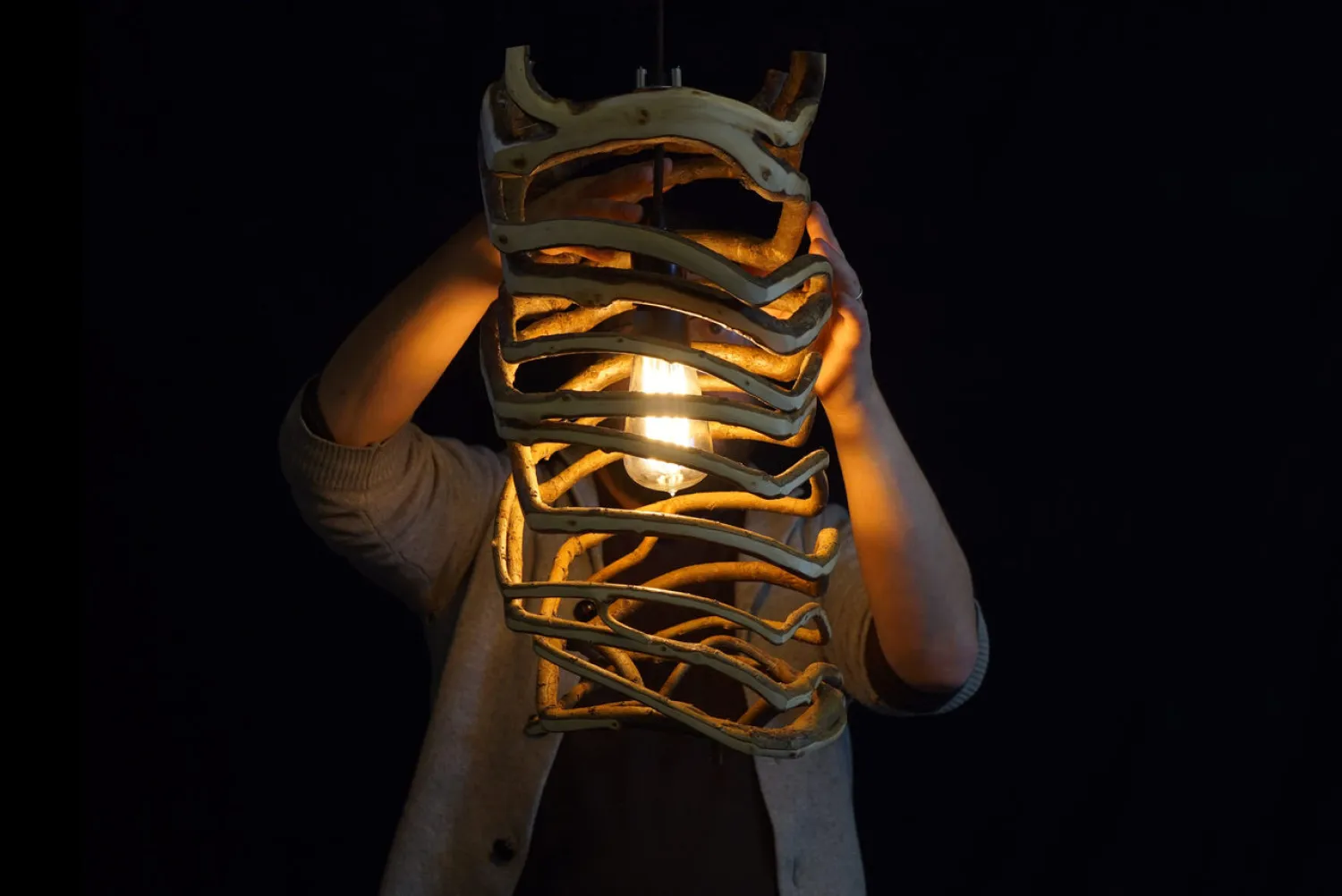
 A Full Grown lamp, made from tree branches formed into this
spiral shape. COURTESY FULL GROWN
A Full Grown lamp, made from tree branches formed into this spiral shape. COURTESY FULL GROWN
TT

British Couple Grows Furniture

 A Full Grown lamp, made from tree branches formed into this
spiral shape. COURTESY FULL GROWN
A Full Grown lamp, made from tree branches formed into this spiral shape. COURTESY FULL GROWN

On a two-acre field in England's Midlands, Gavin and Alice Munro are taking sustainability to the next level: they harvest trees which they train to grow into chairs. The couple has a furniture farm in Derbyshire where they are nurturing 250 chairs, 100 lamps and 50 tables. It is their answer to what they see as the inefficient and carbon-heavy process of cutting down mature trees to create furniture.

According to Gavin, "instead of force-growing a tree for 50 years and then cutting it down and making it into smaller and smaller bits, the idea is to grow the tree into the shape that you want directly. It's a kind of 3D printing."

Part of the inspiration for the idea came when Gavin was a young boy. He spotted an overgrown bonsai tree which looked like a chair. Gavin, 44, was born with a curved spine and as a child spent several years wearing a metal frame to reset his back.

"The medical staff was just brilliant. The nurses, the doctors, they would kind of combine kindness and competence in a way that really, really impressed me," he added. He began experimenting in 2006 when he tried to grow chairs on two small plots of land in the Peak District, also in central England.

But in 2012, a year after they married, Gavin and Alice set up the company Full Grown and committed to the idea full-time. Progress has been bumpy. One of their first attempts at a crop ended in disaster when it was trampled by cows and eaten by rabbits. They have also had to discover the most effective way to shape a tree without stunting its growth.

The couple has learned to guide shoots already heading in the right direction, rather than forcing shoots the wrong way against their will. The labor and time involved in producing the organic pieces means they do not come cheap.

Chairs sell for 10,000 pounds ($12,480), lamps for 900-2,300 pounds and tables for 2,500-12,500 pounds. The average chair takes six to nine years to grow, and another year to dry out.

The longest commission the company has is for 2030. It is a chair for a customer's retirement. Ancient Romans, Chinese and Japanese are known to have shaped trees to customize their forms.


Face of 400-Year-Old 'Vampire' Recreated

Scientists have given a face to a decapitated skull which was uncovered in Croatia. (Croatia’s excavation team)
TT

Face of 400-Year-Old 'Vampire' Recreated

Scientists have given a face to a decapitated skull which was uncovered in Croatia. (Croatia’s excavation team)

The face of a "vampire", whose remains were posthumously mutilated to prevent them from rising from the dead, can be seen for the first time in more than 400 years, reported Sky News.

Discovered in a grave at Racesa, a fortress in eastern Croatia, the body had been exhumed, beheaded and reburied face down beneath heavy stones.

And since the desecration cannot be explained by environmental factors, experts believe it was done to stop the dead man returning as a vampire.

Now the face of the deceased can be seen for the first time in centuries, after scientists rebuilt his likeness from his skull.

Archaeologist Natasa Sarkic, part of the excavation team, said the fear inspired by the man in death may stem from the fear he inspired in life.

She said: “Bioarchaeological analysis showed that this man often participated in violent conflicts, and died a violent death. He experienced at least three episodes of serious interpersonal violence during his lifetime.”

“One of those attacks left his face disfigured, which could cause fear and repulsion, leading to social exclusion. Before even recovering from the penultimate trauma, he sustained a final fatal attack,” she revealed.

“Individuals who died violently, behaved violently in life, or were considered sinful or socially deviant, were believed to be at risk of becoming vampires,” she continued.

“He may have been regarded as a 'vampire', or a supernatural threat due to his facial disfigurement and his marginal lifestyle, characterized by repeated interpersonal violence,” Sarkic explained.

She said such beings were thought to be restless, vengeful, and capable of harming the living, spreading disease and killing people or livestock.

Sarkic said that, in the Slavic tradition, the soul remains attached to the body for about 40 days after death.


Caffeinated Beverages May Help Protect the Brain, Study Says

A cup of coffee and a cappuccino are seen at a Juan Valdez store in Bogota, Colombia June 5, 2019. (Reuters)
TT

Caffeinated Beverages May Help Protect the Brain, Study Says

A cup of coffee and a cappuccino are seen at a Juan Valdez store in Bogota, Colombia June 5, 2019. (Reuters)

Drinking a few cups of caffeinated coffee or tea every day may help in a small way to preserve brain power and prevent dementia, researchers reported on Monday.

People with the highest daily intake of caffeinated coffee had an 18% lower risk of developing dementia compared to those with the lowest such intake, according to a study based on responses to questionnaires by 132,000 U.S. adults spanning four decades.

The study, published in JAMA, also found that the people with the highest intake had a lower rate - by nearly 2 percentage points - of ‌self-perceived memory ‌or thinking problems compared to those with ‌the ⁠lowest intake.

Results were ‌similar with caffeinated tea, but not with decaffeinated beverages, the researchers said.

While the findings are encouraging, the study does not prove caffeine helps protect the brain, they said.

The magnitude of caffeine's effect, if any, was small, and there are other better-documented ways to protect cognitive function as people age, study leader Dr. Daniel Wang ⁠of Harvard Medical School said in a statement.

Lifestyle factors linked with lower risks of ‌dementia include physical exercise, a healthy diet ‍and adequate sleep, according to previous ‍research.

"Our study suggests that caffeinated coffee or tea consumption can ‍be one piece of that puzzle," Wang said.

The findings were most pronounced in participants who consumed two to three cups of caffeinated coffee or one to two cups of caffeinated tea daily, the researchers reported.

Those who drank caffeinated coffee also showed better performance on some objective tests of cognitive function, according to the ⁠study funded by the National Institutes of Health.

Further research is needed to validate the factors and mechanisms responsible for the findings, the researchers said.

They noted that bioactive ingredients in coffee and tea such as caffeine and polyphenols have emerged as possible factors that reduce nerve cell inflammation and damage while protecting against cognitive decline.

"We also compared people with different genetic predispositions to developing dementia and saw the same results - meaning coffee or caffeine is likely equally beneficial for people with high and low genetic risk of developing ‌dementia," study coauthor Dr. Yu Zhang of the Harvard T.H. Chan School of Public Health said in a statement.


AlUla Announces Exceptional Ramadan Experiences

These programs come as part of efforts to enhance AlUla’s tourism experience - SPA
TT

AlUla Announces Exceptional Ramadan Experiences

These programs come as part of efforts to enhance AlUla’s tourism experience - SPA

AlUla Governorate is welcoming the holy month of Ramadan this year with a wide range of diverse tourism experiences that reflect the area’s distinctive character and rich cultural heritage, reinforcing its position as one of the Kingdom’s most prominent destinations to visit during the holy month.

During Ramadan, AlUla offers an integrated experience catering to different visitor preferences, including guided stargazing experiences, cultural events, and night markets, in addition to traditional dining experiences for Iftar and Suhoor, embodying the depth of AlUla’s cultural heritage and local identity.

The Ramadan programs in AlUla include a variety of standout events, such as Ramadan experiences at Maraya Hall, a cultural market, and live performances in the atmosphere of Ashar Valley, alongside heritage tours in AlUla Old Town that narrate stories of AlUla and its Ramadan customs, including the award-winning Incense Road Experience, SPA reported.

The programs also feature seasonal art exhibitions hosted across multiple cultural venues, including Design Space AlUla, the fourth edition of Desert X AlUla, and the Arduna exhibition at AlUla Oasis, in addition to experiences combining art, nature, and stargazing at Daimumah Oasis in collaboration with AlUla Manara.

Visitors are also offered tours to prominent archaeological sites, including Hegra, Dadan, and Jabal Ikmah, to explore ancient sites dating back centuries BCE and view unique rock inscriptions, as well as adventure experiences ranging from dinner and stargazing in Sharaan, hot-air balloon rides, mountain hiking trails, and safari tours.

These programs come as part of efforts to enhance AlUla’s tourism experience during the holy month of Ramadan and provide diverse options that meet visitor expectations, contributing to the growth of tourism activity and showcasing the governorate’s natural and cultural assets.