Houthis Accused of Causing ‘Demographic Change’ in Sanaahttps://english.aawsat.com/home/article/1928016/houthis-accused-causing-%E2%80%98demographic-change%E2%80%99-sanaa
Houthis Accused of Causing ‘Demographic Change’ in Sanaa
Armed Houthi followers carry their rifles as they attend a gathering to show support for the Houthi movement in Sanaa, Yemen December 19, 2018. REUTERS/Khaled Abdullah
Houthis Accused of Causing ‘Demographic Change’ in Sanaa
Armed Houthi followers carry their rifles as they attend a gathering to show support for the Houthi movement in Sanaa, Yemen December 19, 2018. REUTERS/Khaled Abdullah
Yemeni officials have attributed soaring property prices in the Yemeni capital Sanaa to Houthi militias forcing a "demographic change" that includes settling their members coming from Saada, Amran and Hajjah.
Al-Thawra newspaper quoted local sources as saying that the rise in the prices is caused by a huge Houthi demand to settle militia members in Sanaa.
Houthi leaders are rushing to purchase properties and rent residential apartments, leading to higher rents and an increase in the price of land plots, the sources said.
Most of the members brought to Sanaa are from Saada, Amran, and Hajjah, they said.
As a result of the new changes, most residents in the capital are incapable of paying soaring rents amid a paralysis in the payment of their salaries in the past three years and a rise in the number of low-income families.
Further, sources revealed that Houthi official Ahmed Hamed endorsed YER1.8 billion (one dollar equals around YER50) to pay rents to his followers coming from Saada and settling across Sanaa and its suburbs.
They added that Hamed founded in 2016 a secret department, affiliated with the Supreme Political Council, to shelter the militants.
The department, which falls under his direct supervision, has a clear mission to pay the rents and purchase lands, houses and villas for Houthi officials close to the group’s leader, Abdul-Malik al-Houthi.
Former Syrian Official Convicted of Torture under Assad Faces Sentencing in the UShttps://english.aawsat.com/arab-world/5319299-former-syrian-official-convicted-torture-under-assad-faces-sentencing-us
Former Syrian Official Convicted of Torture under Assad Faces Sentencing in the US
Ousted Syrian President Bashar Assad - File Photo
A former Syrian military official convicted of torturing prisoners during President Bashar Assad's regime is facing a possible decades-long prison sentence in the US.
A federal judge in Los Angeles is scheduled to sentence Samir Ousman Alsheikh on Thursday. A jury found him guilty in March of one count of conspiracy to commit torture and three counts of torture while in charge of Syria's infamous Adra Prison from roughly 2005 to 2008, reported The Associated Press.
Human rights groups and United Nations officials have accused the Syrian government of widespread abuses in its detention facilities, including torture and arbitrary detention of thousands of people, in many cases without informing their families.
Prosecutors say Alsheikh, seeking to quash political dissent, sent certain prisoners to a wing of Adra where they were held in small isolation cells and tortured.
At the two-week trial, three victims recounted beatings while suspended from pipes on the ceiling and the use of a device that folded their bodies in half at the waist. One person testified that Alsheikh stomped on the device with his foot, according to the US Department of Justice.
“Defendant knew that what he was doing was wrong,” DOJ prosecutors said in a sentencing memo filed this month. “Nonetheless he ordered and participated in the torture of his victims because he had the power to do so and because he thought he would never be held accountable.”
The memo included statements from several victims, one of whom, Nidal Shikhani, said he can “still hear the screams of others begging for mercy, repeating, ‘Leave me, leave me.’”
The prosecutors asked US District Judge Hernan D. Vera for a minimum sentence of 80 years. Alsheikh's attorneys, Nina Marino and Collin Cate, have called for a five-year sentence, noting that he is 74 years old and has “significant medical and cognitive conditions.”
They also said he was willing to be deported to Syria, where a new government has sought to hold former members of the Assad regime accountable.
“Whatever moral weight this case carries in the broader arc of history — however much the world, or the victims, or the public might wish the sentence to ‘send a message’ — that desire cannot be the foundation of a just sentence,” Marino and Cate wrote in their Sept. 3 memo.
Alsheikh came to the US in 2020 and applied for citizenship, but prosecutors say he concealed his involvement in torture. Federal authorities detained him at Los Angeles International Airport in July 2024.
Jurors also convicted him in March of lying to US immigration authorities and fraudulently obtaining a green card and attempting to naturalize as a US citizen.
Syria Arrests Group Accused of Running Fake Sectarian Accountshttps://english.aawsat.com/arab-world/5319289-syria-arrests-group-accused-running-fake-sectarian-accounts
Syria Arrests Group Accused of Running Fake Sectarian Accounts
The graduation ceremony of the 66th batch of personnel with the rank of guard in Homs. (The Internal Security Forces)
Syrian security forces arrested a group in Homs province accused of receiving money from abroad to operate fake sectarian social media accounts and gather information on security checkpoints, the Internal Security Forces said Wednesday.
The arrests in al-Rastan, 25 km north of Homs city, followed electronic surveillance and an investigation, the forces said on Telegram.
According to the statement, the suspects created fake social media accounts carrying sectarian content under instructions from handlers abroad, published fabricated material glorifying the deposed regime, and monitored and photographed several security checkpoints.
Authorities said they also seized what they described as high-quality fabricated videos and images used to undermine public confidence and destabilize civil peace and social stability.
Legal procedures are underway to refer those involved to the judiciary, the Internal Security Forces said.
The forces urged the public to exercise caution over anonymous accounts spreading rumors and to rely on verified official sources for news.
Meanwhile, the Syrian Ministry of Interior celebrated the graduation of the 66th batch of personnel with the rank of guard in Homs.
The ceremony concluded an intensive 80-day training program managed by the Training and Rehabilitation Branch. During the course, the recruits underwent field, behavioral, and military discipline training.
The graduation featured military parades demonstrating the readiness of the internal security forces to preserve public safety and national stability.
Yemen Interior Minister to Asharq Al-Awsat: Iran Seeking to Militarize Bab al-Mandeb Through the Houthishttps://english.aawsat.com/arab-world/5319145-yemen-interior-minister-asharq-al-awsat-iran-seeking-militarize-bab-al-mandeb
Yemen Interior Minister to Asharq Al-Awsat: Iran Seeking to Militarize Bab al-Mandeb Through the Houthis
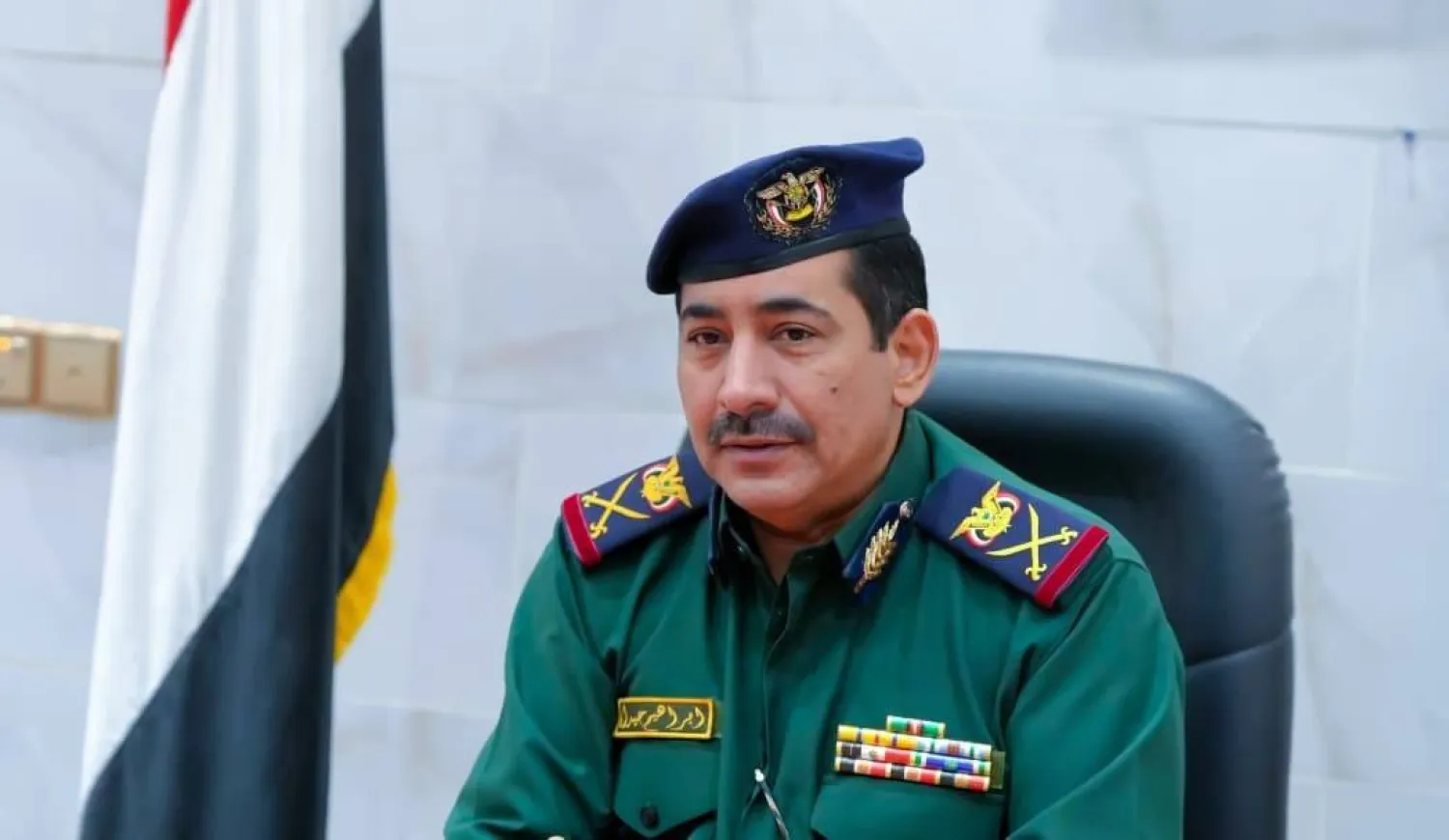
Yemen’s interior minister warned that Iran was seeking to “militarize Bab al-Mandeb” through the Houthis. (Turky Al-Agili)
Yemen’s Interior Minister Major General Ibrahim Haidan warned that Iran is seeking to establish long-term military influence over the Bab al-Mandeb Strait and its surrounding islands and coastlines by exporting to the Red Sea the model it developed to “militarize maritime corridors” in the Strait of Hormuz.
Haidan said experts from Iran’s Revolutionary Guards Corps (IRGC) were helping the Houthis strengthen their capabilities and build fortifications, operations rooms and facilities for missiles, drones and remotely guided boats.
“The danger is not limited to the threats that exist today, but extends to what is being built for the future,” Haidan told Asharq Al-Awsat.
He warned that continued Houthi control of strategic areas could give Iran leverage over one of the world’s most important shipping lanes and help it connect Yemen with the Horn of Africa through smuggling networks and armed groups.
His remarks followed sweeping government losses along Yemen’s western coast. In an offensive from Sept. 3 to 11, the Houthis seized Hays, Al-Khokha, Mokha and its port before advancing to Bab al-Mandeb, Mayyun Island and the remaining Yemeni islands in the southern Red Sea.
Haidan said security readiness had been raised in Aden, Lahj and areas behind the frontlines following the developments in Mokha and along the western coast.
The defense and interior ministries were coordinating through a joint operations room to prevent operatives and cells from infiltrating those areas or exploiting waves of displacement to carry out security breaches, he added.
‘Militarizing’ Bab al-Mandeb
Haidan placed the latest developments in a broader context, saying Yemen was “part of a regional and international security system” and that events there quickly reverberated around the world because of the Bab al-Mandeb Strait.
The gravest danger, he said, was the military infrastructure being built in the area for future use.
Experts linked to the IRGC were providing the Houthis with expertise and guidance to conduct operations and develop their military capabilities, he said.
Those efforts included building “capabilities, fortifications, bases, operations rooms and caves used to manufacture drones and remotely guided boats and to develop missiles” across Bab al-Mandeb and the surrounding islands, coastlines and highlands.
Haidan said Iran aimed to replicate in Bab al-Mandeb its experience of “militarizing maritime corridors” in the Strait of Hormuz.
That could turn an open international waterway into a source of influence and pressure for future use, he warned.
Iranian and Houthi assurances about the safety of navigation should not be treated as sufficient guarantees, he said, arguing that such messages merely gave the Houthis more time to expand their military systems and fortifications.
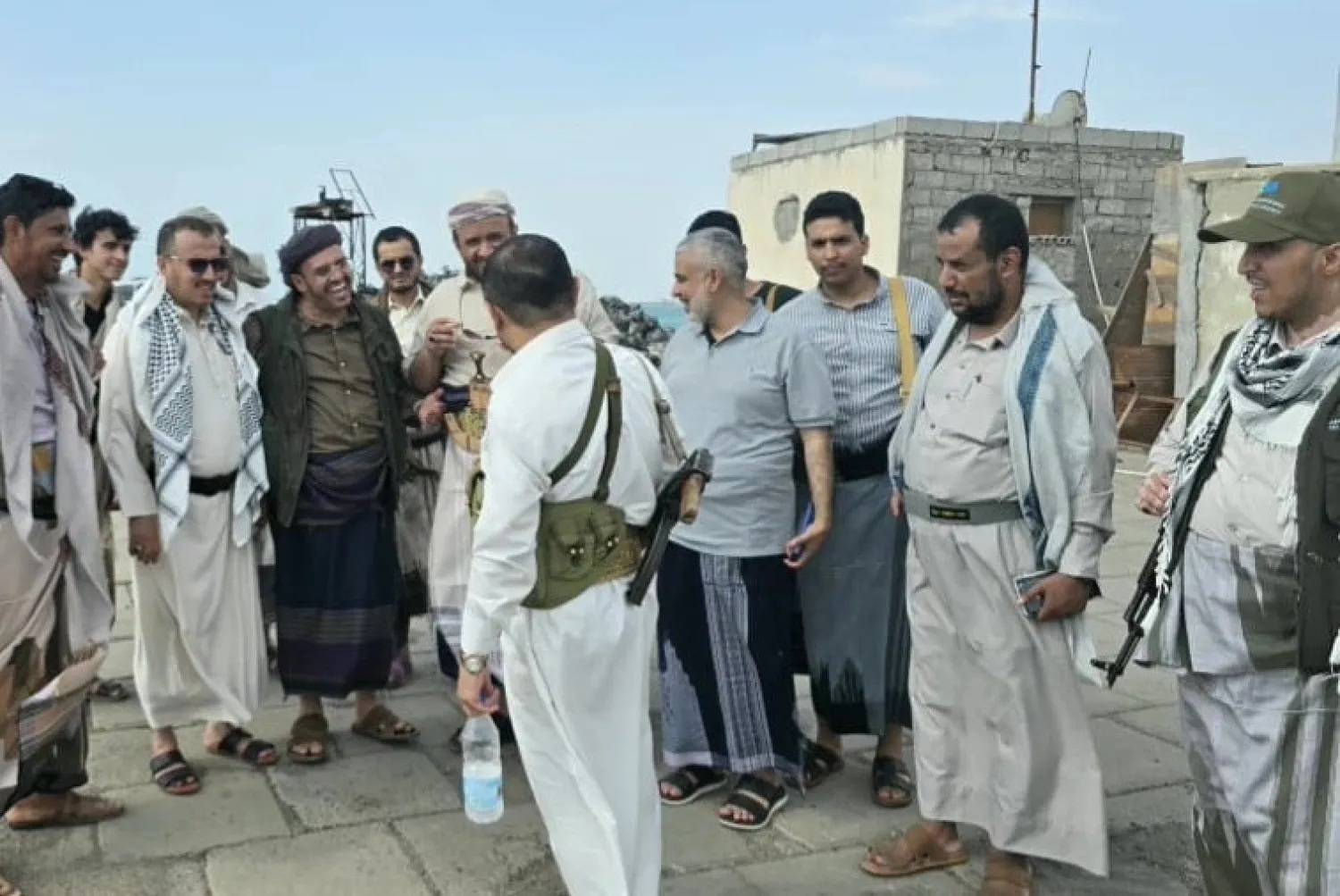
Houthi leaders at Mokha port after its capture (Houthi media)
Could Mayyun become another Larak?
Haidan outlined a more specific threat to the Red Sea islands, warning that additional time could allow the Houthis to build bases, hideouts and fortified caves, backed by advanced surveillance, tracking and jamming systems.
Mayyun Island, at the heart of Bab al-Mandeb, could take on a military role similar to that of Iran’s Larak Island in the Strait of Hormuz, he said.
Zuqar and the Hanish Islands, as well as the highlands and coastlines along the Red Sea, could also become part of an “integrated military system” if the Houthis consolidated their presence in the strait, he added.
From the Red Sea to the Horn of Africa
The danger extends beyond Bab al-Mandeb, according to Haidan.
Houthi control of the strait could give the Revolutionary Guards greater scope to connect Yemen with the Red Sea and the Horn of Africa, he said.
Smuggling networks and maritime routes could be used to move weapons, equipment and expertise, strengthen Houthi military and logistical capabilities and expand communication with armed groups and terrorist organizations operating in the Horn of Africa, particularly Somalia’s al Shabaab.
Haidan warned that those groups’ capabilities could merge with those of the Houthis and IRGC networks.
Such coordination could turn Bab al-Mandeb into “a foothold for multifaceted Iranian influence across several arenas” and give Tehran a strategic tool to deploy during any regional escalation, he said.
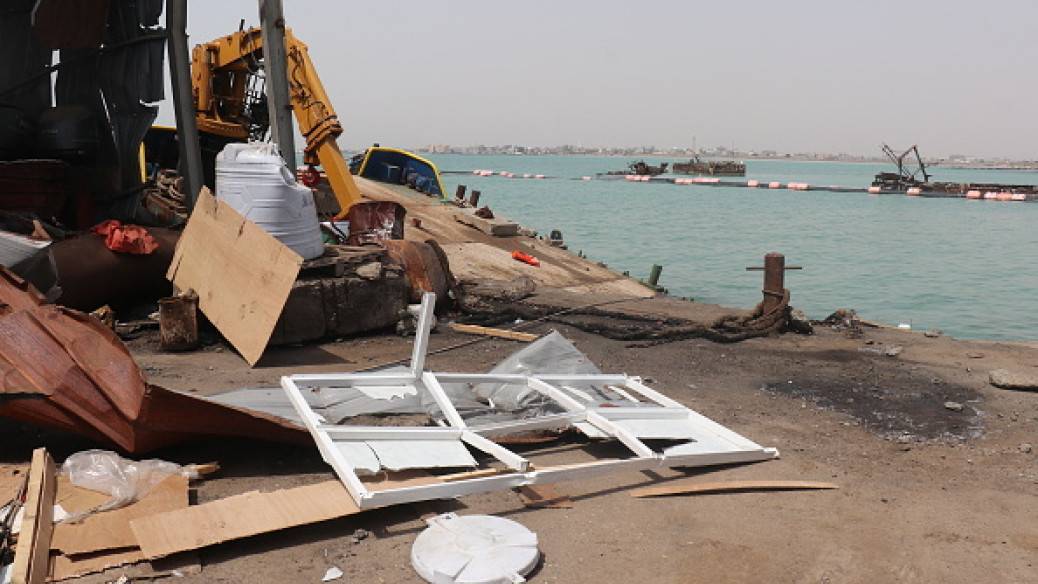
Destruction in Mokha after being attacked by the Houthis. (Getty Images)
Coastguard needs urgent support
Government forces continue to confront the Houthis and work to regain and secure lost territory, Haidan stressed.
He singled out smuggling as one of the main arteries for financing and supplying the Houthis.
Yemen’s coastguard was carrying out its duties despite limited resources, but needed “urgent, specialized support” from allied and friendly countries, he remarked.
That support should include maritime surveillance and reconnaissance capabilities, tracking and monitoring systems, patrol boats and modern equipment. Intelligence capabilities must also be strengthened to uncover smuggling networks, track their routes and intercept their shipments, he added.
Protecting Bab al-Mandeb and combating smuggling were no longer purely domestic Yemeni concerns, Haidan declared.
“The security of navigation and international trade routes begins with the state exercising sovereignty over its territory and waters,” he said.
Confronting the threats required regional and international support for the Yemeni state and stronger state capabilities, he added.
Securing Aden and Lahj
Security deployments have been reinforced at the entrances to Lahj province, the interim capital Aden and surrounding areas as displacement increased following the developments along the western coast, Haidan said.
The Interior Ministry treated the crisis as extending beyond the military frontlines. It acted simultaneously to protect displaced civilians and raise security readiness under plans prepared in advance for different scenarios.
The measures sought to balance the protection of displaced people with the need to stop the Houthis from exploiting their movement “for security purposes or to carry out infiltration and penetration operations,” he said.
Authorities have stepped up coordination and information-sharing among security agencies, local authorities and military units. They have also intensified preemptive intelligence efforts to prevent operatives from entering government-held areas or carrying out acts of sabotage.
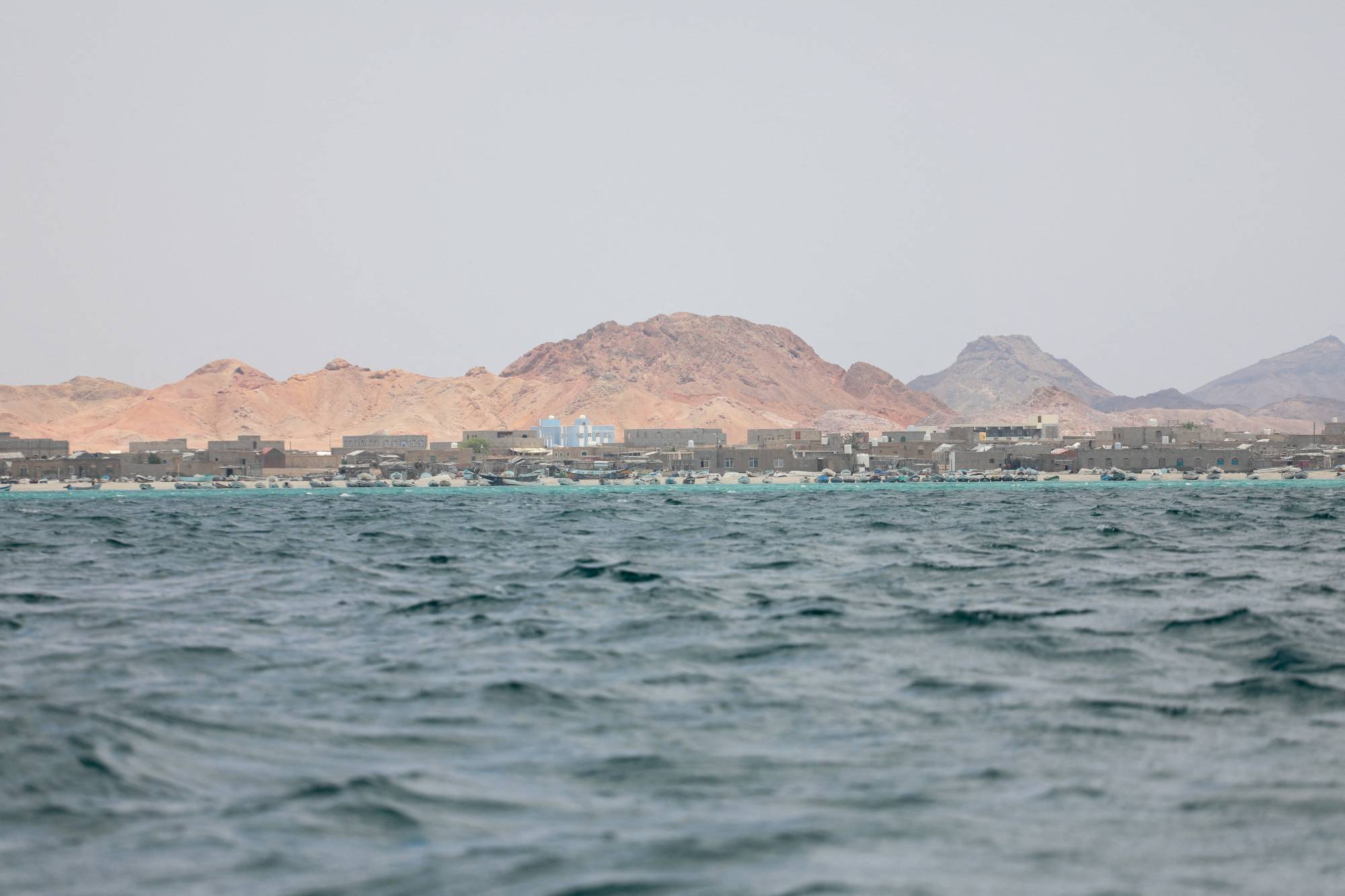
A view of a village on the coast of Bab al-Mandeb, Yemen April 2, 2026. (Reuters)
Joint operations room
The defense and interior ministries were coordinating through a “joint operations room,” Haidan said.
Its work included producing a unified assessment of the situation, assigning responsibilities and speeding up responses to developments on the ground.
Security and military services had also strengthened communication and information-sharing, focusing on frontlines, roads and areas that could be used to infiltrate operatives and cells or transport weapons and explosive devices.
Displacement remained “primarily a humanitarian issue,” Haidan said, but it also required careful security management to prevent it from being used as cover to infiltrate operatives or cells into government-held areas.
Sleeper cells and smuggling
Asked about the threats facing the security services, Haidan cited infiltration attempts and the potential use of displacement movements to conceal operatives or transport information and materials for acts of sabotage.
Sleeper cells, smuggling networks and organized crime also posed risks, he told Asharq Al-Awsat.
The heightened security measures in Aden and Lahj were largely “preventive and preemptive,” Haidan explained. They aimed to stop military pressure on the frontlines from spilling into cities while preserving a humanitarian approach toward displaced people.
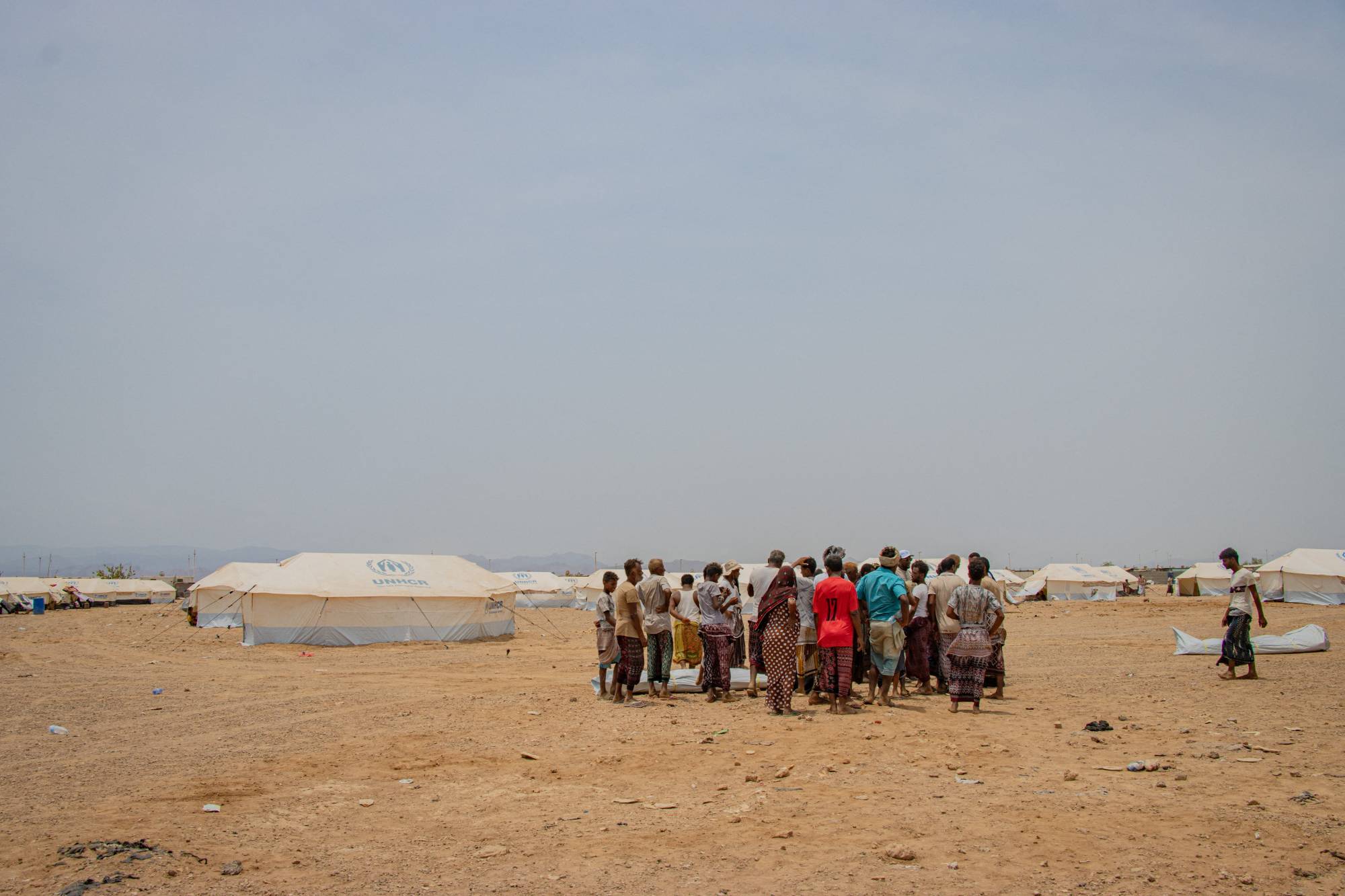
People fleeing clashes between Houthi militants and Yemeni government forces gather at the Markazi refugee camp after arriving in Djibouti, September 15, 2026. (Mylaèle Negga/International Organization for Migration/Handout via Reuters)
Mokha a ‘practical test’
Haidan described the events in Mokha as a “direct and practical test” of the security establishment’s readiness and the Interior Ministry’s contingency plans.
From the outset, those plans accounted for advances and retreats, shifting frontlines, widening displacement and mounting pressure on provinces behind the fronts, he said.
Protecting the home front was not a temporary task tied to a particular military development, but an “integral and permanent” part of the Interior Ministry’s work.
Resources and security deployments had been adjusted to battlefield developments, while information-sharing among security agencies, local authorities and military forces had been strengthened, he added.
‘Collusion’ with terrorist groups
Beyond the Houthi threat, Haidan warned that terrorist organizations, smuggling networks and organized crime groups could exploit the widening war, shifting frontlines and troop redeployments to create security vacuums.
He said there was “collusion” between the Houthis and those groups and networks. The relationship predated the latest developments and included links with Somalia’s al Shabaab.
Security agencies did not treat the Houthi threat, terrorism, organized crime and smuggling as separate files, but as “a single security system,” Haidan said.
That required heightened readiness, stronger deployments in sensitive areas and tighter monitoring of entry points, roads and smuggling routes to prevent the military developments from triggering a broader security crisis.
لم تشترك بعد
انشئ حساباً خاصاً بك لتحصل على أخبار مخصصة لك ولتتمتع بخاصية حفظ المقالات وتتلقى نشراتنا البريدية المتنوعة