

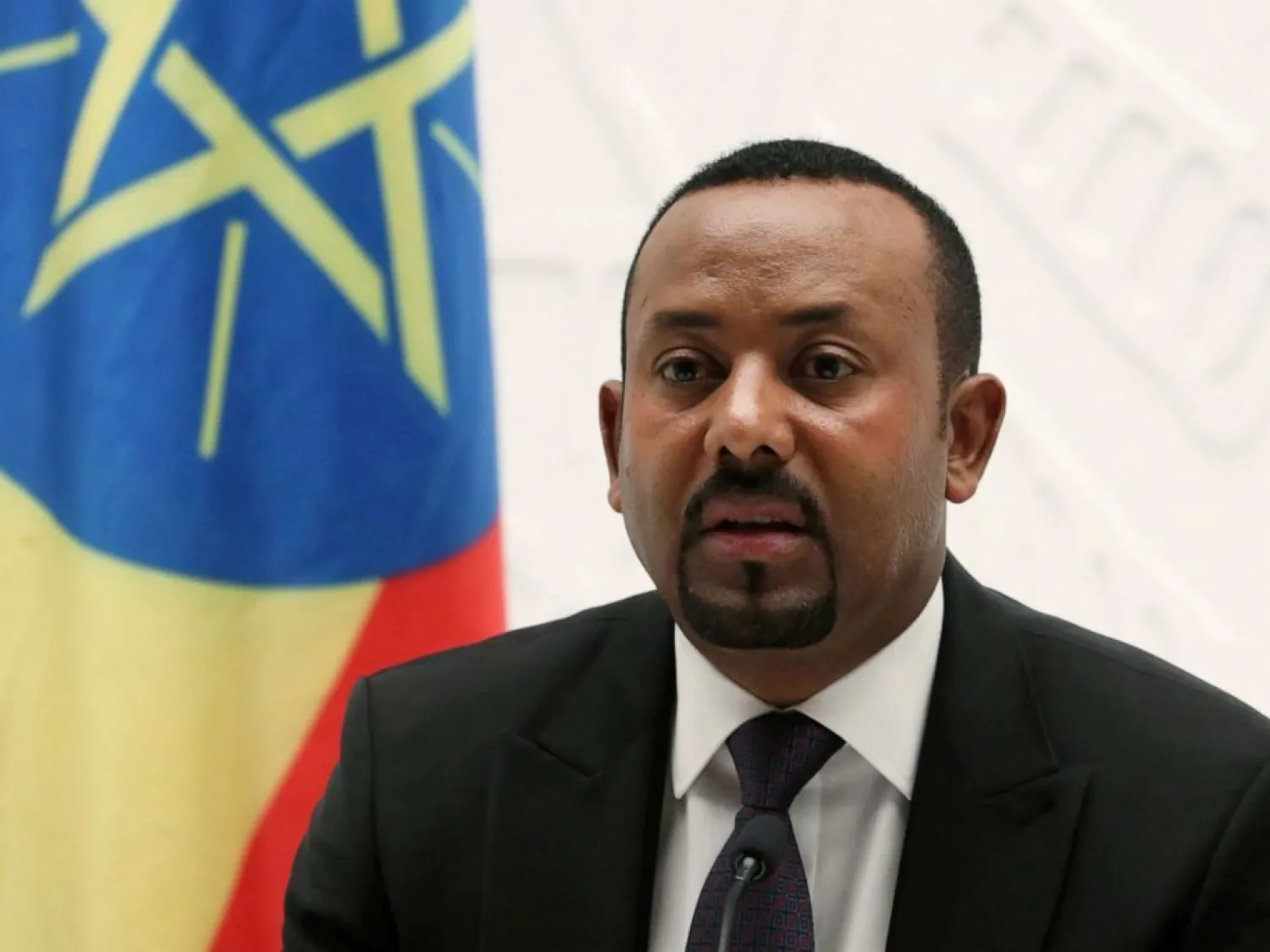

Ethiopia's Abiy Wins Nobel Peace Prize for Ending Eritrea Standoff

Ethiopia's Prime Minister Abiy Ahmed speaks at a news conference at his office in Addis Ababa, Ethiopia August 1, 2019. REUTERS/Tiksa Negeri
TT

Ethiopia's Abiy Wins Nobel Peace Prize for Ending Eritrea Standoff

Ethiopia's Prime Minister Abiy Ahmed speaks at a news conference at his office in Addis Ababa, Ethiopia August 1, 2019. REUTERS/Tiksa Negeri

Ethiopian Prime Minister Abiy Ahmed won the 2019 Nobel Peace Prize on Friday for his peacemaking efforts which ended two decades of hostility with longtime enemy Eritrea.

Though Africa’s youngest leader still faces big challenges, he has in under two years in power begun political and economic reforms that promise a better life for many in impoverished Ethiopia and restored ties with Eritrea that had been frozen since a 1998-2000 border war.

“I am so humble and thrilled ... It is a prize given to Africa, given to Ethiopia,” Abiy Ahmed said in a recorded phone call with the secretary of the award committee that was posted online.

Abiy was meeting Sudanese Prime Minister Abdalla Hamdok when he was informed he had won the prize, Abiy’s spokeswoman said.

The Nobel Committee said Abiy had won the prestigious prize for “efforts to achieve peace and international cooperation, and in particular for his decisive initiative to resolve the border conflict with neighboring Eritrea.”

It said the prize was meant to recognize “all the stakeholders working for peace and reconciliation in Ethiopia and in the East and Northeast African regions.”

News of the award trickled slowly down to the streets of the Ethiopian capital, Addis Ababa. Bisrat Hadte, a 45-year-old businessman, said he was glad but the government still had much to do to improve daily life in the country of about 100 million.

“The prime minister also has to work on to improve the economy and drive down the cost of living,” he told Reuters.

The Nobel Committee’s decision appeared designed to encourage the peace process, echoing the 1994 peace prize shared by Israeli and Palestinian leaders and the 1993 award for moves towards reconciliation in South Africa, said Dan Smith, head of the Stockholm International Peace Research Institute.

“It is a case of wanting a constructive intervention in the peace process ... to give leverage and encouragement,” he told Reuters.

“The challenge now is internal for Abiy Ahmed, with Ethiopia needing to deal with the consequences of long-term violence, including three million displaced people and the need for continuing the political process.”

Abiy had been bookmakers’ second favorite to win, behind the teenage Swedish climate change campaigner Greta Thunberg.

“I have said often that winds of hope are blowing ever stronger across Africa. Prime Minister Abiy Ahmed is one of the main reasons why,” said United Nations Secretary-General Antonio Guterres.

“His vision helped Ethiopia and Eritrea achieve a historic rapprochement.”

CHALLENGES AHEAD FOR ABIY

Abiy, now 43, took office in April 2018 after the resignation of Hailemariam Desalegn following three years of violent anti-government protests. The ruling coalition had already begun making conciliatory measures, including releasing many political prisoners, but Abiy speeded up the reforms.

His government has promised to liberalize the bureaucratic, state-controlled economy, unbanned many political parties and dismissed or arrested many senior officials accused of corruption, torture or murder.

The changes are the most sweeping since the coalition took power in 1991, and the loosening of the state’s iron grip has raised hopes in the country and abroad.

Abiy’s landmark achievement to date is securing peace with neighboring Eritrea. What remains to be seen is whether Abiy - who joined the Ethiopian army in his teens and rose through the ruling EPRDF coalition over the past two decades - can control the political forces he has unleashed.

He faces challenges from elements within the ruling coalition who feel disempowered and from new, ethnically-based parties eager to flex their muscles in next year’s elections.

The loosening of political freedoms means many regional powerbrokers are demanding more influence and resources, fueling ethnically-tinged conflicts around the country.

In June, a rogue state militia leader killed the state president of the Amhara region and other top-level officials in what the government described as a regional coup attempt.

Desalegn Chane, president of the new National Movement of Amhara (NAMA) party said three of his party’s leaders were still in jail, held without charge and suspected of being linked to the violence.

“As an Ethiopian, actually, I am very happy that the prime minister won the Nobel peace prize,” he told Reuters by phone.

“However, we still have legitimate concerns and grievances that Abiy needs to address. The political repression our people the Amhara have been suffering from has continued under Abiy.”

Abiy also faces high expectations from young Ethiopians who want jobs, development, and opportunities.

The Nobel Peace Prize will be presented in Oslo on Dec. 10, the anniversary of the death of Swedish industrialist Alfred Nobel, who founded the awards in his 1895 will. It is worth nine million Swedish crowns, or around $900,000.

This year’s award is the 100th Nobel Peace Prize award since 1901, when Henry Dunant, a founder of the Red Cross, and the French parliamentarian and peace activist Frederic Passy shared the first one. No awards were made on 19 occasions, including during the two world wars.



Nigeria's President to Make a Sate Visit to the UK in March

Nigeria’s President Bola Tinubu gives a joint statement with Brazil’s President Luiz Inacio Lula da Silva, at the Planalto presidential palace, in Brasilia, Brazil, Aug. 25, 2025. (AP Photo/Eraldo Peres, File)
TT

Nigeria's President to Make a Sate Visit to the UK in March

Nigeria’s President Bola Tinubu gives a joint statement with Brazil’s President Luiz Inacio Lula da Silva, at the Planalto presidential palace, in Brasilia, Brazil, Aug. 25, 2025. (AP Photo/Eraldo Peres, File)

Nigeria’s president is set to make a state visit to the UK in March, the first such trip by a Nigerian leader in almost four decades, Britain’s Buckingham Palace said Sunday.

Officials said President Bola Tinubu and first lady Oluremi Tinubu will travel to the UK on March 18 and 19, The AP news reported.

King Charles III and Queen Camilla will host them at Windsor Castle. Full details of the visit are expected at a later date.

Charles visited Nigeria, a Commonwealth country, four times from 1990 to 2018 before he became king. He previously received Tinubu at Buckingham Palace in September 2024.m

Previous state visits by a Nigerian leader took place in 1973, 1981 and 1989.

A state visit usually starts with an official reception hosted by the king and includes a carriage procession and a state banquet.

Last year Charles hosted state visits for world leaders including US President Donald Trump, French President Emmanuel Macron and German President Frank-Walter Steinmeier.


Iran Strikes Hard Line on US Talks, Saying Tehran's Power Comes From Saying 'No'

Traffic moves through a street in Tehran on February 7, 2026. (Photo by ATTA KENARE / AFP)
TT

Iran Strikes Hard Line on US Talks, Saying Tehran's Power Comes From Saying 'No'

Traffic moves through a street in Tehran on February 7, 2026. (Photo by ATTA KENARE / AFP)

Iran's top diplomat insisted Sunday that Tehran's strength came from its ability to “say no to the great powers," striking a maximalist position just after negotiations with the United States over its nuclear program and in the wake of nationwide protests.

Foreign Minister Abbas Araghchi, speaking to diplomats at a summit in Tehran, signaled that Iran would stick to its position that it must be able to enrich uranium — a major point of contention with President Donald Trump, who bombed Iranian atomic sites in June during the 12-day Iran-Israel war.

Iran will never surrender the right to enrich uranium, even if war "is imposed on us,” he noted.

"Iran has paid a very heavy price for its peaceful nuclear program and for uranium enrichment." 

Israeli Prime Minister Benjamin Netanyahu is expected to travel to Washington this week, with Iran expected to be the major subject of discussion, his office said.

While Iranian President Masoud Pezeshkian praised the talks Friday in Oman with the Americans as “a step forward,” Araghchi's remarks show the challenge ahead. Already, the US moved the aircraft carrier USS Abraham Lincoln, ships and warplanes to the Middle East to pressure Iran into an agreement and have the firepower necessary to strike the Islamic Republic should Trump choose to do so, according to The AP news.

“I believe the secret of the Islamic Republic of Iran’s power lies in its ability to stand against bullying, domination and pressures from others," Araghchi said.

"They fear our atomic bomb, while we are not pursuing an atomic bomb. Our atomic bomb is the power to say no to the great powers. The secret of the Islamic Republic’s power is in the power to say no to the powers.”

‘Atomic bomb’ as rhetorical device Araghchi's choice to explicitly use an “atomic bomb” as a rhetorical device likely wasn't accidental. While Iran has long maintained its nuclear program is peaceful, the West and the International Atomic Energy Agency say Tehran had an organized military program to seek the bomb up until 2003.

Iran had been enriching uranium up to 60% purity, a short, technical step to weapons-grade levels of 90%, the only non-weapons state to do so. Iranian officials in recent years had also been increasingly threatening that Tehran could seek the bomb, even while its diplomats have pointed to Iranian Supreme Leader Ali Khamenei’s preachings as a binding fatwa, or religious edict, that Iran wouldn’t build one.

Pezeshkian, who ordered Araghchi to pursue talks with the Americans after likely getting Khamenei's blessing, also wrote on X on Sunday about the talks.

“The Iran-US talks, held through the follow-up efforts of friendly governments in the region, were a step forward,” the president wrote. “Dialogue has always been our strategy for peaceful resolution. ... The Iranian nation has always responded to respect with respect, but it does not tolerate the language of force.”

It remains unclear when and where, or if, there will be a second round of talks. Trump, after the talks Friday, offered few details but said: “Iran looks like they want to make a deal very badly — as they should.”

Aircraft carrier in the Arabian Sea During Friday's talks, US Navy Adm. Brad Cooper, the head of the American military's Central Command, was in Oman. Cooper's presence was apparently an intentional reminder to Iran about US military power in the region. Cooper later accompanied US special envoy Steve Witkoff and Jared Kushner, Trump's son-in-law, to the Lincoln out in the Arabian Sea after the indirect negotiations.

Araghchi appeared to be taking the threat of an American military strike seriously, as many worried Iranians have in recent weeks. He noted that after multiple rounds of talks last year, the US “attacked us in the midst of negotiations."

“If you take a step back (in negotiations), it is not clear up to where it will go,” Araghchi said.


Russia: Man Suspected of Shooting Top General Detained in Dubai

An investigator works outside a residential building where the assassination attempt on Russian Lieutenant General Vladimir Alexeyev took place in Moscow, Russia February 6, 2026. REUTERS/Anastasia Barashkova
TT

Russia: Man Suspected of Shooting Top General Detained in Dubai

An investigator works outside a residential building where the assassination attempt on Russian Lieutenant General Vladimir Alexeyev took place in Moscow, Russia February 6, 2026. REUTERS/Anastasia Barashkova

Russia's Federal Security Service (FSB) said on Sunday that the man suspected of shooting top Russian military intelligence officer Vladimir Alexeyev in Moscow has been detained in Dubai and handed over to Russia.

Lieutenant General Vladimir Alexeyev, deputy head of the GRU, ⁠Russia's military intelligence arm, was shot several times in an apartment block in Moscow on Friday, investigators said. He underwent surgery after the shooting, Russian media ⁠said.

The FSB said a Russian citizen named Lyubomir Korba was detained in Dubai on suspicion of carrying out the shooting.

Russian Foreign Minister Sergei Lavrov accused Ukraine of being behind the assassination attempt, which he said was designed to sabotage peace talks. ⁠Ukraine said it had nothing to do with the shooting.

Alexeyev's boss, Admiral Igor Kostyukov, the head of the GRU, has been leading Russia's delegation in negotiations with Ukraine in Abu Dhabi on security-related aspects of a potential peace deal.