

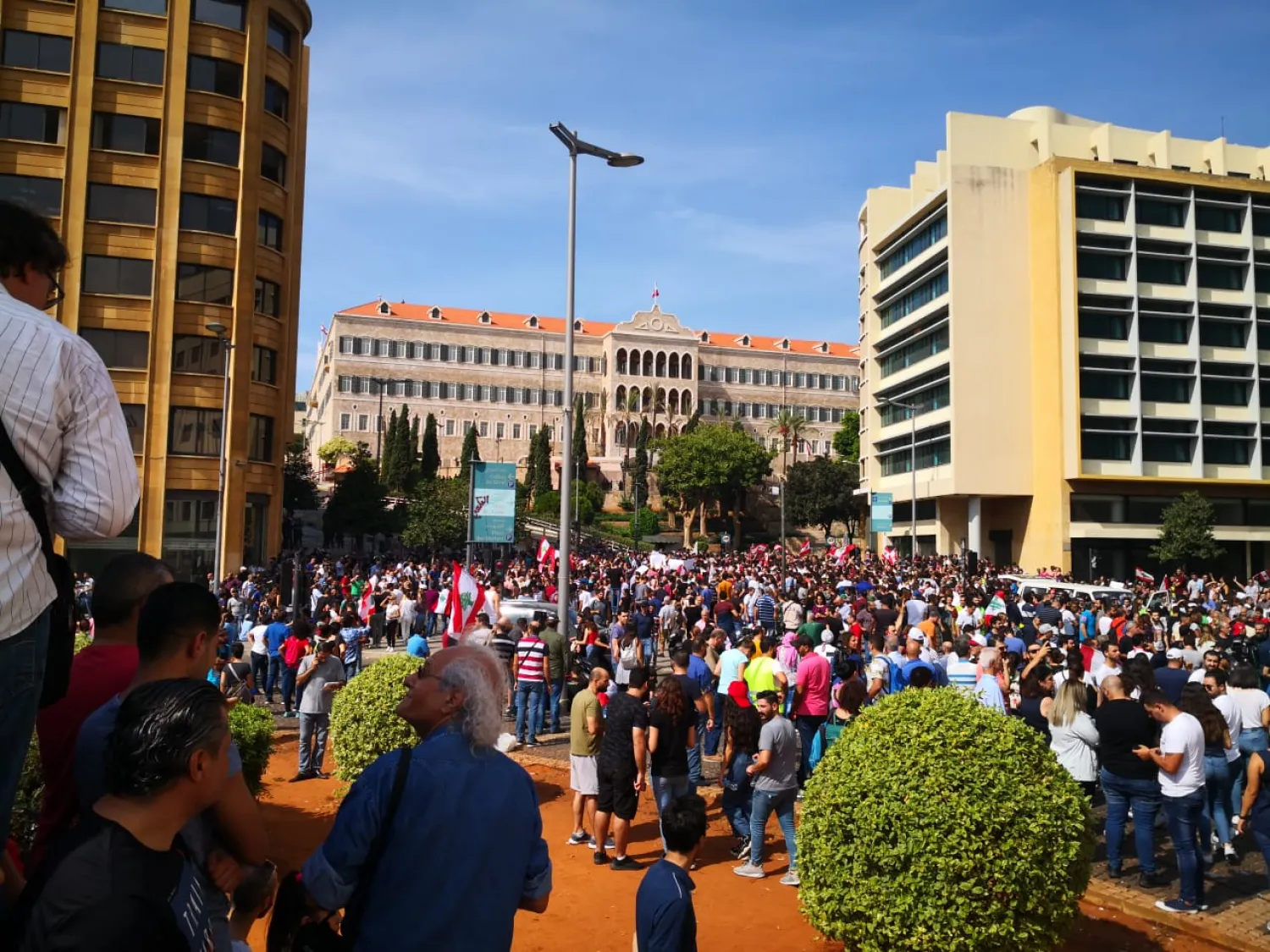

Lebanese PM Gives Govt. 72-Hour Deadline to Act as Protests Rage

Thousands have taken to the streets across Lebanon to protest dire economic conditions
TT

Lebanese PM Gives Govt. 72-Hour Deadline to Act as Protests Rage

Thousands have taken to the streets across Lebanon to protest dire economic conditions

Lebanon's Prime Minister Saad Hariri gave a 72-hour deadline on Friday to his "partners in government" to stop obstructing reforms and threatened to take a different approach otherwise, but stopped short of resigning.

Hariri, addressing massive protests across the country, said Lebanon was going through an "unprecedented, difficult time".

He added that his efforts to enact reforms have been blocked by others in government whom he did not name.

Tens of thousands of protesters blocked roads, burned tires and marched across Lebanon for a second day on Friday, demanding the removal of a political elite they accuse of looting the economy to the point of breakdown.

Lebanon’s biggest protests in a decade are reminiscent of the 2011 Arab revolts that toppled four presidents. They brought people from all sects and walks of life on to the streets, holding banners and chanting slogans calling on the government to resign.

At sunset, protesters poured through the villages and towns of Lebanon’s south, north and east as well as the capital Beirut. No political leader, Muslim or Christian, was spared their wrath.

Across the country, they chanted for top leaders, including President Michel Aoun, Hariri and parliament Speaker Nabih Berri to step down.

The mood was a mixture of rage, defiance and hope.

A security source said one protester was killed and four wounded after the bodyguards of a former member of parliament fired into the air in the northern city of Tripoli.

Fires burned in the street of Beirut. Pavements were littered with smashed glass and torn billboards. Demonstrators reached the edge of Aoun’s palace in Baabda.

Addressing protesters from the presidential palace, Foreign Minister Gebran Bassil, Aoun’s son-in-law, said the government must work to stop corruption and avoid imposing new taxes.

“Any alternative to the current government would be far worse and might lead the country into catastrophe and strife,” said Bassil, dismissing calls for the administration to resign.

The latest unrest was prompted by anger over inflation, new tax proposals including a fee on WhatsApp voice calls, and the rising cost of living.

In an unprecedented move, Shiite protesters also attacked the offices of their deputies from Lebanon’s influential Hezbollah group and the Amal movement in southern Lebanon.

“We came to the streets because we can no longer bear this situation. This regime is totally corrupt,” said Fadi Issa, 51, who was marching with his son. “They are all thieves, they come to the government to fill their pockets, not to serve the country.

“We don’t want just a resignation. We want them to be held accountable. They should return all the money they stole. We want change,” he said, according to Reuters.

The demonstrations follow warnings by economists, investors and rating agencies that indebted Lebanon’s economy and graft-entrenched financial system are closer to the brink than at any time since the war-torn 1980s.

Foreign allies have pressured Hariri to enact reforms long promised but never delivered because of vested interests.

“Downfall of the regime”

“The people want the downfall of the regime,” protesters near the government’s Serail headquarters chanted, echoing the “Arab Spring” slogans.

The unrest prompted Hariri to cancel a cabinet meeting due on Friday to discuss the 2020 draft budget.

“Our demand is to stop the salaries of all parliamentarians, prime minister and ministers,” one banner read. “They are looters, down with them.”

Fatima, a dentist, said: “We are protesting against the politicians to force them to give back the money they stole and put it back at the service of the people. If it wasn’t for their corruption there would be no economic crisis.”

In a country fractured along sectarian lines, the unusually wide geographic reach of these protests highlights the deepening anger of the Lebanese. The government, which includes nearly all of Lebanon’s main parties, has long failed to implement reforms that are vital to resolve the crisis.

Slowing capital flows

Lebanese Forces leader Samir Geagea and Progressive Socialist Party leader Walid Jumblatt, whose parties both have ministers in the coalition cabinet, have called on the government to resign.

Seeking ways to boost revenues, a government minister on Thursday announced plans for a new fee for WhatsApp calls, fueling outrage. But as the protests spread, Telecoms Minister Mohamed Choucair revoked the proposed levy.

Shattered by war between 1975 and 1990, Lebanon has one of the world’s highest debt burdens as a share of its economy. Economic growth has been hit by regional conflict and unemployment among the under-35s runs at 37%.

The steps needed to fix the national finances have long proven elusive. Sectarian politicians, many of them civil war militia leaders, have long used state resources for their own political benefit and are reluctant to cede prerogatives.

The crisis has been compounded by a slowdown in capital flows to Lebanon, which has depended on remittances from its diaspora to meet financing needs.



Appeal Trial of Tunisia Jailed Prominent Lawyer Starts

People stand outside a closed court during a nationwide strike in Tunis, Tunisia November 22, 2018. REUTERS/Zoubeir Souissi
TT

Appeal Trial of Tunisia Jailed Prominent Lawyer Starts

People stand outside a closed court during a nationwide strike in Tunis, Tunisia November 22, 2018. REUTERS/Zoubeir Souissi

The appeal trial of a prominent Tunisian lawyer jailed on anti-terror charges started on Thursday, after the judge rejected the defense's demand of his provisional release on health grounds.

Ahmed Souab's lawyers and relatives said his health condition had become critical since his jailing in April last year as part of what many said was a crackdown on political dissent.

The court rejected his provisional release and postponed the hearing to February 23, his lawyer, Fedi Snene, told AFP.

Souab -- also a rights advocate and a former judge -- was detained after claiming that judges were under political pressure to hand down hefty sentences last year in a mass trial of critics of President Kais Saied.

He had been a member of the defense team during the high-profile mass trial, and last October he was sentenced to five years in prison in a speedy trial that lasted less than two minutes.

UN Special Rapporteur on human rights defenders Mary Lawlor said on Wednesday Souab had been convicted on "baseless charges" and called for his "immediate release".

Snene rejected accusations against Souab, saying "he should not be in prison".

"He is a well-known man of law, who served for nearly 30 years as a judge before becoming a lawyer," Snene added.

Souab's son, Saeb, told AFP the family had submitted a "substantial medical file" asking the judge for his release pending a verdict.

Saeb said his father suffered a heart attack in 2022 and that his cardiologist had certified that prison conditions could worsen his health.

Souab had accused authorities of putting "a knife to the throat of the judge who was to deliver the verdict" during the mass trial that saw around 40 public figures sentenced to long terms on charges including plotting against the state.


At Least 21 Drown in Nile Boat Sinking in Sudan

At least 21 people drowned when a boat sank in the Nile River in northern Sudan, according to the local state government and eyewitnesses interviewed by AFP. (REUTERS)
TT

At Least 21 Drown in Nile Boat Sinking in Sudan

At least 21 people drowned when a boat sank in the Nile River in northern Sudan, according to the local state government and eyewitnesses interviewed by AFP. (REUTERS)

At least 21 people drowned when a boat sank in the Nile River in northern Sudan, according to the local state government and eyewitnesses interviewed by AFP.

River Nile State said Thursday that 21 bodies had been recovered after the accident, listed their names and warned that some passengers were still missing.

The boat was crossing the river between the villages of Tayba al-Khawad and Deim al-Qarai, according to the local government's statement.

The statement did not explain the cause of the accident.

Eyewitnesses told AFP the boat was carrying 30 people.

The Sudanese Doctors Network said in a statement that six of the boat's passengers survived.

The group said the incident exposes "the fragility of river transport and the absence of basic safety requirements, as well as the complete absence of local authorities and civil defense rescue teams in the early hours of the incident".

Many Sudanese rely on river transport via single-engine boats captained by solo operators.

The country's infrastructure has been collapsing due to a war that has been ongoing for nearly three years.

The war has divided the country between the army and their enemy, the paramilitary Rapid Support Forces, with road closures and a severe deterioration in public services and medical and educational infrastructure.


Syria Affirms Deep Ties with Saudi Arabia

Saudi Ambassador to Damascus Dr. Faisal Al-Mujfel visits the Kingdom’s pavilion, guest of honor at the Damascus International Book Fair (Saudi Embassy account). 
TT

Syria Affirms Deep Ties with Saudi Arabia

Saudi Ambassador to Damascus Dr. Faisal Al-Mujfel visits the Kingdom’s pavilion, guest of honor at the Damascus International Book Fair (Saudi Embassy account). 

Syria has reaffirmed the strength of its relations with Saudi Arabia during a visit by the Saudi ambassador to Damascus, Dr. Faisal Al-Mujfel, to the Saudi pavilion, guest of honor at the 2026 Damascus International Book Fair.

Saudi Arabia’s participation in the fair, held from Feb. 6-16, is led by the Literature, Publishing and Translation Commission.

At the start of the visit, Al-Mujfel met Syria’s Minister of Culture, Mohammad Yassin Saleh, who welcomed the Kingdom’s designation as guest of honor as a clear affirmation of the depth of Saudi-Syrian cultural relations, based on partnership and mutual respect.

Saleh praised Saudi Arabia’s cultural efforts and commended the pavilion for showcasing activities that reflect the richness and diversity of Saudi cultural heritage.

He noted that the Saudi program highlights the Kingdom’s commitment to supporting culture and literature at both the Arab and international levels. The pavilion features a wide range of events, including seminars and poetry evenings, with the participation of leading Saudi writers and intellectuals.

During a guided tour, the Saudi ambassador was briefed on the creative diversity presented at the pavilion. Exhibits include a collection of manuscripts, a section dedicated to traditional Saudi attire, displays of archaeological replicas, and a selection of publications issued by the Literature, Publishing and Translation Commission.

Among the featured works are titles from the “Translate” initiative, the “Saudi Literature Comics” series, and short story collections from Saudi authors, offering visitors insight into the Kingdom’s contemporary literary scene.

The commission is overseeing Saudi Arabia’s participation as guest of honor at the 2026 book fair, presenting what it described as a vibrant cultural experience that celebrates Saudi creativity and promotes dialogue through books.

The program aligns with the Kingdom’s National Culture Strategy under Vision 2030, which emphasizes cultural exchange, knowledge sharing, and constructive dialogue among nations, while reinforcing Saudi Arabia’s role in the Arab and global cultural landscape.

The visit was attended by several Arab diplomats accompanying the Saudi ambassador, including the ambassadors of Bahrain, Oman and Lebanon, as well as the chargé d’affaires of the United Arab Emirates embassy in Damascus.