


Deep-Sea Explorers Seek out Sunken World War II Ships

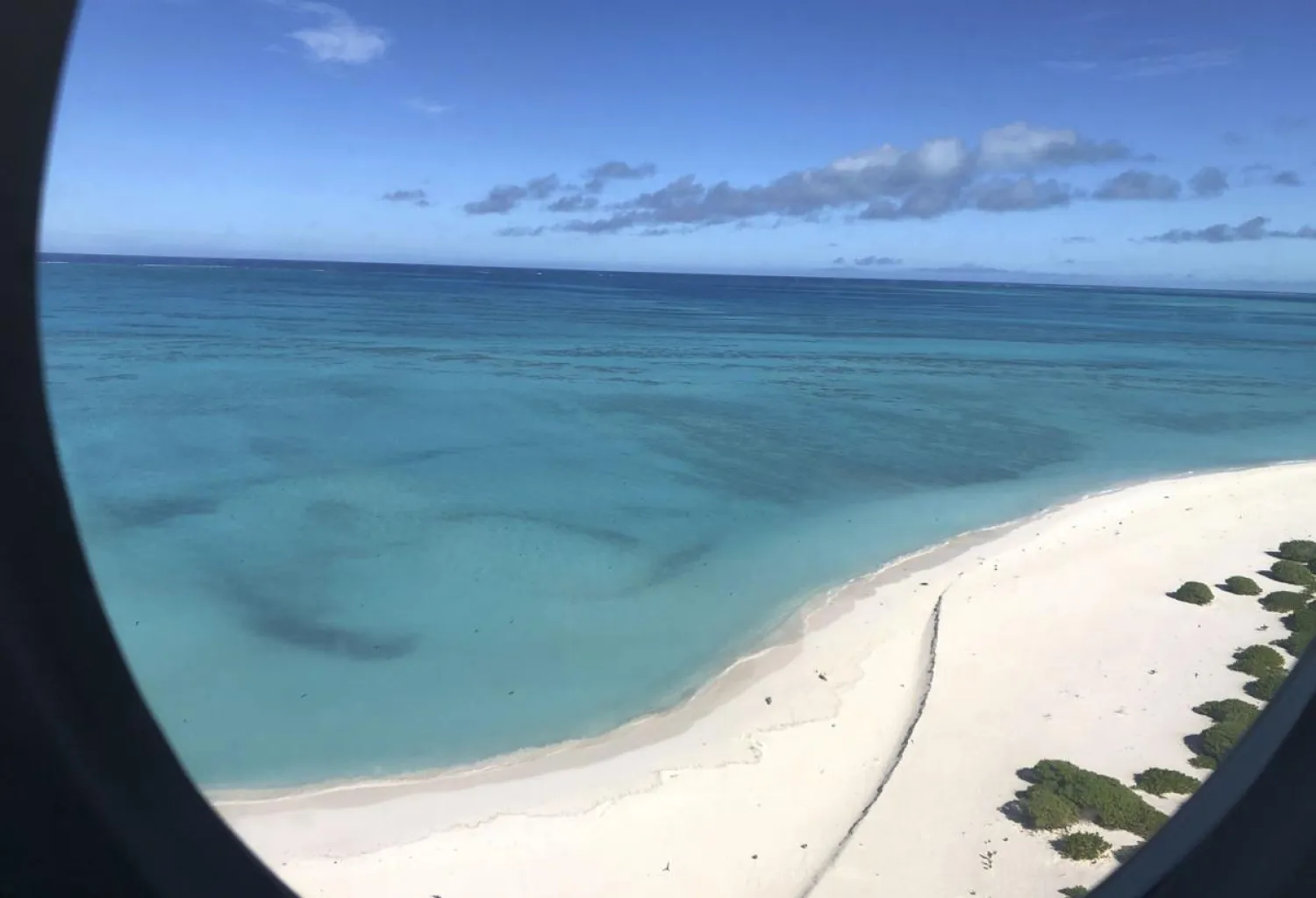
In this Tuesday, Oct. 15, 2019 photo, the shoreline of Midway Atoll in the Northwestern Hawaiian Islands is shown from a landing airplane. Deep-sea explorers scouring the world's oceans for sunken World War II ships are honing in on a debris field deep in the Pacific. Weeks of grid searches around the Northwestern Hawaiian Islands already have led the research vessel Petrel to one sunken battleship, the Japanese aircraft carrier Kaga. (AP Photo/Caleb Jones)
TT

Deep-Sea Explorers Seek out Sunken World War II Ships

In this Tuesday, Oct. 15, 2019 photo, the shoreline of Midway Atoll in the Northwestern Hawaiian Islands is shown from a landing airplane. Deep-sea explorers scouring the world's oceans for sunken World War II ships are honing in on a debris field deep in the Pacific. Weeks of grid searches around the Northwestern Hawaiian Islands already have led the research vessel Petrel to one sunken battleship, the Japanese aircraft carrier Kaga. (AP Photo/Caleb Jones)

Deep-sea explorers scouring the world's oceans for sunken World War II ships are focusing in on debris fields deep in the Pacific, in an area where one of the most decisive battles of the time took place.

Hundreds of miles off Midway Atoll, nearly halfway between the United States and Japan, a research vessel is launching underwater robots miles into the abyss to look for warships from the famed Battle of Midway.

Weeks of grid searches around the Northwestern Hawaiian Islands have already led the crew of the Petrel to one sunken warship, the Japanese ship the Kaga. This week, the crew is deploying equipment to investigate what could be another.

Historians consider the Battle of Midway an essential victory for the US and a key turning point in WWII.

"We read about the battles, we know what happened. But when you see these wrecks on the bottom of the ocean and everything, you kind of get a feel for what the real price is for war," said Frank Thompson, a historian with the Naval History and Heritage Command in Washington, D.C., who is onboard the Petrel. "You see the damage these things took, and it's humbling to watch some of the video of these vessels because they're war graves."

Until now, only one of the seven ships that went down in the June 1942 air and sea battle - five Japanese vessels and two American - had been located.

The expedition is an effort started by the late Paul Allen, the billionaire co-founder of Microsoft. For years, the crew of the 250-foot (76-meter) Petrel has worked with the US Navy and other officials around the world to find and document sunken ships. It is illegal to otherwise disturb the underwater US military gravesites, and their exact coordinates are kept secret.

The Petrel has found 31 vessels so far. This is the first time it has looked for warships from the Battle of Midway, which took place six months after Japan's attack on Pearl Harbor and left more than 2,000 Japanese and 300 Americans dead.

The attack from the Japanese Imperial Navy was meant to be a surprise, a strike that would give Japan a strategic advantage in the Pacific. It was thwarted when US analysts decoded Japanese messages and baited their enemy into revealing its plan.

As Japanese warplanes started bombing the military installation at Midway Atoll, a tiny group of islands about 1,300 miles (2,090 kilometers) northwest of Honolulu, US forces were already on their way to intercept Japan's fleet. US planes sank four of Japan's aircraft carriers and a cruiser, and downed dozens of its fighter planes.

One of the American ships lost was the USS Yorktown, an aircraft carrier that was heavily damaged and being towed by the US on the battle's final day when it was hit by torpedoes. The other, the USS Hammann, went down trying to defend the Yorktown.

Retired Navy Capt. Jack Crawford, who recently turned 100, was among the Yorktown's 2,270 survivors.

Japanese dive bombers left the Yorktown badly damaged, with black smoke gushing from its stacks, but the vessel was still upright.

Then the torpedoes hit, Crawford told The Associated Press by telephone from his home in Maryland.

"Bam! Bam! We get two torpedoes, and I know we're in trouble. As soon as the deck edge began to go under, I knew . she wasn't going to last," said Crawford, whose later military career was with the naval nuclear propulsion program. He also served as deputy assistant secretary for nuclear energy in the Department of Energy.

The Yorktown sank slowly, and a destroyer was able to pick up Crawford and many others.

In May 1998, almost 56 years later, an expedition led by the National Geographic Society in conjunction with the US Navy found the Yorktown 3 miles (5 kilometers) below the surface.

Crawford doesn't see much value in these missions to find lost ships, unless they can get some useful information on how the Japanese ships went down. But he wouldn't mind if someone was able to retrieve his strongbox and the brand-new sword he left in it when he and others abandoned ship 77 years ago.

He was too far away to see the Kaga go down.

A piece of the Japanese aircraft carrier was discovered in 1999, but its main wreckage was still missing - until last week.

After receiving some promising sonar readings, the Petrel used underwater robots to investigate and get video. It compared the footage with historical records and confirmed this week it had found the Kaga.

The other three Japanese aircraft carriers - the Akagi, Soryu and Hiryu - and the Japanese cruiser Mikuma are still unaccounted for.

The Petrel crew hopes to find and survey all the wreckage from the entire battle, an effort that could add new details about Midway to history books.

Earlier this year, they discovered the USS Hornet, an aircraft carrier that helped win the Battle of Midway but sank in the Battle of Santa Cruz near the Solomon Islands less than five months later. More than 100 crew members died.

The Petrel also discovered the USS Indianapolis, the US Navy's single deadliest loss at sea.

Rob Kraft, director of subsea operations on the Petrel, says Allen gave him and his crew a mission to preserve history, educate people about the past and honor those who fought on these great ships. Allen died last year.

"We're still carrying on Paul's legacy to honor our service members," Kraft said. "This originated from his desire to honor his father's service to his country, and to remember our service members and to make sure that future generations remember that as well, and they actually understand what that means and to respect that."



Caffeinated Beverages May Help Protect the Brain, Study Says

A cup of coffee and a cappuccino are seen at a Juan Valdez store in Bogota, Colombia June 5, 2019. (Reuters)
TT

Caffeinated Beverages May Help Protect the Brain, Study Says

A cup of coffee and a cappuccino are seen at a Juan Valdez store in Bogota, Colombia June 5, 2019. (Reuters)

Drinking a few cups of caffeinated coffee or tea every day may help in a small way to preserve brain power and prevent dementia, researchers reported on Monday.

People with the highest daily intake of caffeinated coffee had an 18% lower risk of developing dementia compared to those with the lowest such intake, according to a study based on responses to questionnaires by 132,000 U.S. adults spanning four decades.

The study, published in JAMA, also found that the people with the highest intake had a lower rate - by nearly 2 percentage points - of ‌self-perceived memory ‌or thinking problems compared to those with ‌the ⁠lowest intake.

Results were ‌similar with caffeinated tea, but not with decaffeinated beverages, the researchers said.

While the findings are encouraging, the study does not prove caffeine helps protect the brain, they said.

The magnitude of caffeine's effect, if any, was small, and there are other better-documented ways to protect cognitive function as people age, study leader Dr. Daniel Wang ⁠of Harvard Medical School said in a statement.

Lifestyle factors linked with lower risks of ‌dementia include physical exercise, a healthy diet ‍and adequate sleep, according to previous ‍research.

"Our study suggests that caffeinated coffee or tea consumption can ‍be one piece of that puzzle," Wang said.

The findings were most pronounced in participants who consumed two to three cups of caffeinated coffee or one to two cups of caffeinated tea daily, the researchers reported.

Those who drank caffeinated coffee also showed better performance on some objective tests of cognitive function, according to the ⁠study funded by the National Institutes of Health.

Further research is needed to validate the factors and mechanisms responsible for the findings, the researchers said.

They noted that bioactive ingredients in coffee and tea such as caffeine and polyphenols have emerged as possible factors that reduce nerve cell inflammation and damage while protecting against cognitive decline.

"We also compared people with different genetic predispositions to developing dementia and saw the same results - meaning coffee or caffeine is likely equally beneficial for people with high and low genetic risk of developing ‌dementia," study coauthor Dr. Yu Zhang of the Harvard T.H. Chan School of Public Health said in a statement.


AlUla Announces Exceptional Ramadan Experiences

These programs come as part of efforts to enhance AlUla’s tourism experience - SPA
TT

AlUla Announces Exceptional Ramadan Experiences

These programs come as part of efforts to enhance AlUla’s tourism experience - SPA

AlUla Governorate is welcoming the holy month of Ramadan this year with a wide range of diverse tourism experiences that reflect the area’s distinctive character and rich cultural heritage, reinforcing its position as one of the Kingdom’s most prominent destinations to visit during the holy month.

During Ramadan, AlUla offers an integrated experience catering to different visitor preferences, including guided stargazing experiences, cultural events, and night markets, in addition to traditional dining experiences for Iftar and Suhoor, embodying the depth of AlUla’s cultural heritage and local identity.

The Ramadan programs in AlUla include a variety of standout events, such as Ramadan experiences at Maraya Hall, a cultural market, and live performances in the atmosphere of Ashar Valley, alongside heritage tours in AlUla Old Town that narrate stories of AlUla and its Ramadan customs, including the award-winning Incense Road Experience, SPA reported.

The programs also feature seasonal art exhibitions hosted across multiple cultural venues, including Design Space AlUla, the fourth edition of Desert X AlUla, and the Arduna exhibition at AlUla Oasis, in addition to experiences combining art, nature, and stargazing at Daimumah Oasis in collaboration with AlUla Manara.

Visitors are also offered tours to prominent archaeological sites, including Hegra, Dadan, and Jabal Ikmah, to explore ancient sites dating back centuries BCE and view unique rock inscriptions, as well as adventure experiences ranging from dinner and stargazing in Sharaan, hot-air balloon rides, mountain hiking trails, and safari tours.

These programs come as part of efforts to enhance AlUla’s tourism experience during the holy month of Ramadan and provide diverse options that meet visitor expectations, contributing to the growth of tourism activity and showcasing the governorate’s natural and cultural assets.


NCW Releases over 10,000 Animals under Reintroduction Programs

The releases carried out by the center over the past years included more than 80 priority wildlife species - SPA
TT

NCW Releases over 10,000 Animals under Reintroduction Programs

The releases carried out by the center over the past years included more than 80 priority wildlife species - SPA

The National Center for Wildlife (NCW) announced that the total number of wildlife animals released under its breeding and reintroduction programs for locally threatened species has exceeded 10,000 animals, an achievement reflecting the scale of the center’s sustained efforts to develop wildlife, restore ecosystems, and enhance biodiversity across various regions of the Kingdom.

The releases carried out by the center over the past years included more than 80 priority wildlife species, including reem gazelles (sand gazelles), Arabian oryx, Idmi gazelles, mountain ibex, houbara bustards, ostriches, and sandgrouse, as part of efforts aimed at supporting the recovery of natural populations of these species and enhancing their sustainability within their environmental and historical ranges, SPA reported.

CEO of NCW Dr. Mohammad Qurban noted that release operations are among the key tools for restoring ecosystems and reducing ecological imbalance, as the return of wildlife to their natural habitats contributes to protecting biodiversity and improving environmental quality, which in turn supports habitat integrity, the continuity of plant and animal components, and the enhancement of ecosystem functions over the long term.

NCW continues to implement its strategic plans to develop wildlife, protect endangered species, and enhance the efficiency of natural habitat management through expanding breeding programs, enhancing applied scientific research, building national capacities, and applying the best international practices in biodiversity management, in addition to raising environmental awareness, engaging local communities, and supporting eco-tourism, thereby contributing to achieving the objectives of the Saudi Green Initiative and Saudi Vision 2030, and the National Environment Strategy, toward thriving and sustainable wildlife, biodiversity, and ecosystems.