


Lack of Food Pushes S.Sudan Opposition Troops to Desert Training Camps

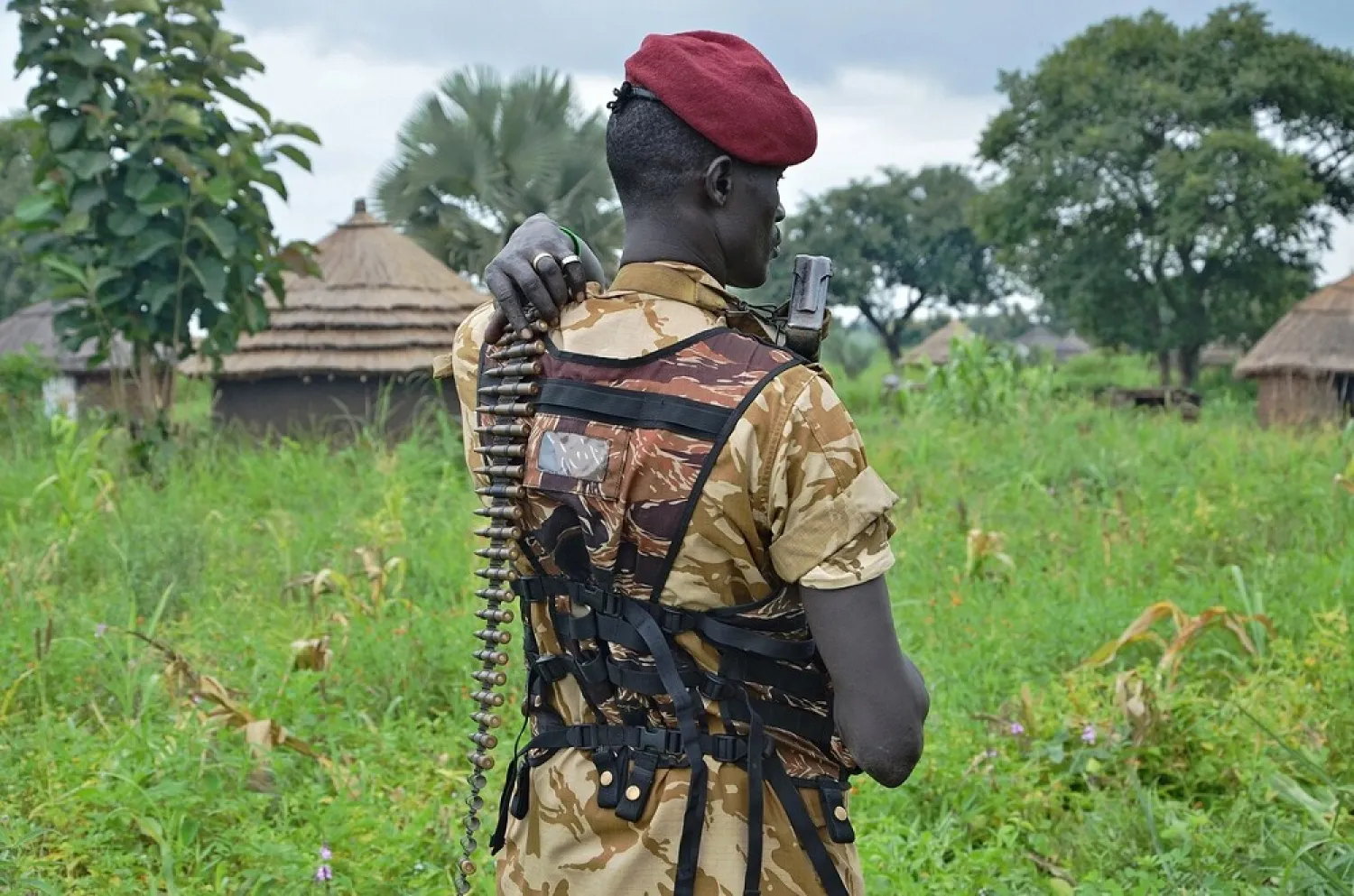
A South Sudanese SPLA soldier is pictured in Pageri in Eastern Equatoria state on August 20, 2015. (Getty Images)
TT

Lack of Food Pushes S.Sudan Opposition Troops to Desert Training Camps

A South Sudanese SPLA soldier is pictured in Pageri in Eastern Equatoria state on August 20, 2015. (Getty Images)

Hundreds of South Sudan opposition fighters are leaving cantonment sites set up to register and train them under a deal to end the country's war, claiming lack of food and medical supplies, authorities say.

The process of gathering fighters into military camps with a view to forming an 83,000-strong unified army is a cornerstone of a September 2018 peace deal.

But the operation has been riddled with delays and lack of funding, hampering the readiness of the force.

The problem is one of the major stumbling blocks as a deadline looms on November 12 for President Salva Kiir, his longtime rival Riek Machar and other rebel groups, to form a power-sharing government.

At one of the largest opposition cantonment sites in the village of Pantit near the northern town of Aweil, hundreds of soldiers sleep under trees and are forced to shelter with locals in their mud huts, known as "tukuls," when it rains.

Lieutenant General Nicodemus Deng Deng, who is in charge of the cantonment site, told AFP that it had been over two months since they had received any food.

"The food got finished and now we are left with no food on the ground," said Deng, adding that about 700 registered troops had since left the camp due to the conditions.

"We do survive on community food, we go to cultivate with them, go and collect groundnuts from their farms as a way of survival," said Deng.

The peace agreement required that at least half of the 83,000 forces be barracked, trained and deployed by September 2019.

Last week the Joint Monitoring and Evaluation Commission (JMEC) which is tasked with overseeing the implementation of the peace agreement, said that of 25 designated opposition cantonment sites, 24 were operational and of 10 barracks for government forces, six were operational.

However, registration was still ongoing and training had yet to begin.

'Desperate, angry'

William Gallagher, head of the ceasefire monitoring entity CTSAMM, told AFP during a visit to Pantit that it was positive the forces there had been registered.

"However, unfortunately, many of those soldiers that have been registered have since deserted because of unacceptable living conditions," he said.

"It is a very, very, severe problem that thousands and thousands of soldiers and their family members are facing right now across South Sudan at the cantonment sites, without food, mostly without water, and all of them without medicine of some kind and they are desperate, they are angry and they see no solution to the problem."

Japan and China have donated money for water and rice at the cantonment sites, but western donors have been loath to fund the process, with diplomats fearing it could be used as a recruitment exercise, and citing a lack of fiscal transparency from Juba.

Meanwhile, the situation at the barracks has heaped pressure on local communities, themselves struggling to survive.

"We have (soldiers) who come to us here and they have no water for drinking and they also don't have jerry cans for collecting water, but we the hosts are also suffering, when... our children fall sick with malaria we don't always get medicine," said 50-year-old Pantit resident, Ajok.

South Sudan's war, which broke out two years after achieving independence in 2011, after a falling out between Kiir and Machar, has left nearly 400,000 dead and displaced nearly four million people.

The International Committee of the Red Cross (ICRC) said last week that while food security has improved, more than half of the population was still going hungry and millions depend on food aid.

Machar arrived in Juba Saturday for another round of talks with Kiir in a bid to salvage the peace deal and resolve the security issue and the thorny question of determining the number of states and their boundaries.



Top Trump Iran Negotiator Says Visits US Aircraft Carrier in Middle East

US Special Envoy Steve Witkoff delivers a press conference upon the signing of the declaration on deploying post-ceasefire force in Ukraine, during the so-called "Coalition of the Willing" summit, at the Elysee Palace in Paris, France, January 6, 2026. (Reuters)
TT

Top Trump Iran Negotiator Says Visits US Aircraft Carrier in Middle East

US Special Envoy Steve Witkoff delivers a press conference upon the signing of the declaration on deploying post-ceasefire force in Ukraine, during the so-called "Coalition of the Willing" summit, at the Elysee Palace in Paris, France, January 6, 2026. (Reuters)

US President Donald Trump's lead Iran negotiator Steve Witkoff on Saturday said he visited the USS Abraham Lincoln aircraft carrier currently in the Arabian Sea, with Washington and Tehran due to hold further talks soon.

"Today, Adm. Brad Cooper, Commander of US Naval Forces Central Command, Jared Kushner, and I met with the brave sailors and Marines aboard the USS Abraham Lincoln, her strike group, and Carrier Air Wing 9 who are keeping us safe and upholding President Trump's message of peace through strength," said Witkoff in a social media post.

Iranian Foreign Minister Abbas Araghchi said on Saturday he hoped talks with the United States would resume soon, while reiterating Tehran's red lines and warning against any American attack.


Israel’s Netanyahu Expected to Meet Trump in US on Wednesday and Discuss Iran

Israeli Prime Minister Benjamin Netanyahu delivers a speech during a special session to mark the 77th anniversary of the Knesset's establishment and the 60th anniversary of the dedication of the current building at the Knesset, the Israeli parliament, in Jerusalem, 02 February 2026. (EPA)
TT

Israel’s Netanyahu Expected to Meet Trump in US on Wednesday and Discuss Iran

Israeli Prime Minister Benjamin Netanyahu delivers a speech during a special session to mark the 77th anniversary of the Knesset's establishment and the 60th anniversary of the dedication of the current building at the Knesset, the Israeli parliament, in Jerusalem, 02 February 2026. (EPA)

Israeli Prime Minister Benjamin Netanyahu is expected to meet US President Donald Trump on Wednesday in Washington, where they will discuss negotiations with Iran, Netanyahu's office said on Saturday.

Iranian and US officials held indirect nuclear ‌talks in the ‌Omani capital ‌Muscat ⁠on Friday. ‌Both sides said more talks were expected to be held again soon.

A regional diplomat briefed by Tehran on the talks told Reuters Iran insisted ⁠on its "right to enrich uranium" ‌during the negotiations with ‍the US, ‍and that Tehran's missile capabilities ‍were not raised in the discussions.

Iranian officials have ruled out putting Iran's missiles - one of the largest such arsenals in the region - up ⁠for discussion, and have said Tehran wants recognition of its right to enrich uranium.

"The Prime Minister believes that any negotiations must include limiting ballistic missiles and halting support for the Iranian axis," Netanyahu's office said in a ‌statement.


Italy FM Rules Out Joining Trump’s ‘Board of Peace’

Italy's Minister for Foreign Affairs Antonio Tajani speaks to the press during the EPP Leaders’ meeting, in Zagreb, Croatia, 30 January 2026. (EPA)
TT

Italy FM Rules Out Joining Trump’s ‘Board of Peace’

Italy's Minister for Foreign Affairs Antonio Tajani speaks to the press during the EPP Leaders’ meeting, in Zagreb, Croatia, 30 January 2026. (EPA)

Italy will not take part in US President Donald Trump's "Board of Peace", Italian Foreign Minister Antonio Tajani said Saturday, citing "insurmountable" constitutional issues.

Trump launched his "Board of Peace" at the World Economic Forum in Davos in January and some 19 countries have signed its founding charter.

But Italy's constitution bars the country from joining an organization led by a single foreign leader.

Prime Minister Giorgia Meloni, a Trump ally, last month noted "constitutional problems" with joining, but suggested Trump could perhaps reopen the framework "to meet the needs not only of Italy, but also of other European countries".

Tajani appeared Saturday to rule that out.

"We cannot participate in the Board of Peace because there is a constitutional limit," he told the ANSA news agency.

"This is insurmountable from a legal standpoint," he said, the day after meeting US Secretary of State Marco Rubio and US Vice President JD Vance at the Olympics in Milan.

Although originally meant to oversee Gaza's rebuilding, the board's charter does not limit its role to the Palestinian territory and appears to want to rival the United Nations.