


Dozens Killed in Anti-Government Protests in Iraq

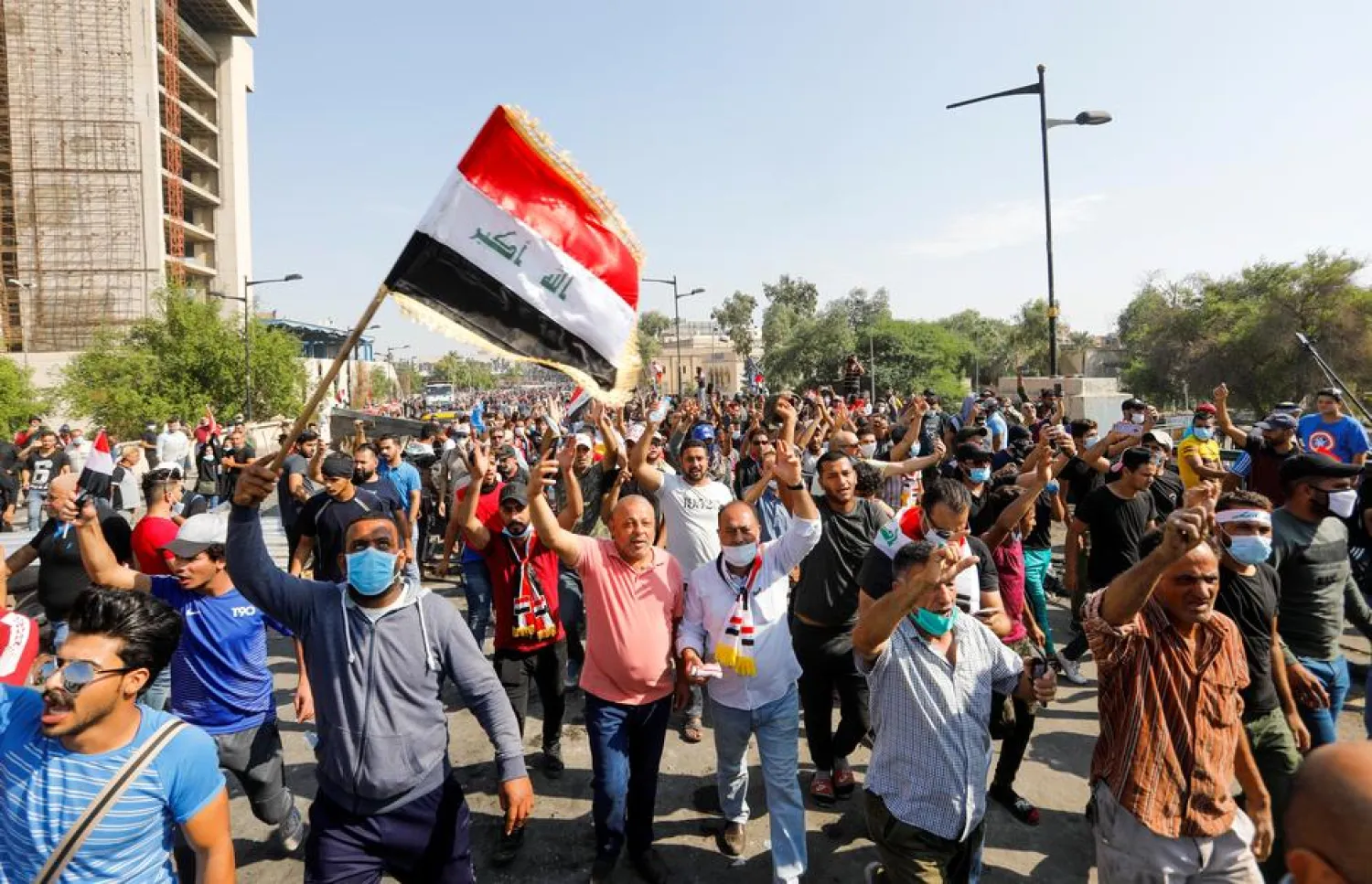
Demonstrators are seen at Al Jumhuriya bridge during a protest over corruption, lack of jobs, and poor services, in Baghdad, Iraq October 26, 2019. REUTERS/Khalid al-Mousily
TT

Dozens Killed in Anti-Government Protests in Iraq

Demonstrators are seen at Al Jumhuriya bridge during a protest over corruption, lack of jobs, and poor services, in Baghdad, Iraq October 26, 2019. REUTERS/Khalid al-Mousily

Nearly 50 people have died in renewed anti-government protests across Iraq, officials said Saturday, with clashes breaking out as demonstrators turned their fury against government and paramilitary offices.

The death toll from protests this month has climbed to 205, including dozens who were killed as they torched government buildings or offices belonging to factions of the Popular Mobilization Forces (PMF) over the past two days.

The demonstrations first erupted on October 1, with protesters railing against government corruption and unemployment, while a second wave broke out late Thursday.

This latest round of demonstrations has been notably violent, with 48 people killed in as many hours.

Three protesters were killed in the capital Baghdad on Saturday, with medics and officials reporting trauma wounds sustained by tear gas canisters lobbed at demonstrators.

But the majority of victims have been in the Shiite-majority south, where protesters torched dozens of provincial government buildings, party offices and PMF centers.

On Saturday, three people were shot dead while setting fire to a local official's home, a police source told AFP.

The previous night, 12 protesters died in Diwaniyah while setting fire to the headquarters of the Badr organization.

Top PMF commanders have threatened "revenge" after their offices were attacked, and denounced those they said aimed at sowing "discord and chaos" in the country.

In a bid to contain the violence security forces have announced curfews across most of Iraq's southern provinces -- but brief protests nevertheless took place in Diwaniyah, Nasiriyah, Babylon and Najaf.

In the southern port city of Basra, protesters failed to come out in large numbers after security forces strictly enforced a curfew.

Fears of 'armed spoilers'

The PMF was founded in 2014 to fight the ISIS group but its factions have since been ordered to incorporate into the state security services.

"Public anger is directed at them in addition to governorate councils, for they were the obvious face of 'the regime'," wrote Harith Hasan, a senior fellow at the Carnegie Middle East Center, according to AFP.

But the attacks could also hint at political rivalries between the PMF and populist cleric Moqtada al-Sadr, who has thrown his weight behind the demonstrations.

"The Sadrists, especially in their traditional strongholds such as Missan, saw this an opportunity to act against competing militias," such as Asaib Ahl al-Haq, Badr, and Kataeb Hezbollah, Hasan said on Twitter.

The United Nations on Saturday said it was "tragic" to see renewed violence but also warned against "armed spoilers".

"Armed entities sabotaging the peaceful demonstrations, eroding the government's credibility and ability to act, cannot be tolerated," said the UN top official in Iraq, Jeanine Hennis-Plasschaert.

Protesters gathered in Baghdad's emblematic Tahrir (Liberation) Square on Saturday morning despite efforts by riot police to clear them with tear gas.

"It's enough -- theft, looting, gangs, mafias, deep state, whatever. Get out! Let us see a (functioning) state," said one protester, referring to perceived cronyism and corruption in the country.

"We don't want anything, just let us live," he added as puffs of smoke from tear gas rose behind him.

'It's enough!'

Oil-rich Iraq is OPEC's second-highest producer -- but one in five people live below the poverty line and youth unemployment sits at 25 percent, according to the World Bank.

About 60 percent of Iraq's 40-million-strong population is under the age of 25.

The staggering rates of joblessness and allegations of corruption sparked the widespread protests on October 1 and the government has struggled to quell public anger by proposing reforms.

Prime Minister Adel Abdul Mahdi has suggested a laundry list of measures, including hiring drives, increased pensions and a cabinet reshuffle.

New education and health ministers were approved by parliament in a session earlier this month, the only time it was able to meet since protests began.

But a scheduled meeting of parliament on Saturday to discuss the renewed protests failed to take due to a lack of quorum.

Protesters so far have seemed unimpressed by the government's efforts.

"They told young people: 'go home, we'll give you pensions and come up with a solution'. They tricked us," said one of the rare woman protesters on Saturday, her young son at her side.

They have even directed some of their anger at Sadr and country's top Shiite religious authority, Grand Ayatollah Ali al-Sistani, who is deeply revered among most Iraqis,

"Sadr, Sistani -- this is a shame," a protester in Tahrir said on Saturday.

"We were hit! It's enough," he said, waving a tear gas canister fired earlier by security forces.



Rescue Teams Search for Survivors in Building Collapse that Killed at Least 2 in Northern Lebanon

A Lebanese flag is pictured, in the aftermath of a massive explosion, in Beirut's damaged port area, Lebanon August 17, 2020. REUTERS/Hannah McKay
TT

Rescue Teams Search for Survivors in Building Collapse that Killed at Least 2 in Northern Lebanon

A Lebanese flag is pictured, in the aftermath of a massive explosion, in Beirut's damaged port area, Lebanon August 17, 2020. REUTERS/Hannah McKay

At least two people were killed and four rescued from the rubble of a multistory apartment building that collapsed Sunday in the city of Tripoli in northern Lebanon, state media reported.

Rescue teams were continuing to dig through the rubble. It was not immediately clear how many people were in the building when it fell.

The bodies pulled out were of a child and a woman, the state-run National News Agency reported.

Dozens of people crowded around the site of the crater left by the collapsed building, with some shooting in the air.

The building was in the neighborhood of Bab Tabbaneh, one of the poorest areas in Lebanon’s second largest city, where residents have long complained of government neglect and shoddy infrastructure. Building collapses are not uncommon in Tripoli due to poor building standards, according to The AP news.

Lebanon’s Health Ministry announced that those injured in the collapse would receive treatment at the state’s expense.

The national syndicate for property owners in a statement called the collapse the result of “blatant negligence and shortcomings of the Lebanese state toward the safety of citizens and their housing security,” and said it is “not an isolated incident.”

The syndicate called for the government to launch a comprehensive national survey of buildings at risk of collapse.


Israel to Take More West Bank Powers and Relax Settler Land Buys

A view of Israeli settlement of Maale Adumim, in the West Bank, Sunday, June 18, 2023. (AP)
TT

Israel to Take More West Bank Powers and Relax Settler Land Buys

A view of Israeli settlement of Maale Adumim, in the West Bank, Sunday, June 18, 2023. (AP)

Israel's security cabinet approved a series of steps on Sunday that would make it easier for settlers in the occupied West Bank to buy land while granting Israeli authorities more enforcement powers over Palestinians, Israeli media reported.

The West Bank is among the territories that the Palestinians seek for a future independent state. Much of it is under Israeli military control, with limited Palestinian self-rule in some areas run by the Western-backed Palestinian Authority (PA).

Citing statements by Finance Minister Bezalel Smotrich and Defense Minister Israel Katz, Israeli news sites Ynet and Haaretz said the measures included scrapping decades-old regulations that prevent Jewish private citizens buying land in the West Bank, The AP news reported.

They were also reported to include allowing Israeli authorities to administer some religious sites, and expand supervision and enforcement in areas under PA administration in matters of environmental hazards, water offences and damage to archaeological sites.

Palestinian President Mahmoud Abbas said the new measures were dangerous, illegal and tantamount to de-facto annexation.

The Israeli ministers did not immediately respond to requests for comment.

The new measures come three days before Prime Minister Benjamin Netanyahu is scheduled to meet in Washington with US President Donald Trump.

Trump has ruled out Israeli annexation of the West Bank but his administration has not sought to curb Israel's accelerated settlement building, which the Palestinians say denies them a potential state by eating away at its territory.

Netanyahu, who is facing an election later this year, deems the establishment of any Palestinian state a security threat.

His ruling coalition includes many pro-settler members who want Israel to annex the West Bank, land captured in the 1967 Middle East war to which Israel cites biblical and historical ties.

The United Nations' highest court said in a non-binding advisory opinion in 2024 that Israel's occupation of Palestinian territories and settlements there is illegal and should be ended as soon as possible. Israel disputes this view.


Arab League Condemns Attack on Aid Convoys in Sudan

A general view shows the opening session of the meeting of Arab foreign ministers at the Arab League Headquarters (Reuters)
TT

Arab League Condemns Attack on Aid Convoys in Sudan

A general view shows the opening session of the meeting of Arab foreign ministers at the Arab League Headquarters (Reuters)

Arab League Secretary-General Ahmed Aboul Gheit strongly condemned the attack by the Rapid Support Forces on humanitarian aid convoys and relief workers in North Kordofan State, Sudan.

In a statement reported by SPA, secretary-general's spokesperson Jamal Rushdi quoted Aboul Gheit as saying the attack constitutes a war crime under international humanitarian law, which prohibits the deliberate targeting of civilians and depriving them of their means of survival.

Aboul Gheit stressed the need to hold those responsible accountable, end impunity, and ensure the full protection of civilians, humanitarian workers, and relief facilities in Sudan.