


‘The Romário-Fication of Raheem’: How Manchester City Transformed Sterling

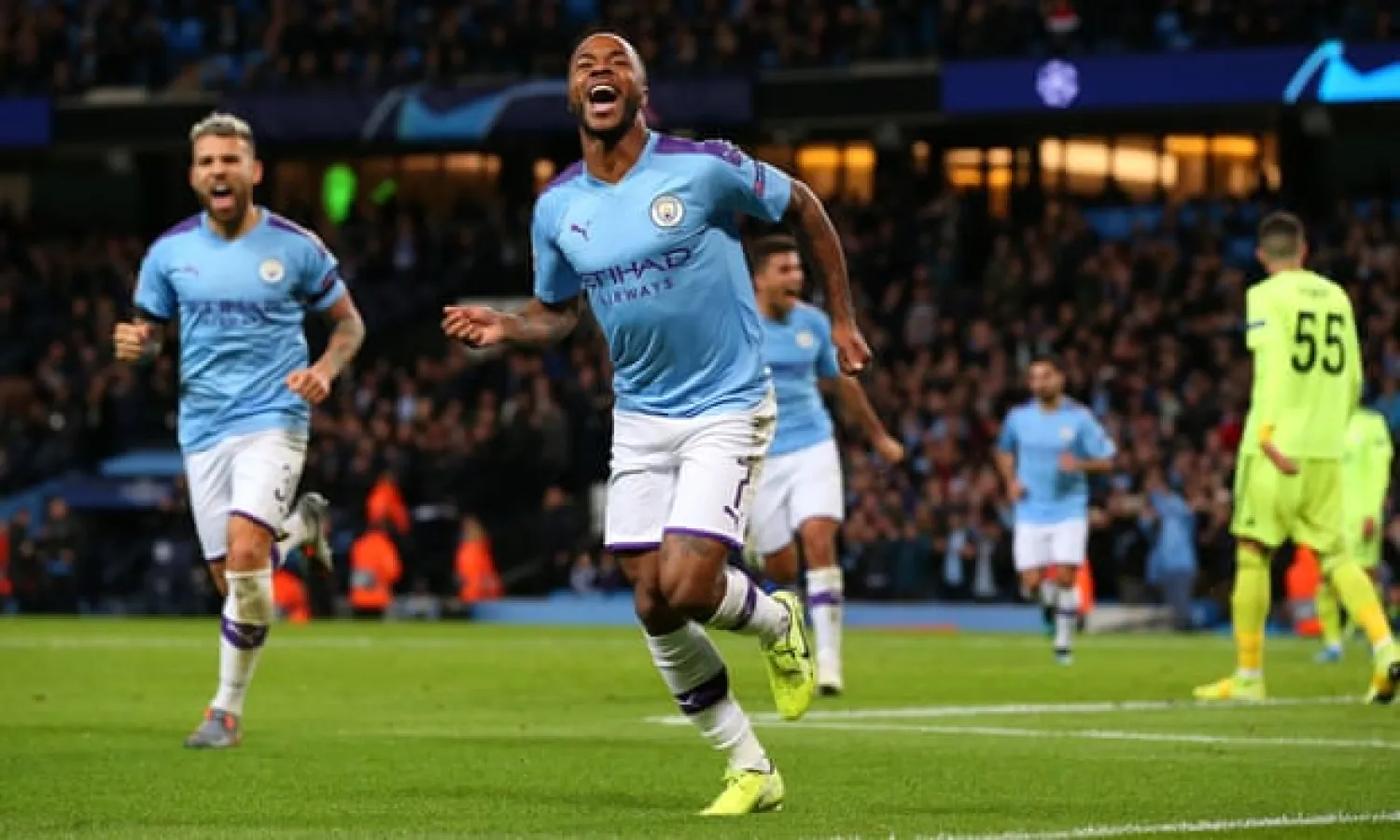
 Raheem Sterling celebrates after scoring for Manchester City against Dinamo Zagreb this season. Photograph: Alex Livesey - Danehouse/Getty Images
Raheem Sterling celebrates after scoring for Manchester City against Dinamo Zagreb this season. Photograph: Alex Livesey - Danehouse/Getty Images
TT

‘The Romário-Fication of Raheem’: How Manchester City Transformed Sterling

 Raheem Sterling celebrates after scoring for Manchester City against Dinamo Zagreb this season. Photograph: Alex Livesey - Danehouse/Getty Images
Raheem Sterling celebrates after scoring for Manchester City against Dinamo Zagreb this season. Photograph: Alex Livesey - Danehouse/Getty Images

Raheem Sterling joined City the year before Pep Guardiola left Bayern Munich, in July 2015, for a record £50m – at that time the highest fee paid for an English player. After a lacklustre first season, he joined England for their disastrous 2016 Euro campaign which saw them knocked out by Iceland in the last 16.

A disappointing first year followed by a disastrous summer. Enter Pep. City’s football director, Txiki Begiristain, had signed Sterling specifically in anticipation of Pep taking over.

“He had a spark, a capacity to shake off markers. He’s explosive and above all he’s got that burst of pace which takes effective wide players to the goalline. Even then, it was also clear that he was a guy who loved to cut in, too.”

Begiristain’s football instincts were correct. Under the guidance of Pep and his team, Sterling has become a truly world-class player. In his first season under Manuel Pellegrini, Sterling managed only six league goals and by the second half of the campaign had lost his place as a regular starter.

“The huge transfer fee was actually pretty detrimental in terms of his self-confidence, which is so important for any player. As things didn’t come off for him you could almost see Raz fading away,” explains Mikel Arteta, who was still playing for Arsenal at the time. The following year, Arteta joined Pep and Domènec Torrent at City and he began to work closely with Sterling.

“We wanted him much closer to the penalty area. It was like he was a bit scared of the goal. We wanted him to become the kind of player who would get us a goal every game, or even just missing two or three big chances. We wanted him constantly generating goal threat. And we wanted him to lose the fear. He needed to believe in himself, to believe that he could be the best.”

The new regime had an almost immediate impact. Suddenly his head was up, he was running more than ever and, by Pep’s second season, had formed one of the most lethal attacking forces in the history of the Premier League with Leroy Sané and Sergio Agüero, between them scoring 67 of the team’s total of 140 goals.

First, however, the coaching team had to realign Sterling for his role on the right of Guardiola’s trident. Mikel Arteta: “He’d picked up a few bad habits along the way. He’d played on the inside a lot or out on the left wing. When you move to the right wing, the direction and angle of possession coming to you is very different. When the ball reached him he really had his gaze fixed on it – rather than half-touch instinctive control and the vision of what’s around him.”

Sterling was static when he got the ball. Guardiola’s solution was to try to turn him into City’s version of Romário, the coach’s old Barcelona teammate and a World Cup winner with Brazil in 1994.

Pep Guardiola: “In that Dream Team era, whenever I saw Romário with his back to the centre-halves I’d never give him the ball. But the instant I saw him on the half-turn with his shoulder dipping as if he wanted the ball fed into his right or left foot, I knew he thought he could explode away from his marker. In that instance I always hit the pass immediately. Every time. I’d learned that his vision meant he’d had one eye on the distance between him and the opposition goal and the other eye on where the ball was. If he opened up his body shape like that and I fed him the ball, the defender was automatically done for.”

The key to this strategy was Sterling’s acceleration. Guardiola’s analysis staff compare their forward’s explosive first steps to those of Leo Messi. While the Barcelona player doesn’t possess a sprinter’s speed over distance, his acceleration – combined with an intuitive sense of when to make his move – leaves defenders in his wake. Thus began the Romário-fication of Raheem.

The plan was that Sterling should make a habit of dropping slightly further away from his marker, or nearest opponent, when looking to receive possession, his body turned towards the goal. In that position, if he then gunned his extraordinary accelerator, the sprint was always to the danger area. Arteta: “If he’s found a space about three metres off his defender but he’s half-turned towards the goal then his sprint takes him much more quickly to a space where he can shoot and that’s going to cause the rival much more damage. It’s also a tactic, dropping off a little, so that your defender gets drawn into a position he mightn’t want to be in. It leaves space behind him and Raheem can attack that space. If it’s close to, or in the penalty area, they also have to hesitate before putting in a challenge.”

Arteta is drawing on facts with his assessment. For example, in the 1-0 Champions League victory over Feyenoord in November 2017, Sterling pulled all of this together. He dropped off at the edge of the box, drawing his defender, Renato Tapia, with him and, with his back to goal, shunted a quick pass backwards to Gundogan. The instant he released the ball, he swivelled and burst into one of his 0-60 sprints, into the space where Tapia had been. Gundogan read the move, slid the one-two pass into that space. One-v-one with the keeper, Sterling lofted it over Brad Jones for City’s winning goal.

Sterling played increasingly on the left wing in season 2018-19, although Guardiola continued to move him around a lot. His partnership with Bernardo Silva went from strength to strength, meaning that Sané figured much less in the starting XI. The PFA Young Player of the Year won by Sané in 2018 went to Sterling in 2019, after he finished the season with a personal best of 25 goals and 18 assists from 51 games. By November 2018 City had seen enough to extend Sterling’s contract through season 2022-23.

Yet Guardiola continues to see room for improvement. Take the coach’s critique of him after the home game against Watford on 9 March 2019, in which he had scored a hat-trick by the 64th minute. “Sterling could do better. He didn’t follow his full-back two times. He lost two, three or four balls which he has to avoid because he conceded counterattacks. Of course, I am so glad in terms of what he has done, scoring three goals. The first half was not the best Raheem has done this season and we will work on that.”

The Guardian Sport


Hospital: Vonn Had Surgery on Broken Leg from Olympics Crash

This handout video grab from IOC/OBS shows US Lindsey Vonn crashing during the women's downhill event at the Milano Cortina 2026 Winter Olympic Games on February 8, 2026. (Photo by Handout / various sources / AFP)
TT

Hospital: Vonn Had Surgery on Broken Leg from Olympics Crash

This handout video grab from IOC/OBS shows US Lindsey Vonn crashing during the women's downhill event at the Milano Cortina 2026 Winter Olympic Games on February 8, 2026. (Photo by Handout / various sources / AFP)

Lindsey Vonn had surgery on a fracture of her left leg following the American's heavy fall in the Winter Olympics downhill, the hospital said in a statement given to Italian media on Sunday.

"In the afternoon, (Vonn) underwent orthopedic surgery to stabilize a fracture of the left leg," the Ca' Foncello hospital in Treviso said.

Vonn, 41, was flown to Treviso after she was strapped into a medical stretcher and winched off the sunlit Olimpia delle Tofane piste in Cortina d'Ampezzo.

Vonn, whose battle to reach the start line despite the serious injury to her left knee dominated the opening days of the Milano Cortina Olympics, saw her unlikely quest halted in screaming agony on the snow.

Wearing bib number 13 and with a brace on the left knee she ⁠injured in a crash at Crans Montana on January 30, Vonn looked pumped up at the start gate.

She tapped her ski poles before setting off in typically aggressive fashion down one of her favorite pistes on a mountain that has rewarded her in the past.

The 2010 gold medalist, the second most successful female World Cup skier of all time with 84 wins, appeared to clip the fourth gate with her shoulder, losing control and being launched into the air.

She then barreled off the course at high speed before coming to rest in a crumpled heap.

Vonn could be heard screaming on television coverage as fans and teammates gasped in horror before a shocked hush fell on the packed finish area.

She was quickly surrounded by several medics and officials before a yellow Falco 2 ⁠Alpine rescue helicopter arrived and winched her away on an orange stretcher.


Meloni Condemns 'Enemies of Italy' after Clashes in Olympics Host City Milan

Demonstrators hold smoke flares during a protest against the environmental, economic and social impact of the Milano-Cortina 2026 Winter Olympics in Milan, Italy, February 7, 2026. REUTERS/Kevin Coombs
TT

Meloni Condemns 'Enemies of Italy' after Clashes in Olympics Host City Milan

Demonstrators hold smoke flares during a protest against the environmental, economic and social impact of the Milano-Cortina 2026 Winter Olympics in Milan, Italy, February 7, 2026. REUTERS/Kevin Coombs

Italian Prime Minister Giorgia Meloni has condemned anti-Olympics protesters as "enemies of Italy" after violence on the fringes of a demonstration in Milan on Saturday night and sabotage attacks on the national rail network.

The incidents happened on the first full day of competition in the Winter Games that Milan, Italy's financial capital, is hosting with the Alpine town of Cortina d'Ampezzo.

Meloni praised the thousands of Italians who she said were working to make the Games run smoothly and present a positive face of Italy.

"Then ⁠there are those who are enemies of Italy and Italians, demonstrating 'against the Olympics' and ensuring that these images are broadcast on television screens around the world. After others cut the railway cables to prevent trains from departing," she wrote on Instagram on Sunday.

A group of around 100 protesters ⁠threw firecrackers, smoke bombs and bottles at police after breaking away from the main body of a demonstration in Milan.

An estimated 10,000 people had taken to the city's streets in a protest over housing costs and environmental concerns linked to the Games.

Police used water cannon to restore order and detained six people.

Also on Saturday, authorities said saboteurs had damaged rail infrastructure near the northern Italian city of Bologna, disrupting train journeys.

Police reported three separate ⁠incidents at different locations, which caused delays of up to 2-1/2 hours for high-speed, Intercity and regional services.

No one has claimed responsibility for the damage.

"Once again, solidarity with the police, the city of Milan, and all those who will see their work undermined by these gangs of criminals," added Meloni, who heads a right-wing coalition.

The Italian police have been given new arrest powers after violence last weekend at a protest by the hard-left in the city of Turin, in which more than 100 police officers were injured.


Liverpool New Signing Jacquet Suffers 'Serious' Injury

Soccer Football - Ligue 1 - RC Lens v Stade Rennes - Stade Bollaert-Delelis, Lens, France - February 7, 2026  Stade Rennes' Jeremy Jacquet in action REUTERS/Benoit Tessier
Soccer Football - Ligue 1 - RC Lens v Stade Rennes - Stade Bollaert-Delelis, Lens, France - February 7, 2026 Stade Rennes' Jeremy Jacquet in action REUTERS/Benoit Tessier
TT

Liverpool New Signing Jacquet Suffers 'Serious' Injury

Soccer Football - Ligue 1 - RC Lens v Stade Rennes - Stade Bollaert-Delelis, Lens, France - February 7, 2026  Stade Rennes' Jeremy Jacquet in action REUTERS/Benoit Tessier
Soccer Football - Ligue 1 - RC Lens v Stade Rennes - Stade Bollaert-Delelis, Lens, France - February 7, 2026 Stade Rennes' Jeremy Jacquet in action REUTERS/Benoit Tessier

Liverpool's new signing Jeremy Jacquet suffered a "serious" shoulder injury while playing for Rennes in their 3-1 Ligue 1 defeat at RC Lens on Saturday, casting doubt over the defender’s availability ahead of his summer move to Anfield.

Jacquet fell awkwardly in the second half of the ⁠French league match and appeared in agony as he left the pitch.

"For Jeremy, it's his shoulder, and for Abdelhamid (Ait Boudlal, another Rennes player injured in the ⁠same match) it's muscular," Rennes head coach Habib Beye told reporters after the match.

"We'll have time to see, but it's definitely quite serious for both of them."
Liverpool agreed a 60-million-pound ($80-million) deal for Jacquet on Monday, but the 20-year-old defender will stay with ⁠the French club until the end of the season.

Liverpool, provisionally sixth in the Premier League table, will face Manchester City on Sunday with four defenders - Giovanni Leoni, Joe Gomez, Jeremie Frimpong and Conor Bradley - sidelined due to injuries.
