


Lebanon's Closed Banks Pledge to Pay Out Salaries

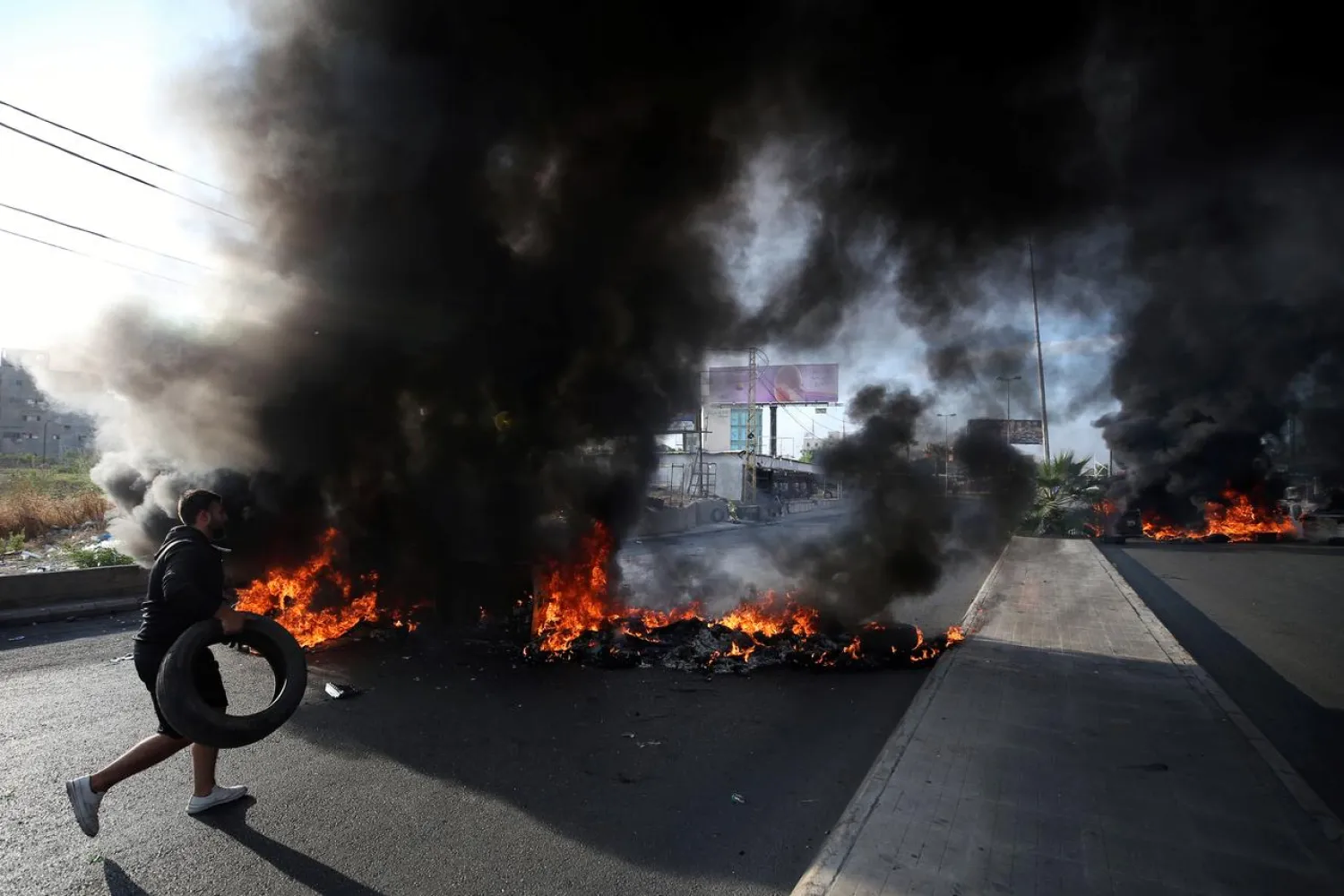
A demonstrator burns tires blocking a road in the port city of Sidon, Lebanon, October 28, 2019. REUTERS/Ali Hashisho
TT

Lebanon's Closed Banks Pledge to Pay Out Salaries

A demonstrator burns tires blocking a road in the port city of Sidon, Lebanon, October 28, 2019. REUTERS/Ali Hashisho

Lebanese banks said on Monday they would ensure public sector workers were paid their salaries as they remain closed by a wave of protests against politicians blamed for corruption and steering Lebanon toward economic collapse.

Protesters set up new roadblocks early on Monday to keep pressure up, defying security forces who tried to re-open roadways but with orders not to use force.

As the day wore on the protests, now in their 12th day, appeared to be smaller than in recent days.

The crisis has paralyzed Lebanon, closing banks, schools and some businesses. The government has yet to indicate it would cede ground to protesters, whose demands include its resignation.

On Monday President Michel Aoun said on he was “following developments”, and Prime Minister Saad al-Hariri is due to hold a cabinet meeting to discuss one of the measures in an emergency reform package proposed last week.

Lebanon’s banking association said banks would remain shut on Tuesday for a 10th working day, but said the central bank had provided the liquidity necessary to pay out salaries for public sector workers, including security forces.

Banks have previously said they will ensure people receive their end-of-month salaries through ATMs. The banks have said they are staying closed out of concern for the safety of customers and employees.

Bankers and analysts have also cited wide fears depositors will try to take out their savings when banks reopen.

Gabriel Sterne, head of global macro research at Oxford Economics, said Lebanon is facing a “bank jog”, rather than a full-blown bank run. He added that capital controls were needed in the short-term, but can also scare away investors.

The International Monetary Fund (IMF) said it was evaluating an emergency reform package the Lebanese government announced last week, but which has failed to defuse the popular anger or reassure foreign donors.

Capital inflows needed to finance the state deficit and pay for imports have been slowing down, generating financial pressures not seen in decades, including the emergence of a parallel market for dollars.

While Lebanon’s pound currency is officially pegged at 1507.5 to the dollar, parallel market rates have risen in recent months.

One market source quoted a price of 1,700 pounds to the dollar, while a second quoted 1,740, a roughly 15% premium on the official rate.

As economic strains have grown in recent years, Lebanon’s central bank and banks have taken measures to encourage people to keep money in local currency, in longer term deposits and inside the country.

While Lebanon has not imposed hard capital controls, a state prosecutor banned traders and money exchangers from taking significant amounts of physical dollar currency out the country at air and land borders, without specifying amounts.

REFORM PACKAGE
Protesters gathered early on Monday to cut major arteries across Lebanon, using cars, tents and dumpsters.

“We know we are facing lying, corrupt ruling authorities. It’s been 30 years of promises and promises. Why would I believe them now?” said Rawad Taha, 21, a university student manning a roadblock in Beirut.

“I won’t leave the street until the government resigns or there’s a tangible change I can feel.”

On one major road in Beirut, protesters set up a make-shift living room with sofas, armchairs and a fridge for the sit-in.

The leaderless rallies have drawn people from around Lebanon furious at sectarian political leaders they see as plundering state resources for personal gain.

Lebanon is saddled with one of the world’s highest levels of government debt as a share of economic output. The IMF has forecast a fiscal deficit of 9.8% of GDP this year and 11.5% next year.

Prime Minister Hariri’s coalition government, which includes nearly all of Lebanon’s main parties, tried to appease the protesters with a set of reforms including anti-corruption laws and long-delayed measures aimed at fixing state finances.

The plans includes accelerating long-delayed steps to fix the state-run power sector, which drains $2 billion from the treasury per year while failing to meet power needs for the Lebanese.

“We need to see not only what is in the package but also the timeline of the package for a country like Lebanon that has such high level of debt over GDP and high levels of twin deficits,” Jihad Azour, director of the IMF’s Middle East and Central Asia Department told Reuters.

“Fundamental reforms are urgently needed in Lebanon in order to restore macro-economic stability, bring confidence back, stimulate growth and provide some solutions to the issues that were raised by the street,” Azour said.


Aljadaan: Emerging Markets Account for 70% of Global Growth

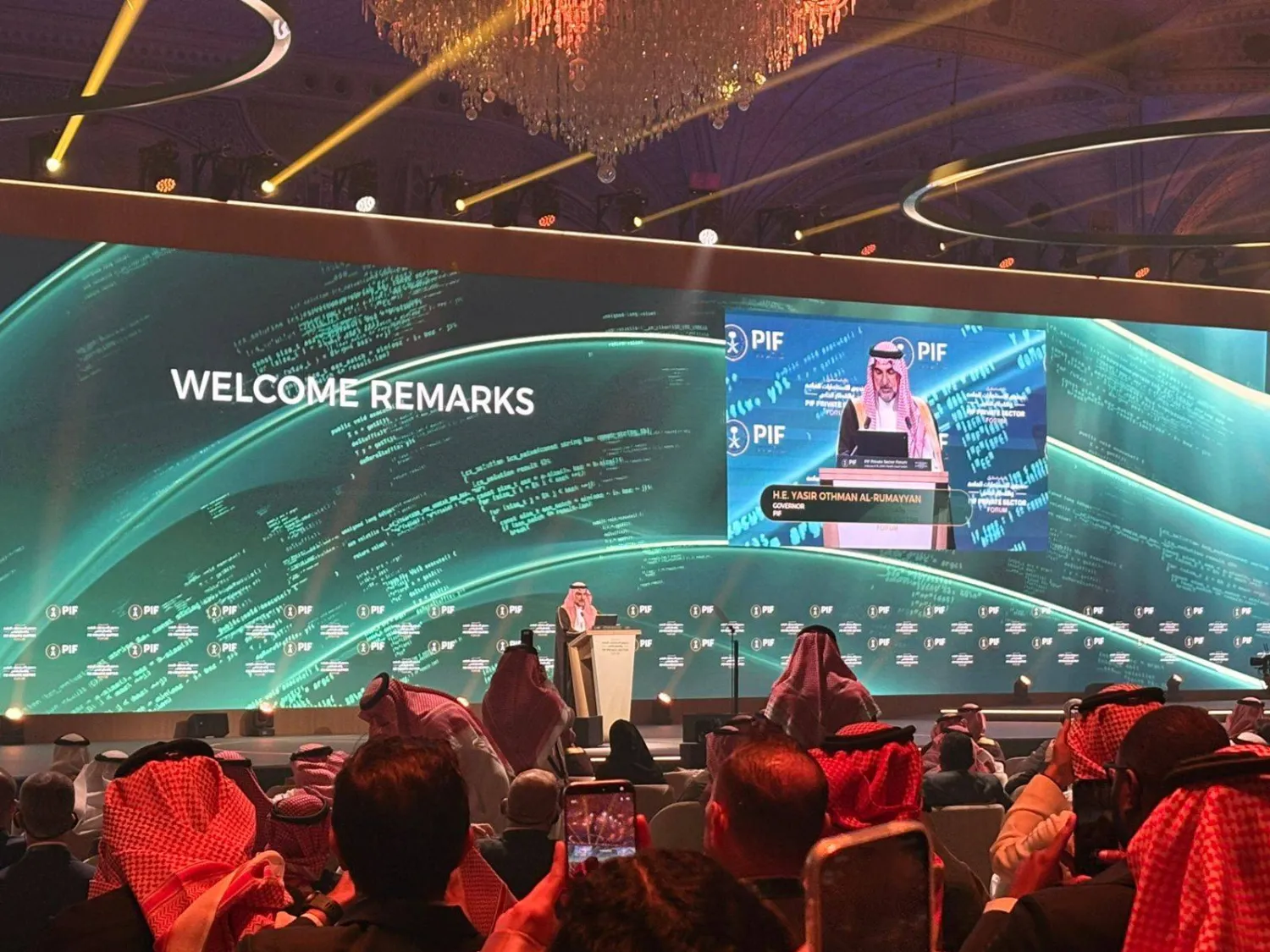
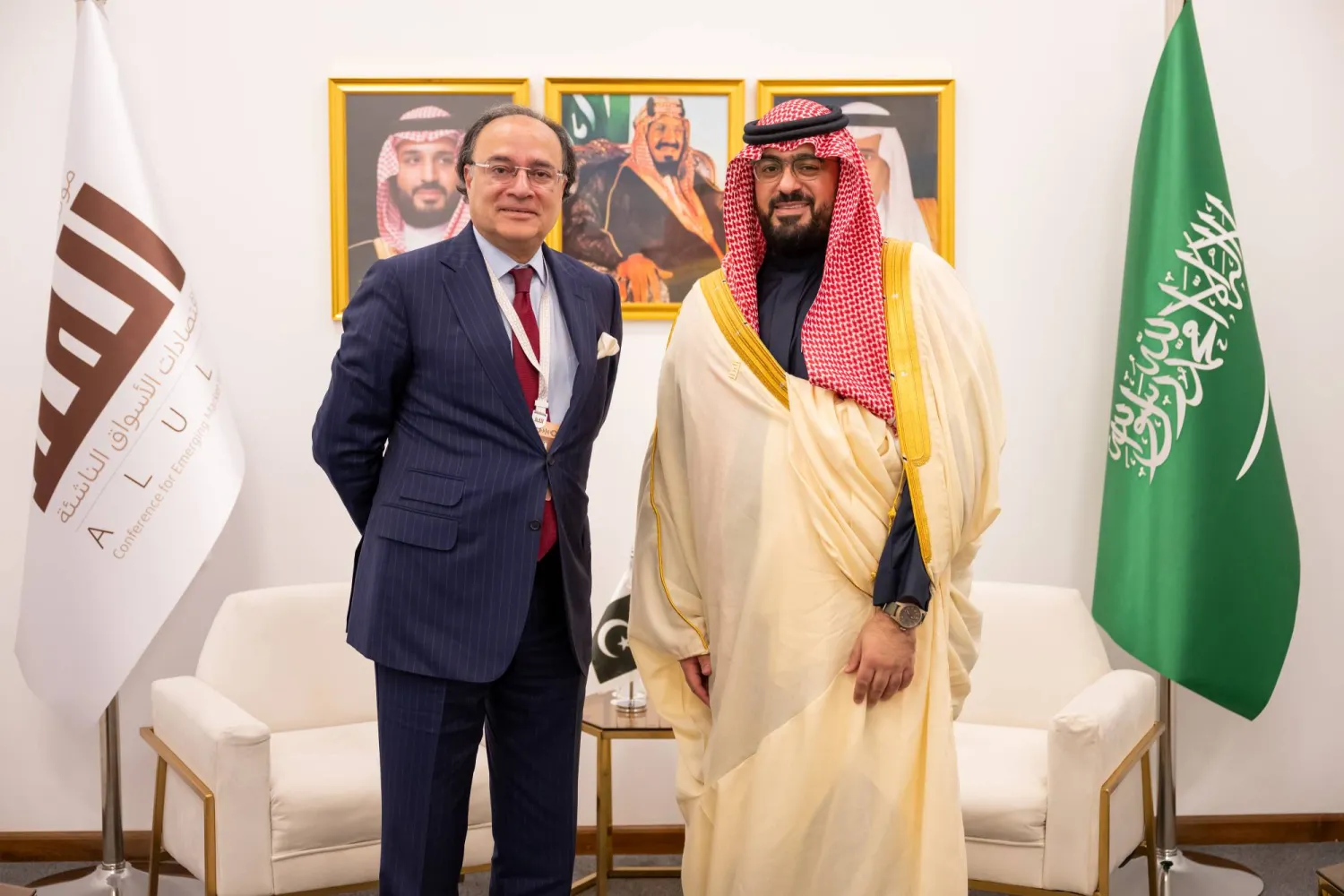
Al-Jadaan speaking to the attendees at the "AlUla Conference for Emerging Market Economies" (Asharq Al-Awsat
TT

Aljadaan: Emerging Markets Account for 70% of Global Growth

Al-Jadaan speaking to the attendees at the "AlUla Conference for Emerging Market Economies" (Asharq Al-Awsat

Saudi Minister of Finance Mohammed Aljadaan stressed Sunday that the world economy is going through a “profound transition,” saying emerging markets and developing economies now account for nearly 60 percent of the global Gross Domestic Product (GDP) in purchasing power terms and over 70 percent of global growth.

In his opening remarks at the AlUla Conference for Emerging Market Economies, organized by the Saudi Ministry of Finance and the IMF in AlUla, the minister said these economies have become an increasingly important driver of global growth with their share of global economy more than doubling since 2010.

“Today, the 10 emerging economies in the G20 alone account for more than half of the world growth. Yet, they face a more complex and fragmented environment, elevated debt levels, slower trade growth and increasing exposure to geopolitical shocks.”

“Unfortunately, more than half of low income countries are either in or at the risk of debt distress. At the same time global trade growth has slowed at around half of what it was pre the pandemic,” Aljadaan added.

The Finance Minister stressed that the Saudi experience over the past decade has reinforced three lessons that may be relevant to the discussions at the two-day conference, which brings together a select group of ministers and central bank governors, leaders of international organizations, leading investors and academics.

“First, macroeconomic stability is not the enemy of growth. It is actually the foundation,” he said.

“Structural reforms deliver results only when institutions deliver. So there is no point of reforming ... if the institutions are unable to deliver,” he stated.

Finally, he said that “international cooperation matters more, not less, in a fragmented world.”


Georgieva from AlUla: Growth Still Lacks Pre-pandemic Levels

Kristalina Georgieva speaking to attendees at the second edition of the AlUla Conference for Emerging Market Economies (Asharq Al-Awsat)
TT

Georgieva from AlUla: Growth Still Lacks Pre-pandemic Levels

Kristalina Georgieva speaking to attendees at the second edition of the AlUla Conference for Emerging Market Economies (Asharq Al-Awsat)

International Monetary Fund (IMF) Managing Director Kristalina Georgieva said Sunday that world growth still lacks pre-pandemic levels, expressing concern as she expected more shocks amid high spending and rising debt levels in many countries.

Georgieva spoke at the AlUla Conference for Emerging Market Economies, organized by the Saudi Ministry of Finance and the IMF in AlUla.

The two-day conference brings together a select group of ministers and central bank governors, leaders of international organizations, leading investors and academics to deliberate on policies to global stability, prosperity, and multilateral collaboration.

Georgieva said that the conference was launched last year in recognition of the growing role of emerging market economies in a world of sweeping transformations.

“I came out of this gathering .... With a sense of hope for the pragmatic attitude and determination to pursue good policies and build strong institutions,” she said.

Georgieva stressed that “good policies pay off,” and said that growth rates across emerging economies reached four percent this year, exceeding by a large margin those of advanced economies that are around 1.5 percent.


Saudi Arabia’s flynas, Syrian Civil Aviation Authority Partner to Launch 'flynas Syria'

The new airline will operate commercial air transport services in accordance with approved regulations and standards (flynas)
TT

Saudi Arabia’s flynas, Syrian Civil Aviation Authority Partner to Launch 'flynas Syria'

The new airline will operate commercial air transport services in accordance with approved regulations and standards (flynas)

Saudi budget carrier flynas has signed an agreement with the Syrian General Authority of Civil Aviation and Air Transport to establish a new commercial airline under the name "flynas Syria," with operations scheduled to begin in the fourth quarter of 2026.

Saturday’s agreement comes within the framework of bilateral cooperation between Saudi Arabia and Syria, as well as the strategic investment agreements between the two countries, coordinated with the Saudi Ministry of Investment and the Syrian General Authority of Civil Aviation and Air Transport.

The new airline will operate commercial air transport services in accordance with approved regulations and standards, meeting the highest safety and aviation security requirements. All licensing and operational procedures will be completed in coordination with the relevant authorities.

The carrier will be established as a joint venture, with 51% ownership held by the Syrian General Authority of Civil Aviation and Air Transport and 49% by flynas.

The new airline will operate flights to several destinations across the Middle East, Africa, and Europe. This expansion aims to bolster air traffic to and from Syria, enhance regional and international connectivity, and meet growing demand for air travel.

"This step is part of our commitment to supporting high-quality cross-border investments. The aviation sector is a key enabler of economic development, and the establishment of 'flynas Syria' serves as a model for constructive investment cooperation,” said Saudi Minister of Investment Khalid Al-Falih.

“This partnership enhances economic integration and market connectivity and supports development goals by advancing air transport infrastructure, ultimately serving the mutual interests of both nations and promoting regional economic stability,” he added.

President of the Syrian General Authority of Civil Aviation and Air Transport Omar Hosari also stated that the establishment of flynas Syria represents a strategic step within a comprehensive national vision aimed at rebuilding and developing Syria's civil aviation sector on modern economic and regulatory foundations.

“This will be achieved while balancing safety requirements, operational sustainability, investment stimulation, and passenger services. The partnership reflects the state's orientation toward smart cooperation models with trusted regional partners, ensuring the transfer of expertise, the development of national capabilities, and the enhancement of Syria's air connectivity with regional and international destinations, in line with global best practices in the air transport industry."

flynas Chairman Ayed Al-Jeaid stated that the company continues to pursue strategies aimed at growth and international expansion, describing the agreement as a historic milestone in the company's journey and a promising investment model in partnership with Syria.

flynas CEO Bander Al-mohanna said the step represents a qualitative leap in the company's strategy and financial performance, highlighting the transfer of the company's low-cost aviation experience to the Syrian market to support regional and international air connectivity.

flynas currently operates 23 weekly flights from Riyadh, Jeddah, and Dammam to Damascus, including two daily direct flights from Riyadh, one daily flight from Jeddah, and two weekly flights from Dammam.

The airline made history on June 5, 2025, by adding the Syrian capital to its network, becoming the first Saudi carrier to resume scheduled flights to Damascus.