


Representatives of Independent Unions Storm Streets in Algeria

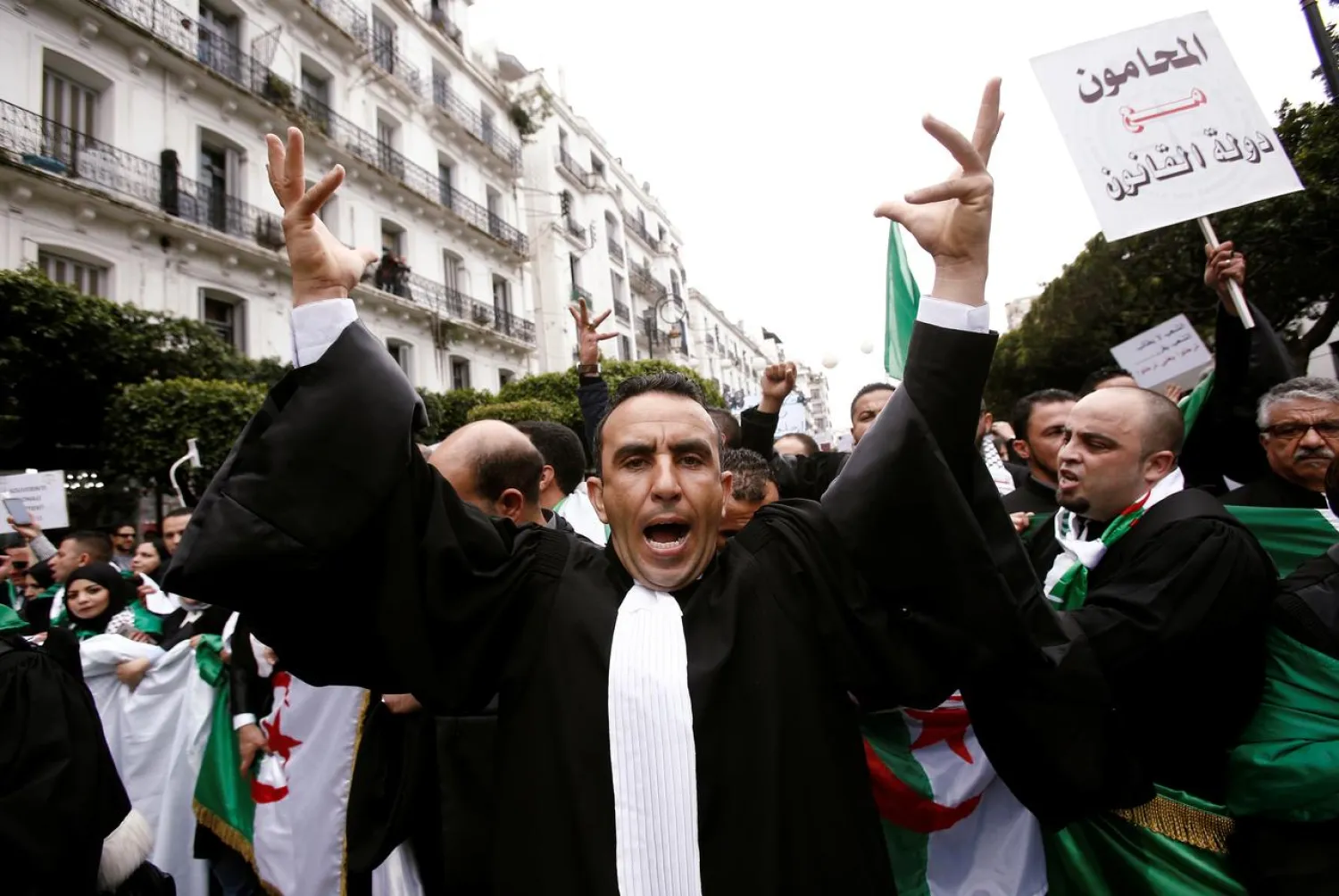
 A lawyer gestures during a protest to demand the immediate resignation of President Abdelaziz Bouteflika, in Algiers, Algeria March 23, 2019. REUTERS/Ramzi Boudina
A lawyer gestures during a protest to demand the immediate resignation of President Abdelaziz Bouteflika, in Algiers, Algeria March 23, 2019. REUTERS/Ramzi Boudina
TT

Representatives of Independent Unions Storm Streets in Algeria

 A lawyer gestures during a protest to demand the immediate resignation of President Abdelaziz Bouteflika, in Algiers, Algeria March 23, 2019. REUTERS/Ramzi Boudina
A lawyer gestures during a protest to demand the immediate resignation of President Abdelaziz Bouteflika, in Algiers, Algeria March 23, 2019. REUTERS/Ramzi Boudina

Algerian trade union leaders stormed the streets in major cities on Monday, following a call by the Confederation of Independent Trade Unions to launch a one-day strike that appeared to affect the education sector more than other sectors.

The unionists, who gathered in the “Martyrs' Square” in the center of the capital, Algiers, held banners with political demands echoed by demonstrators in Friday’s popular movements, and university students’ demonstrations every Tuesday.

These demands call for the regime change and reject the presidential elections scheduled for December 12.

Among the slogans chanted were: “No elections with the gang system,” and “You ate the country, thieves.”

Demonstrators also raised a professional demand for the economic crisis caused by the low oil prices, which resulted in firing dozens of workers from the construction and textile sectors.

Head of the Independent Syndicate of Public Administration Employees (a member of the Confederation) Rashid Maalawi told Asharq Al-Awsat that the strike “has seen a wide response in many areas.”

“The most important of which are Oran (west) and Tizi Ouzou (east) and many areas inside the country, whose residents suffer from a serious deterioration in purchasing power, and assurances by the government to improve their situation no longer convince them.”

He pointed out that the strike in Bejaia province (250 km east of the capital), paralyzed all sectors concerned with economic activity and services.

It was the first state to rise up against the candidacy of former President Abdelaziz Bouteflika for a fifth term, and mass popular protests erupted later on February 22.

It is noteworthy that the Confederation has 13 unions that are independent from the General Union of Algerian Workers (the Central Union), which supports government policies.

It is not recognized by the Ministry of Labor, which often underestimates its importance and degree of representation in the labor market.

Meanwhile, the conflict continued between the National Magistrates Syndicate and Justice Minister Belkacem Zeghmati, who insisted on rejecting demands of the striking judges, mainly forming an independent and impartial judicial system ahead of the scheduled presidential elections on December 12.

Their strike also aims to denounce the decision of the Supreme Judiciary Council to reshuffle almost 3,000 judges.



Report: RSF Drone Strike on School Kills Two Children in Sudan’s Kordofan 

Displaced Sudanese gather near a food distribution point at the Abu al-Naga displacement camp in the Gedaref State, some 420km east of the capital Khartoum on February 6, 2026. (AFP)
TT

Report: RSF Drone Strike on School Kills Two Children in Sudan’s Kordofan 

Displaced Sudanese gather near a food distribution point at the Abu al-Naga displacement camp in the Gedaref State, some 420km east of the capital Khartoum on February 6, 2026. (AFP)

A drone strike blamed on Sudan's paramilitary Rapid Support Forces killed two children and injured 12 others Wednesday in the southern city of El-Rahad, a medical source told AFP.

El-Rahad lies in Sudan's Kordofan region, currently the fiercest battlefield in the war raging between the RSF and the regular army since April 2023.

"I saw a dozen students injured," Ahmed Moussa, an eyewitness to the attack, told AFP, adding that the drone had struck a traditional Quranic school.

El-Rahad, in North Kordofan state, was retaken by the army last February, as part of a rapid offensive that saw it push west to break a long-running siege on state capital El-Obeid.

The RSF has been trying to re-encircle El-Obeid since, including by launching successive drone strikes on the main highway out of the city, which connects the western region of Darfur with the capital Khartoum.

Since it began, the war has killed tens of thousands and left around 11 million people displaced, creating the world's largest hunger and displacement crises.

It has also effectively split the country in two, with the army holding the north, center and east while the RSF and its allies control the west and parts of the south.


Türkiye Signals May Launch ‘Simple’ Military Operation Against PKK in Iraq

PKK fighters in the Qandil Mountains of northern Iraq. (Reuters)
TT

Türkiye Signals May Launch ‘Simple’ Military Operation Against PKK in Iraq

PKK fighters in the Qandil Mountains of northern Iraq. (Reuters)

Türkiye has indicated it may launch a limited military operation against the Kurdistan Workers’ Party (PKK) in the Sinjar region of northern Iraq, while stressing its readiness to work with any government that assumes power in Baghdad.

Turkish Foreign Minister Hakan Fidan said the PKK is set to become a major issue for Iraq, noting that the group does not control any territory inside Türkiye, but “occupies large areas in Iraq”.

“How can a sovereign state allow this?” he asked, adding that “changes could soon take place” in several areas, including Iraq’s Sinjar, Makhmour and the Qandil Mountains.

Fidan outlined what he described as the PKK’s current deployment, saying Makhmour, south of Erbil near the Nineveh province, hosts the group’s civilian structures, while Sinjar, northwest of Mosul near the Syrian border, hosts its armed elements.

He said the leadership and command structures are based in the Qandil Mountains, with other strongholds near Duhok lying outside the area covered by Türkiye’s ongoing Claw Operation.

In a televised interview late Monday, Fidan stated that Sinjar is surrounded by Iraq’s Popular Mobilization Forces (PMF), revealing that Ankara has held around 20 meetings with PMF leader Faleh al-Fayyad to address the issue.

On possible military action against the PKK, he described it as “a simple military operation,” in which PMF forces would advance on the ground while Türkiye conducts air operations, estimating it would take two or three days.

Since 2024, Türkiye has pursued negotiations with imprisoned PKK leader Abdullah Ocalan, which led to his call on February 27, 2025, for the group to dissolve and lay down its arms.

The PKK subsequently announced a ceasefire, declared its dissolution on May 12, 2025, and held symbolic weapons-burning ceremonies in the Qandil Mountains in July. In October, it announced the withdrawal of its fighters from Türkiye to areas in Qandil.

On Baghdad’s position, Fidan said the Iraqi government would be forced to demonstrate genuine political will toward the PKK, insisting that the group cannot remain in Sinjar.

Iraq began addressing the issue during the tenure of former prime minister Mustafa al-Kadhimi and that, under current Prime Minister Mohammed Shia al-Sudani, the PKK has sought to expand its presence in Baghdad, he remarked.

Baghdad is in the process of forming a new government, months after holding parliamentary elections.

Over the past two years, Ankara and Baghdad have established a high-level security coordination mechanism to confront the PKK, holding five meetings in both capitals. The latest took place in April. Following Turkish President Recep Tayyip Erdogan’s visit to Iraq in April 2024, Iraq’s National Security Council formally designated the PKK a banned organization.

Fidan also said the Kurdish issue in Syria has direct implications for Iraq, hoping that Baghdad would draw lessons from recent developments in Syria, including the integration of Kurdish forces into the Syrian army, and take “prudent decisions to ease Iraq’s own transition”.


SDF Starts Withdrawing from Frontlines in Syria’s Hasakah  

Members of the SDF in Hasakah, northeastern Syria, on Tuesday during their withdrawal from frontline positions under an agreement with the Syrian government. (Reuters)
TT

SDF Starts Withdrawing from Frontlines in Syria’s Hasakah  

Members of the SDF in Hasakah, northeastern Syria, on Tuesday during their withdrawal from frontline positions under an agreement with the Syrian government. (Reuters)

The Syrian Democratic Forces (SDF) have begun withdrawing their troops from frontline positions in the city of Hasakah under an agreement reached with the Syrian government, according to news reports and photographs published by Reuters.

Earlier on Tuesday, SDF units started preparations to pull back from southern rural areas of Hasakah. Images circulated by local media showed SDF fighters withdrawing from the Panorama Roundabout checkpoint south of the city, ahead of handing it over to General Security forces.

The move followed a security meeting between the Internal Security Forces (Asayish) and Syrian security services to coordinate the deployment of internal security forces in the city, according to North Press.

Syrian security sources told Asharq Al-Awsat that implementation of the agreement is proceeding smoothly, including steps toward integration.

The SDF has nominated units to be incorporated as brigades within the Ministry of Defense, while some Asayish personnel are expected to join the General Security forces in predominantly Kurdish areas.

On Tuesday, the SDF also began withdrawing its military units and heavy equipment from contact lines inside Hasakah, particularly in southern neighborhoods around the Panorama Roundabout. This step is part of a permanent ceasefire and the launch of a gradual integration process stipulated in the January agreement.

Syrian affairs researcher from the Jusoor Center for Studies Mohammad Suleiman said the withdrawal involves redeploying SDF military forces from inside Hasakah to agreed barracks outside the city, including Dirbasiyah, Amuda, and the outskirts of Qamishli. At the same time, government internal security forces will deploy in the city centers of Hasakah and Qamishli to oversee security integration.

Suleiman noted differing interpretations of the agreement. The SDF considers the withdrawal limited to its military forces, with the Asayish remaining responsible for internal security, while the government views it as a timetable for a full SDF withdrawal from city neighborhoods.

He added that Syrian army units will also pull back to areas around Hasakah, including Shaddadi, while maintaining a ban on military forces entering cities, particularly those with a Kurdish majority.

The current phase marks the second stage of the agreement and includes the transfer of oil wells and Qamishli Airport to state control. A third phase will place border crossings under state control, notably the Nusaybin crossing with Türkiye and the Semalka crossing with the Iraqi Kurdistan Region.

The agreement also calls for the integration of Kurdish autonomous administration institutions into state bodies, stabilization of civilian employees, settlement of Kurdish civil and educational rights, and guarantees for the return of displaced residents to their homes.