


Iran Remains Top State Sponsor of Terrorism, Says US State Department

The US State Department Building is pictured in Washington, January 26, 2017. (Reuters)
TT

Iran Remains Top State Sponsor of Terrorism, Says US State Department

The US State Department Building is pictured in Washington, January 26, 2017. (Reuters)

Iran remains a top state sponsor of terrorism, said the United States Department of State on Friday.

In its annual terrorism report for 2018, it said the Iranian regime has spent “nearly one billion dollars per year to support terrorist groups that serve as its proxies and expand its malign influence across the globe.”

Tehran has funded international terrorist groups such as Hezbollah in Lebanon, Hamas in the Palestinian territories and other groups.

It also has engaged in its own terrorist plotting around the world, particularly in Europe, charged the report. In January 2018, German authorities investigated 10 suspected Iranian Revolutionary Guard Corps Quds Force operatives. In the summer, authorities in Belgium, France, and Germany thwarted an Iranian plot to bomb a political rally near Paris, France. In October, an Iranian operative was arrested for planning an assassination in Denmark, and in December, Albania expelled two Iranian officials for plotting terrorist attacks.

Furthermore, Tehran continued to allow an al-Qaeda facilitation network to operate in Iran, which sends fighters and money to conflict zones in Afghanistan and Syria, and it has extended sanctuary to al-Qaeda members residing in the country, said the report.

“Al-Qaeda and its regional affiliates remain resilient and pose an enduring threat to the United States, our allies and partners, and our interests around the world,” it continued. “Given ISIS’s setbacks, al-Qaeda aims to reestablish itself as the vanguard” of the global extremist movement.

“Despite our sustained efforts since September 11, 2001, and the group’s leadership losses, al-Qaeda’s regional affiliates continue to expand their ranks, plot, and carry out attacks, as well as raise funds and inspire new recruits through social media and virtual technologies,” it added.

“Regionally focused terrorist groups also remained a threat in 2018. For example, Pakistan-based Lashkar-e-Tayyiba – which was responsible for the 2008 Mumbai attacks – and Jaish-e-Mohammad (JeM) maintained the capability and intent to attack Indian and Afghan targets,” it said.

The report also warned that the global presence of ISIS continued to advance in 2018 through networks and affiliates even though the Trump administration declared it defeated the terror group in Syria and killed its leader last month in a US raid.

War-hardened fighters from groups such as ISIS returning to their home countries began raising fresh threats, the report said.

“Even as ISIS lost almost all its physical territory, the group proved its ability to adapt, especially through its efforts to inspire or direct followers online,” said Nathan Sales, the US counter-terrorism coordinator, whose office produced the congressionally mandated report.

“Additionally, battle-hardened terrorists headed home from the war zone in Syria and Iraq or traveled to third countries, posing new dangers,” he said.

The report also noted that terrorist tactics and use of technologies evolved throughout 2018. It cited the increased use of commercially available drones and encrypted communications, as well as low-tech vehicle and knife attacks. These presented additional challenges for the international counter-terrorism community.

“In October, the White House released the National Strategy for Counter-terrorism, the United States’ first counter-terrorism strategy since 2011. The strategy emphasizes the need to counter the full spectrum of terrorist threats we face, including ISIS, al-Qaeda, and Iran-backed groups, as well as regional terrorist organizations.

“It also highlights the need for a whole-of-government approach to counter-terrorism – one that relies on both civilian and military tools to address near- and long-term terrorist threats. Our strategy places a premium on dismantling terrorist organizations using a wide range of diplomatic, law enforcement, military, intelligence, financial and other tools.

“It also calls on our foreign partners to assume a greater share of the burden. In 2018, the United States used this whole-of-government approach to mobilize international responses to counter the most dangerous transnational terrorist organizations,” stressed the report.

Restricting terrorist travel remained a top priority. The United States played a leading role in helping states implement key measures in UN Security Council Resolution 2396 aimed at countering terrorist travel, including border security and information sharing measures.

The United States signed three new arrangements to share terrorist watchlists under Homeland Security Presidential Directive 6, bringing the total number of partner countries to 72. The Personal Identification Secure Comparison and Evaluation System (PISCES) border security platform grew to include 227 ports of entry in 23 countries, and partners use it to screen more than 300,000 travelers each day.

In December, the United States launched an initiative at the International Civil Aviation Organization (ICAO) to adopt a standard for passenger name record data – a key screening tool that the United States has used for decades and that UN Security Council Resolution 2396 made mandatory for all UN members – by the end of 2019.



Macron Says Wants ‘European Approach’ in Dialogue with Putin

Russian President Vladimir Putin attends a meeting with Moscow Mayor Sergei Sobyanin at the Kremlin in Moscow, Russia February 9, 2026. (Sputnik/Vyacheslav Prokofyev/Pool via Reuters)
TT

Macron Says Wants ‘European Approach’ in Dialogue with Putin

Russian President Vladimir Putin attends a meeting with Moscow Mayor Sergei Sobyanin at the Kremlin in Moscow, Russia February 9, 2026. (Sputnik/Vyacheslav Prokofyev/Pool via Reuters)

French President Emmanuel Macron has said he wants to include European partners in a resumption of dialogue with Russian leader Vladimir Putin nearly four years after Moscow's invasion of Ukraine.

He spoke after dispatching a top adviser to Moscow last week, in the first such meeting since Russia launched its full-scale invasion of Ukraine in February 2022.

"What did I gain? Confirmation that Russia does not want peace right now," he said in an interview with several European newspapers including Germany's Suddeutsche Zeitung.

"But above all, we have rebuilt those channels of discussion at a technical level," he said in the interview released on Tuesday.

"My wish is to share this with my European partners and to have a well-organized European approach," he added.

Dialogue with Putin should take place without "too many interlocutors, with a given mandate", he said.

Macron said last year he believed Europe should reach back out to Putin, rather than leaving the United States alone to take the lead in negotiations to end Russia's war against Ukraine.

"Whether we like Russia or not, Russia will still be there tomorrow," Suddeutsche Zeitung quoted the French president as saying.

"It is therefore important that we structure the resumption of a European discussion with the Russians, without naivety, without putting pressure on the Ukrainians -- but also so as not to depend on third parties in this discussion."

After Macron sent his adviser Emmanuel Bonne to the Kremlin last week, Russia's Foreign Minister Sergei Lavrov on Thursday said Putin was ready to receive the French leader's call.

"If you want to call and discuss something seriously, then call," he said in an interview to state-run broadcaster RT.

The two presidents last spoke in July, in their first known phone talks in over two-and-a-half years.

The French leader tried in a series of phone calls in 2022 to warn Putin against invading Ukraine and travelled to Moscow early that year.

He kept up phone contact with Putin after the invasion but talks had ceased after a September 2022 phone call.


Seven Killed in Gold Mine Accident in Eastern China, State Media CCTV Reports

Gold mine in China (archive-Reuters)
TT

Seven Killed in Gold Mine Accident in Eastern China, State Media CCTV Reports

Gold mine in China (archive-Reuters)

Seven people were killed in a gold mine accident in China's eastern Shandong province, and authorities were investigating, state-run CCTV reported, sending shares of the mine owner, Zhaojin Mining Industry, down 6% on Tuesday, Reuters said.

The accident occurred on Saturday when a cage fell ‌down a mine ‌shaft, CCTV reported ‌late ⁠on Monday ‌night.

The emergency management and public security departments were investigating the cause of the accident, and whether there had been an attempt to cover it up, the ⁠report added.

The mine is owned by ‌leading gold producer Zhaojin ‍Mining Industry, according ‍to the Qichacha company registry. Shares ‍of the company were down 6.01%, as of 0525 GMT. A person who answered Zhaojin's main phone line told Reuters that the matter was under investigation and ⁠declined to answer further questions.

China's emergency management ministry on Monday held a meeting on preventing accidents during the upcoming Lunar New Year holiday. It announced inspections of mines, chemical companies, and other hazardous operations. Also on Saturday, an explosion at a biotech company ‌in northern China killed eight people.


Still a Long Way to Go in Talks on Ukraine, Russia's Lavrov Says

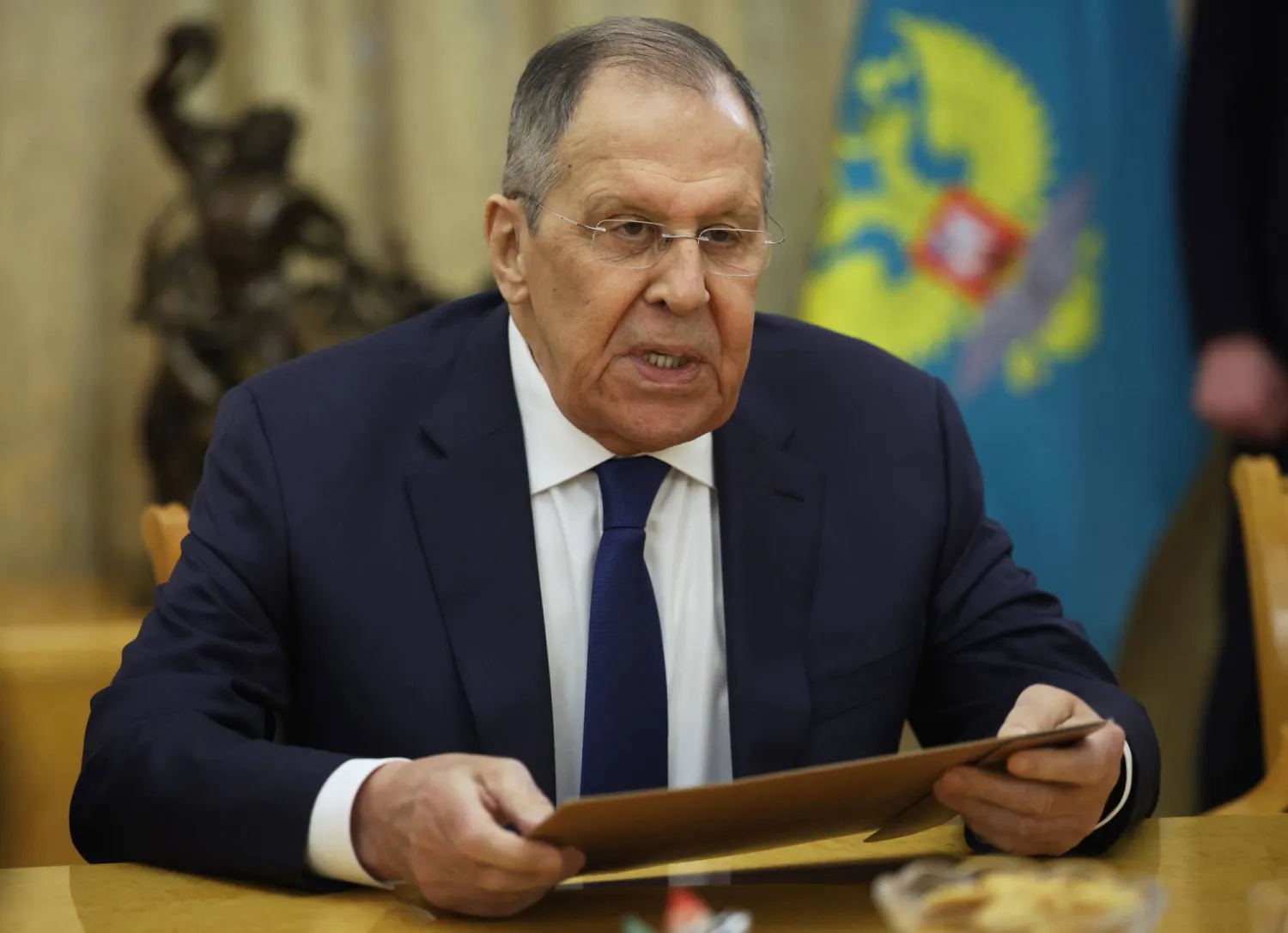
Russian Foreign Minister Sergei Lavrov attends a meeting with Tanzanian Minister of Foreign Affairs and East African Cooperation Mahmoud Thabit Kombo (not pictured), in Moscow, Russia, 09 February 2026.  EPA/RAMIL SITDIKOV / POOL
Russian Foreign Minister Sergei Lavrov attends a meeting with Tanzanian Minister of Foreign Affairs and East African Cooperation Mahmoud Thabit Kombo (not pictured), in Moscow, Russia, 09 February 2026. EPA/RAMIL SITDIKOV / POOL
TT

Still a Long Way to Go in Talks on Ukraine, Russia's Lavrov Says

Russian Foreign Minister Sergei Lavrov attends a meeting with Tanzanian Minister of Foreign Affairs and East African Cooperation Mahmoud Thabit Kombo (not pictured), in Moscow, Russia, 09 February 2026.  EPA/RAMIL SITDIKOV / POOL
Russian Foreign Minister Sergei Lavrov attends a meeting with Tanzanian Minister of Foreign Affairs and East African Cooperation Mahmoud Thabit Kombo (not pictured), in Moscow, Russia, 09 February 2026. EPA/RAMIL SITDIKOV / POOL

Russian Foreign Minister Sergei Lavrov said that there was no reason to be enthusiastic about US President Donald Trump's pressure on Europe and Ukraine as there was still a long way to go in talks on peace in Ukraine, RIA reported on Tuesday.

Here are ‌some details:

The ‌United States has ‌brokered ⁠talks between Russia and Ukraine ‌on various different drafts of a plan for ending the war in Ukraine, but no deal has yet been reached despite Trump's repeated promises to clinch one.

* "There is still a long way to go," Lavrov ⁠was quoted as saying by Russian news agencies.

* Lavrov said that ‌Trump had put Ukraine ‍and Europe in their places ‍but that such a move was ‍no reason to embrace an "enthusiastic perception" of the situation.

* Russian Deputy Foreign Minister Alexander Grushko said that any deal would have to exclude NATO membership for Ukraine and rule out the deployment of foreign troops in Ukraine, Izvestia ⁠reported.

* At stake is how to end the deadliest war in Europe since World War Two, the future of Ukraine, the extent to which European powers are sidelined and whether or not a peace deal brokered by the United States will endure.

* Russia invaded Ukraine in February 2022 after eight years of fighting in eastern Ukraine, triggering the biggest confrontation between ‌Moscow and the West since the depths of the Cold War.